


Hi friends 👋,
Happy Friday and welcome to our 212th Weekly Dose of Optimism!
Fun week over here at not boring. Feedback on Would We Send Our Kids to HAA?, which I wrote with Alex Danco, has been great - as one person said, if you have kids, want to have kids, or know someone who has kids, you should read it. While we were busy writing, the world’s entrepreneurs and scientists were busy making the world a little bit better.
Let’s get to it.
This Week’s Weekly Dose is Brought to you by… Jack & Jill

One hire can change your company.
Jill helps over 5K startups like Ramp, Strala, Corgi, and Attio make their next great hire.
Jack helps 380K+ professionals find their next best move.
When there’s a match, you get a direct introduction to the company or candidate. No application required.
Thinking about your next move? Talk to Jack. Building a remarkable team? Meet Jill.
(1) Vironexis Turns the Liver Into a Cancer Drug Factory
Here at the Dose, we love a lot of things, but we hate cancer.
In last week’s Dose, we covered a drug that helps T cells attack cancer and a gene therapy that gives kids the instructions to make a missing enzyme. This week, a company called Vironexis shared encouraging results from putting those two ideas together: give the body instructions to make its own cancer-fighting medicine.
On Monday, Vironexis reported that all three patients in a subgroup with relapsed or refractory acute lymphoblastic leukemia achieved complete responses after a single administration of VNX-101, with no residual leukemia detected in testing. The first patient’s response lasted 260 days, at which point their doctor proceeded with a stem cell transplant.
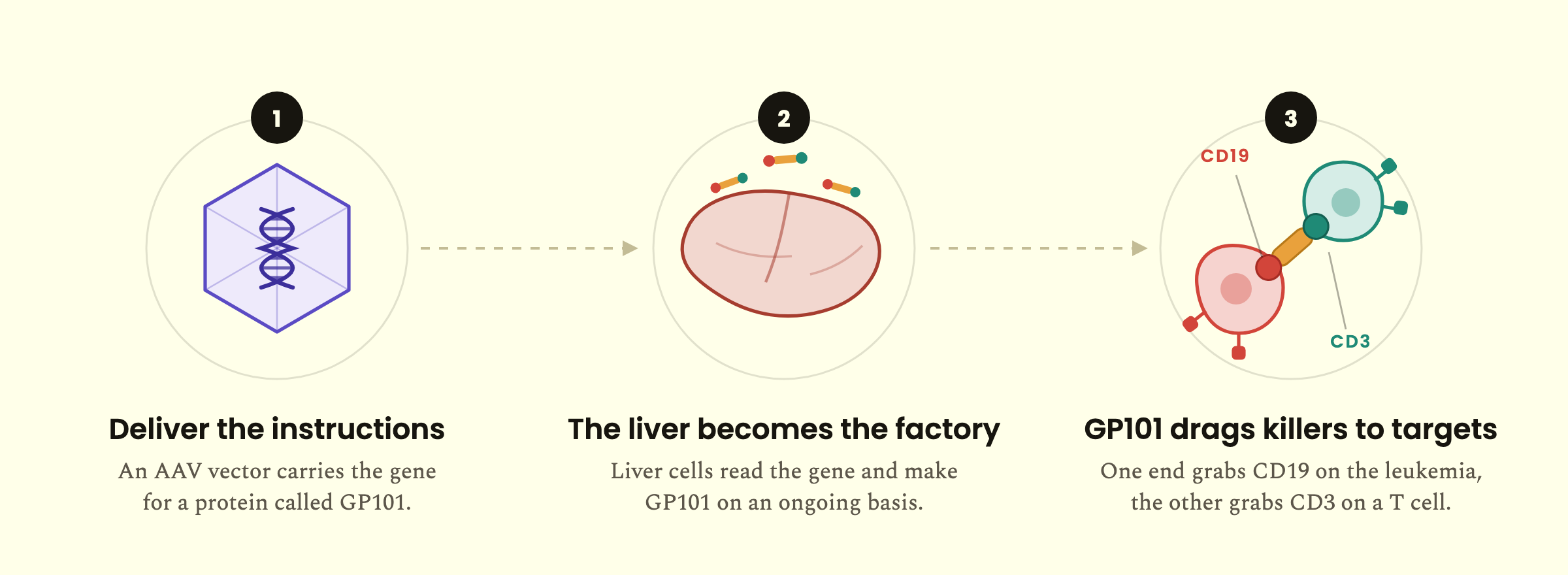
Three is a very small number of patients, but the mechanism is very cool. An adeno-associated virus, or AAV, delivers genetic instructions to liver cells, which produce a protein called GP101. One end grabs CD19 on cancer cells while the other grabs CD3 on T cells, bridging the immune system’s killer T cells right to their targets.
Once a patient takes VNX-101, their liver cells keep making GP101, like a little pharmaceutical factory manufacturing the treatment inside the body.
There are a bunch of qualifications - those three patients had no pre-existing anti-AAV antibodies; the broader Phase 1/2 trial has treated nine people across several blood cancers; they’re early, company-reported results; Cytokine release syndrome and neurological toxicity occurred during dose escalation and resolved with treatment; and there is still a lot to learn about dosing, safety, and how long the responses last - but the promise is enormous. The pharma industry spends enormous effort and money figuring out how to manufacture medicines and get them into people, repeatedly, over and over. If we can safely teach people’s own cells to handle more of that manufacturing, we could give people more time living their lives, less time receiving infusions, and ultimately, longer, healthier lives.
Say it with me… get fucked, cancer.
(2) Solcoa Raises $75M for American Rare Earth Metallization
Not Boring readers will understand that the future depends on rare earth metals, and that China currently mogs the US in its control over that supply chain.
Enter Solcoa. On Thursday, Solcoa announced $75 million to build Solcoa One, a rare earth metalmaking plant in Nevada designed to produce 500 tonnes a year, with operations targeted for July 2027. The financing includes $45 million in equity led by Bain Capital Ventures and $30 million in debt and equipment financing anchored by J.P. Morgan.
Solcoa works on metallization: converting refined rare earth oxides into metals that magnet manufacturers can use. It’s one more step in the chain from mine to magnet to anything that moves electrically that we’ll be able to do here.
The company already produces neodymium-praseodymium and samarium metal at a rate of about 10 tonnes a year in Alameda, but 10 tonnes doesn’t do much against a 100-kiloton-a-year NdPr market and a 2 kiloton-a-year samarium market. The money will help them 50x that, and then 6x that, and if they’re successful, hopefully unlock capital to scale some more.
Its approach combines new chemistry with modular reactors that it builds itself. Solcoa says the process uses less energy and costs less than conventional molten-salt electrolysis. Developing new technology is the key way America will catch up to China.
And there’s progress further along the chain, too. In Dose #169, we covered Vulcan Elements’ $1.4 billion partnership with the government and ReElement to expand domestic magnet production. This week, Axios reports that Vulcan will supply magnets for the Army’s SkyFoundry drone initiative. Vulcan says its magnets will go into the brushless motors that power the drones.
You can start to see a western rare earths supply chain developing. Earth AI can find them. Solcoa can metallize them. Vulcan can turn them into magnets. And Westmag can turn those magnets into motors and actuators to fly drones and actuate robots.
We’re going to need a lot of rare earth metals. Good to see them becoming less rare.
(3) Terraform Makes Methanol From Sunlight and Air
We’re a simple newsletter. Terraform makes something from sunlight and air, we cover it.
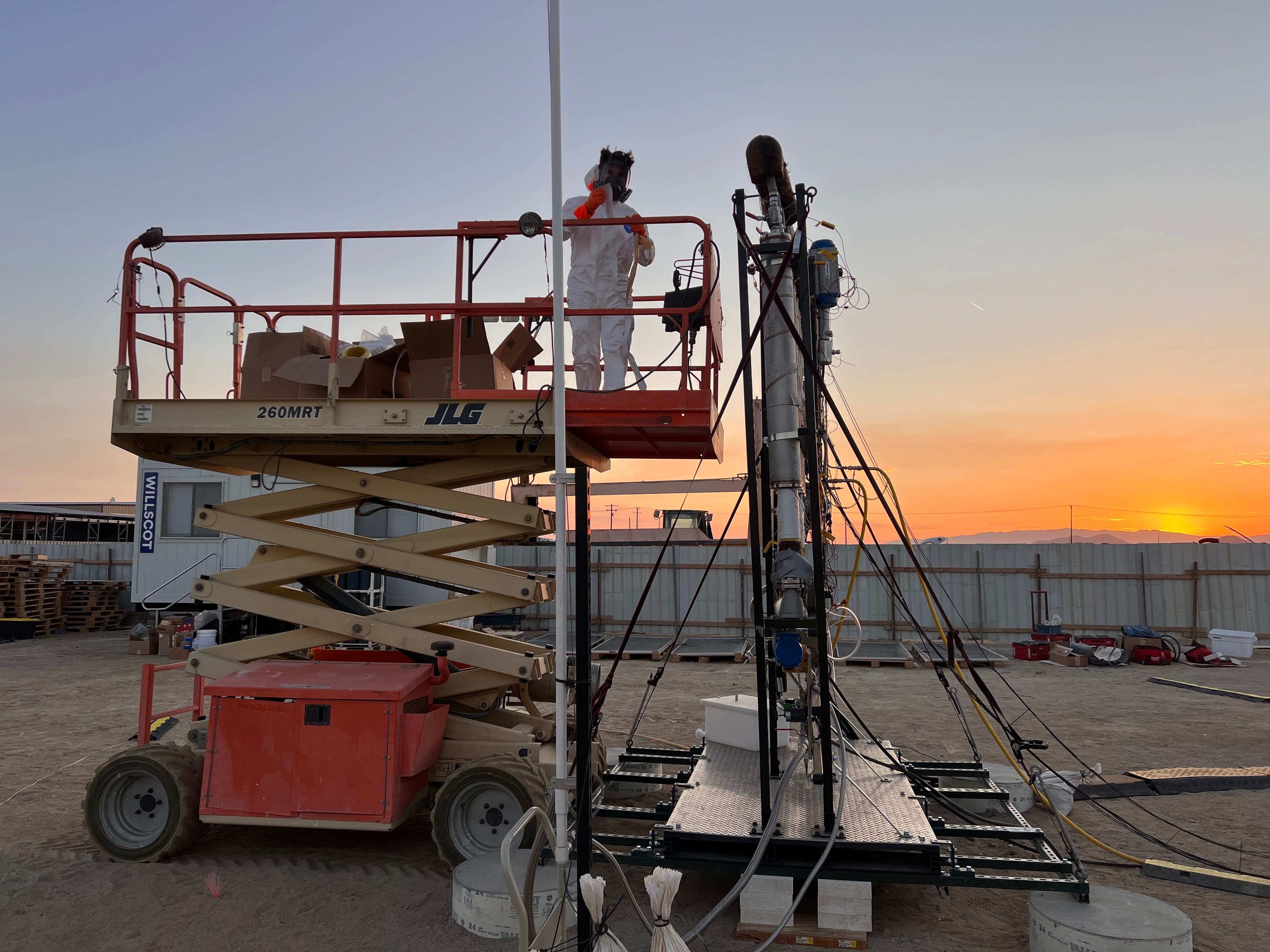
Back in Dose #205, we covered Terraform making hydrogen with its solar-powered electrolyzer. Seven weeks later, Casey Handmer & Co are back with their next molecule. On Monday, he announced that Terraform’s reactor team had produced batches of high-purity methanol at its Muroc desert test site. Per Casey, here’s the timeline for those keeping score at home:
Let’s review our progress in 2026. In January, we closed on our Muroc test site. By March, construction was underway. By May, we had 1.8 MW of solar installed. In July, we produced CO2 on site, and in August, Hydrogen.
Methanol is both a useful chemical in its own right, and as a starting point for making more complicated things, including gasoline, aviation fuel, and plastics. Terraform already makes (and now sells) methane, and adding methanol gives it another route into replacing the enormous collection of products we currently get from oil and gas with sunshine and air.
Now, the big question is what cost Terraform can get to at scale. Casey’s strategy is to start with high-purity products that command higher prices, sell them, and use the production experience to drive costs down until the company can compete in bigger, cheaper markets.
The hope is that we’ll be able to manufacture chemicals we previously needed dead dinosaurs to make… and we’re all out of dinosaurs.
(4) Joby Flies Across America Autonomously

At Woodland Cemetery in Dayton, Ohio, I suspect Wright Brothers are flying in their graves. The planes that they figured out how to make fly can now fly themselves.
Last Friday, after we hit send on the Dose, Joby announced that its J208 had flown 3,199 miles across the United States with zero control inputs from the onboard safety pilot, ending in North Carolina’s Outer Banks near Kitty Hawk, where the Wrights took their historic first flight in 1903.
The plane was a converted Cessna Caravan, not one of the company’s electric air taxis, but it served as a test of the company’s autonomous systems, and its autonomous systems passed. It handled taxis, takeoffs, navigation, and landings across a route with stops in Arizona, Texas, and South Carolina, during which it operated at busy airports and rerouted around severe weather.
We’re big fans of autonomy here at the Dose. This summer, we covered autonomous boats, drones and robotaxis, and more drones, and for good reason. Autonomy is one of the things that will help reshape how things and people move around the world, and in so doing, reshape the world itself.
But autonomy is just one piece of the puzzle, table stakes. More to come on the rest next week.
(5) Meta Makes VR Glasses (and more)
Never bet against Zuck!
Back when Dan wrote the Weekly Dose, we included a lot of pro-Zuck content, because Dan is a self-described “Zuck Cuck.” Well, Dan is smiling today, wherever he is (slinging creatine).
Meta held its Meta Connect event on Wednesday, and it announced a bunch of new stuff, both digital and physical. Muse, its AI assistant, has a voice and video now. Meta Glasses can serve as FDA-approved hearing aids. There’s a less creepy pair of Glasses that are audio-only, along with a bunch of new frames. They even released an unexpected Muse Charm, a little guy you can put on your keychain to talk to Muse. Anything to get you away from your Apple iPhone.
The biggest announcement, though, were the Meta VR Glasses, a VR headset weighing just 100 grams. I love it. Zuck has been skewered by critics for the tens od billions of dollars he’s invested in the “Metaverse” and related devices, an investment that was not worth just the Oculus Quest 3. But he persisted against the plan.
Zuck has been super clear for years — I remember an old Joe Rogan or Lex Fridman podcast, maybe both — that the company was going to develop less technologically advanced glasses (the Meta Ray-Bans and Glasses) for daily use, and bulkier, more advanced ones that offer AR and VR experiences occasionally, while you’re sitting down, but that over time, the technology would improve and shrink and ultimately, those two would merge into one thing, a pair of glasses that are comfortable to wear, look cool, and have even more capability than today’s most advanced VR headsets.
This probably isn’t that, yet, but they’re very cool. The glasses have a 5K micro-OLED display, eye and hand controls, and the ability to turn a flat surface into a keyboard and touchpad. Meta is promising more than 100 immersive live US sporting events a year, plus 3D movies and hologram calling. They’re due in spring 2027 for $1,299.99, with up to three hours of media playback on a charge.
More importantly, they’re a sign that the plan is on track, and that ultimately, Zuck is going to be right. Long live the Emperor.