
Hi friends 👋,
Happy Friday and welcome back to our 204th Weekly Dose of Optimism!
The pace of all of this good stuff continues to blow my mind. We sent the Dose last Friday morning. It was jam-packed. “How can things get any better than this?” I asked myself.
And then the big tech companies came out in favor of open-weight models out of pure self-interest, which I wrote about in AI is Oil, Not God.
And then… the Sixers signed Lebron James!
I guess the real lesson, no matter which particular stories we cover each week, is to Trust the Process.
This week’s theme is physical AI - robots, robot brains, drones, and AVs, with a little robot regulation in the Extra Doses.
Let’s get to it.
(1) Enigma Comes Out of Stealth with $71M & 100 Robot Online Control
A company called Enigma is a little less enigmatic after emerging from stealth on Monday with a $71 million seed round led by Index Ventures and Ribbit Capital, plus its decision to open up more than 100 real AI-powered robots available online for anyone to control in real-time. You can go play with them right now, and tell them what to paint, how to lightsaber, to please defuse that bomb, or even which experiments to run.
The cute little robot arms you’re controlling are actual physical machines in facilities in Israel and California, taking your instructions through the browser.
Enigma is building robot-agnostic software, foundation models for robotics, and user interfaces that make robots easier to command across different hardware and tasks. Its bet is that studying how humans engage with robots produces both better interfaces and possibly a different kind of robotic brain.
The public robots.online experiment lets users try text, audio, demonstrations, and other interaction patterns while the company observes how people naturally attempt to get machines to do things. If the race in robotics is about accumulating real training data fast and cost-efficiently, this is a novel and orthogonal approach to that which doubles as a unique marketing stunt.
Part of the reason the company is able to do something so different is that its founders aren’t robotics people. Jonathan Jacobi and Gal Niv met in teenage hacking competitions and served together in Israel’s Unit 8200. Neither is a roboticist. That might be a good thing - in deep tech, people can often get stuck in whichever path they focused on for their PhD. No PhD, no stuck.
Will it work? Who knows, I’m not a robotics PhD. But it looks fun and different.
(2) Gemini Robotics 2 Brings Whole-Body Intelligence to Robots
BAH GOD THAT’S GOOGLE DEEPMIND’S MUSIC!
The frontier lab exploring the most frontiers, and the one that has done by far the most to advance the state of robots and world models, is back with Gemini Robotics 2, its next-generation robotics model family for controlling robots across whole-body movement, dexterous manipulation, embodied reasoning, and multi-robot collaboration.
The release includes three models: Gemini Robotics 2, a vision-language-action (VLA) model that maps vision and language into motor control; Gemini Robotics ER 2, an embodied reasoning (ER) model for planning longer tasks and coordinating robots; and Gemini Robotics On-Device 2, a local model that can adapt to new robot bodies with a few hours of data, typically fewer than 200 examples.
With these models, GDM is moving beyond tabletop manipulation into full-body control. The model can control Apptronik’s Apollo humanoid as it walks, crouches, reaches, and manipulates objects in cluttered environments. It can also operate different end effectors, including five-fingered hands and two-finger grippers, across tasks like tying a knot, sealing a ziplock bag, packing tools, and placing objects. DeepMind says the same model checkpoint controlled multiple embodiments, including Apollo variants and a Franka Duo setup.
Humanoid robots haven’t been solved yet. Travis Kalanick is still right, for now. GDM notes that movement speed still needs work, and the benchmarks show uneven performance on multi-finger dexterity. But it is a meaningful shift in the robotics stack, with one model family handling perception, planning, control, adaptation, safety, and collaboration across different bodies.
Ironically, after the team by the name got subsumed into Google DeepMind, robots are finally getting a … Google Brain.
(3) DoorDash Announces DoorDash Air Drones
So we have robots that anyone with a computer can control, and models that can control any robot that walks, and now DoorDash is making its own flying robots, aka drones.
DoorDash announced on Wednesday that DoorDash Labs earned FAA Part 135 air carrier certification and launched DoorDash Air, its in-house drone delivery program. Part 135 lets DoorDash operate as an air carrier, and the company says it is only the eighth drone operator to earn it.
In its tweet, DoorDash said, “Drones are just one delivery option DoorDash Labs built to scale delivery for merchants, alongside Dashers, Dot, and our autonomous delivery partners. Everything from the aircraft to the merchant handoff system have been designed to get your orders to you quickly and safely.”
The company’s strategy and bet is clear here: they believer that it already owns the most important part of the delivery ecosystem - the network of customers and merchants and the technology to coordinate it all - and that it can commoditize the ways that it gets things from one party to the other. Whatever is at the right spot on the cheap/fast Pareto Frontier, they can choose.
Someone smarter on drones than I am said they’re making their drones less as a standalone drone play and more as a template to build standards and encourage competition in the space. Like Nvidia and Microsoft signing the letter, DoorDash is trying to commoditize its complements.
It’s a super interesting bet, like Uber trying to make its own self-driving cars. It’s interesting to note that Uber is no longer doing that, but that it is providing a demand cannon to dedicated AV makers. In any case, I want drone delivery ASAP, and I’m glad DoorDash is making the push to speed the whole thing up.
And look, I think it’s cool, but the most-liked reply to DoorDash’ tweet is:

So we have a little ways to go before people get used to a burrito landing in their yard.
(4) Zoox Wins 1st US Approval for Robotaxis w/o Steering Wheels
Everyone is super excited about computer AI and I get it but I continue to think that the way cooler and way more underappreciated thing is what’s going to happen in the physical world, and in particular the way that we move people and things.
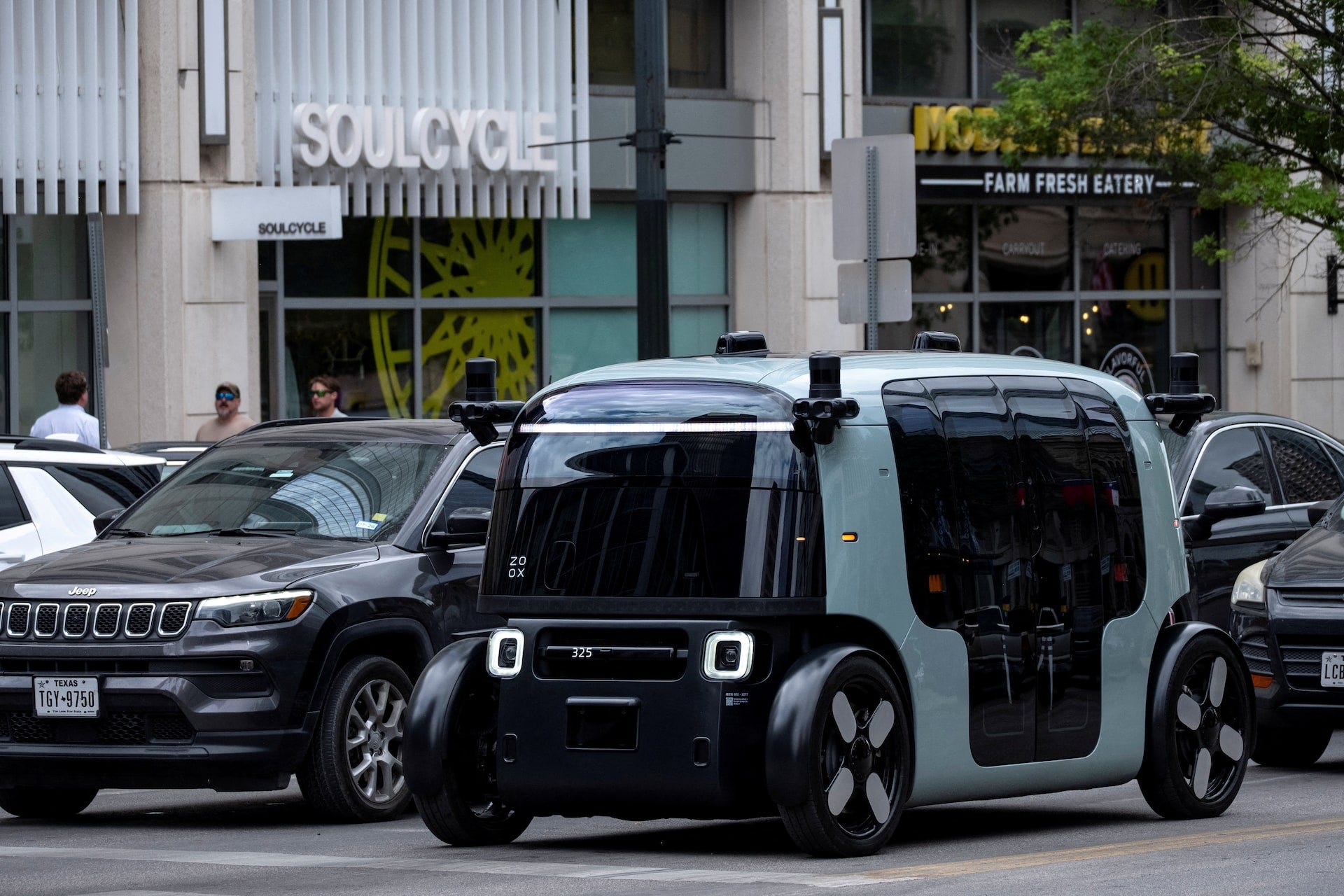
While DoorDash is flying our burritos overhead, Amazon’s Zoox will be zooking passengers around the streets sans human driver, sans, even, the potential for a human driver.
Per Reuters, “Zoox unit won U.S. approval on Wednesday for limited commercial deployment of its novel steering-wheel-free robotaxis, a first for the autonomous ride industry, the U.S. auto safety agency said Thursday.”
This isn’t the first self-driving car, obviously. Waymo and Tesla are operational in a number of American markets, and they are incredibly cool. But it’s the first vehicle designed from the ground-up for a self-driving world that will be commercially available in the US, the Adam or Eve of future generations of vehicles that never even contemplated that a human might drive it.
In Zoox’s case, that means no driver’s seat or steering wheel, and “two rows of inward-facing seats” so passengers can spend their ride hanging out more easily. I would imagine that in the future, cars will be designed more and more like moving rooms. Hop in, work or enjoy a movie or get a spa treatment or whatever, and get out at your destination.
I can’t wait to see the horrendous things people do to and in these cars.
(5) OpenAI Gives 10k Researchers Free Access to Frontier Models


There’s almost nothing I’ve found as fascinating this year as Sam Altman / OpenAI’s comms transformation, and there’s nothing that’s captivated me over the past week as much as market incentives aligning almost everyone against the market leader, Anthropic, and towards things that are great for everyone else.
I tweeted about the former after Sam’s Invest Like the Best appearance, and wrote about the latter after the open letter here.
This latest announcement by OpenAI, and Sam’s commentary, combines both.
Basically, OpenAI’s new message since bringing the TBPN guys on (correlation or causation, who knows) has been that they’re building tools to empower people to do amazing things. Replacing people is weird. Trying to do everything themselves is weird. Thinking they can predict the future is weird. Just make tools, give them to people, and see what happens.
This is both a response to how little people want the AI labs to tell them what their future is going to be, and to Anthropic’s more opinionated views. I’m not passing a value judgment here - I believe that Dario fully believes what he’s saying, and that he’s doing a principled thing by speaking out about what he sees to be the risks to his product even if it hurts him or the company. I just happen to strongly disagree with that view (he’s a million times smarter than me and in the center of this, so grain of salt) and it also gives OpenAI a wide-open lane for counterpositioning.
The ILTB conversation was a great example of the comms side of this - Sam was very on-message about AI being a tool. I especially liked the point that it’s not even that out of line with historical trends in progress, that everyone always just wants to feel that they’re in a special role in the special part of history. The whole thing is designed to deflate fears that AI will replace us and to make Anthropic look weird.
But those are words, as is signing the open letter, and at the same time, OpenAI is likely lobbying behind the scenes for regulatory capture, too.
What’s amazed me most this week, and made me appreciate capitalism, is that even if you don’t trust Sam or OpenAI or big tech, companies are incentivized to do things that are good for the public, too.
In this case, counter-positioning against Anthropic trying to go more vertical in certain categories like biotech means that OpenAI is giving free frontier models to tens of thousands of researchers because “the best way to do this is for us to empower scientists, not to try to figure out everything ourselves.”
A jab, to be sure, but if the result is that more researchers get more powerful tools with which to benefit us all, jab away.
EXTRA DOSES: HT Conversation, FCC Covers Foreign Robots, Wall-Penetrating Camera, Pangram, No Science Breakthroughs This Week
(Extra 1) My Conversation with General Catalyst CEO Hemant Taneja
Throwing this one above the paywall as an extra little tweet. There is a ton going on in the private markets, a ton of it driven by AI, and there are very few firms deploying more capital in more different ways to AI in the private markets than General Catalyst. In conjunction with the release of his Q2 Letter, I sat down with GC’s CEO Hemant Taneja for a conversation on the markets and AI generally, how GC is approaching it specifically — including owning a healthcare system and making Anthropic its biggest position — and what the role of a venture capitalist is today.
This was a fun one because there are definitely some things we disagree on, and we went into them, but we are both fundamentally optimistic about technology.
You can also find the conversation on Spotify here.