


Hi friends 👋 ,
Happy Friday and welcome to our 202nd Weekly Dose of Optimism!
As always, a big week here at the Dose. This week, we had a lot of good news come in pairs: two Saronic stories, two Austin stories, two robotics stories, and two open-weight model stories. So I cheated and combined them to squeeze a little extra optimism into your Dose.
Let’s get to it.
Today’s Weekly Dose is brought to you by… Not Boring
At the bottom of this and every Weekly Dose, we share some extra goodies, including Science Breakthroughs from Ulkar Aghayeva, who I first found through her work with collaborators ranking 2025’s papers and breakthroughs for their potential impact. Now, you get those glimpses into the future as they happen each week.
That’s one of many goodies we’re bringing to paid not boring subscribers, from the full version of Riding the Leopard to co-written essays with founders on the cutting edge of robotics, AI, manufacturing, and more. We’ll keep bringing you more, and I hope you’ll join us.
(1) Saronic’s Very Big Week
We last covered Saronic, the Austin-based autonomous shipbuilding startup, in Dose #197, when its Corsair drone boats rescued a downed Apache crew near the Strait of Hormuz. A little over a month later, the company has had an even more absurd week.
On Monday, three of its 24-foot Corsair autonomous boats were used in combat (not rescue) for the first time, striking an Iranian submarine and ship-maintenance facility at Bandar Abbas. The military has not publicly assessed the damage. A system built by a four-year-old startup went from prototype to a live combat mission, a month after another Corsair performed the first known rescue of downed pilots by an autonomous boat. Seems to be working.
Then yesterday, Saronic announced that it had chosen Brownsville, Texas, for Port Alpha, a more than $3 billion greenfield shipyard. The first phase will cover 835 acres, with room to expand to nearly 4,400. Construction is supposed to begin this year, operations in 2028, and the company expects to create as many as 10,000 direct jobs over the next decade.
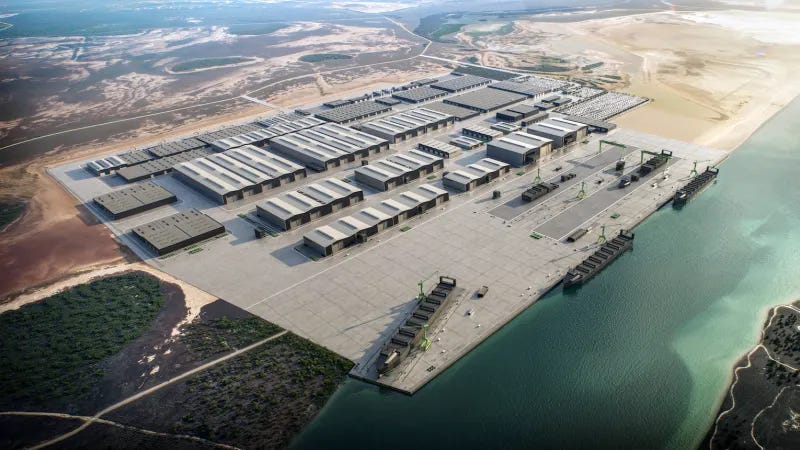
The initial yard will be able to build ships up to 850 feet long. Fully built out, Saronic says it could reach roughly 2 million gross tons of annual shipbuilding capacity. The plan is to build crewed and uncrewed military ships, container ships, roll-on/roll-off vessels, tankers, and icebreakers, using the same autonomy and advanced-manufacturing stack as the drone boats.
Proving that a startup can build autonomous boats that are useful in combat is huge, but proving that they can build a great American shipyard again might be even bigger.
If you’ve been reading the Dose for a while, you might be thinking … wait, wasn’t that shipyard supposed to be a part of California Forever? Good memory. It was. California fumbled it, because local and state government failed to pass legislation around a proposed permitting framework in time.
“We hope this missed opportunity serves as a wake-up call that inaction and political gridlock have real costs for all Californians,” the California Forever-led labor and business coalition that pushed for the legislation wrote. Until then, in the words of Tim Riggins, it’s Texas Forever.
(2) Big Week for Austin, Actually: Base Launches in Austin + TerraFirma
Speaking of Austin companies doing big things… IT’S COMING HOME.
No, not the World Cup. Jude Bellingham shit-talked Messi, so Messi decided to end England’s run in the semis.
I’m talking about Base Power Company, which after more than two years operating out of Austin, TX is finally operating in Austin, TX.
Base is beginning to serve homeowners inside Austin Energy territory as part of a 40-megawatt residential battery agreement with the city-owned utility. Base will install and maintain the batteries. Austin Energy will be able to dispatch the fleet when demand and wholesale power prices spike. Homeowners get whole-home backup when the grid goes down. Win-Win-Win.
In the very same week, another Austin company, TerraFirma, which is “Building giant robots to build a brighter future,” announced a $100M Kleiner Perkins-led Series A to make construction robots. In the SpaceX-vets’ words, “We’re a new type of company, a robotic construction company that builds the full technology stack needed to deliver an order-of-magnitude improvement in one of the world’s oldest, largest, most important, but least efficient industries.”
It seems like the TerraFirma guys also got every great vertical integrator co-founder/exec on the cap table, including Anduril’s Matt Grimm, Hadrian’s Chris Power, and their Austin neighbor, Base’s Justin Lopas.
It’s time to build. Hook ‘em. Texas Forever.
(3) Don’t Forget About the Humanoids: Walden and Sunday
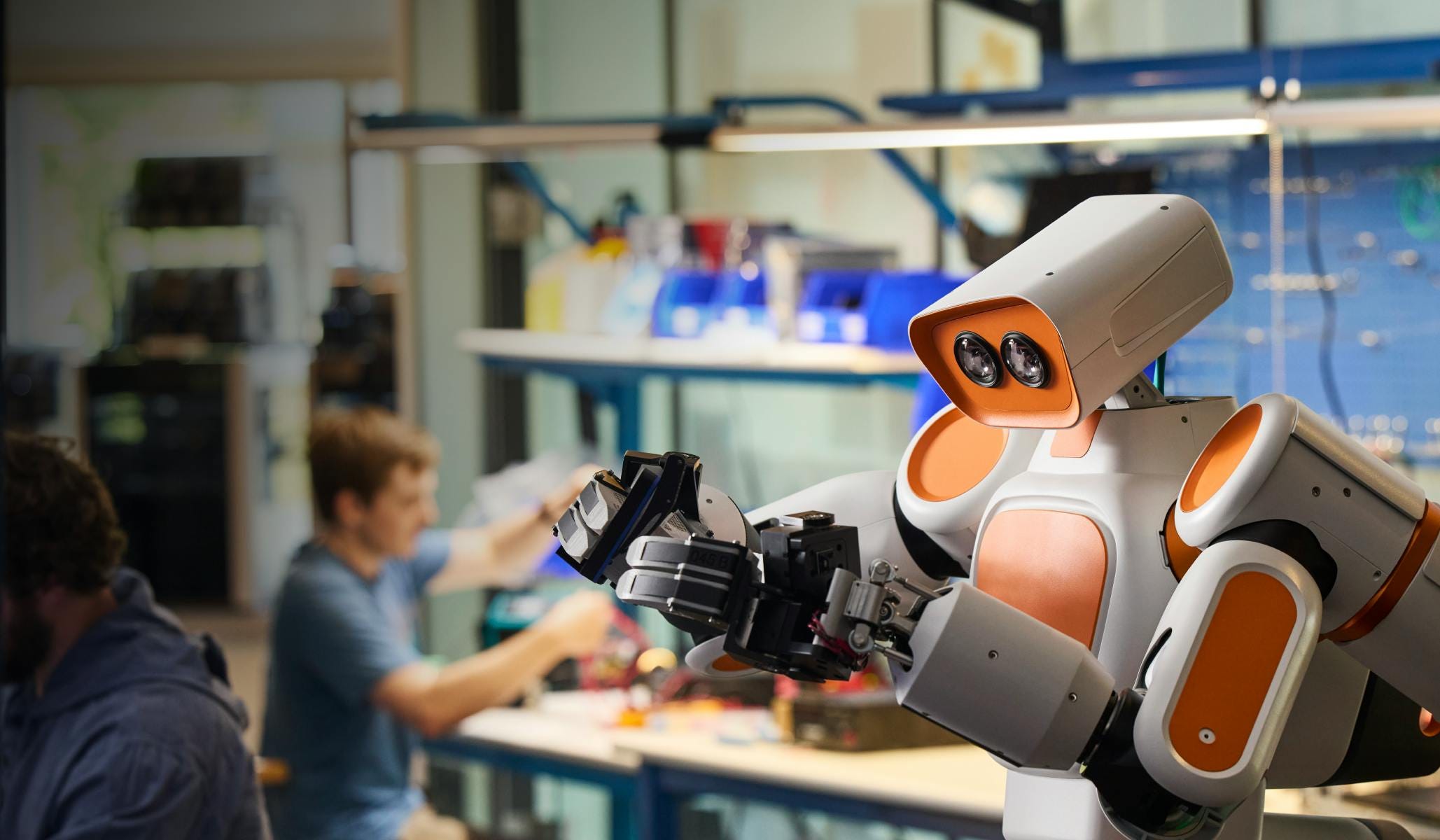
Regular-sized robots can raise money, too, and it seems like they can do more than that.
On Wednesday, Walden Robotics came out of stealth with $300 million in seed funding at a $1.1 billion valuation co-led by Deviation Capital and a trio of Toyota investors (Toyota Motor Corp, Toyota Invention Partners, and Toyota Ventures). Its robots are already doing useful work in a North American Toyota factory, too.
The Toyota connection makes sense, because Walden spun out of Toyota Research Institute in January. CEO Russ Tedrake, an MIT professor who led TRI’s robotics and machine learning team for nearly a decade, brought over many of the people behind Diffusion Policy, Large Behavior Models, OpenVLA, and the Drake robotics simulator. By February, the new company had robots in production - on the factory floor in two months!
The robots are built as a full stack: hardware, software, models, and an application layer for deploying them into real workflows, a la Standard Bots. They learn tasks through demonstrations, then improve through practice, starting with the annoying jobs in manufacturing and logistics that have remained hard to automate because they change too often or require a little too much judgment for traditional fixed automation.
Most of us don’t live in factories, though, we live in homes. And there seems to be good news for us home-dwellers, too.
Yesterday, Sunday Robotics introduced ACT-2 Preview, its new robotics model for Memo, the company’s home robot. Sunday says ACT-2 can learn a new behavior from a single fine-tuning example, generalize it zero-shot to real homes it has never seen, and perform with a 99% success rate.
It’s still a preview, but they got ahead of the slick demo criticism by introducing something called Solves. “Progress in robotics is difficult to measure because demos vary by setup. Demo ≠ Solved,” CEO Tony Zhao tweeted. “A Solve declares two boundaries: scope and adaptation cost. Without both, 99% has no context.”
They found a “general recipe for Solves: scale pretraining, then hill-climb with minimal in-house data. For the first time, one fine-tuning example can teach a new behavior that generalizes.”
Blah blah blah that’s a lot of robot words. What can it actually do for me?
And now for your Moment of Zen (3 hours of Memo folding laundry)…
(4) FDA Approves New Merck Pill to Slash Cholesterol Levels

Sorry the picture for this one isn’t that exciting. Merck doesn’t do fancy pictures for their FDA-approval announcements. What they do do is make drugs that save lives, which, if you have to choose, is what you want.
Yesterday, the FDA approved Merck’s Lipfendra, the first oral PCSK9 inhibitor. It’s a once-daily pill that lowers LDL cholesterol about as much as the injectable PCSK9 drugs: a placebo-adjusted 56% in a broad hypercholesterolemia trial and 59% in patients with the inherited form.
It’s a bad time to be LDL Cholesterol. In Dose #195, we talked about Eli Lily’s new PCSK9-targeting gene therapy. Which means it’s a good time to be a heart. LDL cholesterol is one of the leading causes of heart attacks. PCSK9 is a protein that destroys LDL receptors on liver cells. If you can block it, more receptors survive to pull bad cholesterol out of the blood.
This isn’t the first PCSK9-targeting drug. There’s the upcoming gene therapy, and there are injected antibodies like Repatha and Praluent that do this very well. They are also injections, which turns out to be a meaningful barrier when you are asking millions of people to take something for years.
Luckily, the other thing they do uniquely ahead of the curve is macrocyclic peptides. They signed a $220M biobucks deal with not boring capital portfolio company Unnatural Products in 2024 to work on macrocyclic peptide, which it describes as “the next wave of drug discovery.”
What macrocyclic peptides allow you to do is to take larger molecules that normally require injections (they generally get chewed up in the gut) and deliver them orally. Lipfendra is a macrocyclic peptide, folded into a shape that helps it make the journey from mouth to target intact.
This isn’t a new capability, but it’s a new delivery mechanism: heart attacks can now be attacked back with antibody-like potency in a $10.50 daily pill. Eat your heart out.
(5) Kimi and Thinky Open Up the Frontier
Thinking Machines and Moonshot AI
It feels like just weeks ago that the US Government shut down Anthropic’s Fable 5 for being too dangerous while the USMNT squashed its opponent in a World Cup Match. Oh how things change.
In bad news for people who think that AI models are super super dangerous and might even kill us all on behalf of their owners like the Genie in Aladdin when Jafar has the lamp, and good news for normal people, a Chinese open source model has basically caught up to Fable 5 (and OpenAI’s GPT-5.6 Sol).
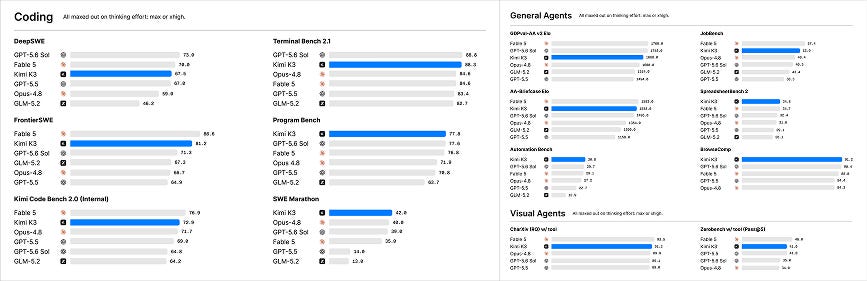
Yesterday, Beijing-based Moonshot AI released Kimi K3, the first open model in the 3-trillion-parameter class. K3 has 2.8 trillion total parameters, a one-million-token context window, and native vision. It is live now in Kimi’s apps and API, with the full weights scheduled for release by July 27th.
The big model is sparse, activating just 16 of 896 experts at a time. Moonshot says its new Kimi Delta Attention makes decoding up to 6.3x faster in million-token contexts, while a second architectural change called Attention Residuals delivers roughly 25% higher training efficiency at less than 2% additional cost. Taken together with the larger mixture of experts and new training recipes, the company claims about a 2.5x improvement in scaling efficiency over Kimi K2.
Moonshot says K3 still trails Claude Fable 5 and GPT-5.6 Sol overall. But on its published evaluations, it is in the same band and wins individual agentic and coding tests: 91.2 on BrowseComp versus Fable’s 88.0 and GPT-5.6 Sol’s 90.4, for example, and 88.3 on Terminal Bench 2.1 versus Fable and Opus 4.8 at 84.6. Those are company-run results and will need independent replication, but it looks like an open model is competing with the big boys.
This comes on the heels of Mira Murati’s Thinking Machines Lab releasing its first model, Inkling, on Wednesday, with the weights available to download under an Apache 2.0 license. Inkling is a 975-billion-parameter mixture-of-experts model with 41 billion active at a time. It accepts text, images, and audio, has a context window up to one million tokens, and can be fine-tuned through Thinking Machines’ Tinker platform.
Inkling is not the best model in the world, either, by Thinking Machines’ own admission. Its bet is that it is a strong, broad model that other people can turn into the best model for one particular thing.
To make the point, the team had Inkling write and run its own fine-tuning job, evaluate the new weights, and switch itself over to a version that never uses the letter “e.” Then, they opened it up to everyone, in the hopes that someone has an even better idea than that, which is how free markets work.
Open models competing is great because competition is great, because it means that more value will accrue to the many companies that make up the economy versus a handful of closed labs, because it lessens the odds that Dario is in charge of the world, and because open models, theoretically, compound on each other.
This seems to be happening here. Inkling’s architecture draws on China’s DeepSeek-V3, and Thinking Machines used data generated by Moonshot’s Kimi K2.5 during post-training.
Open-weight is not the same thing as fully open source. Neither lab is handing over every piece of training data and code, and almost nobody is going to run a multi-trillion-parameter model on a gaming PC. But weights are the valuable part if you want to inspect a model, customize it, improve it, or build on it permissionlessly.
Plus, it’ll give Ramp’s new AI Token Spend Management tool more ammo in the fight against bad ROT.