

Welcome to the 730 newly Not Boring people who have joined us since our last essay! Join 268,518 smart, curious folks by subscribing here:
Hi friends 👋,
Happy Tuesday! Welcome to a Deep Dive I’ve been excited to write since The Electric Slide, about a company I invested in to build one layer of the Electric Stack - motors and actuators - in America.
If you’ve heard of Westmag, it might be because they make really great hats. Everyone loves the Westmag hats. I’m wearing one right now, which co-founder David Hansen gave me right off his head. This hat, I think, in a decade or two, will be a collector’s item.
I think that because over the past year, in stealth, Westmag has been making a lot more than hats. It’s been making motors and actuators, and it’s been making them to scale, so that in a decade or two, when we sit on the grass looking up at drone-decorated skies while robots do our chores, those drones and robots will be driven by Westmag motors and actuators.
Let’s get to it.
Today’s Not Boring is brought to you by… Framer

Launch fast. Design beautifully. Build your company’s website on Framer.
Framer helps teams design, build, and launch their marketing sites lightning fast. With the ability to publish hundreds of CMS pages in a single click, operate at a global scale with seamless localization, and even host unified content across multiple domains, teams have never been able to ship faster. Companies like Miro, Bilt, and Perplexity trust Framer to achieve:
Speed without chaos: ship pages and updates faster without turning the site into a fragile set of one-off hacks.
Reduced dependency: shift routine brand and marketing work out of product engineering queues.
Production-grade foundation: Run real marketing systems (CMS, SEO, performance optimization) with governance and collaboration.
👉 Build your company’s site on Framer today
America Spins on Westmag

If you drive out to South San Francisco, past and away from the city’s “Stop Hiring Humans” billboards and into the industrial part, you will find a low-slung facility from which David Hansen and Jordan Sanders plan to sling American-made motors and actuators to the American companies making drones, robots, and eventually, anything that moves under the power of electrons.
It is called Westmag, a portmanteau of Western and Magnetics, which pretty much sums up the mission. Electric motors are spinning magnets, and if America is to participate in the coming electric revolution, we are going to need to make them in the West.
This is the kind of statement you read on Twitter, at varying degrees of jingoism, as in “Get those Chinese motors out of my yard.” But it isn’t self-evident that we need Western motors, or, therefore, Westmag. The promise of globalization was cheaply-made Chinese motors powering expensively-designed American products for the benefit of all mankind.
Certainly, we want to design our own robots and drones. Intellectual Property is what America does best. We probably want to manufacture them here, or in a friendly country, too. Even if you don’t believe the China hawks’ predictions that there will be a hot Great Power Conflict within the decade, it is better to err on the side of not putting a heavy, software-controlled, and easily-bugged Chinese hunk of metal inside every American home, or, eventually, putting every American human inside a flying, software-controlled, and easily-bugged Chinese hunk of metal to fly through the sky.
But where do you draw the line?
Should you make every magnet that goes inside every motor in the USA? Should you mine the rare earths that make the magnets here, mine them elsewhere and refine them here, or import them? The rare earths are commodities, after all, and impossible to bug or remotely control with known technology. And even assuming that you want to make everything here, is there a company to be built doing so? Who in their right mind would want to compete with China’s massive scale and subsidy advantages?
American motors seem to violate both David Ricardo’s concept of Comparative Advantage and Michael Porter’s Five Forces. And yet, Westmag exists, and I invested in the company, alongside a16z, Founders Fund, Lux Capital, NFDG, Menlo Ventures, and my Electric Slide co-author, Sam D’Amico.
In that essay, I wrote, “I even just invested in a stealth company making electric motors.” Westmag is that company. We also shared the reason America wants a company like Westmag, and many similar ones in all areas of the Electric Stack, to exist in America:
Manufacturing and design are inextricably linked. When you make things, you learn how to make them better. You learn which parts of the underlying stack need to be improved, improve them, and make better products. This is a theme that comes up over and over again in our Electric Stack story.
In the Electric Era, maintaining design leadership without manufacturing leadership is not a coherent strategic position, and one that gets less coherent the better you believe AI will get.
Elon has solved this by building practically everything inside of his own companies. There is a parallel American ecosystem emerging to serve the growing number of electric companies not in the Elonverse. Westmag will be the winning motor company in this ecosystem, and will, in turn, enable its customers to win.
In a time of experimentation and innovation, like the one drones and robots are in today, if you place component manufacturing near product manufacturing, the whole machine spins faster. This is particularly true when, to say nothing of geopolitics and everything of commerce, American companies are producing at volumes at which they are not Chinese component suppliers’ top priority.
But that is half the story, a geopolitical imperative, not a corporate strategic one.
The other half of the story is why a specific company like Westmag should exist, and how it can generate persistent differential returns in a market in which practically zero-margin Chinese alternatives exist. While we will tell the whole thing, that’s the half we’ll focus on today.
It’s a story about Westmag specifically, and motors and actuators specifically, but it’s also the story of how to ride the Red, White, and Blue premium for just as long as you need to without counting on it long-term in order to kickstart demand and ride that growing volume down the cost/performance curve until, without subsidies and without patriotic premia, you can use scale and proximity and flexibility and speed to compete on overall system cost and win.
This, to be sure, is a scale game, and that’s not the type of game we’ve played well recently. As David said, “Motors are capped at 100% efficiency, so most improvements are incremental. So you can go from 89% to 91%, but it turns out that doesn’t matter at all if you don’t make it and get it adopted at scale.” Previous attempts to compete in motors were focused on those efficiency gains or theoretical breakthroughs at the expense of the ability to quickly reach meaningful adoption and scale, he continued:
Actually building a lot of it is the only way to get good at building it. China’s strength, which we are replicating, is building a lot of things and then improving it along the way. Bespoke low volume doesn’t create a manufacturing powerhouse with compounding advantages.
Westmag plans to build a manufacturing powerhouse by focusing on scale. As Jordan put it:
We are first focused on scale: scaling what works now and what is in demand now, while in parallel innovating on, and through scaling that, we will drive this virtuous feedback loop of innovations in how we manufacture and how we design motors, both for manufacturability but also for performance. You only get good at the stuff if you build a lot of it. And then you only win the market if you can actually get it out to the market in large numbers.
So this is a story about why and how to build electric motors in America for economic reasons, how to build them at scale, and how to win. And it’s a story about what it will mean for the rest of America’s electric ecosystem, alongside which Westmag is growing up, if it does.
It begins with what electric motors are, why they’re important, and where they’re made today.
Electric Motor Primer
In The Electric Slide, we used the electric motor as the vehicle for understanding the whole Electric Stack, because the motor is where everything comes together. The batteries supply power to the electromagnets that create rotating fields that pull the Neodymium magnets around and around, coordinated by the embedded compute that takes in data from sensors and tells the power electronics how to flip the current thousands of times per second to create the smooth rotation that turns electrical power into mechanical power.
Specifically, in a brushless DC motor, which power drones and the actuators inside humanoid robots, the stator, the part that holds still, is a ring of copper coils wound around teeth of laminated electrical steel, and the rotor, the part that spins, is studded with permanent neodymium magnets.
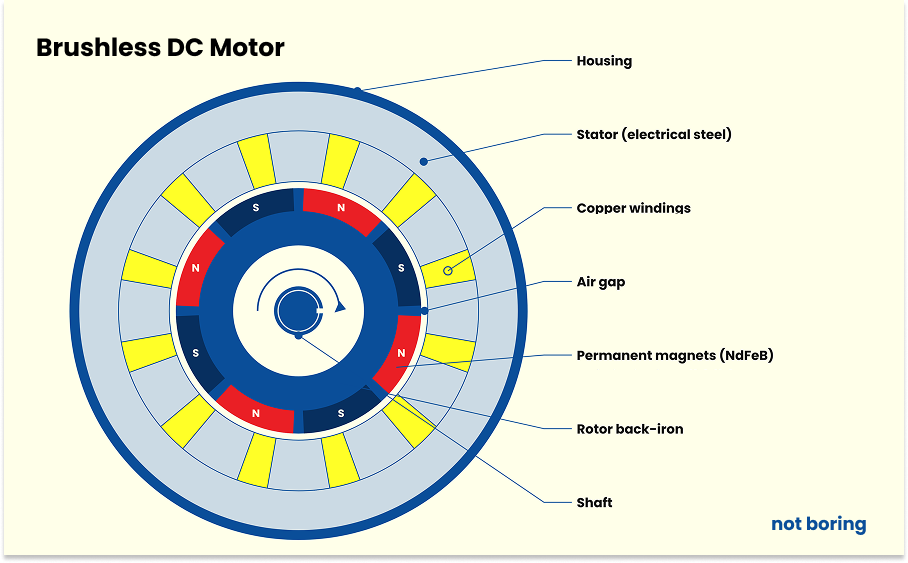
The controller fires the stator coils in a precise rotating sequence. Three phases switch on and off thousands of times per second, so that the magnetic field appears to whirl smoothly around the stator. The permanent magnets in the rotor chase that rotating field and never quite catch it, and that perpetual chase is what spins the shaft. As we wrote:
The magnetic force is doing the spinning. Everything else is about getting the magnets in the right place with the right polarity; nature does the rest.
An electric motor simply directs electromagnetic forces that want to move towards equilibrium.
The “brushless” part is an upgrade from older motors, which used carbon brushes to physically scrape current onto a rotating commutator, a mechanical hack that worked well enough but wore out, sparked, and capped achievable speeds. If you swap the brushes for electronics, you get a motor that is quieter, more efficient, more controllable, capable of tens of thousands of RPM, and good for a billion rotations before anything wears out. Which is why it has become the motor of choice for almost everything that needs to move precisely under software control, which is an increasingly large number of things.
If you want a deeper understanding of how electric motors work, check out our explainer, How Electric Motors Work, or watch this video:
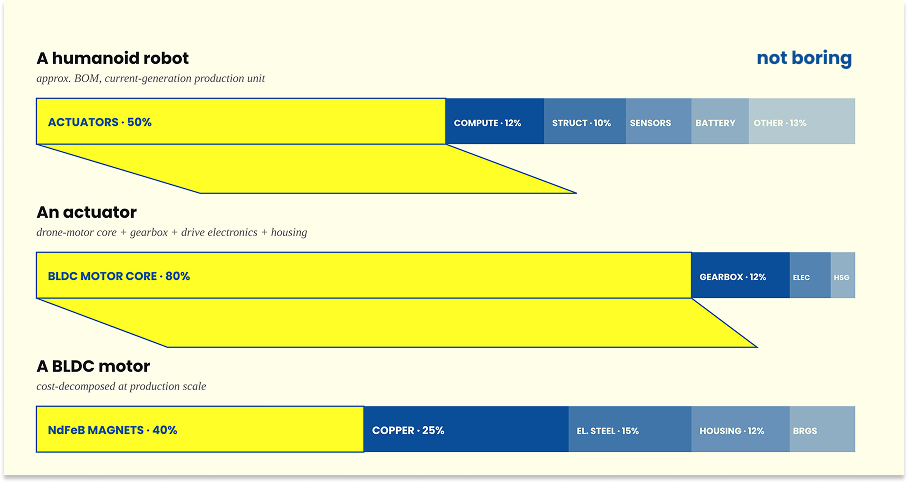
For our purposes, what you need to know is that any electric product that moves is basically a bunch of actuators, of which motors are a subset, converting some form of energy into physical motion, wrapped in bodies that allow them to understand the world around them and move certain ways in response. The bill-of-materials (BOM) for a humanoid robot, for example, is roughly 50% actuators with motors and magnets at their core, which act as their joints.
“Motors are simple,” Jordan told me, someone to whom motors are not simple, when I visited the proto-motor factory. “They’re just magnets and copper wire wrapped around some electrical steel.”
From a materials perspective, motors are simple. Making motors, however, turning those materials into a precision component at scale, is much more complex.
A brushless DC motor is a bundle of compounding tolerance requirements. The electrical steel arrives as thin sheets that have to be stamped into laminations, coated to prevent eddy currents, and stacked into a stator with the layers aligned to within a hair. Copper wire, sometimes thinner than a human hair itself, has to be wound around the stator teeth at a precise tension, in a precise pattern, with as much copper crammed into the available slot area as physically possible.
Then there are the magnets. Neodymium magnets get pressed into the rotor at orientations specified to a fraction of a degree, and magnetized in place by fixtures that fire enormous bursts of current through coils to align the magnetic domains. Increasingly, you can get blocks of neo magnets in the US, but what you get is a slab of metal that isn’t yet magnetized or cut to the right shape. To turn block into a usable motor magnet you have to cut it (small-motor magnets are curved, and the curve is not easy), shape it, coat it, and magnetize it. No one does this in America today, so if you want to do it right and quick (i.e. if you don’t want to send the American magnet block to China or Malaysia and back), you probably need to do it yourself. If you get the orientation slightly wrong, your field ends up lumpy. If your field is lumpy, your motor cogs, vibrates, and wastes energy.
Stack those tolerances on top of each other (lamination, winding, magnet orientation, rotor balance, bearing fit, etc…) and you start to see why motor manufacturing is mostly a process problem, not a materials problem. The materials are simple. The process is annoyingly precise.
That is why, as much as their total dominance of the rare earth magnet supply chain or (no longer) cheap labor, China is so good at this. Over the past thirty years, they have made a lot of motors, and in the process, they have written a library of institutional knowledge. The winding machines in Shenzhen have been refined by a thousand small revisions. Chinese line workers know what a properly-wound stator feels like in their hands. Their test rigs have been calibrated against millions of motors.
This knowledge compounds for you, just like the tolerances compound against you, and it’s only if the knowledge wins that you can produce a lot of motors, cheaply and reliably. For the past three decades, China has been doing all of the compounding.
China Spins Up Motor Production
Like every layer of the Electric Stack, electric motors were invented in the West and Japan. Michael Faraday of cage fame built the proto-motor in London in 1821. A decade later, in Princeton, Joseph Henry discovered that you could make incredibly powerful electromagnets by wrapping insulated wire around iron cores.
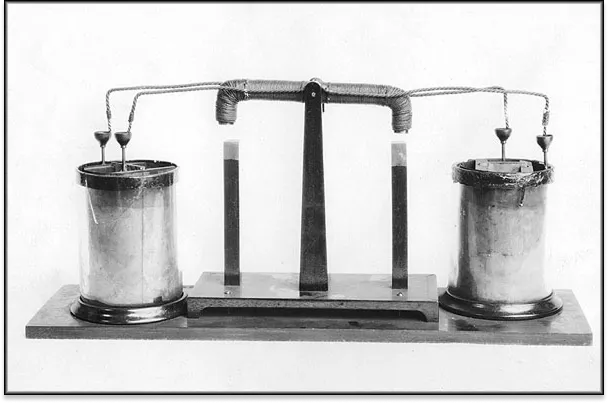
Forty years later, in 1871, Zénobe Gramme built the first commercially successful generator, using electromagnets for the field magnets, powered by some of the current it generated itself in a process called self-excitation. In the 1950s and 1960s, American researchers began replacing mechanical commutators with electronic switching, and in the 1960s and 1970s, Japanese firms like Yaskawa, Panasonic, Sony, and later Mabuchi aggressively productized compact permanent‑magnet motors as transistors and then MOSFETs got cheaper. These were the first truly mass‑manufactured, consumer‑scale BLDC motors.
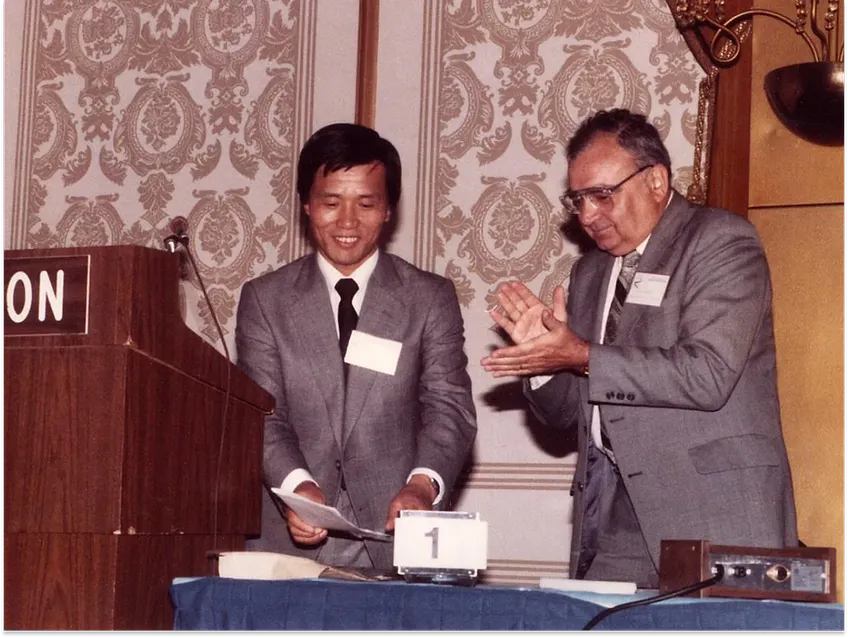
In 1983, in a story that you need to read if you haven’t, Sumitomo’s Masato Sagawa (Japan) and GM’s John Croat (US) independently discover Nd₂Fe₁₄B, the modern neo magnet, and presented their findings at the same conference in Pittsburgh.
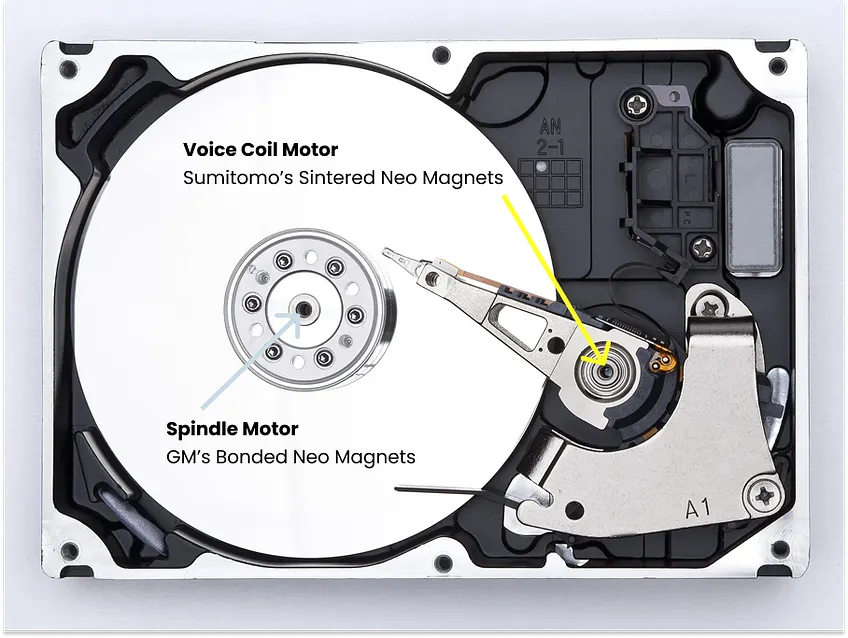
Sumitomo perfected sintered high‑performance blocks, while GM’s Magnequench division perfects bonded molded magnets, both of which were used in neodymium magnets’ alpha product: 3.5” hard-disk drives (HDD), which relied on two small electric motors, voice coil motors and spindle motors.
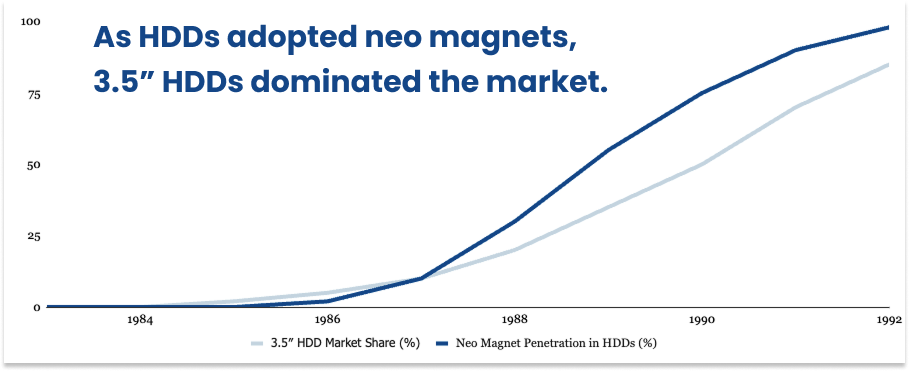
As 3.5” HDDs overtook 5.25” HDDs, neo magnets swept the market.
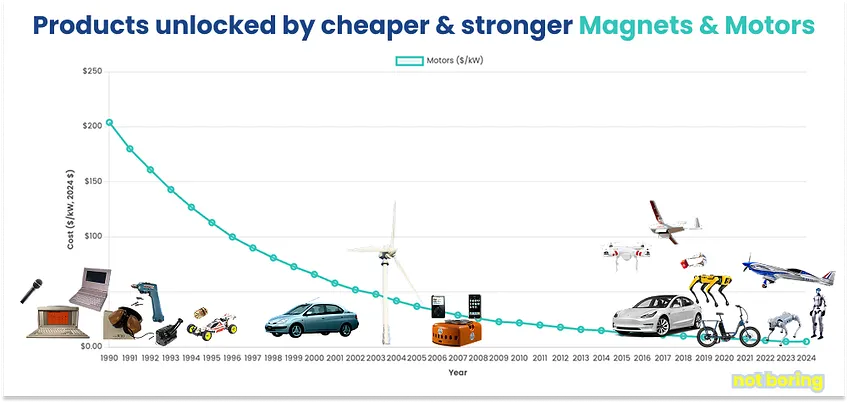
And as neo magnets scaled, they and the motors they powered got cheaper, unlocking new use cases, more scale, better price-for-performance, and therefore more use cases, and more scale, in a virtuous cycle that we are still riding today. You can read the full story in The Electric Slide.
Today, however, the products that run on electric motors don’t run on American-made electric motors or neo magnets.
In 1995, GM, under financial pressure, sold 80% of Magnequench for $70M to a “US‑led” consortium that was, in reality, two PRC‑controlled companies led by Deng Xiaoping’s sons‑in‑law. CFIUS approved the deal on the condition of a 5‑year pledge to keep production in the US. Long before the five-year pledge expired, Magnequench’s Chinese owners had already cloned the Indiana lines in Tianjin. By 2003, the US plant shut down.
In parallel, as part of Xiaoping’s long-term plan, China came to dominate rare earth mining and manufacturing, including the mining and manufacturing of neodymium. By the early 2000s, having undercut them on price and environmental standards, China forced the US’ only big rare earth mine, Mountain Pass, into bankruptcy, and came to control the full rare‑earth → NdFeB magnet chain that is essential for high-performance BLDC rotors.
But supply without demand does not an industrial superpower make. Enter Shenzhen.
Shenzhen was a small fishing village of about 30,000 people across the border from Hong Kong before Xiaoping, as part of his “reform and opening” policy, designated it the opening country’s first Special Economic Zone in May 1980.

Throughout the 1980s and into the 1990s, China’s quasi-capitalist city exploded. Cheap labor poured in from across China to fill the demand for hands: Shenzhen had quickly become a hub for assembly and low-end manufacturing. Soon, dozens of contract manufacturers were making toys, watches, and all manner of cheap electronic devices.
BYD started in Shenzhen, to execute an arbitrage: reverse engineer Japanese battery manufacturing processes and replace all of the expensive automation with Shenzhen’s cheap, abundant labor. Over time, Wang Chuanfu’s company built out Shenzhen’s battery supply chain while becoming the world leader in electric vehicles, one feeding the other. If you make the components, you can make better products.
Johnson Electric, founded in Hong Kong in 1959 by Wang Seng Liang and his wife, set out to manufacture miniature DC motors specifically for the booming Hong Kong toy industry. When Xiaoping opened the Pearl River Delta to ~capitalism, Johnson moved production across the border, like many of Hong Kong’s electronics companies. By the 1990s, more than 80% of Hong Kong’s factories had moved to the mainland, mostly into the Pearl River Delta. Per the (surprisingly shitty) Porter’s Five Forces website entry for Johnson Electric, “the 1980s show a shift toward application‑specific motion solutions as automation and automotive electrification rose.” By the 1990s and early 2000s, “Johnson Electric established mainland China production and verticalized stamping, molding, and magnetics to protect margins; it diversified from brushed motors into BLDC, stepper, linear actuators and subassemblies.”
Thanks in part to the competence that Johnson Electric had built in motor manufacturing, Shenzhen became the epicenter of the RC hobby industry, which refined brushless motors specifically. The next big thing will start out looking like a toy.
So by the time that Frank Wang used the proceeds from selling flight-control parts to universities and Chinese power companies to move to Shenzhen and start Da-Jiang Innovations, or DJI, the city was already the place where almost every component a flying camera needs was already being made within a couple hours’ drive of his apartment, by people who had been making them for years. RC hobbyists were refining the brushless motors, and the speed controllers to drive them. BYD had already been making lithium cells and packs for a decade. Camera modules were widely available hand-me-downs from the smartphone industry that had turned Shenzhen into the best place on Earth to turn a bare Sony sensor into a working, calibrated eye for a few dollars. Gimbals, plastics, PCBs, radios, and GPS units were available on a quick stroll through Huaqiangbei, the city’s electronics district, where Wang could pull from some 30 billion components crammed into a single square mile, get a custom PCB turned around in 90 minutes, and go from sketch to prototype in a few days.
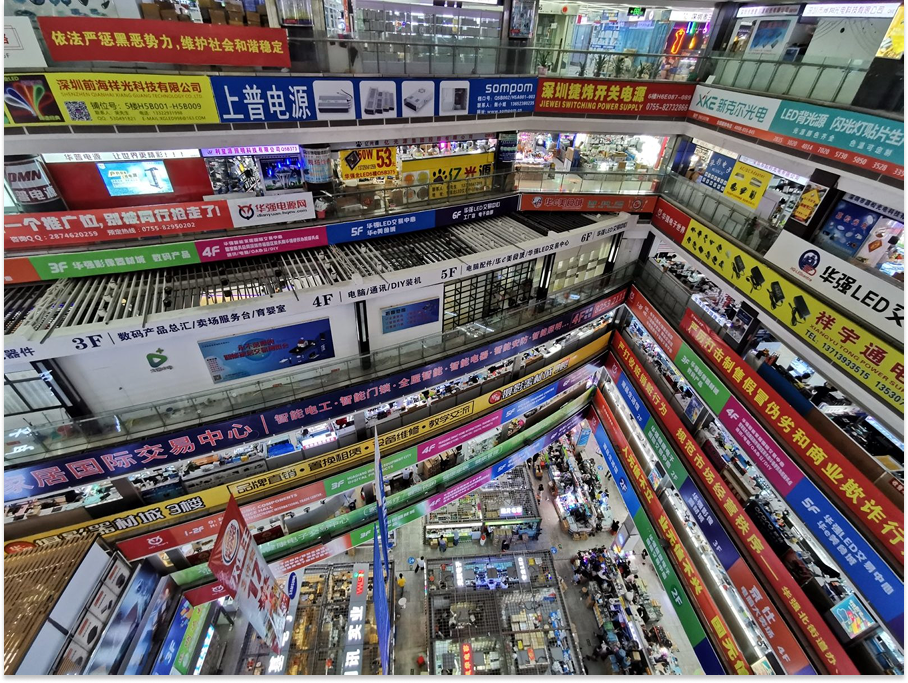
Cheap labor had attracted BYD, Johnson Electric, and countless other manufacturers to Shenzhen, but it was the components and expertise they’d built with that labor that made the city an ideal place to start a drone company in 2006.
But precisely because components were so widely available, a hundred copycats could pull them off the same shelves. So DJI started vertically integrating. It built the flight controller first, because that was the part Wang understood best, and the cost fell from several thousand dollars in the mid-2000s to a few hundred by 2012. Then they developed the gimbal in-house and shrunk until it cost a tenth of the professional rig it replaced. Then the camera. Then, eventually, the propulsion system itself, the motor and ESC and propeller, designed as a single matched unit.
Today, DJI makes something like 70-80% of the drones in the world, and it is, by itself, supplying itself, the largest drone motor manufacturer in the world by a wide margin. It got so good at making motors that it’s even started selling its Avinox e-bike motors to other companies.
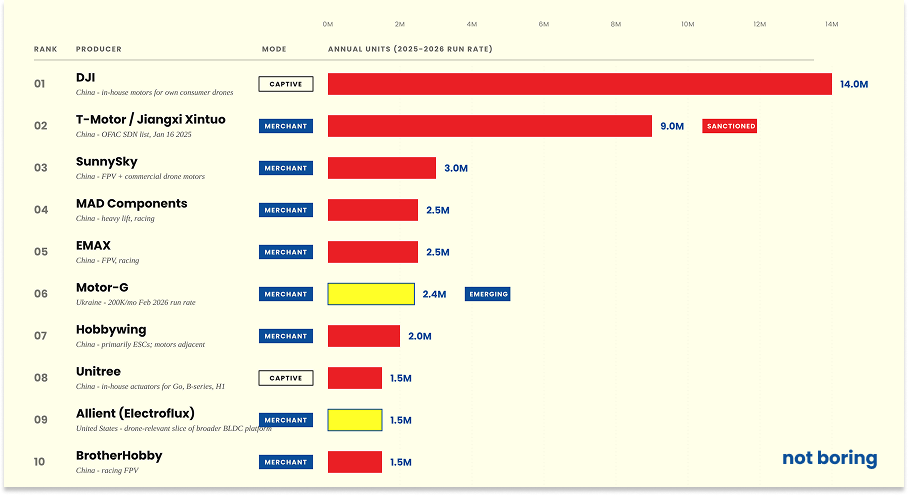
Thanks in large part to DJI, but also to the ecosystem it grew up in and Xiaoping’s foresight, to the fact that someone buying a motor can also buy a battery and power electronics and custom-made PCBs right next door, China absolutely dominates the world’s production of drone motors.
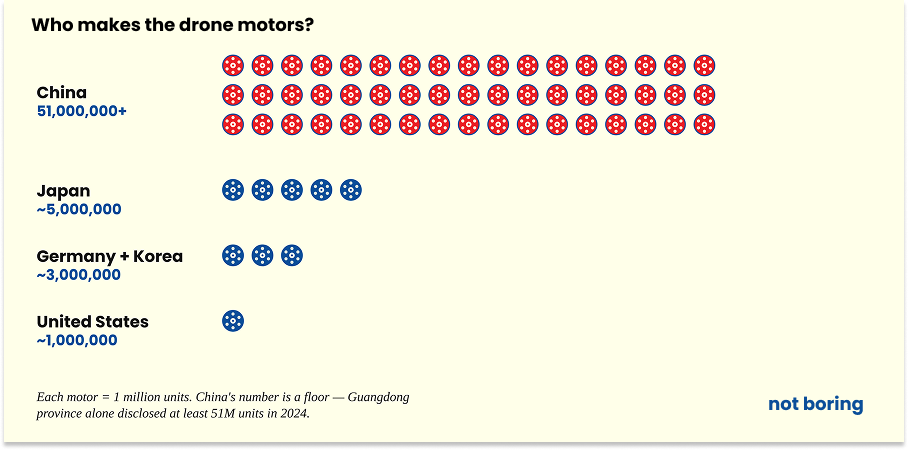
That same expertise allows them to dominate the world’s production of robot actuators, each of which has a drone motor at its core.
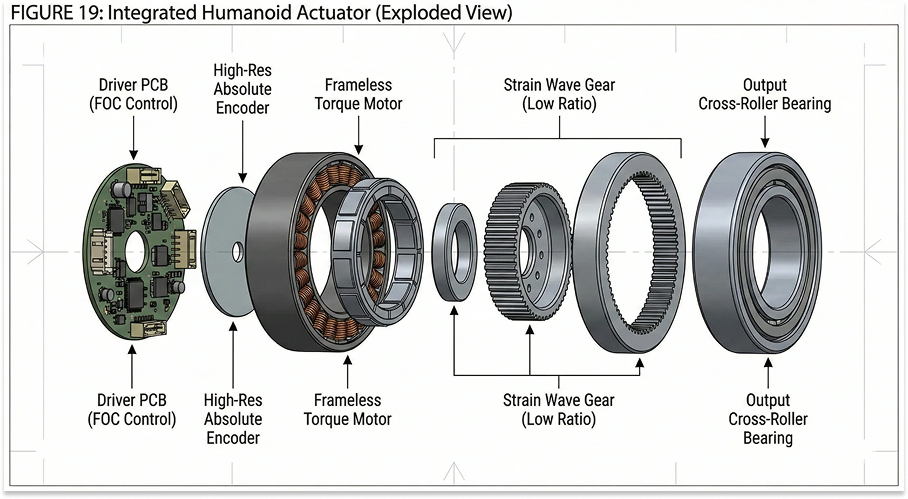
Which means, along with all of those batteries and power electronics and custom-made PCBs, that China absolutely dominates the world’s production of drones and robots.
Because if you want to build products on the Electric Stack, it is critical to have fast-turn components available nearby.
Why America Needs Its Own Motor Company
On its face, it is not bad that China dominates drone motor and actuator production. In a frictionless utopia, it would be great.
A company in one country (say, America) would design a drone or a robot or anything that moves, they would send the specs for the components they need to a bunch of other countries (like, for example, China) where they could be made best-for-the-cost, those countries would make the components and ship them near-instantly back to the buyer, the buyer would assemble those components into a finished drone or robot or whatever, and it would sell them to customers around the world, each of whom would benefit from a product made in the most efficient way possible.
Sure, America could design and manufacture here, and there was a time in the 1970s when we were better at both designing and manufacturing than China, but if we’re better at designing than manufacturing, and if design captures more of the value, we can design here and manufacture in China, which has a comparative advantage in manufacturing.
Comparative advantage is a concept coined by the economist David Ricardo in 1817 to explain why countries engage in international trade even when one country’s workers are more efficient at producing every single good than workers in other countries. When Nobel Laureate Paul Samuelson was challenged to “name me one proposition in all of the social sciences which is both true and non-trivial” by the mathematician Stanislaw Ulam, he thought for a few years and came back with comparative advantage: “That it is logically true need not be argued before a mathematician; that it is not trivial is attested by the thousands of important and intelligent men who have never been able to grasp the doctrine for themselves or to believe it after it was explained to them.”
This is the logic that policymakers and economists used to justify globalization and the World Trade Organization, and it fueled China’s rise.
From the reform era through WTO accession in 2001 and into the 2000s, China was labor-abundant and capital-and-skill-scarce, so it specialized in labor-intensive assembly while the US specialized in the capital-, IP-, and skill-intensive ends. For a while there, it worked as planned. Americans were smiling all the way to the bank.
The Smiling Curve depicts how “value added varies across the different stages of bringing a product on to the market in an IT-related manufacturing industry,” and therefore, where value is captured.
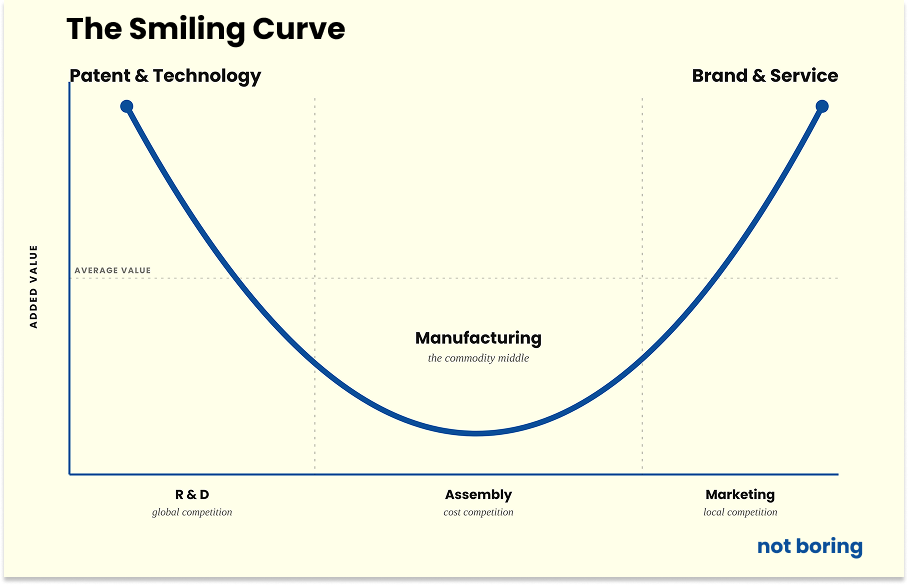
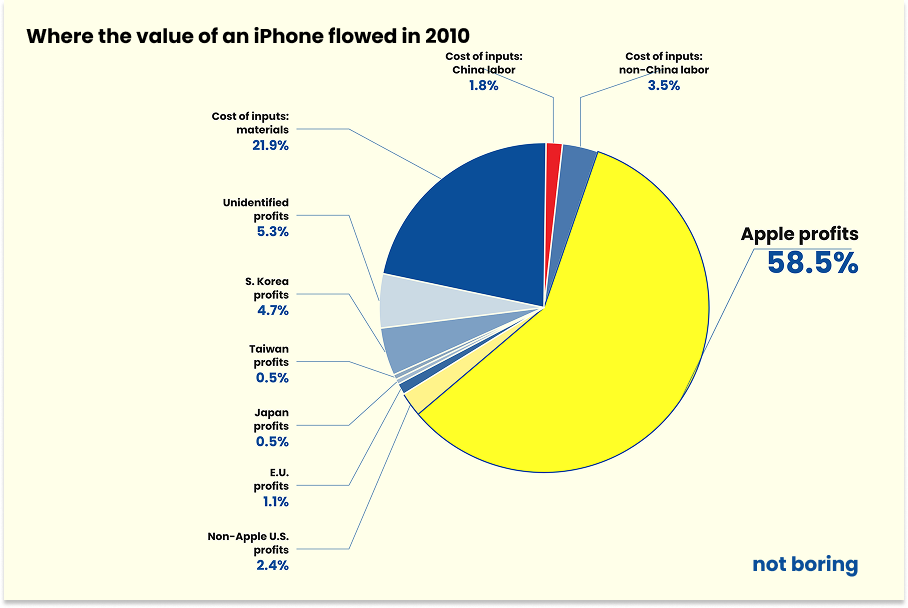
This was the dream. China would sit low in the middle while America captured value on both sides. The iPhone is a canonical example. Kraemer, Linden, and Dedrick’s 2010 teardown found that Apple captured 58.5% of the value of the iPhone 4/3G in profits, while China’s labor earned just 1.8% of the value.
But China, as we’ve seen, didn’t plan to stay on the bottom lip, and it didn’t, because doing the assembly taught it the adjacent capabilities. Assembling electronics pulled it into making components, then the tooling and machines that make components, then design itself. Serving as the world’s factory was a thirty-year education that pulled China up the smile curve and across the product space into denser, more complex nodes. Over time, the country’s edge became capability instead of labor cost.
Today, in a specific set of sectors, China holds an absolute advantage, with the lowest cost and highest capability and most complete stack, all at once, such that capital and capability rationally flow toward China rather than away. The advantage rests on scale economies (largest volume → furthest down the learning curve → lowest unit cost), agglomeration (the Shenzhen/Pearl River cluster where all of the inputs, tools, and skill sit within a short radius), accumulated process knowledge, and vertical integration.
This is the situation we described in The Electric Slide. China doesn’t hold an advantage in everything, but it certainly does hold the advantage in the Electric Stack.
“Today, China produces 75% of lithium-ion batteries globally and manufactures 90% of the neodymium magnets that make motors spin. In power electronics and embedded compute, it’s rapidly gaining ground.” As a result, the world’s leading drone company (DJI), electric vehicle company (BYD), and humanoid robotics (Unitree, although the market is still very small) are all Chinese. As the WSJ reported, even Tesla is turning to China for Optimus’ actuators.
Read statically, at a moment in time in the late 20th Century, comparative advantage correctly identified assembly as the low-margin thing for America to offload. Read dynamically, however, low-margin assembly was the tuition that China paid to climb up the value ladder into absolute advantage over America in a category that I believe will define the future.
Again, there is a way to read all of this as “China Bad,” which isn’t particularly interesting. Certainly, if China is currently America’s greatest adversary and largest geopolitical threat, it is not ideal that they produce the magnets, motors, and batteries on which our drones, future humanoid soldiers, and all manner of electric vehicles run. It is in America’s defense interest to incentivize the production and consumption of American components by American companies, and it is doing that, as we will discuss.
But America’s goal should not simply be to survive militarily, but to thrive economically through the Electric Era, when almost everything we combust fuel to power today, and many things that aren’t currently possible, will need to be rebuilt on the Electric Stack.
And to do that, we will need to manufacture key components here, right next to the companies that make the products that use them because maintaining design leadership without manufacturing leadership is not a coherent strategic position.
In 2010, former Intel CEO and Silicon Valley legend Andy Grove wrote an editorial for Bloomberg Businessweek titled How to Make an American Job.
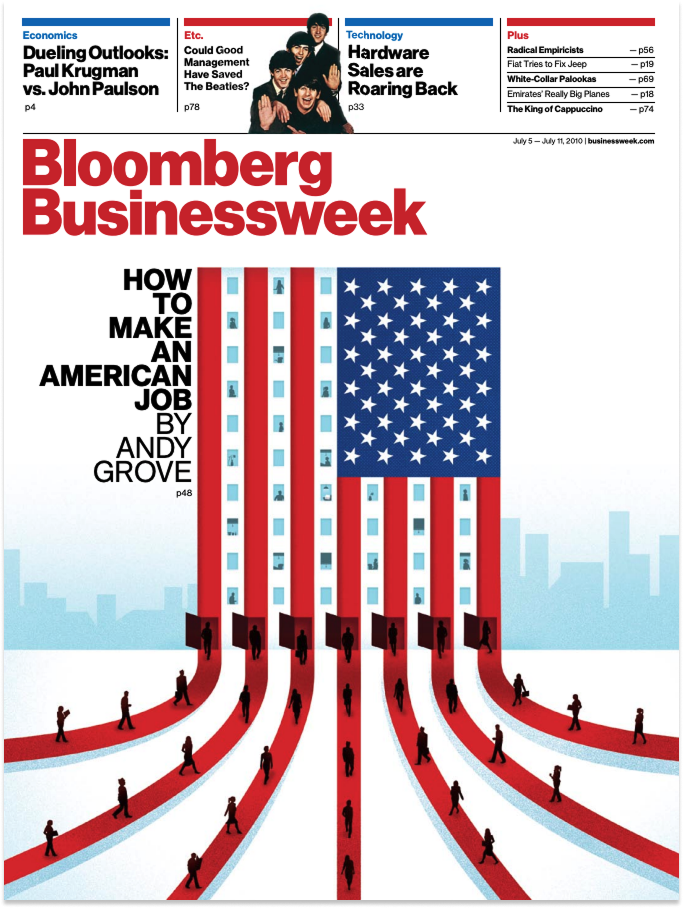
In it, he argued that it was unsustainable for Silicon Valley to pay a small number of Americans increasingly high compensation while hollowing out manufacturing jobs, and correctly predicted that China’s lithium-ion battery dominance would lead to EV dominance.
There’s more at stake than exported jobs. With some technologies, both scaling and innovation take place overseas.
What microprocessors are to computing, batteries are to electric vehicles. Unlike with microprocessors, the U.S. share of lithium-ion battery production is tiny.
That’s a problem. A new industry needs an effective ecosystem in which technology knowhow accumulates, experience builds on experience, and close relationships develop between supplier and customer. The U.S. lost its lead in batteries 30 years ago when it stopped making consumer electronics devices. Whoever made batteries then gained the exposure and relationships needed to supply batteries for the more demanding PC laptop market, and then after that, for the even more demanding automobile market. U.S. companies did not participate in the first phase and consequently were not in the running for all that followed. I doubt they will ever catch up.
Grove disagrees with the then-(and maybe still-) popular idea “that as long as ‘knowledge work’ stays in the U.S., it doesn’t matter what happens to factory jobs… Not only did we lose an untold number of jobs, we broke the chain of experience that is so important in technological evolution. As happened with batteries, abandoning today’s ‘commodity’ manufacturing can lock you out of tomorrow’s emerging industry.”
Sixteen years on, it’s safe to say that Andy Grove was right.
“Without scaling, we don’t just lose jobs — we lose our hold on new technologies,” he wrote, long before LLMs — so put away your Pangrams. “Losing the ability to scale will ultimately damage our capacity to innovate.”
What I like about Grove’s analysis, apart from his predictions proving correct, is that it was written at a time when more Americans viewed China’s ascendency as a positive than a negative.
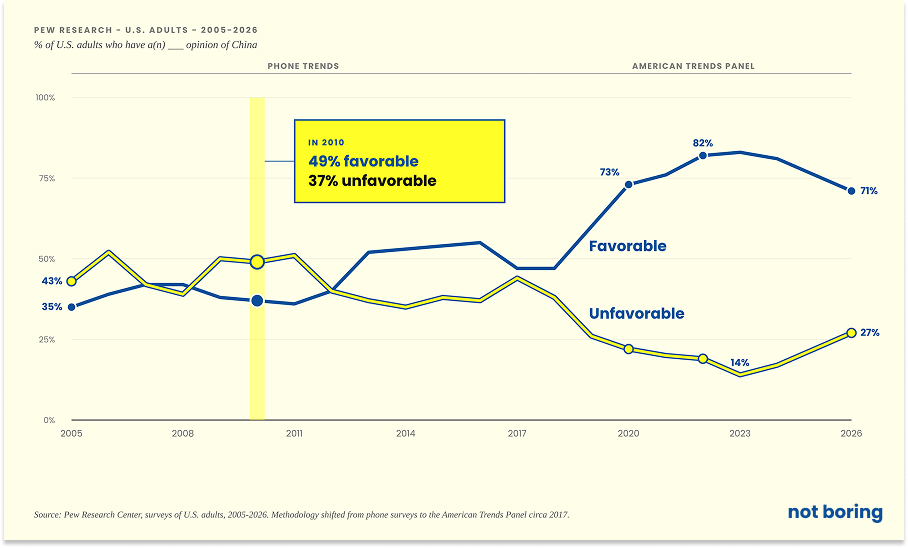
It rests on economic and industrial rather than geopolitical logic; it is offensive, not defensive. And he is arguing that to innovate in America, you need to manufacture the key components here, too.
To make great American drones and robots, for example, you need to manufacture motors and actuators in America, too.
The next question is: given the intense competition, is there a way to build a profitable drone motor and actuator company in America?
David and Jordan Decide to Start a Motor Company
It is de rigueur to care about drone motors, and to want to make them in America, but David Hansen has been obsessed with motors and the Chinese manufacture thereof for longer than some would-be motor mavens have been alive, and he has the tweets to prove it.
An archaeological dig through his account finds that he began reply-guying to tweets on IEEE electric motor-related articles in November 2018 with his own YouTube rabbit hole discoveries on BLDCs.

That’s the same year that David went to China for the first time, to walk Huaqiangbei for himself and begin sourcing for the self-balancing, AI-copiloted e-bike company he would cofound in Seattle in 2018, Weel.
Weel custom designed and built its motors and actuators by hand, due to the fact that there wasn’t yet an off-the-shelf Chinese actuator that worked for their needs. Most small component suppliers didn’t even have English-language websites; it just wasn’t worth it, they had all the demand they could get from customers who spoke Mandarin.
But something you learn about David is that he wants to get to the center of things, to speak to the suppliers’ suppliers’ suppliers directly, to see what he can buy from as close to the source as possible, and to learn how the source does what it does. Despite his best efforts, he was basically stonewalled, until COVID-19 happened and the world shut down.
All of a sudden, there wasn’t too much demand to waste time talking to the persistent American with the small orders anymore, and there was plenty of time to waste:
I learned the Chinese supply chain in 2020 and 2021. When China shut down for COVID, the suppliers were all stuck at home, downloaded WhatsApp, and started replying more to Western companies. Over 2020 you suddenly saw them building English websites — small suppliers with a dozen people who’d never have bothered before, since they already had the channels. A lot of factories went direct that year, just as a means of survival.
So 2020 and 2021 is when I started buying a lot of stuff direct from China: magnets, stators, other parts you couldn’t buy from the factory as easily before. Everybody’s stuck at home in both countries, talking over the internet and buying stuff.
A quick Twitter search verifies the timing, because around 2020 is when David, aka @boxcardavid, started becoming the motor guy on Twitter.
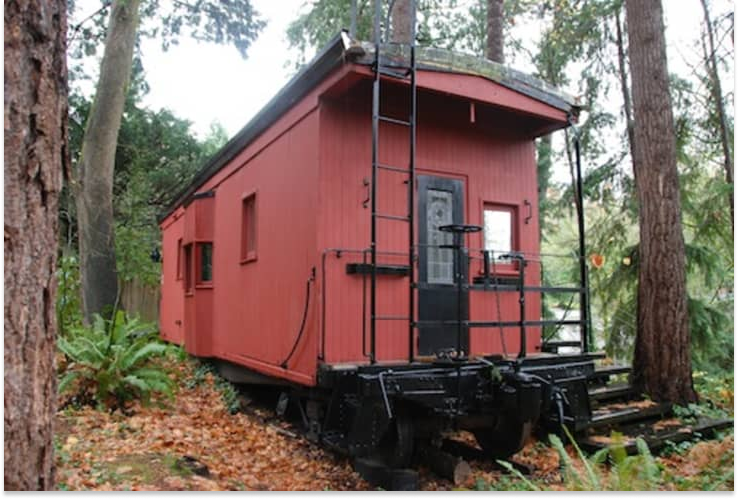
(Lore: David’s handle is @boxcardavid because he lived in this train car for most of his 20’s. If you’re trying to make motors or actuators, this is who you’re competing with.)
You could tell the man liked motors back in the COVID times, but he really let his motorhead flag fly starting in 2024, when he started figuring out what to do after Weel. Teardowns, comparisons, technical debates, knockoffs, factories. If you were one of the small handful of Americans who cared about brushless motors before they were cool, you probably followed David.

That same search for the next thing took David on a tour of the American companies whose products relied on motors and actuators. “David was the motor guy on Twitter, traveling around everywhere,” Jordan said. “Everyone said it was a clear problem. A lot of folks wanted to hire him as Head of Hardware or Head of Motors to solve it, but it was unclear what that role would mean. There was a desire, but not necessarily the urgency to reduce their reliance on Chinese suppliers.”
Chinese motors were just too cheap and too high quality, and besides, it didn’t make much sense for any given company, each of which had low volumes and other things to worry about, to spin up their own in-house motor and actuator assembly lines.
From all of these conversations, David was starting to realize that someone might have to build the American brushless motor company. His plan then, in November 2024, was to try to push someone else to do it.
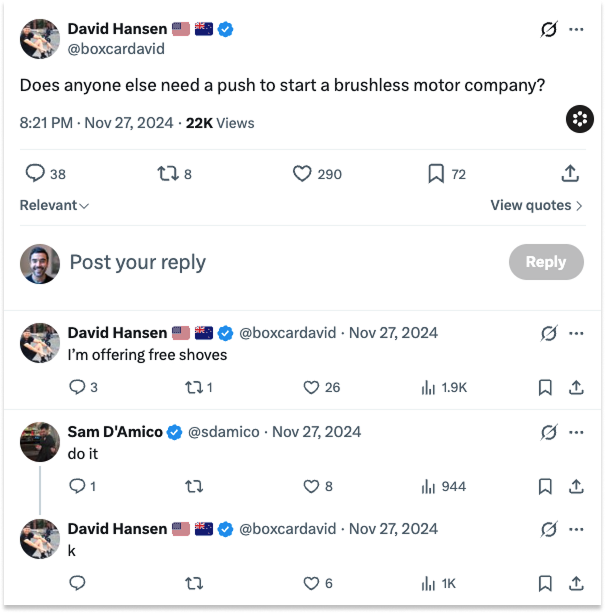
Then our friend Sam D’Amico told him, “do it,” and David said, “k,” and two days later, Western Magnetics Company, a C Corporation named by Sam in a DM, was incorporated.
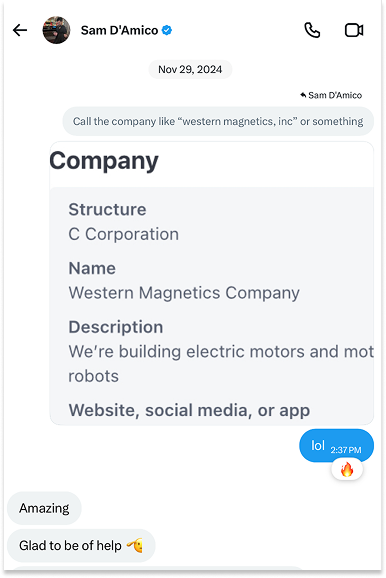
The company that may represent the West’s best hope to compete in drones and robotics began the way that most great companies begin: with an “lol”.
Incorporation docs are not a company, however, and David kept traveling, trying to figure out what everyone who needed motors and actuators was doing to get them. In early 2025, his odyssey took him to Georgia to see Jordan, who had been an early investor and advisor to Weel and was now Chief Commercial Officer at Slip Robotics, a company that builds robots that load and unload trucks.
“Everyone has motor supply and performance issues,” Jordan told me. “Having worked in robotics for a decade, I’d seen and been part of companies that thought about producing their own motors in-house. Then you look into it and realize, oh man, it’s actually pretty expensive and hard. It just didn’t make sense for one company to do it in-house just to fill their own demand.”
But, David and Jordan put their brains together and thought, it might make sense for one company to aggregate demand and build all of the motors and actuators for the rest of them as a vertically integrated horizontal play. To do all of the things that you’d have to do to get really good at making high-quality motors and actuators, like going as far as needed upstream into the supply chain and building automation and, most importantly, getting to scale to drive all sorts of efficiencies.
“Any competent engineer with focus can build a prototype actuator or a motor,” David told me. “You can build a bad motor really easily, and an okay motor without much practice and using open-sourced designs. Same with actuators. The design has literally been open-sourced since 2018, thanks to the great Ben Katz, who I really want to work with one day.” (Ben, if you’re reading this, go work with David and Jordan.)
“How to do it is known: you can order stuff from China, hand assemble it, and make it happen pretty easily,” he went on. “But doing it at scale is almost unrelated.” So scale is what they’d do.
David and Jordan teamed up to found Westmag, a company that was born to scale by growing up alongside the nascent American drone and robot industries, aggregating their demand, and providing them with the motors and actuators they’d need to make their products move, with the consistency, responsiveness, and respect that those companies were simply too small to get from their Chinese suppliers, on tight timelines, and eventually, with scale, at a similar price.
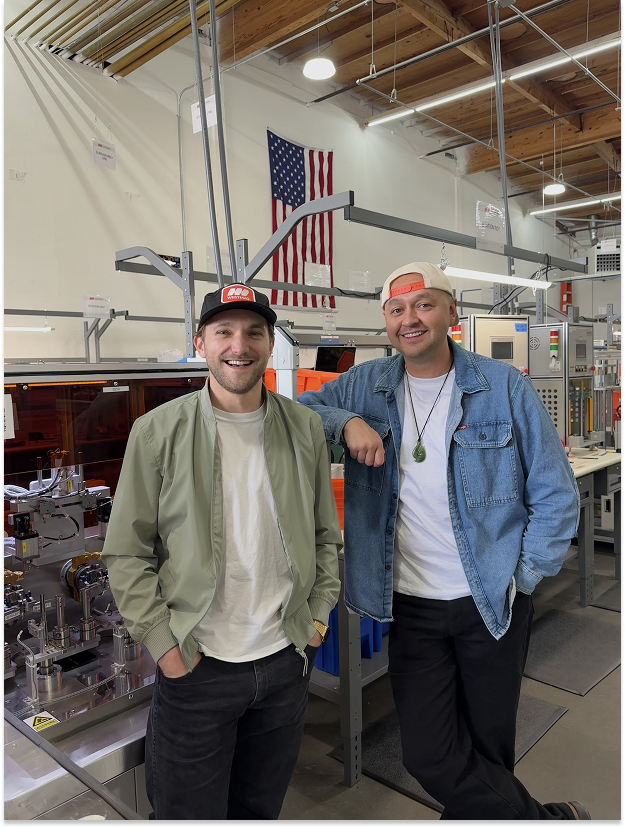
Their timing couldn’t have been better, although they didn’t know it at the time.
Soon after they decided to start Westmag, before they’d made a single hat, let alone a motor, the US Government would sanction T-Motor, China’s largest drone motor supplier, sending drone companies scrambling for a Western second source, and a little later, robotics would become the topic du jour in San Francisco and in the White House, which had no interest in letting China get another 10+ year head start in one of the future’s most important industries.
None of that was part of the plan. That part was just pure luck.
“What’s that phrase?” David searched his brain. “You can’t count on luck, but luck counts, and I definitely count on it. It’s turned out great. Good to be lucky.”
It’s not that Westmag wouldn’t have worked without the new government-mandated necessity of its products, it’s just David and Jordan expected it to take a lot longer. “Our bet was that this stuff would happen in five to ten years,” David said, “but the wind shifted last year, in the middle of us doing all this, with the government, regulators, and customers.”
And truly, I don’t want to leave you hanging here, and the stories about this stuff are some of the best inside baseball in the piece, including T-Motor’s hasty launch of a sub-brand “Lig Power” (as in, we strongly suspect, Ligma, which, if so, nice work, China…) to get around sanctions, and I promise that I will tell them to you, and that they make Westmag’s position in the market stronger than it would have been otherwise at this point, but the whole point of this essay is that Westmag is not a geopolitical bet, that it stands on its own industrial and economic logic, and that, sanctions or no, Great Power Competition or no, Westmag’s strategy is a smart and well-supported one that will require a Herculean grind to pull off but is certainly possible to pull off, and if it does, answers the question “is there a way to build a profitable drone motor and actuator company in America?” in the affirmative, so we have to pause the storytelling for a moment here, in early 2025, before Westmag knew that it would become more necessary, sooner than it expected, to unpack the strategy.
Westmag’s Strategy: Going Vertical to Go Horizontal
When I wrote the Vertical Integrator series, I had a whole section that I ended up cutting on Porter’s Five Forces and why I don’t normally like the position of doing something really hard in order to earn the right to sell components into a handful of large, powerful, and slow-moving incumbents. Maybe, if there are only a couple of key buyers, they’ll hammer you on price and force you to build to spec. Almost certainly, they’ll move on a procurement timeline so slow it will bleed you dry.
Plus, given where we are, at the dawn of a new techno-economic paradigm, in what Carlota Perez calls an Installation Period, book says vertically integrate: “the Installation Period favors Vertical Integrators and the Deployment Period favors modularized suppliers.” If you’ve created a magical new technology, use it as the core of a new system that competes directly with them. In Power in the Age of Intelligence, I summarized my thinking in a question:
If your technology is so good, why aren’t you using it to compete?
Which is to say, in a very simple reading of the situation, Westmag is not the kind of company I’ve been looking to back.
But the fun thing about all of this, and why I find business strategy so endlessly fascinating, is that there are exceptions to every rule, and understanding where to apply the rule or where to grant an exception requires a deep dive into the specific details of the case at hand.
Take Westmag’s key thesis at the beginning, which Jordan described as: “at this moment, maybe these industries are taking off enough that you can actually aggregate this demand and jump to scale.”
There are no large, powerful American incumbents in drones or humanoid robotics. There is a fragmented market of younger companies that are too small to have much buyer power. Each, as Jordan realized, is too small or stretched too thin to spin up meaningful motor or actuator manufacturing themselves, which means there’s an opportunity. It also means that the normal pitfalls of trying to sell to large, powerful incumbents don’t apply: startups can move fast, and for now, no individual company has enough power (or alternatives) to exert pricing power.
The “for now” part is important, because the plan requires that some of the companies Westmag serves get very big. The key is, Westmag will ride to scale alongside them, and aggregate demand among many of them, so that by the time any drone or robot company gets really big, Westmag will have achieved a scale that none of them can match alone.
Scale, they realized early, is everything in this game, and getting to scale first means that Westmag will be able to do all of the hard things required to actually do this well.
Specifically, it will vertically integrate its own supply chain where needed in ways that are deeply impractical for any single drone or robotics company to do.
Two examples, both of which Jordan and David said were the things that kept them up at night early on but no longer do (as much).
First, as discussed, while there are American companies like MP Materials and Vulcan Elements that can provide neo magnet block today, there is a gap in western suppliers that can cut, coat, and magnetize the magnets to the requirements needed for drone motors. Today, the block gets sent to Malaysia or China for cutting and coating, and back to the customer in the US. Leaving aside the added time or export restrictions, this is an issue: “magnets are fragile and like to stick to each other, so they’re difficult to buy the further away you are,” David explained. “That worried us for a long time. We’re less worried now because we know that world, we know how magnets flow around the world and how to get them.”
Westmag is exploring, by itself or with partners, opening up capacity to cut, coat, and magnetize its own magnets in America. This will be annoying, and come with high upfront costs, but it will give Westmag greater control over its supply chain, lower costs, simpler logistics, and the ability to get to a wider product mix.
Second, Westmag will buy electrical steel from Japan (they are clear that the material supply chain will be US and allied countries, not just US), but it will stamp and powder-coat them here to make their own stators.
Doing those things only makes sense if you’re planning to get to scale, but if you can do them, they allow you to build out a broader catalog more quickly, which helps get more scale, because you can serve a larger number of customers.
In motors and actuators, broadening the catalog to serve a high mix means making “smaller circles and bigger circles,” which sounds simple, but it really helps if you control your design and inputs.
“Planning out the product catalog,” David explained:
We realized that if we make our own stators, it’s not too hard to build a different stator size the next day. But if we have to design everything, send it out, and have someone else stamp it, you’ve got built-in cost and friction. That’s another huge reason to move upstream: it’s what enables higher mix.
On the actuator side, if you want to build a different actuator, controlling the motor matters, because the core of an actuator is the drone motor. If you don’t control that, your constraint is whatever motors you have available. I feel like I should say something smart after that, but it’s just true.
A couple minutes later though, he found something smart to say and came back. “Something else on the actuator side, since you control the motors…”
The design-cycle time for actuators right now, for almost anyone in the US, is in the months, because you rely on overseas suppliers to order pretty much everything. We saw the same thing with drone motors: you don’t just start making American motors that are better than China’s. To get good, you have to make a bunch. Same with actuators. So cutting the iteration time on actuators is super important: if you can only redesign four times a year, how far can you get? We think it’s key to making them reliable.
Moving fast and breaking things, along with scale economies, will bring other advantages, namely, process power.
“You can’t easily pull process knowledge out without literally pulling the people out of the neighborhood,” David acknowledged, “but a way to get it is to build and break much, much faster.”
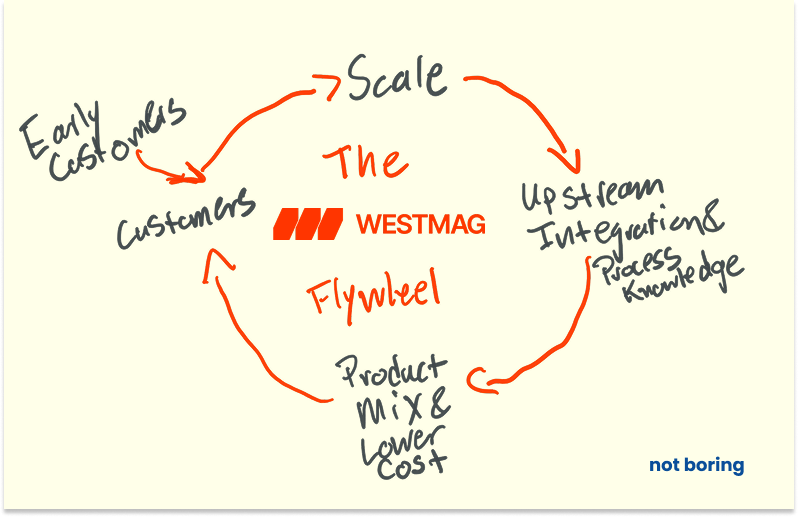
You can start to see how all of this fits together into a strategy.
First things first, you need to get to scale.
That means, Jordan said, “Going to high-volume customers and asking, ‘What do you have? What are you using now?’ and benchmarking our initial SKUs against what they need in order to get larger offtake agreements against an aggressive manufacturing ramp, which justify making larger buys and investments of input materials.” Quite literally, the plan is to not reinvent the wheel, but to make the wheel that people need right now so that they can get enough wheel orders that it makes sense to make bigger input material orders and even to integrate upstream.
Then, if you can integrate upstream, you can spin your whole process faster.
If you can stamp your own stators, you can offer a larger motor on short-notice, which means cost efficiencies plus more demand and larger orders. Plus, if you control motors of a bunch of different sizes, you can iterate on actuator designs more quickly, and Tasmanian Devil your way into process power in months that would otherwise take years. You can then automate the parts of the process that are amenable to it, and start to gain small advantages over Chinese suppliers.
Eventually, riding drone motor volume demand that exists right now, and using it to fuel its parallel work on actuators, each of which has a drone motor at its core, you get to “high volume, high mix” offering on par with the Chinese, but on the same continent as its customers and more responsive to them.
To get there, they’ll need to operate like a fab in the near-term, a bit like a TSMC for motors and actuators.
Being a fab - serving the demand that customers have today - is how you get volume, and you can use that order to standardize, so that your processes get easier, your margins get fatter, and you become the platform on top of which anyone, from a scaling drone manufacturer to a pre-seed robotics team to a hobbyist high schooler, can build all manner of electric things that fly and roll and grab.
The North Star is essentially the T-Motor catalog with a “Buy Now” button and fast shipping.
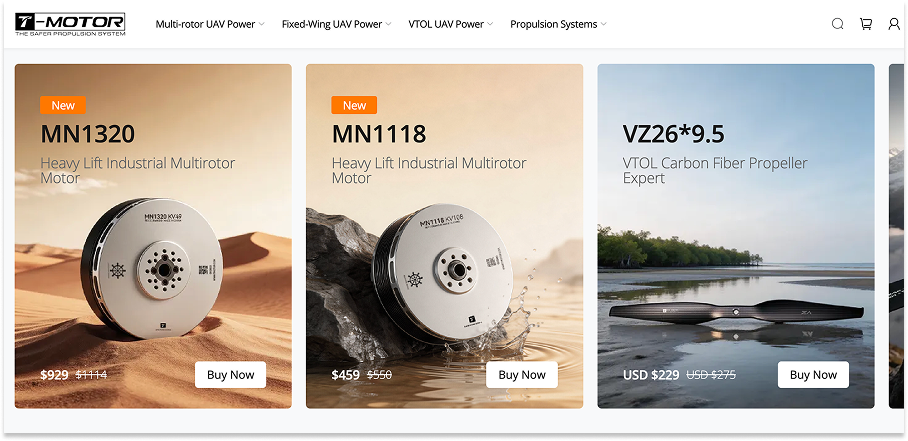
All of this is hard but not impossible, and most of it requires getting to scale first and dominating the space. This doesn’t work as well if the drone motor and actuator supplier landscape becomes really fragmented, because it could mean no one gets to the scale required to offer great quality at a great price.
To that end, Westmag has some advantages.
While there are a number of motor startups popping up now that the space is hot, it really helps that Westmag has been building out its production capacity, relationships, know-how, and supply chain since before it was cool. It has a head start.
It also has the right investors. In August 2025, Westmag raised its $11 million Seed Round from a16z, Founders Fund, Lux Capital, NFDG, Menlo Ventures and a group of angels including SendCutSend’s Jim Belosic, Sam, and me. These firms are among the most likely to back something like this over the many years and hundreds of millions, or billions, of dollars it will take to win. Their portfolios are also full of the companies that will be Westmag’s first customers if they can deliver.
As I wrote in Vertical Integrators Part IV, “Among startups, I expect we’ll see much less competition. The companies that show an early ability to execute against a big and credible enough vision will attract the top talent and the limited pool of investors willing to back such hard-to-underwrite companies, sucking the air out of the room for would-be challengers.” In an industry that requires scale more than raw innovation, this is a feature.
Still, the longer it takes to get to scale, the more opportunity there is for new entrants to come in and fragment the market.
Which is why it helps that Westmag got a little lucky.
Westmag Becomes Urgently Needed
Ok we’re back.
When David was running around talking to drone companies in 2024, most of them weren’t urgently trying to get out of China. They knew cerebrally they needed to diversify their supplier base as they scaled, as any company does, and probably would have preferred to diversify into a country other than China, but they were hooked on China’s cheap prices and availability. It just didn’t make sense to spend the reps figuring it out only to get more expensive and possibly lower quality motors, so at most, they’d diversify to two or three companies in China just in case T-Motor, the gold standard, had an issue.
All of that changed on January 15, 2025, five days before President Trump’s second inauguration and a couple of months after David had incorporated Westmag, when the Treasury’s Office of Foreign Assets Control (OFAC) sanctioned Jiangxi Xintuo / T-Motor by name for sending more than $9 million worth of items to Russian companies, including entities involved in Russian UAV production.
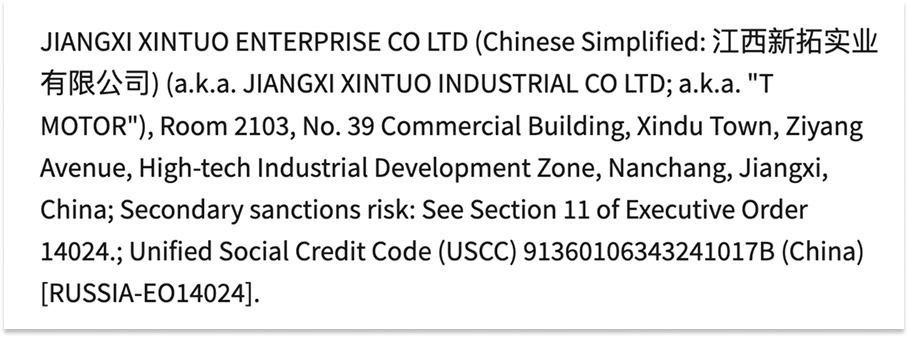
“There was a bit of a delayed reaction,” David remembered. They followed the rules and stopped buying, but they figured that some sort of alternative would pop up, and they had some inventory stored up in the meantime.
And there were workarounds. T-Motor unsubtly spun up “Lig Power” - like, if you go to T-Motor’s website and click “North America,” it just takes you to Lig Power, which is not sanctioned but also probably not your best long-term bet.
It wasn’t until April or May, when their motor shelves started to go bare, that they began to freak out. So while there had been companies taking China seriously - Skydio had already been sanctioned by China, and Neros was already serious about the risk - it was May 2025 when the American drone industry as a whole started thinking urgently about dual-sourcing.
Then Jordan left Slip and the duo really got to work, realizing they’d need to scale up faster than previously anticipated, which was both a blessing and a challenge. And the blessings kept coming.
In December 2025, the Federal Communications Commission (FCC) gave Westmag an early Christmas present when it added Uncrewed Aerial Systems (UAS) and UAS Critical Components Produced Abroad to its Covered List. Already-approved systems were grandfathered in, and it didn’t make using drones or motors you’d already bought illegal, but the Covered List meant that the FCC wouldn’t authorize new foreign-made drone components, and the list of components was broad: data transmission devices, communications systems, flight controllers, ground-control stations/controllers, navigation systems, sensors/cameras, batteries/BMS, motors, and associated software.

The FCC’s move was divisive in the industry. On the one hand, it makes sense: we probably don’t want to rely on Chinese motors for drones that may be used in a war with China. On the other hand, it included foreign countries beyond China (although there are exemptions for some allied suppliers) in an effort to support a Buy American agenda, while kneecapping American drone companies’ ability to produce.
In either case, it meant that American drone companies need to dual-source and find reliable domestic suppliers pronto.
That was the drone side. From the beginning, the plan was: there is a drone industry today, with fast-growing order volume today, so start with the drone motors, and use them to ramp production volume. Then, eventually, since every robot actuator has a drone motor inside of it, use the motor to expand into the potentially much larger robot actuator business over time, as that industry ramps.
Each drone has 4 motors, and Ukraine will need 28 million drone motors for 7 million drones this year; each humanoid robot has 20-40 actuators, and by some estimates, we will have 10 million of them in a decade, and three billion by 2060. That puts actuator demand in the tens to low hundreds of billions.
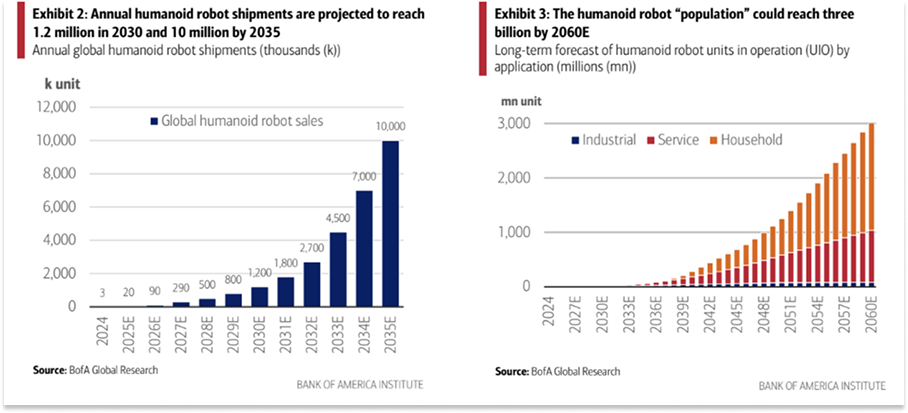
Westmag would have been golden riding drone motors down the learning curve, but the gifts of urgent demand just kept on coming.
In late 2024 and early 2025, when David was talking to robotics companies, he kept hearing that they just couldn’t get the changes they wanted made, that orders were inconsistent, and that Americans were simply at the bottom of the priority list.
You’d order 100 actuators, it’d come in two shipments, and on the second shipment they’d move the connector location or type, change the firmware, or completely change the mechanicals inside.
Jordan and David like to tell the story of a friend of theirs who’s a famous robotics guy over here who found a bug in the firmware for one of these Chinese actuators and sent them a bug fix, and the Chinese manufacturer just didn’t care.
Still, while they were casually looking for other paths, their #1 question back then was, “What is this going to cost?” China wins that question 100 times out of 100 today, especially at lower volume. They wanted to spec their own actuator designs to work with their specific robots, but you could find a contract manufacturer in China who was willing to do that pretty easily. As long as it was roughly to spec and cheap for the quality, they didn’t really care where it came from, so they stayed.
That started to change late last year. Something was in the air.
People began to realize that with AI taking off, robots would be the next big thing, and that, like AI, robots would be hardware constrained. Specifically, they’d need a lot more actuators than we can currently produce.
Quickly, the discussion went from “How much do my actuators cost?” to “Where are we going to get all of the actuators we need in one, two, five years? Can or should all the actuators come from China?”
David is friends with the head of hardware at this one robotics company, and every time they talked last year, the conversation was always about cost. Now, “every text conversation is about it not being in China, having more than one supplier, and planning for if China cuts us off.”
This is the definition of sovereignty in the future as David and Jordan see it: controlling your own robot supply chain.
The US Government seems to be coming around to this definition. Across government and industry, there is a growing belief that while we are about a decade behind in drones and their supply chains, and are taking actions to play catch-up, robotics is so nascent that we can try to be competitive from the jump. People are starting to think about what we can do to be more proactive in the robotics supply chain, which means eating more of the Electric Stack alongside our allies.
Because as we wrote of China’s bet in The Electric Slide, “for intelligence to truly matter, it needs energy and action.” Or as Aaron Slodov put it more pictorially:
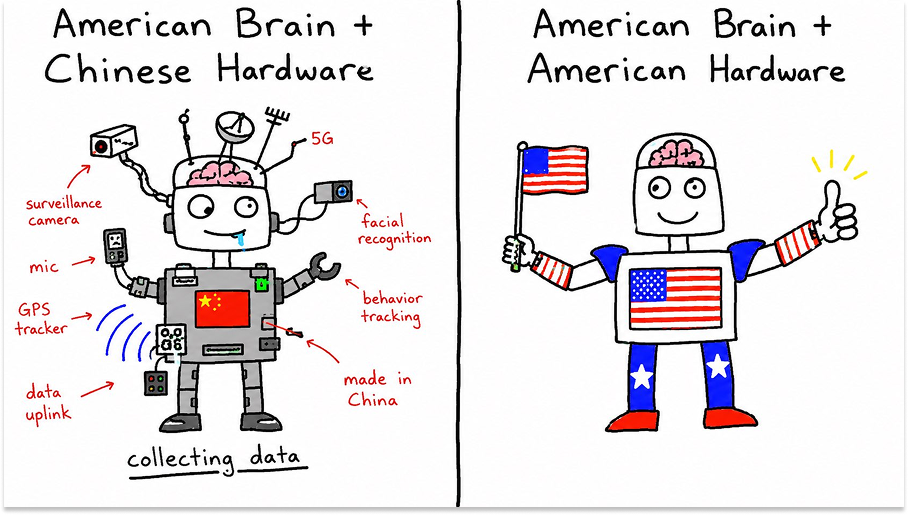
Having the smartest computers doesn’t really matter if they can’t act on the physical world. To act on the physical world, they need bodies (whether humanoid, arms, or vehicles). And to build bodies, you need to control enough of the components to build them well.
God Bless the Red, White, and Blue Premium
Westmag’s initial bet was that if you aggregated demand from the nascent American drone and robotics industries, and made it easier for them to iterate quickly and grow, you could grow with them. It was a true bet, because both drone and robotics companies cared about cost above all else.
And Westmag could get to cost parity, with enough volume and time, but how do you solve that initial chicken and egg? How do you get the early orders that give you the volume to bring your price down to competitive levels?
For motors and actuators, as with many industries, from chips to solar panels, the initial push down the learning curve has come from Defense demand.
With the government’s actions, and the industry’s waking up to the fragility of relying on China for its components, price has become a secondary concern for a certain buyer, particularly one selling into Defense. The DoW is willing to pay more for American drones with American components, which means that the companies making American drones can afford to pay more for American motors. This is industrial policy through Defense demand like the type we discussed in Thank God for Data Centers.
This is referred to as the Red, White, and Blue Premium. It is not a long-term strategy. But it is a hell of a bootstrap and jumpstart.
“DC and Defense are near-term feral markets,” Sam D’Amico told me on a call last week, “but long-term, that’s actually a small part of the TAM. Robot actuators and consumer and commercial demand are. All of the electric cars, appliances, computers… brushless motors are in everything. And if you’re long robotics, you’re long actuators.”
Strategically, the RWB Premium is less about the actual price, and more about the fact that today, it’s where the volume is. Everything else flows from that.
Westmag has begun signing contracts with customers focused on Defense-related applications. In just the last few weeks, it has signed offtake agreements for hundreds of thousands of motors, and is in late-stage discussions with many other drone and robotics companies for similar deals. Commercial demand will be important to getting to scale, but it’s not where the highest volume demand is today. As Sam has pointed out many times, American demand is our greatest advantage.
The government could also potentially get more directly involved in lowering Westmag’s prices and increasing its volume, through subsidies, loans, and offtake agreements. There is precedent: it did deals with American neo magnet manufacturers MP Materials and Vulcan Elements last year, giving both access to cheap capital to fund CapEx, and offtake agreements to support scaled manufacturing. Even if the private market won’t buy the magnets (which is unlikely), the government set a price floor.
In either case, the trick is not to rest on Defense-related contracts, but to use them to fund the things that will make Westmag commercially competitive, potentially as a second-source and then as a primary source for growing drone and robotics companies.
That means doing the things that scale allows you to do, quickly.
As discussed, it will mean moving further upstream into magnet cutting and stator stamping. It will mean deeper partnerships with suppliers in the ecosystem, from electrical steel producers in Japan to machine parts manufacturers in Tennessee.
It will also mean expanding into a larger manufacturing facility in the Bay Area this year. While there are good reasons to spread its upstream facilities throughout the country, it makes sense to manufacture right next to the drone and robotics companies that will be its biggest customers, as Shenzhen has proven.
Speaking of things that Shenzhen has proven, in the beginning, it will mean making the motors the exact same way customers expect. That means designs optimized for Asian supply chains, for now: CNC-ing parts with complex shapes out of aluminum, very little design-for-manufacturing, manual assembly.
Over time, however, Westmag plans to adapt its manufacturing to modern American processes. As volume grows, designing a new way of making motors begins to make sense.
Westmag will design for manufacturing and, given that much of its initial costs come from labor, automation. It will redesign the same motor over time so it uses simpler machined parts and more processes that scale with capital instead of labor, like stamping, die-casting, molding, and near-net-shape parts, and so the geometry is something a machine, not a person, can make and assemble.
This is the other reason to build in San Francisco: it’s where the automation and robotics engineers are.
Working with these engineers, it will design the motor and the factory together, because as David put it, “The design of the factory floor and the design of the motor go hand-in-hand.”
One of China’s gifts is that all of its suppliers are in the same neighborhood, but that also means that it doesn’t make sense for any one of them to put everything under one roof. Westmag doesn’t have that luxury, so it will have to.
Surprisingly, Chinese suppliers still do a lot of this stuff manually, like running wires by hand. There aren’t many automated lines. There isn’t really even one “line,” they’ve discovered:
The “factory” in China isn’t usually in one place. There’s a dense neighborhood of specialized subcomponent shops connected by couriers. There are automated machines, but they’re at one address; a part gets built there, a courier takes it an hour later to another location a few blocks away where it is joined with another part, then a couple hours later that goes via courier somewhere else.
So part of what we’re doing, and will continue to do, is to vertically integrate, bring more processes and machines in house, and connect them. Essentially: connect everything by conveyors, not couriers.
The more it can do in-house, in this Installation Period for American motors and actuators, the faster it can spin, and therefore the faster its customers can, too.
The one place it won’t integrate is downstream, into end products like a full drone or robot, because the point of Westmag is to make affordable, reliable, fast, high-quality motors and actuators on top of which every other American electric product can build.
Without knowing exactly where the peculiarities of the supply chain will take it, it’s hard to know when Westmag will get to cost parity with China, but “it’s not crazy five-to-ten-year math at insane scale to be competitive. It’s classic industrial logic. The Idiot Index denominator on these things (the cost of the raw materials) is very low,” David said, “so even when they’re selling them for $20, there’s room for us to grow, scale, and lower the Index.”
That is a high bar, the unit-to-unit cost comparison, a hard-but-achievable-but-probably-not-necessary one to clear, because the real value if Westmag succeeds, and its raison d’être even if the US and China become best friends, is that if you can make critical components near the customers that use them and supply them reliably, the whole innovation machine spins faster.
Spinning America Faster
“A new industry needs an effective ecosystem in which technology knowhow accumulates, experience builds on experience, and close relationships develop between supplier and customer,” Andy Grove wrote, and time has proven him right.
China has built this way and is now winning the Electric Stack; America has not, and is not.
Westmag’s key insight is that while China has an early lead, the race is just beginning. Both drones and robotics are very new industries.
As much as drones dominate the conversation today, thanks to the war in Ukraine, and as important as people think they will continue to be, I expect that they’ll be even bigger. For large industries, Defense is usually a very small initial market in retrospect. Packages and people will fly through the air faster, cheaper, and more efficiently than they crawl through terrestrial traffic today.
Robotics is even more nascent, with unit volumes in the thousands, and live debates as to which form factors and model architectures will win out. What everyone seems to agree on is that robotics is going to get much bigger.
OpenAI is getting back to its roots and back into robots…

Jensen Huang is getting excited about robots…

And just this week, The Wall Street Journal shared PitchBook data showing that venture investment in physical AI and robotics is on pace to pass an already-record 2025 in the first half of 2026 alone.
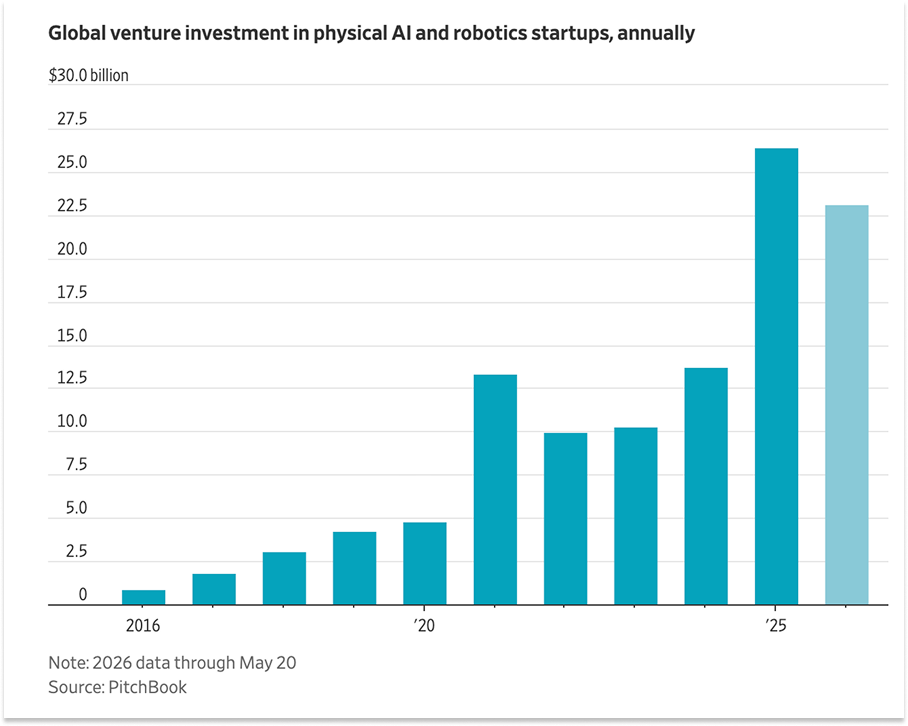
Wall Street estimates vary, but they all project unit volumes in the millions over the next decade, and an installed base in the billions in the decades beyond. We are currently operating in bars that will be barely visible above the x-axis looking backward.
The question is: who’s going to make all of the drones and robots, and therefore, whose economy will most benefit from their growth?
If you had had to bet, back when Nvidia was founded as a gaming graphics chip company in 1993, whether it, Intel, or AMD would be the biggest thirty years hence, you would have gotten ludicrously good odds on Nvidia. The chip market seemed set, even though, as we now know, it was barely in its infancy.
“Real men have fabs!”, former AMD CEO Jerry Sanders declared about chip manufacturing in the 1980s, and were he operating today, he might say the same thing about motors and actuators. DJI and Unitree make the most drones and robots, respectively, today, and both leveraged the know-how from their ecosystems to vertically integrate down to the motors and actuators, respectively.
But in 1987, a former Texas Instruments engineer named Morris Chang launched TSMC, which offered to fab everyone else’s chips for them. Nvidia, founded six years later, was born fabless and free to focus on architecture, software, developer ecosystem, cadence, and market selection. These are the things that have compounded into Nvidia’s moat over time.
Nvidia is now the largest company in the world by market cap, and it still fabs with TSMC. The second and third largest companies, Google and Apple, do too.
TSMC, by vertically integrating the hard, CapEx-intensive, process knowledge-driven work of fabbing chips and serving horizontally, made it possible for an entire ecosystem to flourish. It’s grown up alongside that ecosystem, and even now that the companies it’s enabled are cash-rich enough to build their own fabs, the compounding that their collective business has paid for would make it almost impossible to catch up. So even at scale, TSMC and its customers keep winning together.
A bet on Westmag is that we are at the same place in the Electric Age today that we were in the Information Age then.
Westmag’s hope is that by vertically integrating the hard, CapEx-intensive, process knowledge-driven work of making motors and actuators and serving horizontally, it will make it possible for the American drone and robotics ecosystem to flourish.
Because the company is still small, like the industries it serves, Westmag can afford to give American drone and robot companies the time of day. Because it’s vertically integrated, it can be responsive to their needs and spin up prototypes in days instead of months. Because of that, and because it’s in their backyard, it can shorten the iteration loop, so that its customers can iterate their way to better drones and robots than are made anywhere else in the world.
The real big bet on Westmag is that it’s not too late. That if you build a machine that marries American-style innovation with scaled manufacturing, the way we used to, and spin it really fast, slope will outrace intercept and the future might be built in America again after all.
Thanks to Jordan, David, Sam, and many others for helping me get smarter on motors.
That’s all for today. We’ll be back in your inbox Friday with another Weekly Dose.
Thanks for reading,
Packy
Hi Packy, the Magnequench story is the clearest warning. General Motors co-invented the small, powerful magnet that sits inside electric motors and the guidance systems of smart bombs, then sold the business to Chinese buyers in 1995 with a promise to keep the factory and jobs in the US for five years. The production lines moved to China before those five years were up, and the know-how went with them. That handover matters now: on April 4, 2025 China began requiring export licenses for the specialty metals that keep these magnets working at high heat, its magnet exports fell by about three-quarters in two months, and carmakers in the US and Europe had to slow or stop production within weeks. When one country can switch your supply off like that, making the motors at home is about pure survival for business. Pricing or efficiency suddenly looks like a secondary consideration.
Amazing read as always, Packy. Some thoughts:
1. The China reliance loop doesn't really get broken until we also make the machines that build the actuators + motors here in the US. If we don't want their actuators in our robots, why do we want their machines building the actuators in our robots? Kudos to Westmag for building the motion systems, but it's a solved problem - the real gnarly thing we need to build are the multi-million dollar machines we buy from China to build the machines (i.e. motors)
2. Autonomous robotic manufacturing will herald a new form of manufacturing that the US will excel at - we ought to rethink the software design <> manufacturing loop instead of trying to beat China at their own game.
3. We can, in fact, build motors at competitive prices in the US if we can automate the labour, which is >60% of the production costs for folks like KDE, Vertiq, etc.