

Hey friends 👋,
Happy Friday and Happy Easter Weekend!
We’re going back to the Moon. OpenAI bought TBPN for a lot of money. Somos is going to blanket the globe in fast internet. And a whole lot more good news where that came from.
Let’s get to it.
Today’s Weekly Dose is brought to you by… Guru

Your company has invested in AI tools, which is a great first step. But your AI is only as good as the knowledge behind it. And for most companies, that knowledge is scattered, outdated, and nobody’s job to fix. So your AI gives confidently and sneakily wrong answers to all of your employees.
Guru is the governed knowledge layer that fixes this at the foundation. Companies like Spotify and Brex use Guru to structure their company knowledge, keep it accurate automatically, and make it available to every AI tool and every person, all from one trusted source.
With Guru, when an expert corrects something once, it’s right everywhere you work, in every AI tool, workflow, and answer.
No more garbage in, garbage out. Just cited, verified, always-current knowledge your AI can actually rely on.
(1) NASA’s Artemis II Crew Launches to the Moon
NASA
For the first time in 53 years, 5 months, and 20 days, human beings are on their way to the Moon.
Last night at 6:35 p.m. EDT, NASA’s Space Launch System (SLS), standing 322 feet tall, weighing 5.7 million pounds, and generating 8.8 million pounds of thrust (17% more than the Saturn V), lifted off from Pad 39B at Kennedy Space Center carrying four astronauts aboard the Orion spacecraft (which the crew named Integrity). Commander Reid Wiseman, Pilot Victor Glover, and Mission Specialists Christina Koch and Jeremy Hansen are now on an approximately 10-day trip around the Moon and back. No one has done this since Apollo 17 splashed down in December 1972.
Integrity will spend about a day in a high Earth orbit stretching 46,000 miles out, the crew will manually fly the capsule to test its handling, and then a six-minute translunar injection burn will send them on a free-return trajectory using the Moon’s gravity to slingshot them around the far side and back home. On Monday, April 6, the four of them will become the first humans to lay eyes on parts of the lunar far side, reaching a record distance of 252,000 miles from Earth. They’ll splash down in the Pacific on April 10.
Is getting to the Moon more expensive than it should be? Hell yeah, roughly $4.2 billion per SLS flight by the Inspector General’s math. Did it take way longer than planned? Also hell yeah. But four people are about to travel further from our home planet than any human has traveled before, in the first of a series of missions designed to get us back to the Moon to stay.
I can’t really sum up how I feel any better than this kid did:
(2) OpenAI Acquires TBPN
Katie Deighton for WSJ
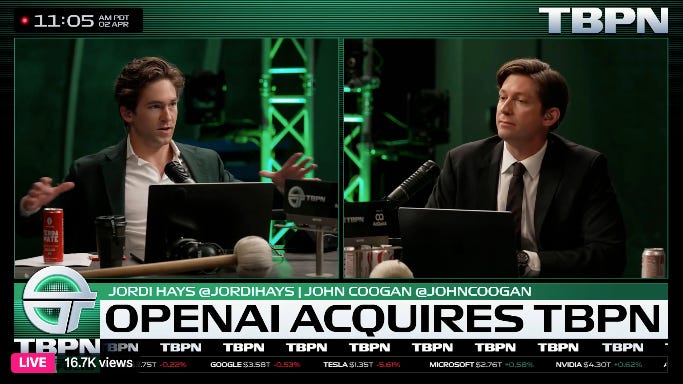
Speaking of going to the f*cking moon… OpenAI, which just closed a $122 billion round at an $852 billion post-money valuation, has spent some of its treasure to acquire tech media’s crown jewel, TBPN. The FT reported that the deal is in the “low hundreds of millions of dollars.”
Huge congrats to Jordi, John, Dylan, Ben, and the whole TBPN crew.
This is an incredibly smart acquisition for OpenAI. I’ve been saying that the frontier AI labs have completely botched their narrative, and this is about as good of a way to get to work fixing it as I could imagine.
A lot of the commentary so far has been about OpenAI acquiring the media property, which will certainly be helpful, but the big get is Jordi & John. They’re simultaneously highly generative creative geniuses and normal guys. I expect that we’ll see their impact on the way the company communicates to non-San Franciscans pretty quickly, and I hope they’ll have a hand in shaping where AI goes more broadly.
In the meantime, it’s just great to see the good guys get a W.
(3) Google DeepMind Releases Gemma 4 Open Source Model
Completely unrelatedly, I’ve told you guys how awesome I think Google DeepMind is, right? Been saying it for years. What a great lab. Could obviously use a little help telling their story, but wow. What a family of models. AlphaFold! Gemini! AlphaProof! AlphaGo! AlphaZero! Nano Banana! Genie! SIMA! DolphinGemma! I could go on and on.
Yesterday, the good folks at GDM just released a family of AI models that can see images, watch video, understand speech, reason through competition-level math, and write code, all open source. You can download them for free, modify them, and ship them in a commercial product under the Apache 2.0 license.
GDM released Gemma 4 in four sizes: a 31B dense model, a 26B mixture-of-experts model, and two edge models (E2B and E4B) designed to run on phones and laptops. None of them is quite up to par with the best frontier models, including GDM’s Gemini, but since they can run locally on your hardware, it means you get the tokens they produce basically for free.
Yesterday, in Bad Analogies, I wrote that OpenAI and Anthropic were burning a ton of money to compete in an incredibly competitive field, and that Google DeepMind was Zeus in this battle of the gods. Gemma is another lightning bolt. The more things people can do with free tokens, the less they’ll spend on tokens, even if the most advanced capabilities will always come at a price. Of course, closed model customers are paying for more than tokens: reliability, ease-of-use, etc… but it’s fun to see the competition drive down prices for consumers.
Jokes aside, I continue to be very impressed by GDM. The lab came up more than any other in my research for both World Models and Many Small Steps for Robots; they’ve done more to push the frontier in more directions than any lab in the world. With Gemma 4, Demis the Menace strikes again.
(4) Solar cells just did the “impossible” with this 130% breakthrough
Kyushu University via Science Daily
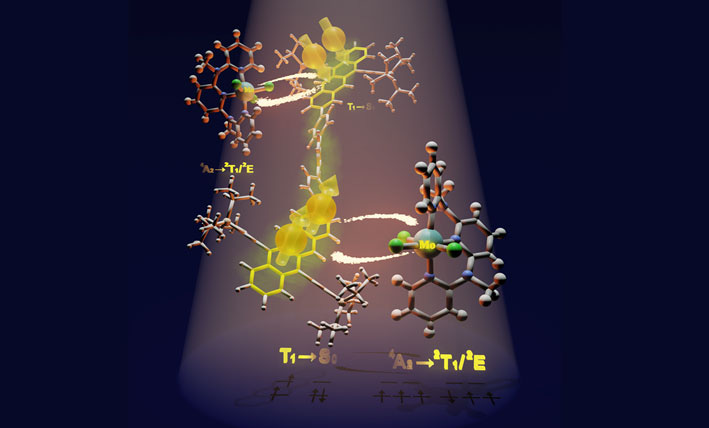
Three weeks back, we led off the Dose with a story on Swift Solar buying a gigawatt-scale solar factory to produce 30-40% efficiency silicon-perovskite tandem solar cells.
This week, researchers at Kyushu University in Japan announced cells with a seemingly impossible 130% efficiency.
There’s a number in solar energy called the Shockley-Queisser limit. It says that a single-junction silicon solar cell can convert, at most, about 33% of the sunlight hitting it into electricity. Silicon-perovskite tandems can up that to 45%. In either case, the rest, especially the high-energy photons, gets wasted as heat. Shockley-Queisser been the ceiling since 1961.
Until now! A team led by Associate Professor Yoichi Sasaki at Kyushu University in Japan, collaborating with Katja Heinze’s group at Johannes Gutenberg University Mainz in Germany, just published a paper in the Journal of the American Chemical Society showing that they paired tetracene-based molecules with a molybdenum-based metal complex (a “spin-flip” emitter) and achieved a quantum yield of roughly 130%. That means for every photon absorbed, the system produced 1.3 energy carriers. More out than in, which seems like it shouldn’t happen.
The trick is a process called singlet fission. When a high-energy photon hits the tetracene, instead of creating one excited electron and dumping the rest as heat, the molecule splits that energy into two lower-energy “triplet” excitons, a little bit like nuclear fission (don’t yell at me real physicists). The problem has always been that a competing process called Förster resonance energy transfer tends to steal the energy back before fission can finish.
Sasaki’s team solved this with the molybdenum complex, which selectively accepts only the multiplied triplet excitons by flipping the spin of its electrons during near-infrared emission. If molybdenum sounds familiar, it’s because it’s the hard-to-pronounce mineral Earth AI found in its first discovery, and because it’s come up a couple of times in recent American Alchemy episodes.
There is an asterisk, for now: the process was demonstrated in solution, not in a working solar panel. It’s a proof of concept. The team’s next step is integrating the tetracene and molybdenum materials together in a solid-state system.
But the result proved that the 100% quantum yield barrier isn’t a physical law, which means the engineers can get to work sorting out the details. If singlet fission can be made to work in commercial cells, we’re going to start putting a lot more photons to good use.
(5) Somos Internet Raises $40M Series B
Alex Konrad for Upstarts Media

In November, I released my longest company Deep Dive ever: Cable Caballero, the story of Forrest Heath III and the vertically integrated internet company he and his band of pirates are building down in Medellín, Colombia.

Explaining how he built what is now the best-performing internet in the region, and maybe the world, with its own fiber network, switches, routers, and ISP, Forrest said:
It’s been this never-ending game of doing something janky, getting credibility, doing crazier stuff, getting more resources, getting smarter people so that we can fix the things that were messed up in the janky past iteration, then gaining credibility to get more resources to get cooler people to do crazier stuff. It’s like this self-sustaining fission process.
Now, Somos has a lot more resources to hire more smart people and do even crazier stuff! This week, the company announced that they raised a $40 million Series B co-led by Bracket Capital and Ribbit Capital. Following on to not boring capital’s original investment was a no-brainer.
Somos is growing fast in Colombia, and it announced that it’s getting ready to expand into Mexico. On TBPN, Forrest even hinted at Somos Caracas…
I think this company is going to build a ton of better, faster, cheaper infrastructure in the coming decades, and they have both the fuel and the backers to do it. If you’ve been looking for a sign to put your stuff in a bag and move to Colombia, this is it.
Vamos Somos!