

Hi friends 👋,
Happy Monday! Today is a good day.
Today, I get to tell you the story of Naman Pushp and Airbound.
There are very few people with the combination of ambition and skill than I’ve seen in Naman in the year since I first invested and have gotten to know him. Just twenty-one, he taught himself physics, engineering, and manufacturing on YouTube during COVID, and turned that knowledge into real, flying aircraft and a company backed by Greenoaks, Lightspeed, and Lachy Groom. I suspect he is in the early days of what will be a decades-long pursuit.
He has chosen a worthy mission. There is no category that so physically reshapes the world as transportation technology. Where you live and work, what you can access, how much you pay for everything, and most importantly, who you spend time with, are all a function of the transportation technology at your disposal.
In my opinion, improving the way we move will have a more positive and noticeable impact on our lives than AI will, and Naman’s aim is to move all movement to the sky.
This is a Deep Dive on how he plans to do it.
Airbound: As We May Move

Every morning, or most, when I can, I wake up before my wife and kids, tip-toe downstairs, ease open the front door, and sit on the stoop as the sun comes up. Huberman says the morning sunlight is good for your circadian rhythm or cortisol or some shit.
I’ve been doing this for a little while now, since the winter at least, but some time in the spring I noticed the birds. There’s a honey locust tree on the sidewalk in front of the stoop, framed by Eric Adams’ legacy (new garbage cans) every Monday and Thursday, and as the sun rises, a quarrel of house sparrows flits back and forth between it and their little nooks at the top of each brownstone.
Since I started noticing these birds, I’ve started noticing other birds more consciously. I think, but I can’t be quite sure, that I can see their wings flapping in higher-resolution, or slower motion, or both? And I’ve been wondering why. Like are the birds a sign? Am I supposed to follow them? How can I follow them, when I can’t fly?
One morning, as I approached my office in Soho thinking about this very piece you’re reading right now, a great blue heron floated regally over the roofs of the block’s cast-iron buildings, and I was like, “Oh, I get it.”
Some time in the spring, I started talking to Naman Pushp about writing a deep dive on Airbound. Pretty much every week since, often more than once, we’ve hopped on a Zoom, me in Manhattan and him in Bangalore, to talk about what the world looks like when flight is the way everything and everyone moves, and what it would take to get there.
One of the things that happens when flight dominates, Naman said, is that buildings flip.
“You fly on to the roof and enter from there,” like a bird.
Birds have long been the envy of and inspiration for earthbound humans.
Leonardo da Vinci studied birds to understand flight at the turn of the 16th century.
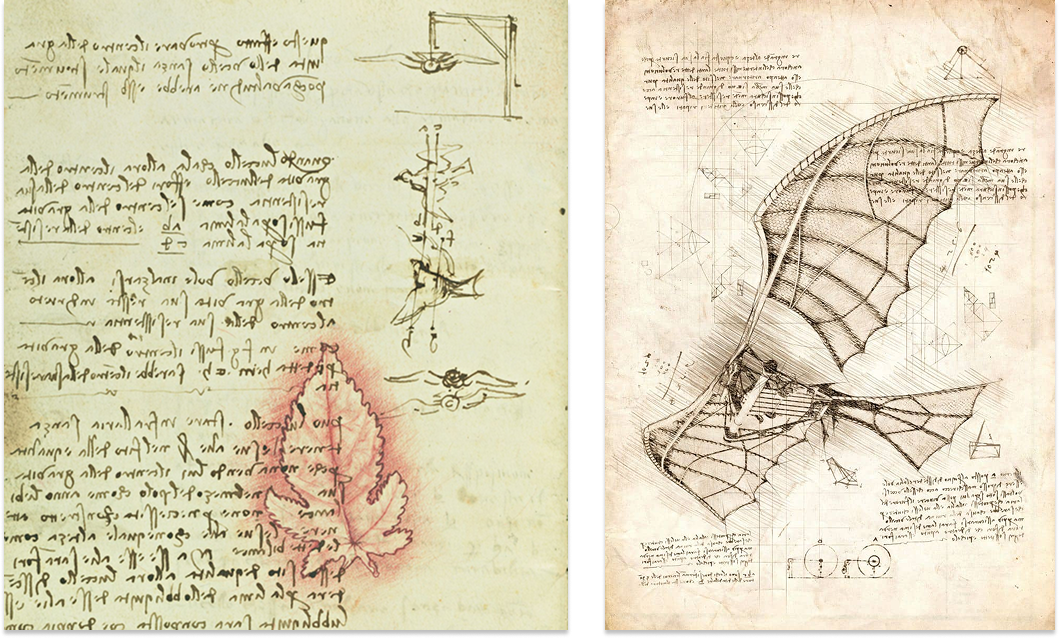
Humans failed to turn those avian observations into flight for four centuries, but the Wright Brothers studied those failures. As bicycle makers, they understood that a machine didn’t have to balance itself if its rider had the right controls. They studied the birds, too. Watching birds twist their wingtips helped them develop “wing warping,” the control mechanism that helped make their 1903 flight possible.
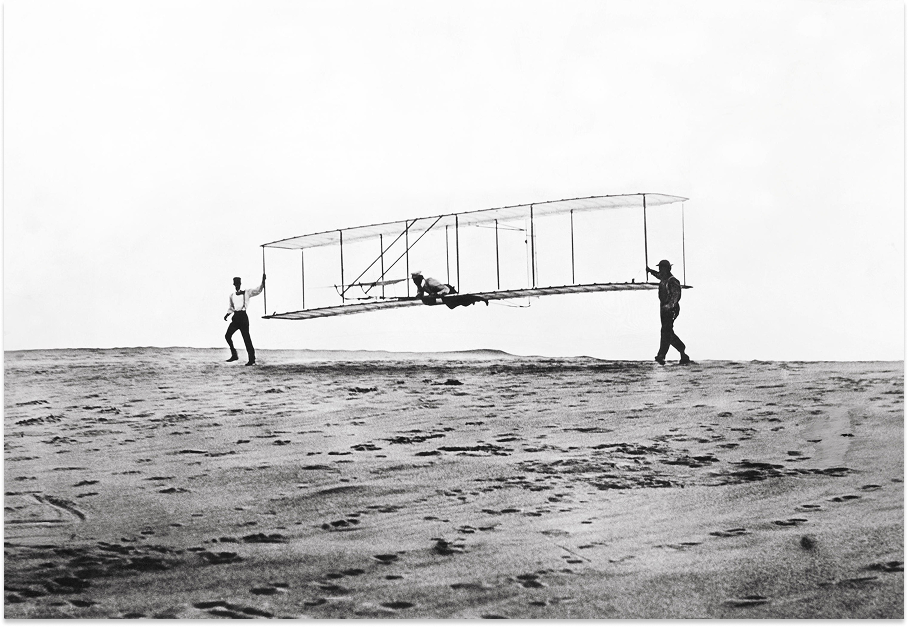
“Learning the secret of flight from a bird was a good deal like learning the secret of magic from a magician,” Orville later said. “After you once know the trick and what to look for, you see things that you did not notice when you did not know exactly what to look for.”
Flying progressed quickly from the Wrights to October 1958 when Pan Am flew the first Boeing 707 from New York to Paris and ushered in the Jet Age, an age that we, 68 years later, still inhabit.
That we can fly through the air, across the globe, while watching movies and munching on snacks, is a technological miracle. It has shrunk the globe, made roses cut in Kenya available in Brooklyn flower shops, and allowed Naman to fundraise in New York and San Francisco without permanently leaving Bangalore.
“Like seriously what in the ever-loving fuck are planes,” Naman marveled in an old blog post. “I’m an aerospace engineer and I still refuse to believe that shit is anything short of magic. Like there’s genuinely no other way to put the accomplishments of humanity other than just… sheer magic.”
And yet… humans still do not flit about in the air as birds do. Planes are much too big for that, for one thing, and too expensive to operate, for another. Daily, we are roadbound, grounded to the streets by feet and wheels, stuck in traffic on streets built for cars at the expense of humans.
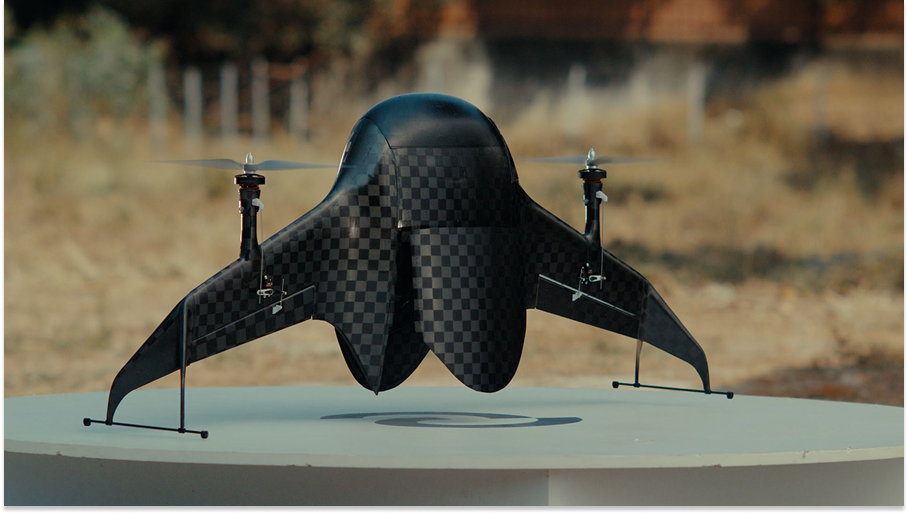
Naman wants to change that, by sending all movement to the sky, with aircraft that borrow from birds not just in their wings, but in the shape of their whole bodies.
To do so, Airbound must beat existing vehicles on speed, versatility, and cost. All three are required for victory.
How quickly can you get somewhere? Can you go from where you are to where you want to be, when you want to go? What does it cost?
“Our goal is to build vehicles that dominate1 across these axes,” Naman wrote in a recent technical memo. “If an aircraft can be more versatile than the car, faster than the train, and cheaper than the bus, then you can replace all of them. That is the universal vehicle we intend to create.”
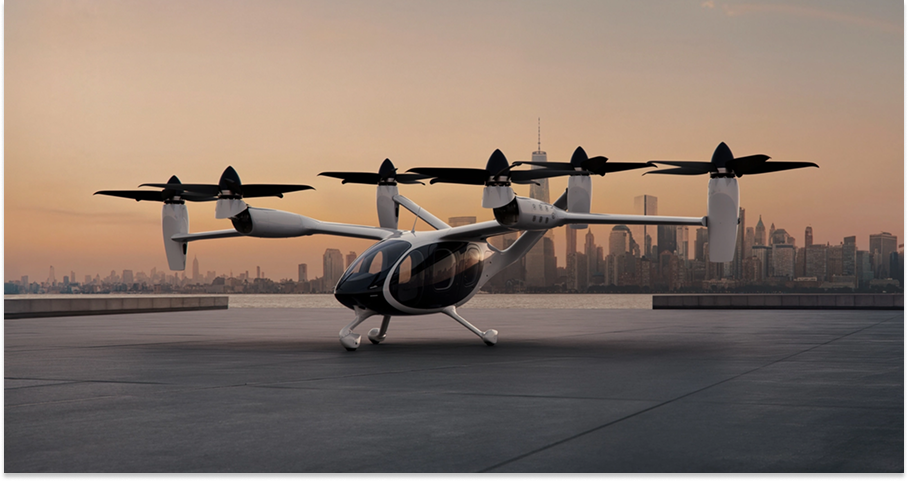
An eVTOL (electric vertical take-off and landing) naturally falls out of these requirements. It takes off and lands straight up and down like a helicopter, so it doesn’t need a runway (versatile), it flies over traffic in a straight line (fast), and it runs on electric motors, which are cheaper to power and maintain than engines (cheap). Every delivery drone you’ve seen is an eVTOL, as are the air taxis Joby and Archer are building. Others are making eVTOLs, too, so while they will all be fast and versatile, Airbound must beat them on cost.
That seems crazy, when the competition has so much scale. Amazon - Amazon! - the company that is the best in the Western Hemisphere at moving goods to people - Amazon is making eVTOL delivery drones.
Last week, The New York Times wrote a story on Amazon Prime Air’s nascent operations in Richardson, Texas: It’s Raining Boxes: Amazon Drones Overwhelm a Texas Suburb. Describing the logistics king’s flying machine, Juliet Macur wrote, “Within a minute or so, an 83-pound drone with six blue arms and whirring propellers appeared in a corner of the sky before zipping over nearby houses, looking like a cross between a mechanical dragonfly and an X-wing fighter, and buzzing like a battalion of bees. The drone’s mission: delivering an Amazon package. The single cardboard box of cargo held a maximum of five pounds...”
Six arms and 83 pounds to carry a maximum of five.
Before I met Naman, I would have read that and thought, “Woah, the sci-fi future has arrived,” but after meeting him and hearing what he’s building and why, those numbers sound absurd.
To be fair, Amazon’s 83 pounds is fully-loaded, so it’s really 78 plus the five pound payload, for a payload-to-empty-weight ratio of 0.06x. Zipline has a much stronger ratio; its P2 weighs 55 pounds and can carry eight, good for 0.15x.
Airbound’s is in a different league. Its first drone, the TRT, is so light (1.5kg) that Naman could hold it with three fingers, and carries 1kg, for a payload-to-empty-weight ratio of 0.67x.
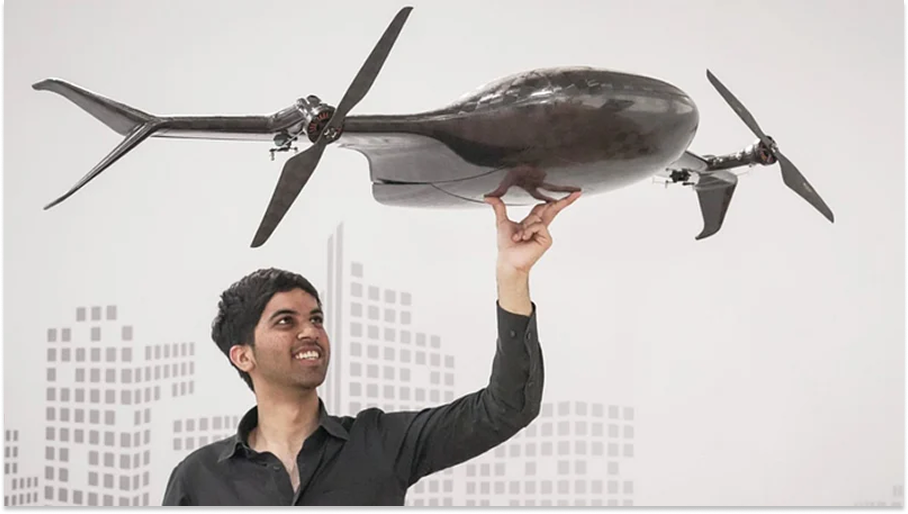
Its new V2 drone can carry five kilograms (11 pounds). Its payload-to-empty-weight ratio is 1.67x. It can carry more than it weighs.
It is not that Amazon doesn’t have resources or smart engineers. It’s just that Naman is obsessed with building aircraft that carry the most payload with the least weight, because he believes that combination is what will allow Airbound to offer the cheapest deliveries possible (fast and versatile, too), which is what he believes it will take to win.
“We believe that if we can truly solve for cost,” Naman wrote, “flight can dominate all existing transportation for 80% of all cargo and 90% of all human movement.”
If they can – and that is certainly not guaranteed – then not only will they move movement to the sky, they will force the earth to shape itself around this new mode of movement.
As Naman wrote in Airbound’s Manifesto, this world is “A world where goods move as freely as information does today; a world where flying is cheaper than taking the bus; a world without compromise.”
Naman’s Vision
I first heard of Naman when my plane landed in Mexico City for an event last October. When my international service switched on, I saw an email from Lachy Groom, who had invested in Airbound and called Naman “One of the most exciting founders I’ve backed recently.” Naman was going to be in NYC the next week, “Want to meet (I highly encourage)?”
I wasn’t particularly interested in a drone delivery company, to be honest. It was a competitive space in which it felt like Zipline had an insurmountable lead and the culture to keep it. Amazon and Google waited in the wings anyway. Regulation is tough. And Naman didn’t seem to have a PhD in aerospace engineering, or a college degree, for that matter.
But I respect Lachy’s judgment, Airbound’s monthly flights were going vertical, and I was intrigued by Naman’s simple explanation - “we’re building the most efficient way to transport atoms” - and ambition - “we can make 1 cent deliveries possible and enable a world where you see trillions of deliveries annually,” so I said I’d love to.
When I met Naman, at Felix Roasting back in Soho, 8,306 miles from Bangalore as the crow flies, he looked young, because he was, just 21 years old, which made it even more embarrassing when he opened his mouth and proved himself to be about 8,306x smarter than me.
In that first conversation, he showed the grasp of the spectrum from 30,000 foot vision to sub-millimeter details that great Vertical Integrator founders seem to possess, and which, I’d come to appreciate, are necessary to hold in one brain when you want to solve a tightly coupled optimization problem like building the “perfect aircraft.”
By the end, he’d convinced me it might be possible to make flight the cheapest mode of movement, inevitable even, that whoever did it would build an enormous business, and that he might just be that whoever.
I invested in Airbound’s $37M Greenoaks-led Series A, and my conviction has grown as I’ve spent time with Naman over the past year and come to better understand what he is trying to achieve, and how.
The idea behind Airbound is really simple: if you move mass more cheaply than anyone else, you win.
“There is one loss function that we care about: cost per kilogram-kilometer,” Naman told me. The total cost of making and operating the aircraft, divided by how much payload it moves and how far it moves it. “Everything is secondary to that.”
Those kilograms might be a burrito, a box of company t-shirts, building materials, or even people. Transportation and logistics are both forms of movement, and Airbound is a Movement Company.
Today, everything that moves needs a human chaperone, and chaperones are expensive. A bus is cheaper than a taxi per-person because it’s cheaper to have one driver move 20 people instead of two. A truck is cheaper than a car per-package because it’s cheaper to have one person move 1,000 packages instead of one. So humanity built its movement networks around batching.
Autonomy removes the onboard chaperone, so the vehicle can be sized around what it carries. Airbound’s bet is that a light enough aircraft can make small, frequent shipments economical. It will start with a small aircraft, where experiments are cheap, and use what it learns to build larger aircraft that move each kilogram, including humans, more cheaply still.
Scale that up or down, and most of movement eventually becomes point-to-point, in the air, carried by billions of aircraft, which Naman thinks, given the astounding size of the sky, will be no more noticeable than birds2, which is to say: barely noticeable unless you choose to notice, from time to time, and marvel.
Birds or Airbound Aircraft? (Airbound Aircraft)
Because if Airbound really succeeds in its mission, those bird-like dots will reshape the world.
Reshaping the World
I grew up outside of Philadelphia, America’s first capital and once-largest city. I love it there. Go Birds. But I don’t live there. I am writing to you from New York City, where I live and work, because of the mad ramblings of a man named Jesse Hawley under the pen name “Hercules.”
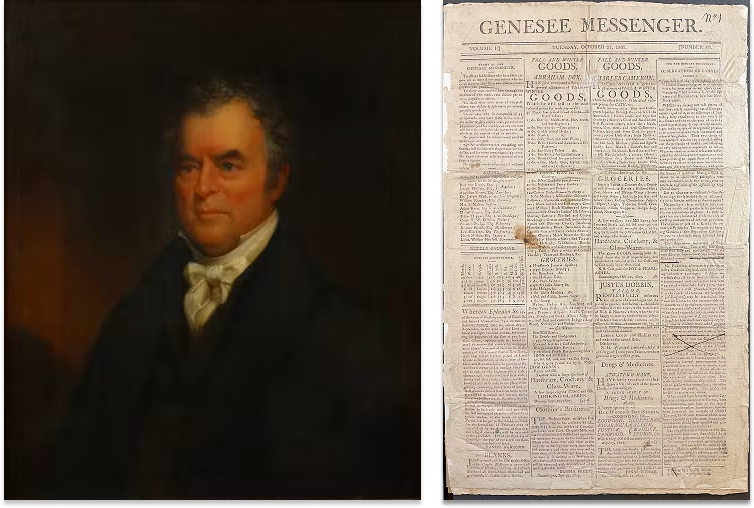
See, Hawley was a flour merchant who milled his wheat upstate in Seneca Falls, New York, and he had a devil of a time getting it to the big market of New York City. There was no direct route to the Hudson River from Seneca Falls. He and his partner went bankrupt, and back then, going bankrupt landed you in debtors prison. There, with nothing but time and what-ifs, Hawley as Hercules wrote a series of fourteen essays, published in the Genesee Messenger in 1807 and 1808, making the case for a “Genesee Canal.”
President Thomas Jefferson called the scheme “little short of madness.” In 1817, President Madison denied federal funding. New York Governor DeWitt Clinton, on the other hand, took it up and went it alone. Opponents called it “Clinton’s Ditch.”
Seventeen years after Hercules’ letters, his ideas took physical form. On October 26, 1825, Governor Clinton and a party of dignitaries boarded the Seneca Chief in Buffalo and led a flotilla of horse-drawn boats east across the state on the brand new Erie Canal, and on November 4, off New York City, Clinton poured a keg of Lake Erie water into the Atlantic, a ceremony they called the Wedding of the Waters.
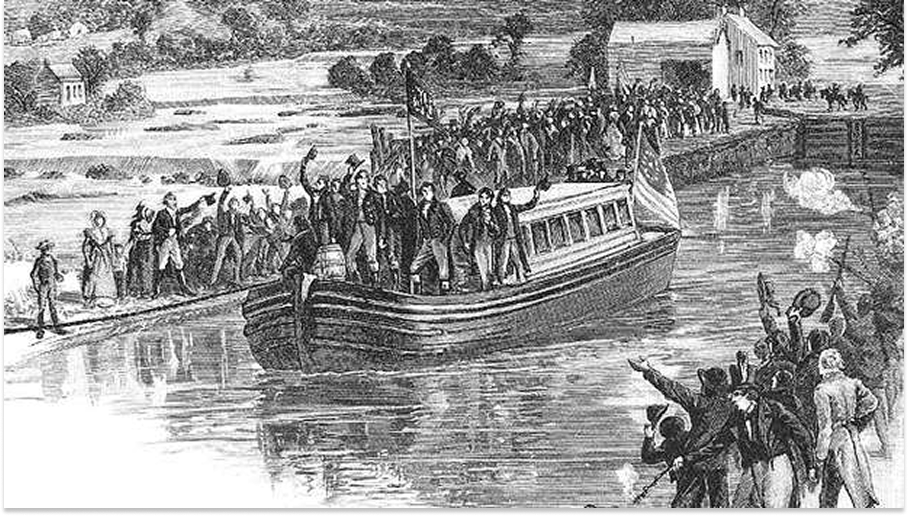
The Canal connected Buffalo, the gateway to the Great Lakes, to the Hudson River, and from there to New York City and the Atlantic Ocean. Before the Canal, it cost $100 and three weeks to move a ton of grain from the midwest, where it was grown, to New York City, where it was consumed or shipped overseas. After, it cost $10 and took six days. That meant that a lot more grain came to New York, which meant that ships bringing immigrants and manufactured goods from Europe could bring grain back to the Continent instead of returning on a costly empty dead leg. That meant that most of the westbound ships came to New York City instead of Philadelphia, Baltimore or Boston; it was the economical thing to do. And that reinforced and grew New York City’s lead as America’s leading city.
In 1820, New York ranked third among American ports in flour. By 1827, it had taken the lead. By 1860, its population had climbed from 124,000 to 814,000, nearly 250,000 more than Philadelphia’s. Everything organized around the people and the trade, and today, New York City is America’s financial capital, the place where a wide-eyed new college grad like I once was just had to move, largely due to the Erie Canal.
This is a very old pattern. Cities don’t typically grow their own calories, so their size and influence has historically been capped by how economically they could get calories to come to them.
Rome was likely the first city to support a million people, despite the fact that Rome itself couldn’t grow nearly enough to feed a million mouths. It did so by shipping somewhere between 150,000 and 400,000 tons of grains a year across the Mediterranean, most of it from Egypt and North Africa, in a vast logistics system called the cura annonae (“care of the grain”). Based on Diocletian’s 301 AD price edict, scholars estimate that for the same weight over the same distance, wagon transport was about 50x as expensive as sea transport.

No European city would hit a million residents again until London did at the turn of the 19th Century, fueled by coal. Just like calories, cities need to import energy. A wood-burning city’s scale is capped by how much forest it can reach by cart, and London had chewed through its hinterland by the 1500s. So it started burning coal from Newcastle, 300 miles up the coast, carried down by a fleet of fat, flat-bottomed colliers that by 1800 were landing something like a million tons a year on the Thames.
I can keep going.
In America, as the Erie Canal cemented New York’s advantage on the east coast, Chicago became the country’s Second City thanks to the railroad. Lee Kuan Yew is rightly admired for his work turning tiny Singapore into a prosperous nation, but the shipping container deserves just as much credit3. And just as Singapore emerged from the swamps thanks to the movement of goods, Dubai emerged from the desert due to the movement of people, on planes like the Boeing 777.
Venice had the galley. Amsterdam had the fluyt. Los Angeles had the car. Atlanta, like Dubai, had the jet.
Did you catch that? One of those is not like the others.
The galley, the fluyt, the canal boat, the grain ship, the railroad, the container ship, and the jet are all centralizing batch machines. They’re expensive to build and expensive to crew, so they only make economic sense when they’re full, and they only stop where there’s enough cargo or enough people to fill them. That means they make points – ports, junctions, stations, hubs – around which cities grow. Rome, New York, Chicago, Singapore, and Dubai are all, at bottom, places where big batches come and get broken into smaller ones.
Even when batch machines spread a city out, they spread it along lines. The streetcar suburbs that grew up around American cities at the end of the nineteenth century reached out in fingers along the tracks.
The car is different. It carries one family or one person, leaves when that person or family wants to leave, and can go anywhere there’s a road. It doesn’t make points or lines, but area. Ford made that vehicle cheap enough for almost everyone, and over the next few decades, the space between the fingers filled in. Los Angeles grew, as did countless American suburbs previously too inconvenient for those who wanted to work where batching machines agglomerated economic activity.
Transportation reshapes the world in two directions. Batched vehicles pull people and activity toward the places where those vehicles land. Individual vehicles let people spread out. The map of the world’s biggest cities is the result of both: great cities formed where the batch machines met, then spread as far as a car could take people in half an hour.
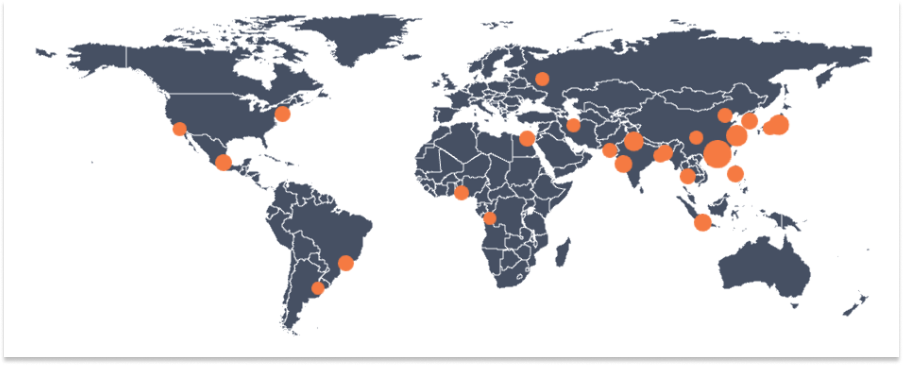
It is notable, then, that despite all of the technological progress of the past half-century, very little has changed on the transportation side. Planes have gotten bigger and more efficient. Cars are beginning to drive themselves. But there has been no great leap. Peter Thiel’s quip that “We wanted flying cars, instead we got 140 characters” is drastically overused but appropriate here.
Flying cars would expand the radius of daily life, as Vight founder Tsung Xu wrote in not boring earlier this year.
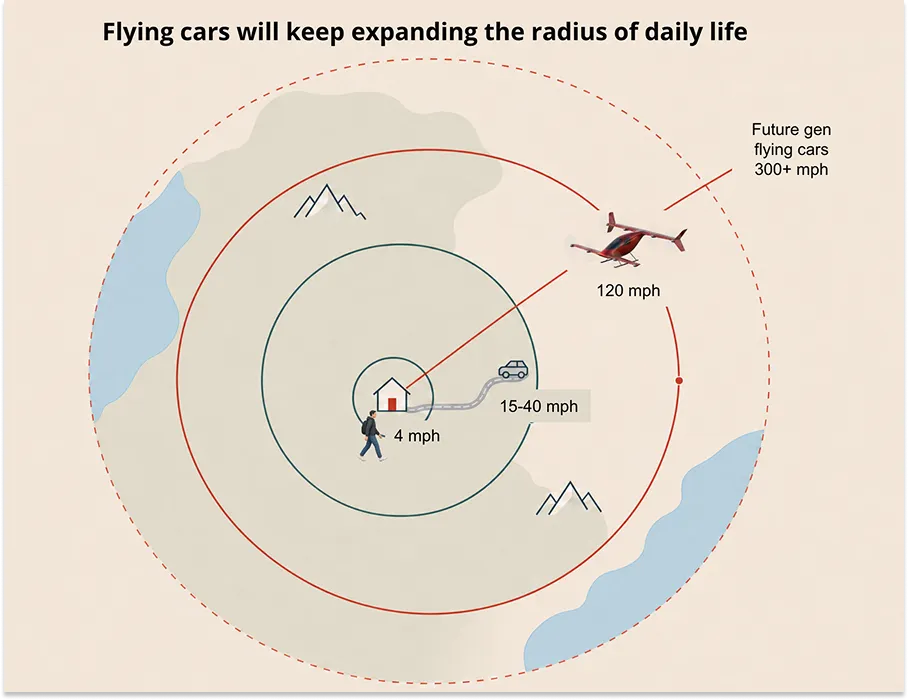
In 1934, Lewis Mumford, paraphrasing Bertrand Russell, noted that “each improvement in locomotion has increased the area over which people are compelled to move: so that a person who would have had to spend half an hour to walk to work a century ago must still spend half an hour to reach his destination.” In a 1994 paper, Anthropological Invariants in Travel Behavior, Cesare Marchetti formalized the idea into what others would call Marchetti’s Constant: humans like to commute about 30 minutes each way, or about an hour a day, and the further we can travel in 30 minutes, the further we will.
For a while there, further we did! Per Marchetti’s study of Berlin, people walked about 2.5km both ways in 1800, then horses pulled us 4.5km starting around 1850, then electric trams, subways, and cars each contributed to growing the radius to about 20km by 1960.
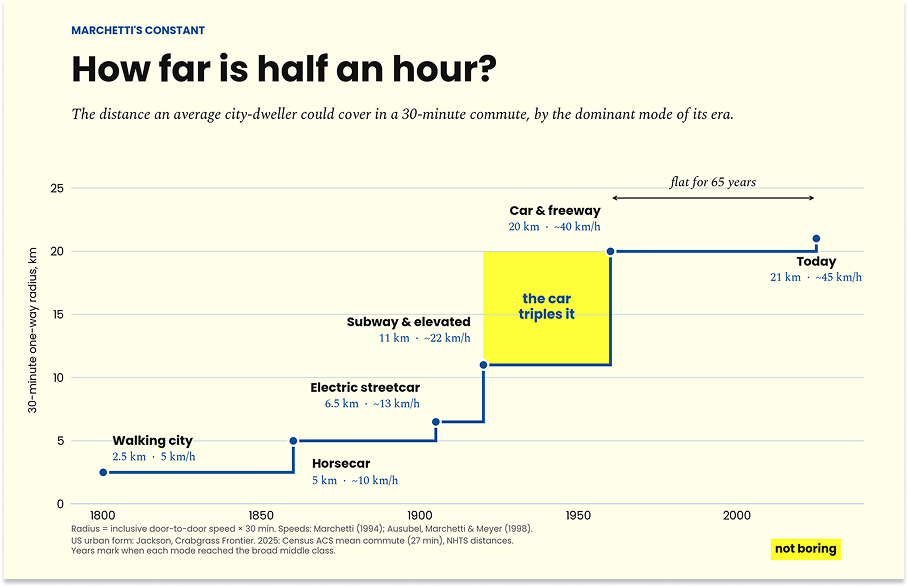
Then we stopped expanding. Distance traveled is just about the same now as it was in 1960, and may have actually shrunk since then due to increased traffic.
Progress in the speed with which we move things is arguably even worse. Container ships, for example, travel more slowly today than they did during the Nixon Administration in the name of fuel efficiency. Planes fly about the same speed as they did back then. Freight trains are a little bit slower.
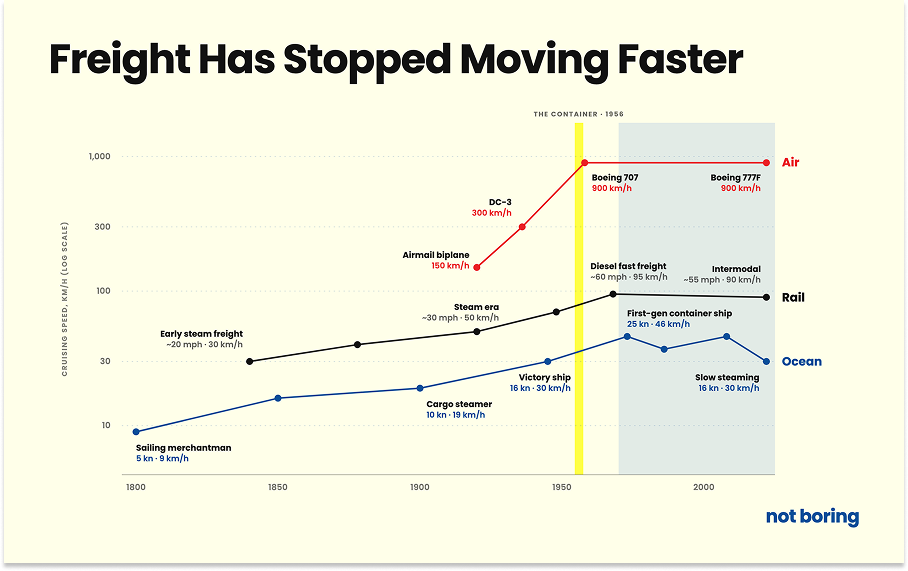
Of course, the average consumer does get their orders more quickly today. You can order almost anything on Amazon and get it tomorrow. That’s because Amazon, and those who have followed suit, have invested a tremendous amount of capital building distribution centers closer to where customers are. When I run to Red Hook, I run past block-sized Amazon DCs that should be houses or restaurants. Per the NBER, Amazon went from eight warehouses across the country to 54, and cut the average package’s trip from 450 miles to 141 miles. Then, they added DCs like the ones in Red Hook where items are sent from fulfillment centers in bulk to be carried the last few miles in smaller batches by vans or silly little bike/car hybrid things, which then block traffic on my street or nearly hit me when I cross the street, respectively.
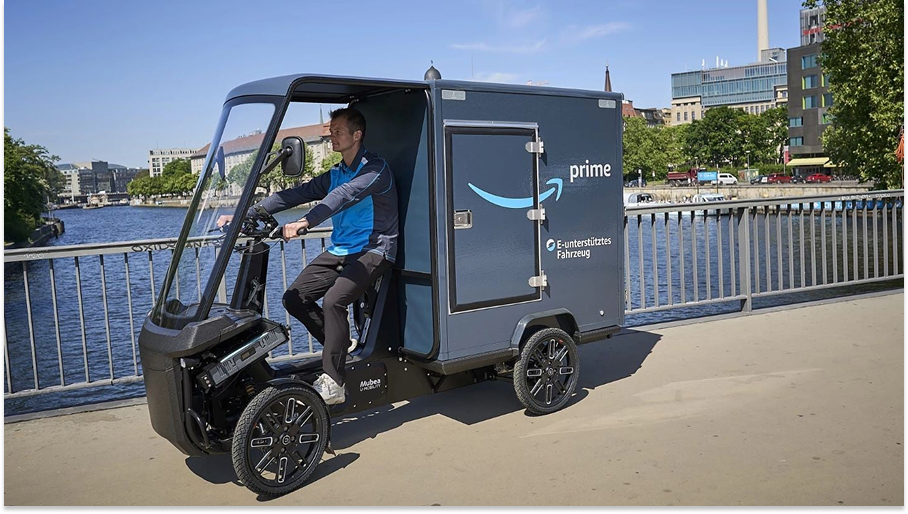
The car (and its sometimes-goofier logistics-specific offspring) explains this, too. It unbatched people by letting the human cargo drive itself. But a package can’t drive, so for things, we’re still stuck with the batch.
Breaking Batch
Good technology eliminates trade-offs. Airbound wants to eliminate the trade-off between cost and speed in the movement of matter.
Imagine that you absolutely need to get an item from where it’s made to its final destination as quickly as possible. A pen, let’s say. A Namiki maki-e fountain pen, lacquered and gold-dusted and encrusted with diamonds, finished by hand at Pilot’s factory in Hiratsuka, an hour southwest of Tokyo on Sagami Bay. For some reason, this pen is the only pen with which two parties in a Park Avenue conference room can sign a $10 billion agreement, and for another reason, the deal explodes in 18 hours. The artisan sets down her brush at 11:00 AM Tuesday, Tokyo time. It is 10:00 PM Monday in New York. You have until 4:00 PM Tuesday. Obviously, price is no issue. What do you do?
The courier takes a car fifty minutes to Haneda, where he boards a Bombardier Global 7500 and flies for eleven hours and forty-five minutes over the Bering Sea before landing at JFK. Teterboro has a 100,000 pound weight limit, and while the plane would come in under after burning its fuel, the Port Authority needs a weight certification seventy-two hours in advance and you don’t have seventy-two hours, so JFK it is. The courier walks the case, still strapped to his wrist, through customs, which takes twenty-five minutes, and boards a helicopter bound for the city. A few minutes later, he and the chopper land at the 34th Street Heliport. He takes a car from the Heliport to the office on Park Avenue, gets out, enters, checks in with security, takes the elevator up to the thirty-seventh floor, and is escorted into a conference room, where he unlocks the case, hands over the pen, and watches the contract get signed at 1:30 PM New York time, with two and a half hours to spare.
The whole trip costs around $430,000 for a 0.04 kg pen over 10,900 km, or $1,000/kg-km. You can get something anywhere you want pretty fast as long as you are willing to pay.
This is, of course, a ridiculous example, meant to show that the cost to move things exists on a spectrum. You can move something fast if you send it by itself, with its own chaperone and its own vehicles. If you want to pay less, you need to send it with other items. You could send the pen from Japan in the mail for ~$10, in which case it will share a commercial plane with 300 passengers and a bunch of other mail. You could send it even more cheaply if you put it in a container on a ship with 300,000 Pilot pens; it would cost a few cents, but it would take a couple of months.
If you want to send something cheaply today, you need to batch it.
This is how our logistics system is designed, whether global or local. It is built around moving the people who move the goods, which means aggregating as many items per person as you can reasonably manage. The further you are from the destination, the bigger the batches that make sense; you wouldn’t tug a ship to each customer’s door. So we’ve built a series of smaller locations to break big batches down into smaller ones: hubs, warehouses, distribution centers, fulfillment centers, sort centers, depots, and last-mile vehicles.
Modern logistics is an exquisitely tuned machine that has squeezed nearly every ounce of optimization out of the existing possibility space. Given the transportation technology available, routing technology has pushed the efficient frontier out as far as it can go, and logistics companies exist to let customers choose from any point on that frontier.
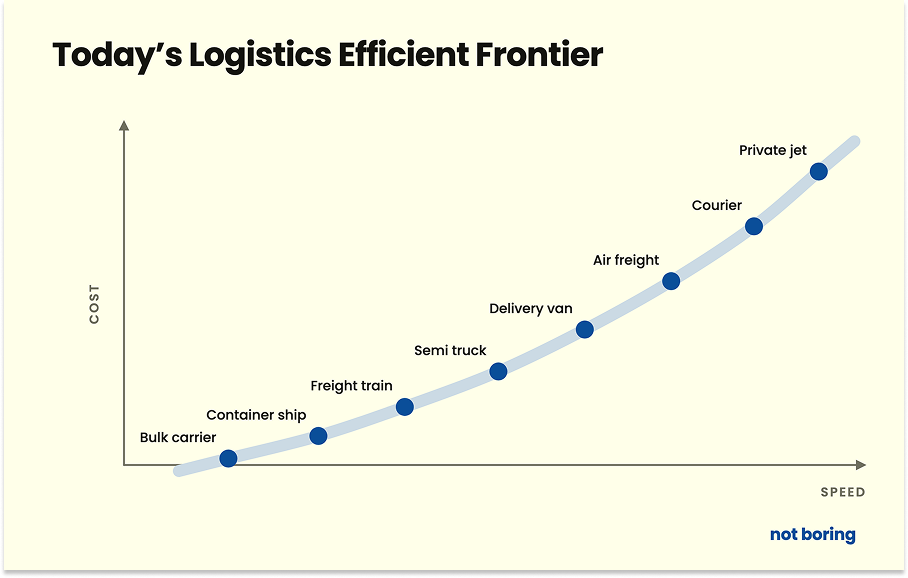
Every vehicle sits somewhere on that frontier, making a different set of trade-offs between speed (and versatility, which impacts factory-to-door speed) and cost. Trains can be fast and cheap, but they only go where the tracks do, and stop wherever the stations are. Cars take you from your driveway to your destination whenever you’d like, but spend much of the trip negotiating other cars. A truck can move goods cheaply as long as it’s full. Bikes are slow, but they’re cheap and versatile. Planes are really fast, but they’re not cheap and they have to land in airports. That’s why the economy makes so many different types of vehicles to do what is fundamentally the same job: move matter, living or dead.
But we are still very limited.
Batching means waiting for the other items in the batch before moving. A restaurant’s delivery driver may need to wait for four meals to finish cooking instead of delivering each meal as soon as it’s ready.
It also means pre-positioning with expensive, fixed, CapEx-heavy locations closer to customers, which costs rent, inventory, equipment, and salaries, all of which get amortized into the cost of the item the customer purchases, and may force further trade-offs, between speed and getting the exact item you want. A retailer may offer limited SKUs for same-day delivery and only make the full catalog available in two to three days.
To solve this problem and make logistics both fast and cheap, you need a transportation technology that is cheap, fast, and free of batching, like the one Airbound is building.
The path to such a technology mirrors that of the path from the steam carriage to the automobile.
You Can’t Replace a Horse with a Steam Engine
When we talk about the history of the car, we often discuss the 23 years from Karl Benz’s three-wheeled Patent-Motorwagen in 1885 to Henry Ford’s Model T in 1908.
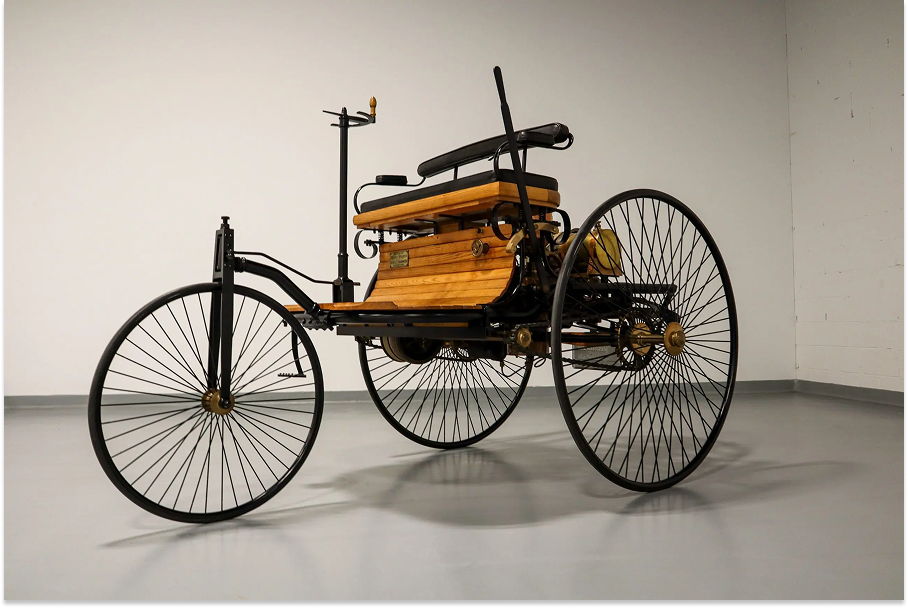
Benz’s invention, however, arrived over a century into humanity’s quest to replace the horse with a machine. Before internal combustion engines, engineers used steam engines.
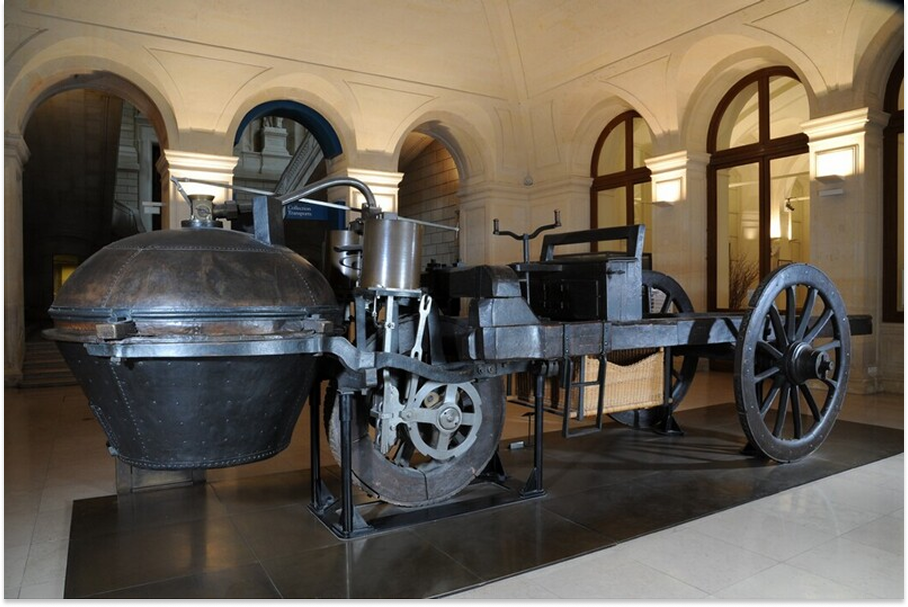
In 1769, a French military engineer named Nicolas-Joseph Cugnot built a steam-powered vehicle intended to move artillery. The project was abandoned two years later, but Cugnot had demonstrated something extraordinary and unprecedented in human history: a heavy vehicle could move itself across the ground, without an animal pulling it.
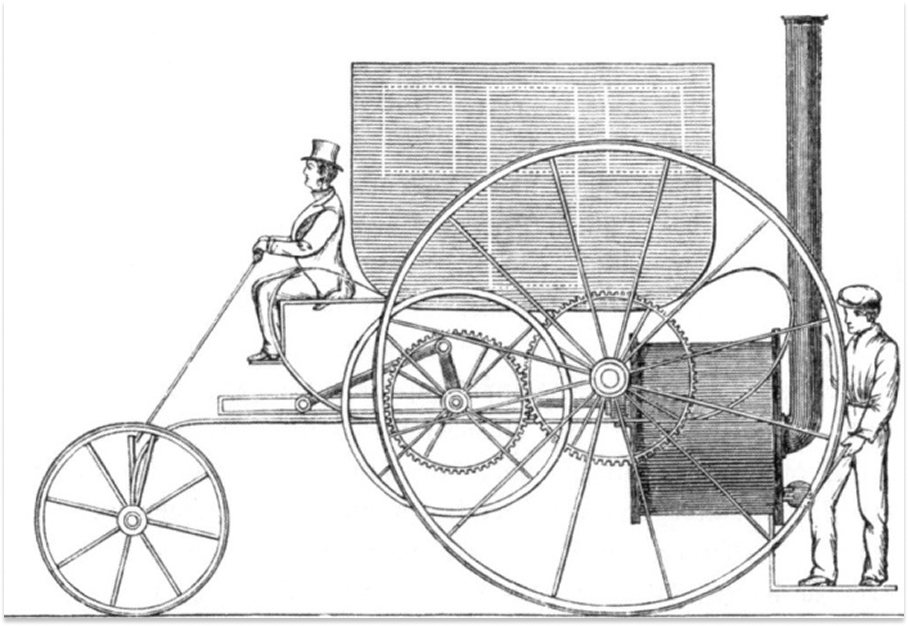
In 1803, the Cornish inventor Richard Trevithick brought a steam carriage to London. It could carry around eight passengers and required no horse, but its replacement occupied a considerable portion of the vehicle; coal and water rode along with the people, including one person whose job it was to shovel the coal into the engine.
By the 1830s, these experiments were turning into actual transportation services. Walter Hancock, an engineer in East London, ran steam buses on regular routes. His 22-seat Automaton made more than 700 journeys and carried over 12,000 passengers in 1836.
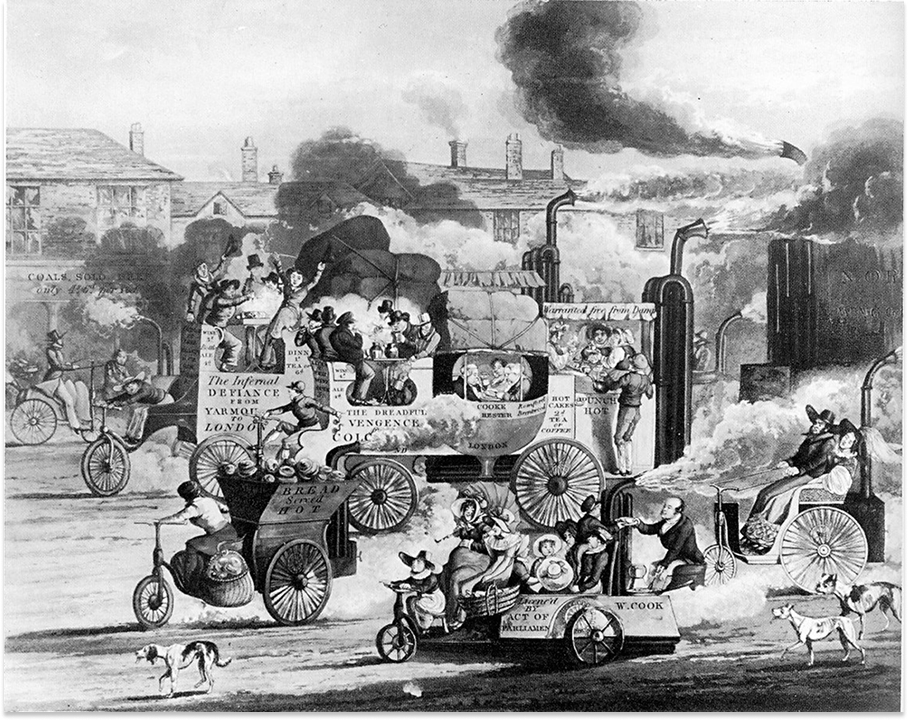

Trevithick and Hancock’s vehicles were novel and inventive, but they were not what we would recognize as cars. They carried eight to twenty-two passengers along established routes at regular intervals.
They were, in other words, buses. They moved humans in batches, because their economics strongly favored batches.
In order to move one person somewhere, that person would have to pay for the time and expertise of the two other people, in addition to the depreciated capex of the machine, its fuel, and its maintenance. Like the ships arriving on America’s east coast before the Erie Canal, the cost of this steam carriage might also have to support an empty ride back home. Those costs are easier to bear if they’re spread across twenty passengers heading in roughly the same direction, and twenty more heading back.
For more than a century, mechanical transportation advanced without making independent, everyday movement affordable. Steam’s greatest successes came from moving more people and goods together. Replacing the family horse and carriage would require a machine that worked economically at the scale of a family.
Enter Benz, who was an engine maker before he was a car maker, and in 1885 created a vehicle with a compact gasoline engine built into a purpose-designed chassis. It had two seats, three wire-spoked wheels, a tubular steel frame, and a single-cylinder four-stroke engine that produced three-quarters of a horsepower. Burning fuel inside the engine eliminated the separate steam boiler and the job of continuously attending to its fire. The engine was small enough that the vehicle it carried could be small, too. Over time, people could even learn to drive it themselves.
Finally, it was practical for an individual to own and operate their own car, to hit the road with no other living human or beast along. It’s just that the individual who owned and operated the car had to be pretty rich. At 600 marks, the original Benz Patent-Motorwagen would have cost a German factory worker a year’s wages; Benz only made 25 of them anyway. It wasn’t particularly powerful, either. It couldn’t, for example, climb up hills.
Over the intervening two decades, automobiles actually got more expensive as they became more powerful. A 1901 Mercedes 35 hp car cost about 15,000 marks. Cheaper versions, like the Curved Dash Oldsmobile and Sears motor buggy, were flimsy and underpowered. Automakers were discovering an efficient frontier of their own, and making different choices on it.
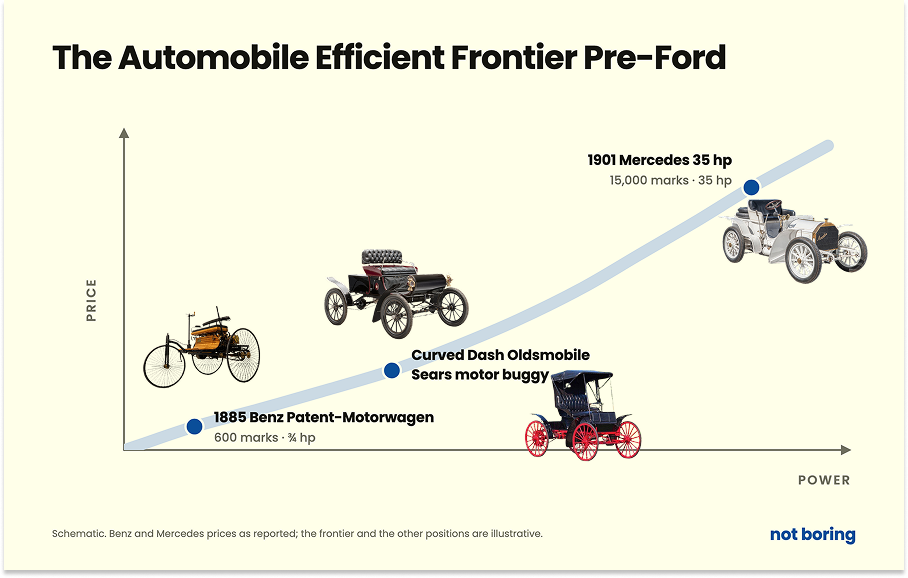
Henry Ford did not invent the automobile, nor did he make the first cheap automobile. When Ford released the Model T in 1908, it was not the most affordable car on the market or even that affordable at all. At roughly $850, it cost something like a year-and-a-half of an average American’s $550 annual pay. What he did, though, was to produce a car that performed well - 20 hp, four cylinders, vanadium steel, enough ground clearance for rutted farm roads - for about half the price of comparable cars, and he did so with careful choices about weight, durability, repair, and manufacturing that would allow him to bring down the cost with scale.
Ford bet on vanadium-alloyed steel – three times as strong as the steel American carmakers were using at the time for its weight – to make the car lighter, and therefore more performant for the same engine, while still being robust to old bumpy roads. He bet on the internal combustion engine starting with his Quadricycle in 1896, while many others pursued steam and electric cars, and reaped the benefits of range and simplicity as the gasoline distribution network built up around him. He bet on a planetary transmission system, which was dead simple for regular drivers to learn, so that owning a car wouldn’t require hiring a driver. In 1909, he bet the whole company on a single car, announcing that Ford would build only the Model T.
As all of these bets paid off, improved, and compounded, he created new points that he alone occupied, far beyond the industry’s efficient frontier.
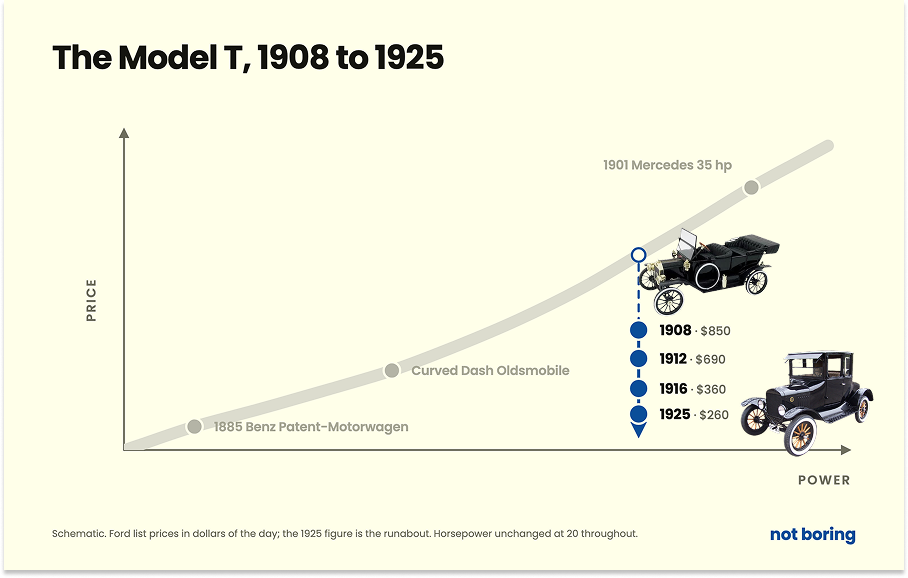
By 1925, the Model T’s $260 price tag cost only 20% of an average American’s much higher $1,350 annual pay. While its cost improved, its performance didn’t. The 1925 Model T had essentially the same 2.9-liter, 20 hp four-cylinder engine as the 1908 car, the same two-speed pedal-operated transmission, and the same 40 to 45 mph top speed. Performance arguably got worse. That was an explicit trade: the man was maniacally focused on cost to the exclusion of everything else. He offered “any color the customer wants, as long as it’s black,” not only for the simplicity, but because this particular black dried more quickly and thus sped up the assembly line.
Cost, he believed, is what would lure customers away from horse and carriages and to cars.
He believed it so completely that when he announced, in 1916, that he’d stop paying special dividends and pour the profits into lower prices and a bigger factory, two of his own shareholders, the Dodge brothers, sued him. The court sided with the Dodges. Ford bought out the rest of his shareholders so he could have full control, and with it, he kept cutting prices.
The first Model T cost roughly 2x a horse and carriage, which was enough to attract early adopters and begin to pull it down the cost-performance curve. Within eight years, it hit price parity. Four years later, it was about half the cost. Everyone bought a Model T.
There’s this famous pair of images, both taken of the Easter Parade on New York City’s Fifth Avenue, one in 1900, the other in 1913, that shows how thoroughly the Model T dominated horse and carriages.
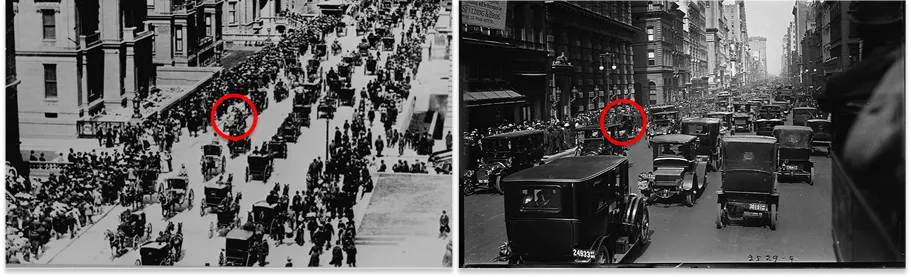
In just thirteen years, the parade went from one car among a sea of horses, to one horse among a sea of cars.
Naman thinks that aviation has followed an uncannily similar trajectory, on an uncannily similar timeline, and is in an uncannily similar place today as the auto industry was in 1908.
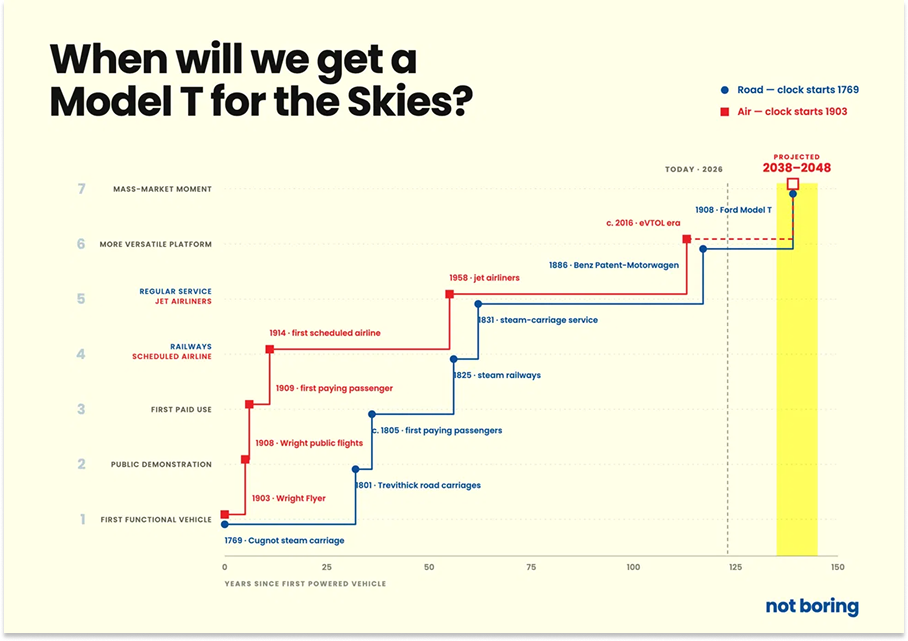
We have had powered flight for more than a century. We have made it extraordinarily good at moving large groups of people and things between places equipped to receive large aircraft. The pilots, ground crews, maintenance facilities, runways, terminals, and schedules necessary to make the whole thing work necessitate a system that becomes economical by spreading its costs across passengers and cargo.
But for daily movement, that arrangement hits many of the same constraints the steam carriage hit.
Even if you could make an ordinary plane dramatically cheaper, it would still need somewhere to take off and land, qualified pilots, and extensive maintenance operations. Its purchase price is only one of the many reasons you don’t have a personal 777 in your driveway. Even a very cheap plane would not replace the car. It is the steam carriage of the sky.
Today’s eVTOLs, to Naman, are the early automobiles. They are capable of autonomous flight and they are electric, which means they can be smaller. Since they’re smaller, they can fit in your driveway, or on your vertiport. It is now practical to replace a human on a bike or in a car with an eVTOL to bring you your burrito, and pending regulatory approval, it is theoretically possible for an individual to own their very own eVTOL. That is just very expensive, even more so than the original Benz. Human-grade eVTOLs cost about $4-5 million to purchase today.
Even at these initial prices, things like delivery and air taxi service make sense. Not having to pay a human chaperone is huge, as is flying right over traffic, as are electric motors. Plus, the electric stack allows for high utilization and requires low maintenance, which lets those who build on it amortize CapEx over so many flights. There are many companies working to take advantage of the novel things the eVTOL stack enables.
There is no one else, Naman believes, who understands how close we are to replacing cars with personal aircraft.
“The two things that make Airbound different,” he explained to me on a recent call, “are, one: I don’t think that anyone else notices that the eVTOL stack is like 90% of the way to replacing cars. They don’t need runways, they can operate autonomously, they’re electric, they can be small. Cost is the last 10%, and it is the most… if you get cost right, everything else will solve itself and you will reshape all movement. If you don’t get cost right, this will just be Aviation++.”
The pieces are there, in his view, “for an aerial vehicle that anyone can own in the same way that the first car [the Benz] brought together the pieces for a car that anyone could own.” The Benz and its successors elsewhere on the same efficient frontier were 90% of the way to replacing horses and carriages. Ford’s focus on cost took the industry the final 10%, and now horses and carriages are the analogy everyone uses to describe something that was completely obsoleted by a new technology.
A flying car that anyone can own sounds as preposterous today as a car that anyone could own did at the turn of the 20th century, but history suggests that we’re on the right track, and that it will come down to cost. So how do you carry aircraft that final 10%?
That’s the second thing that makes Airbound different.
“To get cost right, we realized that carbon fiber is the thing. That we can do so much better with carbon fiber,” Naman gushed. Naman fucking loves carbon fiber.
Naman Learns to Make Drones
He’s loved carbon fiber for his entire adult life, and then some.
Naman grew up across Mumbai, Hyderabad, and Malaysia, where he got his first exposure to robotics via LEGO. By age 13, he started making things with aluminum and steel. He was entranced by his burgeoning ability to turn an idea into a real, physical thing. Then COVID hit when Naman was fifteen, keeping him stuck inside and feeling bored, like a lot of kids. Unlike a lot of kids, he took advantage of all of the free time.
There’s this great David Senra conversation with Ribbit founder Micky Malka that Alex Danco and I included in our piece on HAA, where he talks about the young founders he meets:
The most successful ones right now were the ones that during COVID were learning and were on YouTube sucking information about anything and learning about everything in life. So when they go and build companies, they find that first they’re naive, so they think anything is possible.
That’s Naman.
First, he joined Helpful Engineering, a Slack community of thousands of engineers, technologists, scientists, and doctors worldwide, organized into roughly 40 sub-groups each tackling a different piece of the COVID response in an open-source, share-everything fashion. The main focus of his original group, the Open-PAPR Design team, was respirators, but spending time with grownup makers from around the world gave him the confidence that he could build useful stuff, too. Like drones.
Naman started Opendrone, which would grow into Airbound, as a Helpful Engineering group, formed to create an open-source 3D-printable delivery drone that makers anywhere could build to deliver essential supplies to those in need. To get the drones delivering medicines ASAP, they’d need to work without expensive supporting infrastructure.
The one problem was that Naman, well, he’d built robots but he’d never built drones. No matter. He had all of the world’s knowledge at his fingertips via YouTube, and he gulped it down at 3x speed. He taught himself physics and engineering and aerodynamics and CAD and whatever else he’d need to win the one-week Hackaday hackathon.
The beauty of an open source hackathon is that we can go back and see Naman’s learning in real-time.

In the first design log, which Naman wrote, he and the team had designed their first aircraft, the hexacopter. By the second log, Naman and team had evolved the design, “marking the switch from what people imagine a ‘drone’ to look like, to one more in line with the requirements of a long-range delivery drone.”
“We settled on a tail-sitter,” he wrote, “where the drone would sit vertically, take off, and pitch 90 degrees to transition into fixed wing flight.”
The third iteration, the Blended Wing V2, is the first that looks like what Airbound would eventually build. While the complete redesign “retained many of the characteristics” of the first blended wing model, it featured a “larger middle section, which allows for enough space to store the electronics and the cargo,” based on a 2004 paper from Boeing on blended wing body aircraft.
Note that at this stage (the third image above), it looks very metallic. The biggest note in the fifth and final log, then, from the perspective of Airbound, was one on how they planned to make it and from what: “we had initially begun with a plan to 3D print the drone, then moving on to sheet metal fabrication and finally settling on a composite wet layup process for the body.” While the composite wasn’t yet carbon fiber, he was on the path.
Naman’s design was good enough to win the hackathon, grand prize: $500, which took six months to arrive due to banking issues related to giving money to a teenager. He used the time to keep learning and to keep iterating on the design, until the money hit in early 2021 and he had to actually make a prototype with $500.
“I had to be insanely scrappy,” he told Rahul Sanghi for the awesome Tigerfeathers piece. “I didn’t know anything about aerodynamic principles then. I was just playing around with a bunch of random airfoil designs and seeing what came together. It was more of a 3D modelling exercise than an aerodynamic challenge. Things became trickier because I couldn’t afford an actual 3D printer. So I printed out the stencils of each part using a regular A4 paper printer, and then used a hot-wire cutter to carve the actual parts out of industrial foam. Then I basically stuck them together with toothpicks and tape and some adhesive. I added some polyester putty to fill in any gaps, and then sanded down till I got a smooth shape.”
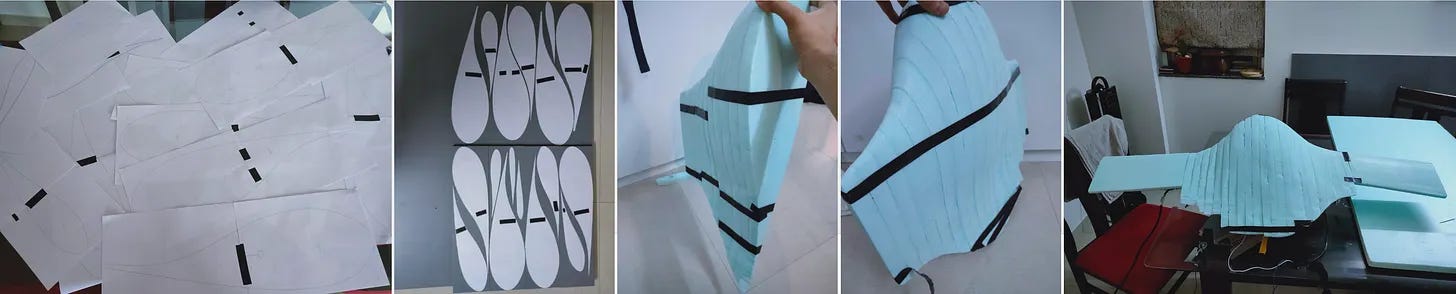
That first prototype that Naman painstakingly built, made using fiberglass as the composite, actually flew, and that was good enough to get a $1,000 grant from 1517 and then a whopping $25k from India’s gradCapital (Naman’s early experiment graces its homepage, and gradCapital founder Abhishek Sethi needed to get on a call with Naman’s dad to convince him to let his son take the money). The 1517 grant gave him the money to buy a 3D printer for the foam molds, and the grad windfall allowed him to move into his own apartment / unofficial lab, where he reworked the design from scratch based on everything he learned and upgraded to carbon fiber and kevlar sheets in place of fiberglass. During that same year, his 12th grade year, he got $150k from Draper Startup House and angels, formed Airbound as a real company to develop the technology, got into Carnegie Mellon, convinced his parents to let him defer Carnegie Mellon, and got to work.
Airbound was born. A Lightspeed investment followed soon after.
Tigerfeathers has a lot more fantastic detail on Naman’s entire journey, and they did such a great job that I’m going to tell you to read it so that we can get back to carbon fiber.
Betting on Carbon Fiber
Now that digital brains are smart enough to drive things, technologists around the globe are racing to add autonomy to anything that moves. There are autonomous boats, autonomous cars and Robotaxis, autonomous trains, autonomous warplanes, and of course, autonomous drones.
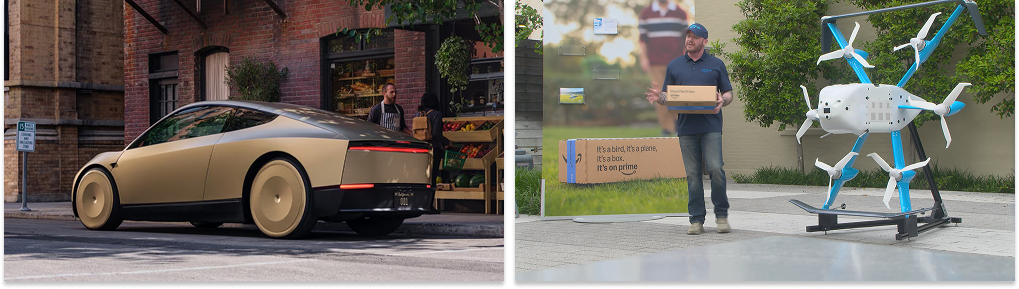
Autonomy is important. It lets you remove the pilot. Electric motors are, too; they let you build small without the weight penalty of a small combustion engine.
These two dynamics are well-understood by Airbound’s competitors.
DJI, Neros, Zipline, Wing, Amazon, DoorDash, and the rest, all of them make autonomous drones with electric motors. All of the drone delivery companies would agree that flying a single item point-to-point is better than batching, and that soaring in the sky beats the danger, traffic, ugliness, and unpredictability of driving on the ground. Zipline, too, aims to give the earth back to humans by moving deliveries to the sky, and it is growing incredibly fast in its efforts to do so.
What Naman thinks everyone else is dramatically underappreciating is carbon fiber.
Carbon fiber is not a new material. Invented in the 1960s and adopted by Rolls-Royce for ill-fated jet engine fan blades by the end of that decade, adoption spread from aerospace and military applications into golf clubs, tennis rackets, and fishing rods in the 1970s and 1980s. Carbon fiber entered Formula 1 with McLaren’s 1981 carbon monocoque, and eventually diffused into road cars and bicycles. The Boeing 787, launched in the 2000s, was the first commercial airliner with a mostly composite airframe. Today, every high performance modern drone, including Zipline, Wing, and Amazon, uses carbon fiber.
Despite its longstanding and fairly widespread use, Naman thinks that everyone is still thinking about carbon fiber wrong, as a metal replacement with better strength-to-weight ratios or something.
He thinks that it’s the third major materials paradigm in world history, after the natural era of wood and stone (find it and use it) and the semi-natural era of metal and concrete (mix existing materials together to get new properties), and the first in which we can design materials from the molecule up.
There has generally been a dominant material for each age with the best structural properties.
The reason why the best material matters and not the most common is that the things we can invent are limited by the best material. A car would not be possible without the structural properties of metals. “You just can’t make a wooden car,” Naman points out. “In the same way, we believe that the future of aviation wouldn’t be possible without the structural strength of carbon fiber and the whole composites umbrella.”
Naman argues that while engineers have been working with carbon fiber for decades, they still design as if it’s a basically drop-in replacement for metal instead of reimagining what’s possible in the new paradigm. The breakthrough, he suggests, won’t come from replacing metal components with lighter, stronger carbon fiber ones, but from entirely redesigning the aircraft, from engineering the reinforcement’s arrangement and the structure together, and precisely tailoring where and how it carries loads.
Instead of thinking about carbon fiber as a stronger, lighter metal, think about it as an exceptionally strong string that can be arranged into a cloth that can follow a three-dimensional shape. The ability to place the carbon fiber strings within the cloth, and the cloth into a shape, gives an engineer more degrees of freedom. He can employ fiber direction, layer placement, resin, and reinforcement to determine how the finished structure behaves.
All of this is unintuitive. Naman, carbon fiber’s staunchest advocate, remembers being “insanely confused” when he worked with carbon fiber for the first time. “It’s really weird that the material is literally a cloth, often woven in the same way your t-shirt is.”

This literal cloth gives weight-conscious engineers superpowers. By placing thin carbon fiber skins on both sides of something light and cheap like foam or honeycomb, you can make it much harder to bend by moving the strong material further apart while adding very little weight. Start with excellent tension-carrying fibers, lined up and spaced to support the intended loads most efficiently, and engineer the rest of the structure around those.
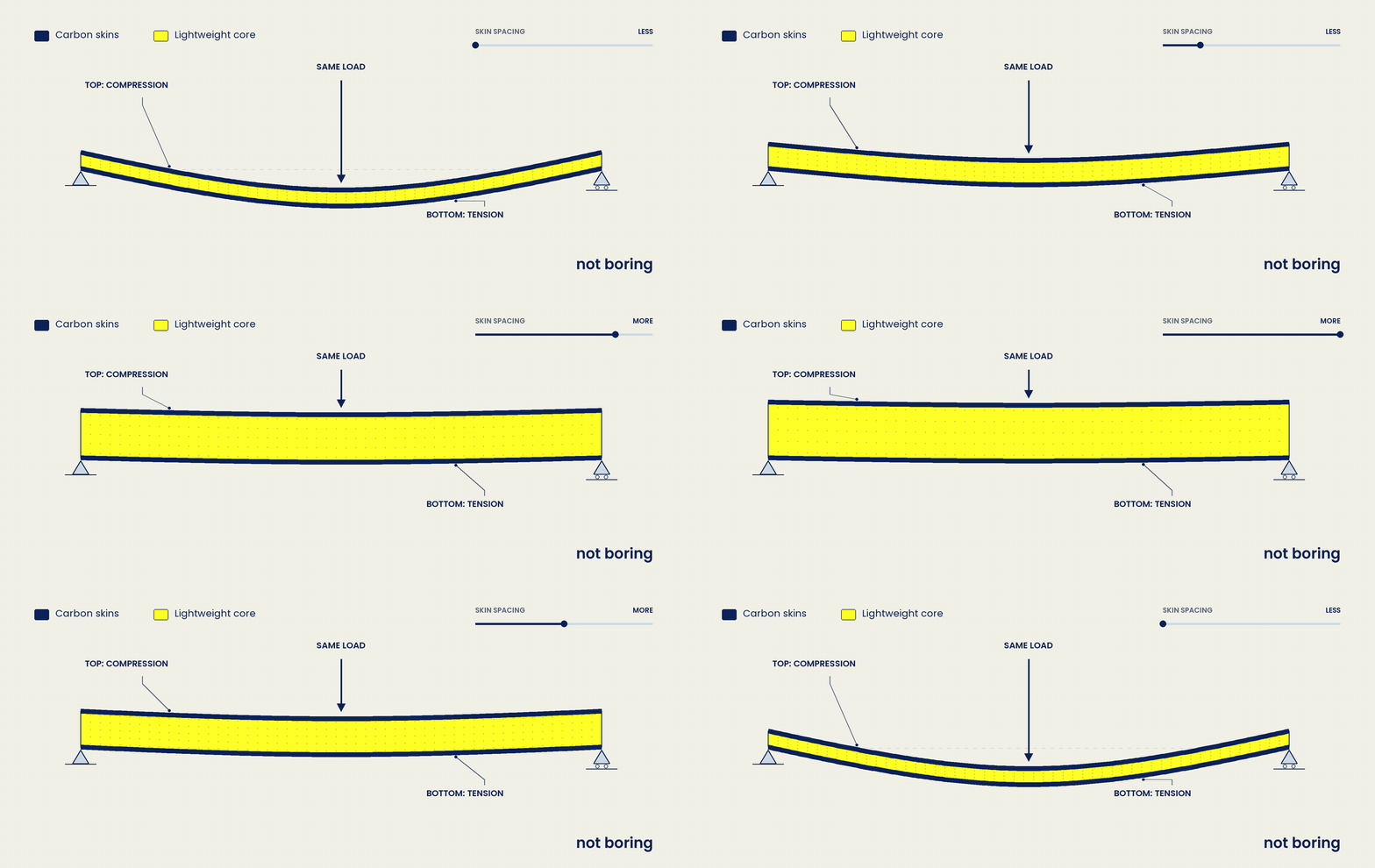
Carbon fiber lets you design a lighter aircraft, which kicks off a virtuous loop called mass decompounding. Holding payload, range, and required performance constant, the loop works like this: a lighter airframe needs less energy to fly, which means you can use a smaller battery, which reduces weight further, lowering the required propulsion power, which means fewer or lighter motors, which means even less weight, and so on.
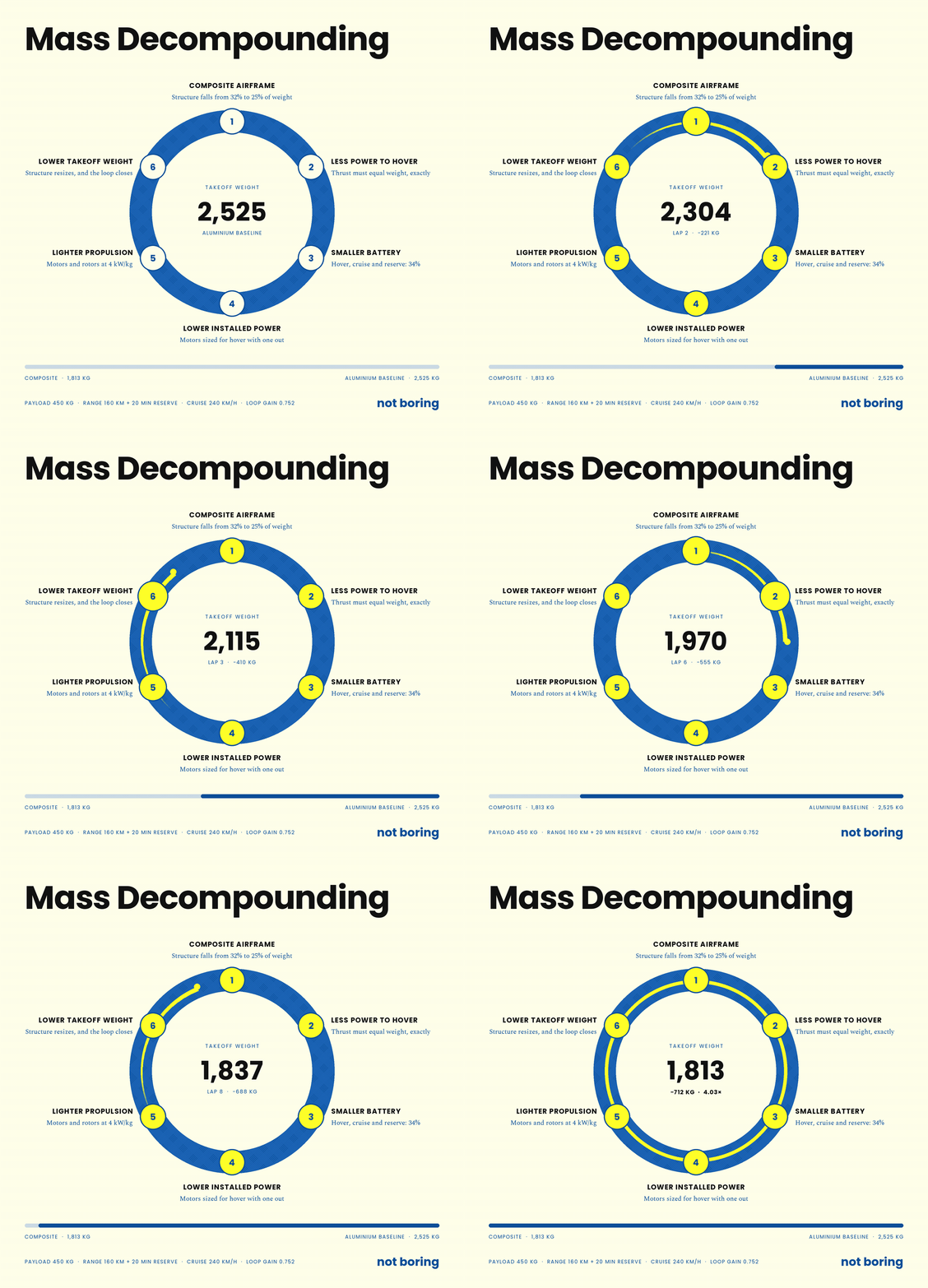
Aircraft design normally faces the opposite, vicious version of the loop: add weight, need more power, need more propulsion, repeat. Carbon fiber, enabled by autonomy and batteries, can flip it. Just as Ford bet on vanadium-alloyed steel – hiring a metallurgist, contracting a small Ohio mill to pour it, and using it in the Model T’s crankshaft, axles, gears, and springs – Naman is betting on carbon fiber.
You can do unbelievable things with carbon fiber, Naman believes, if you design aircraft carbon-fiber-first, and if you couple the design and manufacturing.
What does that mean?
“The easiest thing I can state without having any IP risk,” Naman states, “is that we can use carbon fiber to build more complex structures. What we have pioneered is the ability to make an entire aircraft in one piece - like all of the internal structures, all of the internal support.”
The Airbound Aircraft
Airbound’s v1 aircraft, the TRT, was not made in one piece, but it was made of carbon fiber.
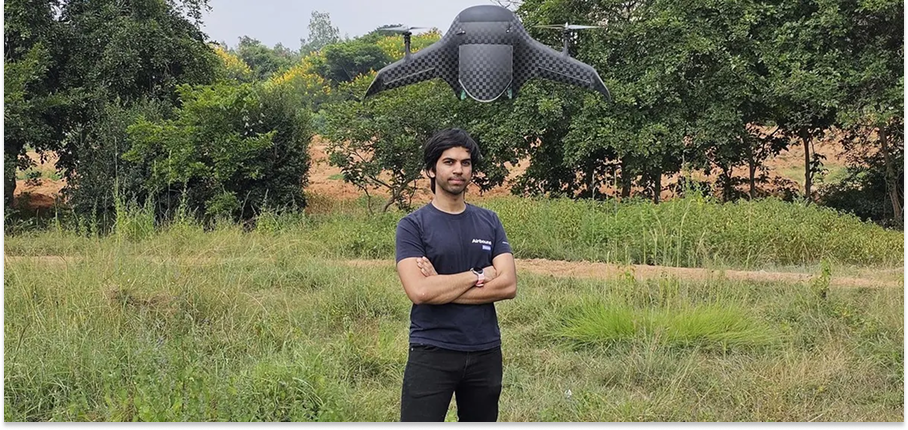
Working with carbon fiber changed how Naman thought about engineering, to the extent that he’d thought about it at all. Because he had taught himself fresh, with a specific goal in mind, he was lucky: he learned composite manufacturing without having absorbed the conventional assumptions of metal manufacturing. He just wanted to figure out how to make a blended wing body drone. As Micky said, “they’re naive, so they think anything is possible.”
And because the TRT was designed to carry a 1kg payload - specifically, medical supplies - the team could start with the impossible and iterate towards just barely achievable relatively cheaply. Small drones gave him room to experiment with material, geometry, and manufacturing at the same time.
They asked questions like “What does a carbon fiber first design look like? And what are the manufacturing capabilities we can build out in carbon fiber?” Then, he tells me, “we use the new capabilities we built to influence the design, which influences what new capabilities we need to build.”
Airbound was trying to do things with carbon fibers that others hadn’t or wouldn’t. While TRT wasn’t all one piece of carbon fiber, including the internal structures, the composites specialist on the now-growing team, Sambid, figured out how to make its surface from a single layer of roughly 40-grams-per-square-meter carbon cloth.
Sambid actually managed to crack the problem, with 36 gsm kevlar instead of carbon fiber at first, during a working interview on a Saturday, while he still had another job. “We wanted him to figure out this layup sequence that we thought was possible and had a few ideas on but weren’t able to get to work,” Naman recalled. “He said it was impossible, I said try it anyways and gave a few ideas. He gave it a try, made a few mistakes and left to let it cure overnight. That evening, he asked me, ‘Can I come tomorrow? I know I can do better.’” He came back Sunday, fixed his mistakes, and made the first successful version of that layup, which Naman thinks was the “first in India, probably first in the world.”
A French vendor that visited Airbound, Tigerfeathers wrote, “came into the office and was like ‘what the hell are you guys even doing, no one else in the market is even attempting this!’.” Outside vendors couldn’t work with such light materials, which forced Airbound to develop more of the capabilities in house. Each improvement in cutting, joining, shaping, or reinforcing the material could change what the aircraft could be, which Airbound could act on immediately, because it was the one designing the aircraft, too.
A new manufacturing technique gives the engineers a new structural possibility. They design around it, discover the next limitation, and work out how to manufacture that. Over successive iterations, the aircraft and the process evolve together. Ideally, the craft keeps getting lighter and lighter and more and more performant as the loop spins. And at some point, they learn enough that they can apply it all to an entirely new aircraft design, and then loop on that.
The current apogee of this loop is Airbound’s V2.
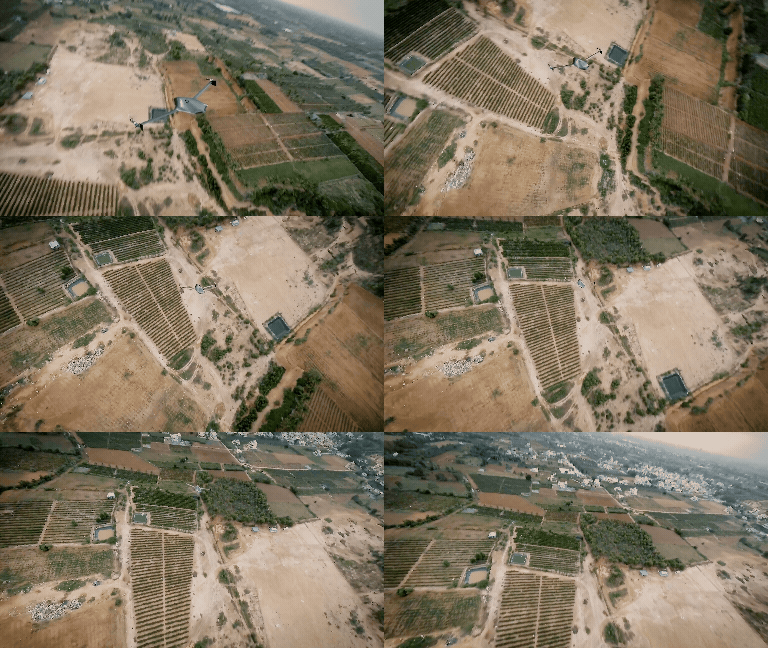
The V2 is an aircraft designed to carry five kilograms, up from the TRT’s one, with an airframe that Naman says the company can manufacture in a single piece, internal supports included.
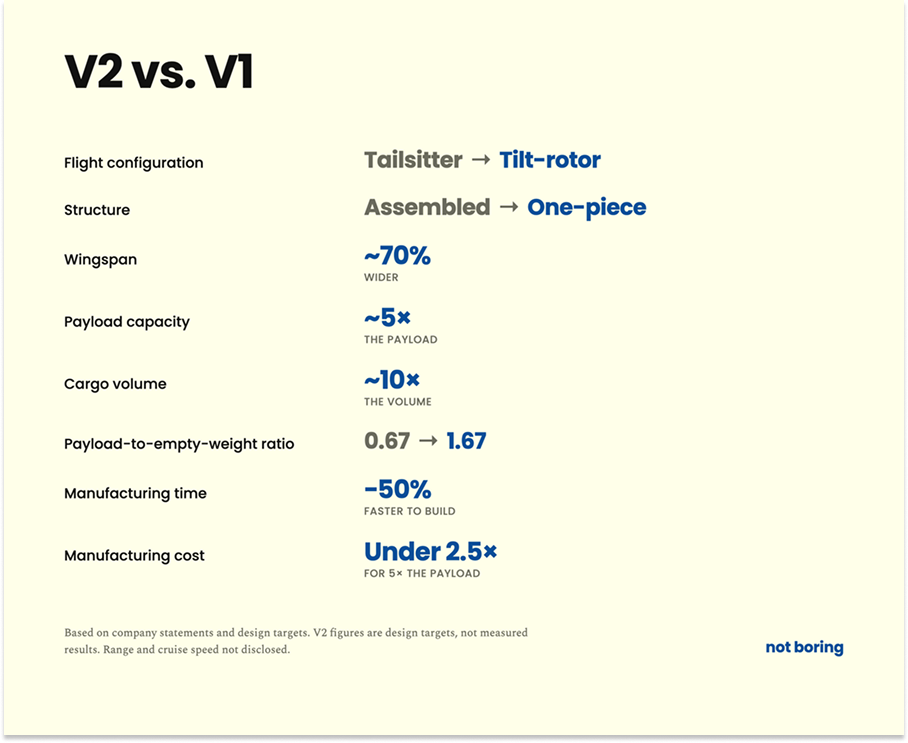
Carbon fiber makes manufacturing the V2 as a single structure possible, and manufacturing as a single structure provides a number of advantages to the weight-conscious aircraft designer.
Wherever you join two separately manufactured components, you have to transfer forces between them. The connection itself needs to be strong enough, and the material around it needs to support the connection. All of that adds weight, and it also adds work. Someone has to make the separate components, line them up, join them, and check that they’ve been joined correctly. Joining slows down manufacturing and weighs down the aircraft.
Designing the structure to be made together gives Airbound an opportunity to remove some of that weight and work at the same time. It also changes what you can design.
Take the wings. The V2 has long, narrow wings, which provide a high aspect ratio. For a given wing area, a higher aspect ratio reduces induced drag, the drag associated with producing lift. That makes long wings attractive if you want to fly efficiently. “You can just stick a wing out to infinity and it’ll be ridiculously efficient,” Naman told me the first time we talked about V2.
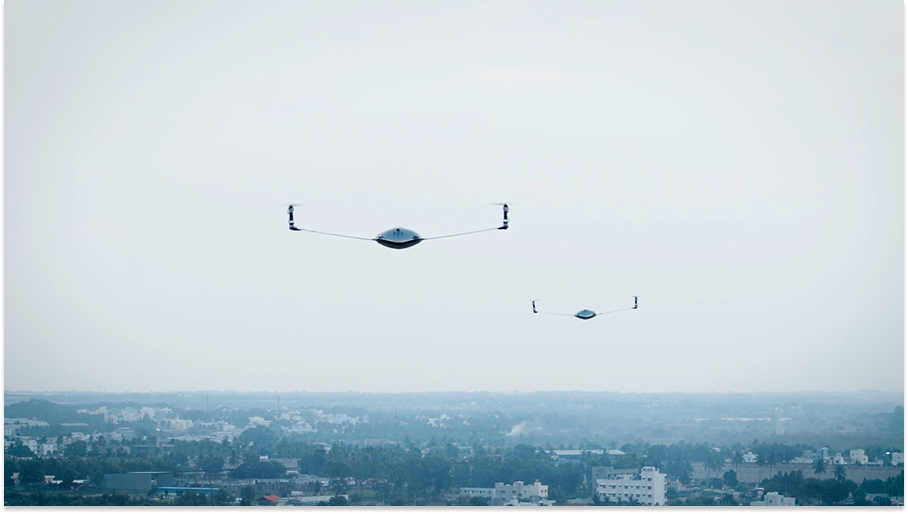
The challenge is, those long wings need to withstand the forces acting on them without bending or twisting too much, and adding material to make them stronger adds weight, which eats into the benefit you were trying to get and sends you into the vicious loop. But using carbon fiber in one piece, with no extra structural material at the join, gives you the ability to improve your aerodynamics, too. Make the wing sufficiently light and strong, and you can use a shape that would otherwise cost too much weight to support. Then you need less energy to fly the same payload over the same distance, which gives you another set of choices about batteries, range, and payload. Reduce weight further? Improve performance? A little bit of both?
In designing its aircraft, Airbound abides by a “Zero Compromises VTOL” philosophy. Moving to vertical take off and landing should not lead to a loss in efficiency. In the early designs, like the original TRT, they achieved the goal by limiting VTOL components to a minimum in order to minimize extra weight. It stood on its tail to take off, then pitched its entire body forward to fly, saving the weight of a mechanism to tilt the propellers, but that design left a broad surface exposed to crosswinds during vertical flight.
As they scale up, though, they need specialized mechanisms for versatility and safety. A tailsitter, for example, can’t scale, because it rotates, and rotating a payload limits what you can carry.
So in newer designs (like the V2 and upcoming V3), they’re focusing on adding VTOL components that add efficiency rather than taking it away. The unique(ish) aspect of their tilt rotor design is that they place their propellers at the wingtips, so that they improve the efficiency of the aircraft by countering wingtip vortices. The effect of wingtip propellers is identical(ish) to extending their wing further out, without any of the structural cost.
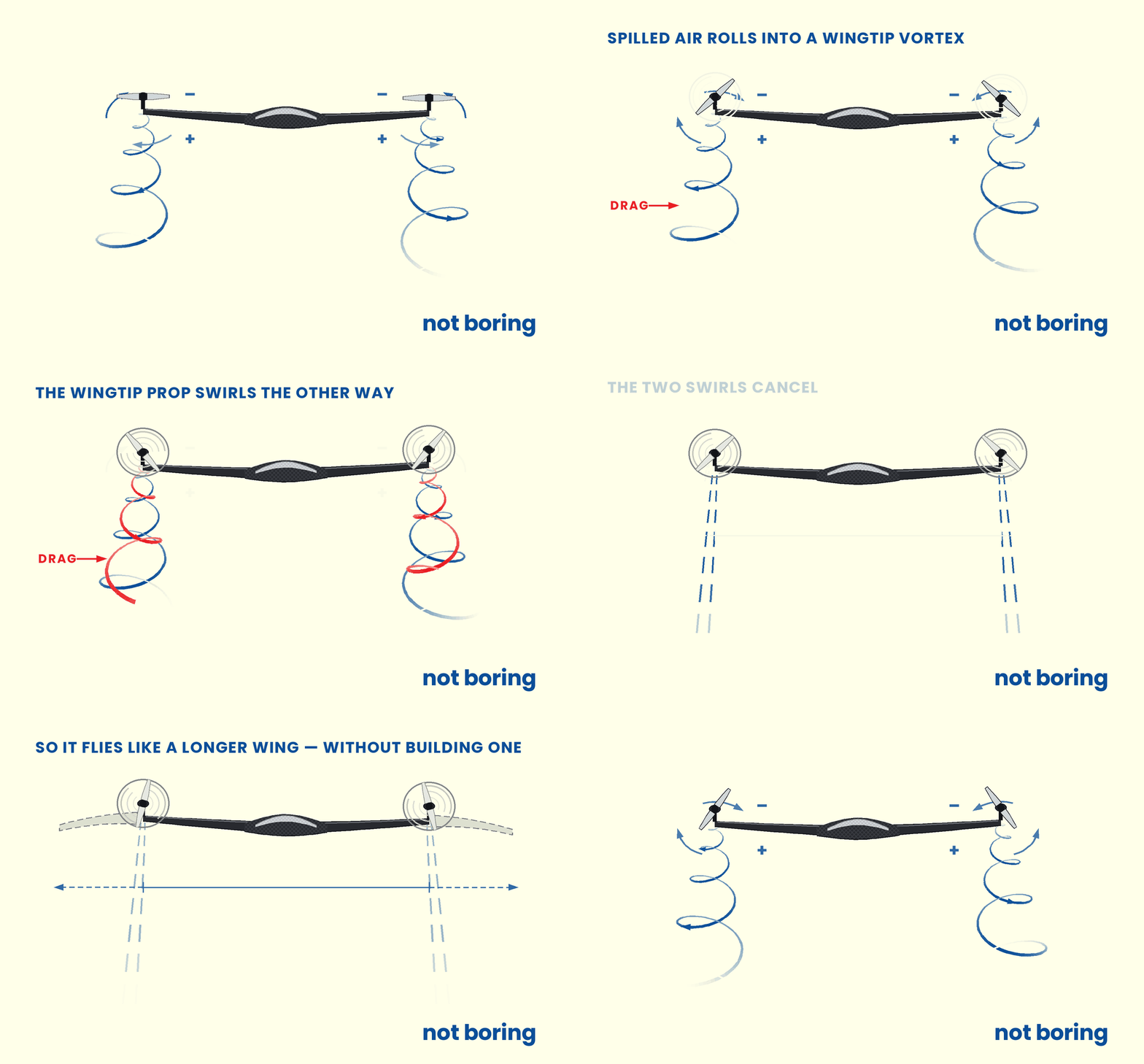
Initially, Naman couldn’t figure out how to make the tilt rotor configuration work with just two propellers while preserving its weight and aerodynamic advantages. But the longer wings help, and once the team figured out a way to tune the controller to make it more stable, it actually became easier to stabilize than the tailsitter. When we spoke after one of the first V2 test flights, and I asked Naman how it was going, he said, “It is just unreasonably stable. It is incredibly stable in the sky.”
Now that it’s flying, he realizes that “for the past three years we’ve just been engineering on hard mode [with the TRT].”
This is a useful example of how Airbound makes decisions. The tail-sitter had fewer mechanisms, and if you were designing to minimize the number of mechanisms or the weight of each component, you might not make the switch.
But Airbound’s north star is to reduce the cost per kg-km, and that allows for certain trade-offs that seem suboptimal in isolation but produce performance and economic benefits at the system level. Then, once the new system is set, they work to make it cheaper, lighter, more efficient, and more economical.
Naman calls Airbound’s approach to engineering efficiency engineering.
Efficiency Engineering
According to Naman, there are two types of engineering: capabilities engineering and efficiency engineering.
Most of aerospace engineering, he argues, including today’s drone industry, focuses on capabilities engineering, making aircraft do things they couldn’t do before. They can carry different types of payloads, hover in the air as the payload lowers to the ground, land in more difficult places, better detect nearby objects. He gives Zipline real credit here; its aircraft can do things that other aircraft simply cannot.
Airbound, on the other hand, is focused on efficiency engineering, which is what you do if you believe that the only thing that will matter in the long-run, once capabilities become commodities, is cost. It takes a fairly well-understood set of capabilities—take off vertically, carry a package, fly to its destination, deliver it—and makes them work as efficiently as possible. It reserves novelty for materials and manufacturing processes, all in service of making the system work better, cheaper.
In Vertical Integrators, I wrote that the best Vertical Integrators optimize entire systems instead of specific components, making trade-offs that those just making components might not.
Airbound is a prime example. Sometimes, as with the tilting rotors, adding something is actually the right move. Sometimes, making one part of the aircraft harder to engineer lets you make the whole thing more easily.
One of the clearest examples involves the cargo bay.
In addition to being able to carry the weight of whatever someone orders, a delivery aircraft needs enough room for the items. A five-kilogram weight limit is much less useful if you run out of space after loading two kilograms of groceries; it is limited by whichever you run into first, the weight or the volume. Naman wanted the V2 to have a large payload volume, which introduced a new problem: the cargo could move the aircraft’s center of gravity around substantially depending on where someone put it.
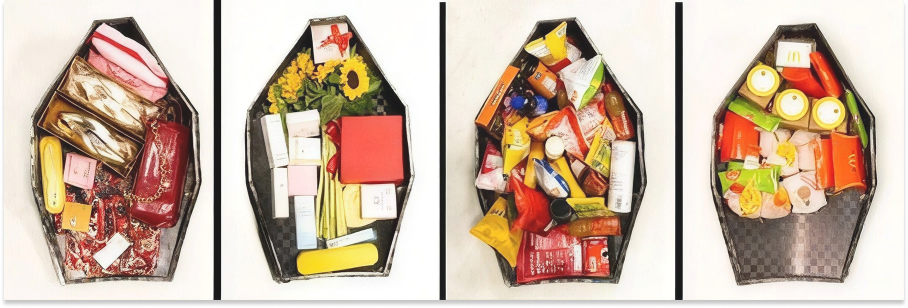
This becomes especially important when you’re trying to build an aircraft that carries more than its own weight, because whatever it carries has a lot of influence over the balance of the craft.
Naman gave me a deliberately extreme example. Imagine someone puts a tungsten cube at the very back of the cargo bay, then fills the rest with foam so it can’t slide around. The shipment might fit perfectly and come in under the weight limit while leaving the aircraft badly balanced.
You could constrain the payload space to make loading mistakes harder, but Naman hated that answer. It “physically hurts me to have to lower volume,” he said, because which payloads you can carry is limited by both weight and volume.
Instead, the team developed a way to lift the payload box from three points and use the load at each to calculate the payload’s center of gravity. If it fell outside the acceptable range, the system could reject the load and tell the worker to try again. Originally, the design process was built around maximizing the center of gravity variance the aircraft could handle, but at a certain point, when it can handle practically anything but tungsten cube-like situations, you’re just sacrificing efficiency on every payload to capture less than 1% of edge cases. At that point, stop maximizing and think. Build a system that can accept 99%+ and reject the <1% instead of failing on them.
This goes beyond aircraft design to systems design.
Elsewhere, he was willing to give the flight controller more work if doing so avoided adding weight and drag. This is similar to the Wrights’ bicycle insight, with software taking on the work of the rider. The aircraft has to be controllable across the conditions in which it operates; deciding to solve something in software gives the controls team a real challenge, but if they solve it once in software, they get it in every aircraft thereafter for free.
These are the sorts of trade-offs Naman is willing to make in pursuit of the “perfect aircraft.”
“I’m not settling for anything less than that because there is a way to measure perfection,” he told me. In Airbound’s case, that is cost per kg-km.
To calculate the cost per kg-km, Airbound counts more than the energy and people needed for each flight. It counts making and maintaining the aircraft, replacing its batteries, and getting it ready for its next job, too. Add up all of those costs over the aircraft’s useful life, then divide by the total kilogram-kilometers of payload it delivers over that same period. That’s the cost per kg-km.
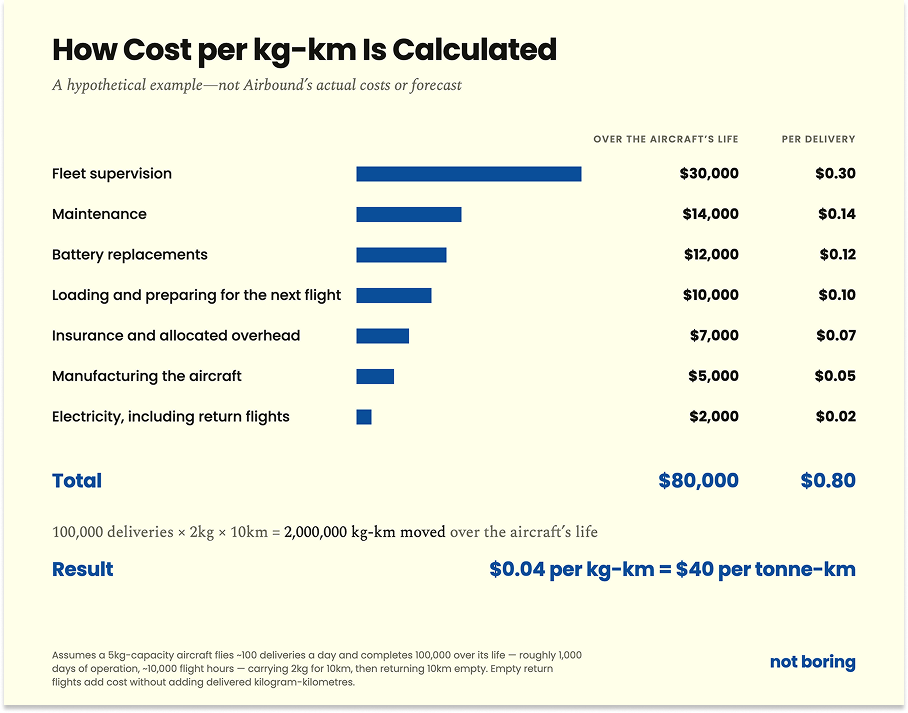
This loss function gives the team a way to argue across every aspect of the business, because each piece contributes to the cost. If one mechanism reduces the force required from a servo but weighs more than the servo weight it saves, that’s a bad trade. If making the controls more sophisticated preserves useful cargo volume without adding hardware, that might be a good one.
The arguments can get extremely detailed, but they have a built-in arbiter: what does this do to the cost of moving useful payload?
They also have a conductor.
On one of our calls, Naman was showing me the V2’s design and explaining why its wings sweep slightly forward. It was an unconventional choice for a drone, but the aircraft needed to tolerate changes in its center of gravity while hovering, and it needed to tolerate them while flying forward. Those were two different engineering problems, and their acceptable ranges didn’t naturally line up. Sweeping the wings forward, he explained, helped bring them into alignment.
I asked him how the team actually, in practice, arrived at a decision like that, how they took such a multivariate problem, with one team working on one thing and another on another, and moved forward despite the push and pull of each choice.
“This is the kind of aircraft that can only be designed by one person,” he said. “Designing the aircraft is the most complex activity. And that is, like, the one activity I can only trust myself to. Like, nobody else was involved in the aircraft design process. It was just me.”
Design, as we’ve discussed, is an iterative process, which means that Naman’s role iterates as contact with reality teaches his team. While most of the people on the team need to be experts in their respective areas, one person needs to hold enough about all of it in his head to feel how it all fits together. To understand the structural cost of changing the wings, the aerodynamic benefit the change might produce, and whether the team might be able to manufacture a structure light enough to make the trade worthwhile. He needs to know how much cargo volume customers will need, how they might load it, how far that could shift the center of gravity, and the levers available to pull to overcome those shifts.
“I need to think through the end state of how the drone will be made while designing the drone,” Naman said.
In Naman’s opinion, the founder needs to be able to follow a decision across the boundaries between disciplines, including boundaries that might otherwise separate different companies. Something the manufacturing team learns changes what the aerodynamicist can ask for. Something the controls team can solve changes how much structure the aircraft needs. He can consider changing several of those things together. Vertical integration helps insofar as the founder can wield the information and control that vertical integration enables.
Fred Brooks, the computer scientist who wrote The Mythical Man-Month, argued for a software system architect who preserves a design’s conceptual integrity, the coherence of the whole, as many people work on its parts. Even an iterative development process, he argued, needs someone responsible for that coherence.
Brooks was writing about software. At Airbound, which makes flying hardware, weight compounds the consequences of losing that coherence.
Imagine each team adds a little hardware to make its own problem easier. The controls become easier to tune. The structure gets a more comfortable margin. Assembly becomes more forgiving. Each decision might be perfectly reasonable on its own, but each adds a little bit of weight, which demands more power, which means bigger batteries and motors and more weight.
Brooks, in fact, used aerospace to illustrate the importance of knowing which resource a team is optimizing. In a NASA moon shot, he told Kevin Kelly in a 2010 WIRED interview, “money is abundant but lightness is scarce.”
Naman’s job is to preserve lightness while still producing an aircraft that people can load, manufacture, maintain, and fly reliably. That requires an obsession with understanding where weight might be saved without making everyone’s jobs impossible, and it requires knowing when to spend weight, as he did on the tilting mechanisms, because the aircraft benefits overall.
The team supplies the specialized knowledge that makes those choices possible. Sambid’s work with thin carbon cloth is a good example. When Sambid figures out how to use really thin carbon fiber cloth, Naman’s job is to understand what really thin carbon fiber cloth makes possible elsewhere in the design, what new capabilities that resulting design will demand from the team, and how much those demands will cost in grams and dollars.
“What makes you good at this?” I asked him, as someone who would decidedly not be good at this.
“A good efficiency engineer is someone who can predict the future,” he answered. “Before I do an experiment, will I know whether this works or not?”
But how can he predict what will happen?
Naman provided a glimpse in a conversation he had with Hemant Mohapatra, a Partner at Airbound investor Lightspeed India, on the Lunchbreak podcast, when he said that basically, he just understands six or seven basic axioms and can build everything up from there.
I think there’s something to the fact that Naman never went to college, that he learned basic axioms, found a problem he really wanted to solve before he’d learned much else, and then set those axioms and directed knowledge acquisition to work on solving it. His intuition has all developed around one idea. There’s that quote that Hall Hibbard once said about Skunk Works legend Kelly Johnson, “That damn Swede can see air.” Naman can see air, too.
When you talk to Naman, you can almost feel how deeply and naturally he understands the forces at play. His objective is simple, and so are the axioms on which the solutions are based. Being able to see how they fit together is incredibly complex, but it’s what he’s trained himself to do on YouTube, in long hours spent cutting, shaping, and joining carbon fiber sheets by hand, and by watching what he’s built try to fly.
That last part is important, because no matter how much Naman can hold in his head, and no matter how good his or any team is, to understand how something flies, you need to fly it.
Which is why the fact that autonomy, the electric stack, and carbon fiber allow Airbound to build small things first is so important.
Small, Medium, Large
If Tesla had its Master Plan, this is Airbound’s: build just three aircraft, a Small that carries 5kg (V2), a Medium that carries 100kg, or a person (V3), and a Large that carries 500kg, or a family (V4).
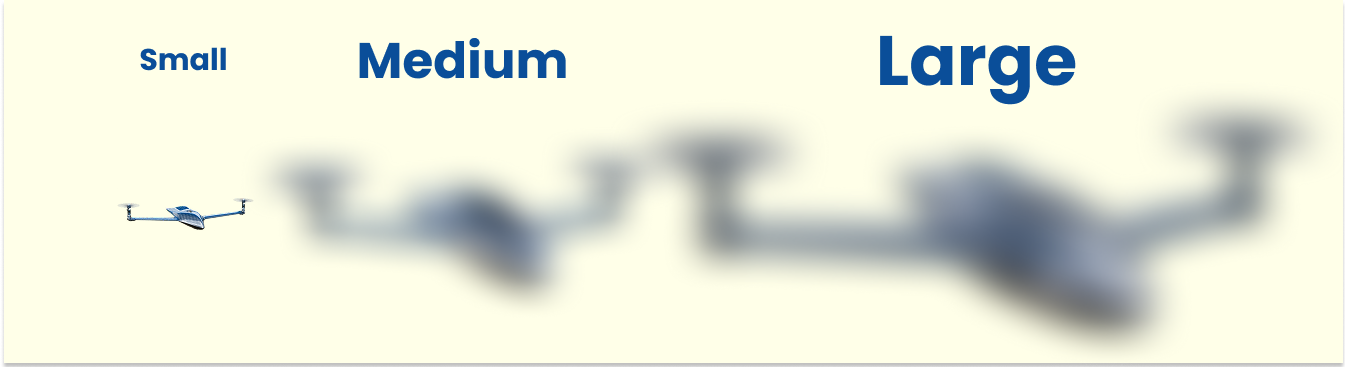
The plan begins with cargo in small vehicles, allowing Airbound to learn cheaply before it carries people, a luxury afforded to the company by the modern ability to build small. Ford didn’t have that luxury, so he tried to start with a personal airplane.
On July 30, 1926, his sixty-third birthday, Henry Ford unveiled the Model T of the air.
He called it the Flivver, after the slang people already used for the Model T itself. It was a single-seat monoplane, a little over fifteen feet long and 350 pounds empty, with a three-cylinder, 35-horsepower engine. According to its designer, Otto Koppen, Ford wanted it small enough to fit in his office. Ford’s top test pilot and close friend, Harry Brooks, used the prototype to fly home from Ford Airport.
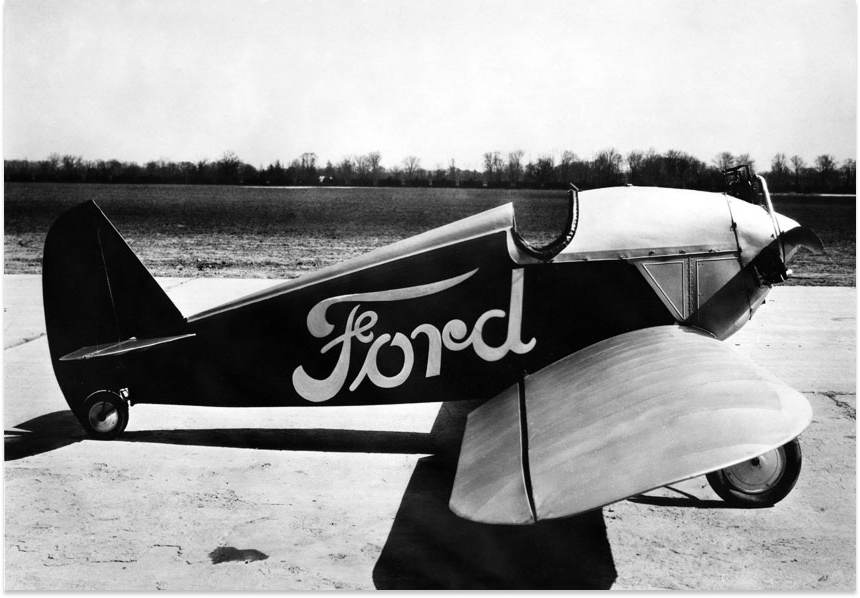
In February 1928, Brooks tried to fly a Flivver from Detroit to Miami. He broke the light-plane distance record on the way, but the destination was Miami, so on to Miami he went. En route, he crashed near Melbourne, Florida, and died. Ford abandoned the project.
Eight years later, in February 1936, a Curtiss-Wright engineer named Theodore Paul Wright published a paper in the Journal of the Aeronautical Sciences called “Factors Affecting the Cost of Airplanes.”
At the time, the Bureau of Air Commerce was sponsoring a program for a small two-seat airplane it hoped could sell for $700, if ten thousand of them could be built. The Bureau’s director at the time was Eugene Vidal, Gore Vidal’s dad. One economist who later dug into the history suggests Wright was inspired by both the mass production of cars and the dream of the family airplane.
What Wright found was that each time the cumulative number of airplanes built doubled, the labor needed to build each one fell by a steady percentage, about 20% on average across American aircraft makers. We call it Wright’s Law now. The curve behind cheap solar panels, cheap batteries, and cheap chips, and hopefully cheap nuclear reactors, one of the most oft-cited ideas in not boring, began as a study of how to make airplanes cheap.
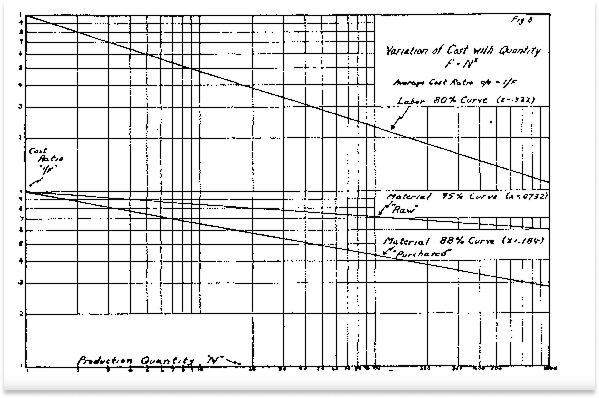
Wright discovered his Law in pursuit of a cheap little airplane. It went on to make almost everything cheap except little airplanes.
Neither the $700 plane nor the Flivver ever arrived in every garage. Planes, thanks to steam-carriage-like economic factors, went big, and therefore, the number of planes produced annually stayed small. “The entire aviation industry globally makes less than 10,000 aircraft a year,” Naman likes to point out, roughly the size of the single production run the Bureau hoped for ninety years ago. The auto industry makes something like 90 million vehicles a year. It has ridden Wright’s curve while airplanes have not.
Today, however, autonomy, the electric stack, and carbon fiber, make small aircraft make sense, which should be a starting point from which to scale to automotive-like volumes.
“Autonomous means I’m not paying any penalties for building small, and then carbon fiber lets me build better,” Naman told me. “So the point is that if I can now build better and there’s no cost to building small, let me build better while small and then scale that up.”
Small
Airbound’s big plans start small.
“Let’s perfect it in a 5kg model,” Naman said, referring to the V2, or Small. “Because that’s what lets us iterate a lot. There, it’s a lot cheaper to iterate. We put a product out into the market and perfect it, and then the engineering risk is just scaling it up.”
Airbound’s V2 is much cheaper than its larger drones will be to produce, and is already cheaper than existing drones made by bigger companies. The V2 costs less than $5,000 to make in India, and would cost an additional $1,000-2,000 with American labor. While there aren’t great publicly available cost numbers on competitors’ drones, Naman estimates that they cost roughly $100k when they were at Airbound’s current production scale, and have come down to the mid-to-high tens of thousands as production ramps. The human-carrying eVTOLs we talked about earlier are obviously much more expensive, at over $1 million to produce and $5 million to buy.
For V2’s price and weight, it is also a very performant aircraft. Naman’s rule of thumb for a conventional aircraft is “30% structures, 30% fuel, 30% payload.” A fully loaded V2 is more than 60% payload at takeoff, and Naman thinks Airbound can get its structure down to 4-5% of the aircraft’s total weight.
It’s easier to manufacture, too. V2 has a wingspan nearly double that of the TRT, and it should take half as long to build.
How? “We just simplified shit a lot,” Naman said. “The running joke is that the V1 was designed by someone who didn’t know manufacturing and the V2 was designed by someone who knows manufacturing. They were both designed by me.”
The Small doesn’t need to beat a fully loaded semi to generate a lot of demand, although there are some uses the Small can steal from a truck immediately: things that people want immediately. Because it doesn’t need to wait for a batch and because it flies over traffic and buildings as the crow does, the Small can start eating same-day delivery use cases on items up to 5kg.
The Small, Naman says, “is meant to be the aircraft that can compete with vans in last-mile.”
The Small mainly needs to beat the cost of a person on a scooter, in a car, or around a van route hand-delivering you something that weighs a few kilograms. In the US, DoorDash advertises base pay of $2–10-plus per job, before tips and promotions. If Airbound can get its all-in cost below a dollar per delivery, it could charge less than many existing US delivery services, earn a margin, and still make a lot of existing deliveries cheaper. India, where Airbound is starting, is a much tougher bar to beat: its deliveries are both cheaper and faster. When we first met, Naman told me he was shocked at how bad American delivery was. Still, a cheap, driverless aircraft should be cheaper and faster than even Indian delivery.
As the cost falls, more things make sense to deliver, more frequently. You might happily pay $5 to have a full dinner delivered, but you probably wouldn’t pay $5 to have a lime delivered to make a margarita unless you were a real lush. But at 50 cents? 25 cents? 10 cents? At some price point, you’d probably stop storing a bunch of things yourself and just order them when you need them. This is particularly true if an AI assistant is monitoring and ordering for you, so you don’t even need to spend the mental energy.
In 2025, Grandview Research sized the market for last-mile delivery at about $167 billion. This is probably high in some ways and low in others. For example, it doesn’t include the cost of the delivery vehicles themselves.
Because Airbound is starting small in an enormous market, and because it’s not flying humans, it’s able to fly a lot. Airbound has made more than 13,000 autonomous flights across Bengaluru and Guntur. When I talked to Naman earlier this month, he had two V2s and twenty-six TRTs in the air at the same time. Each flight gives Airbound data with which it can both improve its aircraft and operations, begin making the case to regulators that Airbound aircraft are safe, and work towards larger platforms.
Medium
All of that flight data will be particularly useful for the Medium aircraft, which will start by flying packages but is intended to ultimately fly humans.
Naman himself admits the Medium can’t be just a scaled-up Small. It has different aerodynamics and a different structural fraction, because it’s a different aircraft with a different airframe. What he hopes to transfer and scale is everything around the airframe:
The carbon-fiber-first design method and the one-piece manufacturing process
The experience making lots and lots of aircraft
The controls work and design principles that make V2 “unreasonably stable”
The autonomy stack and the operations playbook
The supply chain and regulatory relationships
The flight hours
Turns out, that’s actually the kind of stuff that Wright was tracking (the Wright stuff), too. He tracked how many hours of labor it took to build the next plane, which improved based on everything the manufacturer learned. That’s why Wright’s Law describes the “Learning Curve.” In Airbound’s case, the learning from the Small will be brought to bear on the Medium.
The Medium is the aircraft Naman is most looking forward to building, because he can make it much more efficient than the Small.
“It is like, you just cannot make a five kg as efficient as you can make a 100 kg aircraft,” Naman said. “It’s not physically possible.”
You can understand why by watching the birds. Small wings moving slowly live in what aerodynamicists call the low Reynolds number regime. There, the air’s stickiness matters much more relative to the wing’s size, so a small wing pays more drag for every bit of lift. It’s why the sparrows flap like crazy and the heron floats.
Naman says his most efficient designs are north of 100 kg. Bigger aircraft can be proportionally lighter, too. At 100 kg, he thinks structure can get to about 4% of the aircraft’s weight or lower, without needing carbon cloth any thinner than what already exists.
The Medium also fixes the Small’s people problem. While Airbound’s aircraft are cheap to manufacture and getting cheaper, flying one is “still double the cost of what it should be because of labor,” he told me. Specifically, while there are no pilots in the aircraft, people are still required to supervise the fleet from a control room, remotely. As Airbound proves its vehicles are safe, and as regulations change to support drone delivery, the same person will be allowed to monitor more drones. Today, in India, there’s no regulatory limit on how many drones one person can monitor. In the US, it varies from operator to operator, but no one has gone higher than about 10. For now, one person watches every five Airbound aircraft fly. No matter how low that ratio goes, as long as it’s above zero, an aircraft with 20x the payload will pay for 20x less labor per kg.
At that scale, Naman expects electricity and battery replacement to account for most of the cost, with battery replacement the largest item. Longer-lasting batteries and more efficient aircraft would then become the main ways to drive costs lower.
“What we are saying,” Naman said, “is that we can make it so that energy starts to dominate at 100 kgs.”
That will be an incredibly important milestone. When energy dominates, you’re left with physics and nothing left to squeeze but the aircraft itself. And squeezing the aircraft is what Airbound does.
Over time, the goal is to get cheaper (cost) than most vehicles carrying 20 tons on a kg-km or tonne-km basis, even though Airbound aircraft will carry only kilograms at a time, in the air, meaning it will win on speed and versatility, too.
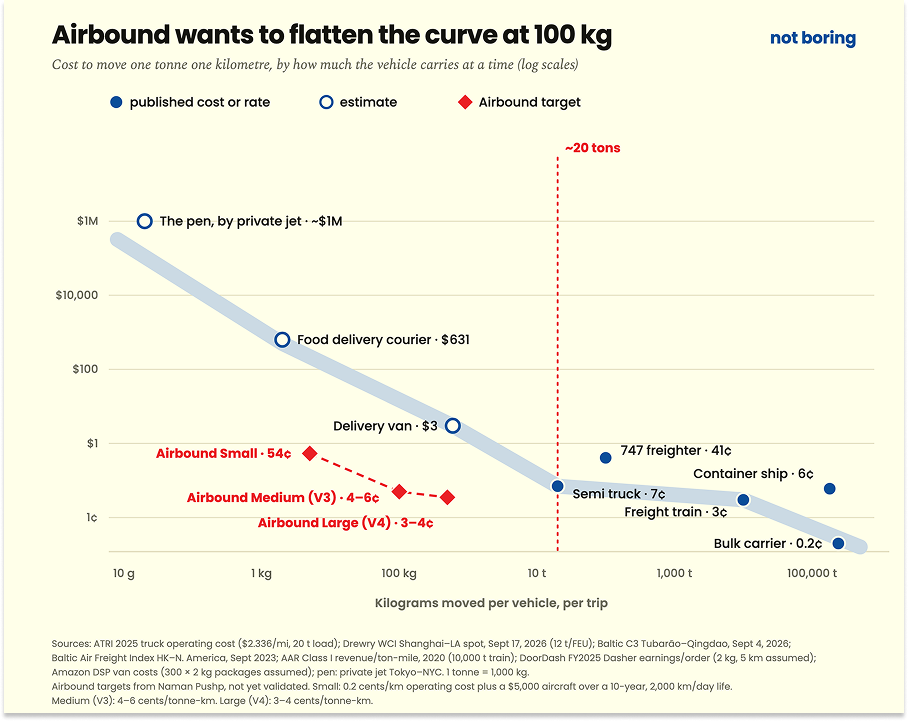
The x-axis shows how many kilograms a vehicle moves at a time. The y-axis shows what it costs to move one tonne one kilometer (the numbers look silly small on a kg basis, so multiply by 1,000 to get a tonne). Bigger is cheaper per kilogram, and costs in the chart are sensitive to loading: the closer a vehicle is to its max payload, and the fewer empty return trips it makes, the cheaper per tonne-km.
“There is a linear relationship between the amount of payload moved and… cost per kg, or cost per ton,” he said, until it “starts to flatline after like 20 tons plus.” Moving a kilogram in a semi is much cheaper than moving it in a van. Moving it in something bigger than a semi isn’t that much cheaper than the semi. This curve is why logistics companies and airlines batch, why your package sits in a warehouse waiting for enough other packages to fill a truck.
Airbound’s pitch is that it can flatten the curve out at 100 kilograms instead of 20 tons. If moving 100 kilograms at a time, like the Medium will, is about as cheap per kilogram as moving 20,000, you don’t need to wait for the other 19,900.
Hitting those costs requires high utilization, which makes the choice between charging and swapping batteries important. It will come down to the economics of each country. For now, in India, where labor is cheap, he’d rather use 5 minutes worth of labor to swap the batteries vs investing in infrastructure to autonomously charge the systems, especially since charging is slower. “It’s basically a question of ‘which is more expensive: 5 minutes of labor cost many times a day, or a 60% utilization loss per vehicle?” Naman explained. “In the US, using labor is probably more expensive. In India, losing the utilization is costlier.”
To dominate, to win on speed, versatility, and cost, the Medium will need to get very cheap to operate, based on a million different decisions on everything from battery swapping to loading to design. The American Transportation Research Institute puts the average operating cost of a truck at about $2.34 per mile. Spread that over a full 20-tonne load and convert to kilometers, and it costs roughly seven cents to move one tonne one kilometer. Carry a half-load – ten tonnes – at the same vehicle cost, and it’s about fifteen cents.
Naman’s target for the Medium is four to six cents per tonne-kilometer. That’s cheaper than a fully loaded semi, and Naman expects it will also be less than half the cost of a bus or train. That is what it takes to give everyone access to flight. Carrying a full 100 kilograms, it works out to about half a cent per kilometer. And those are straight-line kilometers, which Naman counts as worth about two on the road, so the real gap is wider than the per-kilometer numbers suggest.
It’s a target, and there is much work to be done to get there. But getting better than, or close to, full-20-ton-truck economics at 100kg would be a major unlock. A business could receive a truckload’s worth of goods over the course of a day without receiving a truckload all at once, and send each order out as soon as it is ordered. At some point, they will restructure their operations towards point-to-point from fulfillment centers further from a city’s economic core.
Despite the fact that most cargo volume moves on ships, trucking accounts for half of the global logistics market by spend. Market size estimates vary, but it’s somewhere between $8-12 trillion, of which trucking makes up $4-6 trillion. Whatever the true size, it is a very large prize, and one that is largely determined by price.
“2027 is the year I will start pitching ‘Replace all of your trucks with my drones. Not some of them, all of them,’” he said.
But cargo shouldn’t have all the fun. People want to move themselves faster, cheaper, too. The Medium will be the first Airbound aircraft designed to do that.
The sequencing is intentional. Getting regulatory approval to fly humans is much harder than getting approval to move packages. Airbound can use less precious cargo to learn how to make the Medium better, cheaper, and safer, and use the data from its flights to prove that it is indeed safer.
“Before moving a single human,” he said, “let me just come to you [the regulator] with like 10 million hours of flight data on… an aircraft that is technically capable of carrying humans,” carrying “payloads that weigh about the same as a human.” It’s sort of like Wright’s Law applied to safety: learn by doing, and get better and better the more you do, so that by the time you fly humans, you know it’s safe.
An aircraft that carries humans will need to be safe and comfortable for humans, too. It will probably need windows, for one thing, and a seat, for another. Adding windows to the single carbon fiber structure will introduce engineering challenges, and the seat will introduce weight. An early sketch Naman showed me didn’t look very comfortable, but it’s not physically impossible to carry humans safely and comfortably, and there will be plenty of room in the cost to work with. Already, in just a couple months, the latest design has the ceiling height of a sports car, and is roomier in every other dimension. He is learning.
The goal, at the start, is to make the Medium cost competitive with a car. On launch, he expects it to cost around $20,000 to manufacture and about $35-40,000 to buy as a starting point, with costdowns from Wright’s Law from there. He doesn’t expect it will replace the family car, but he does think that it might replace the second car. “That one is normally just for getting one person to work anyway,” he said.
To really eat into the market for moving people though, Airbound will need to let them move together.
Large
Naman plans to introduce a 500 kg aircraft as well. He didn’t want to at first, because five 100kg craft can do what one 500 kg craft can, but he realized that people have families, and families like to travel together.
Here, the cost to beat is the family car.
AAA’s 2026 analysis puts the average cost of owning and operating a new car at about 86 cents per mile, assuming 15,000 miles a year over five years. Fuel, maintenance, repairs, and tires account for about 29 of the 86 cents, so even if you already own the car and count only fuel, maintenance, repairs, and tires, that’s 29 cents a mile. A Medium, which carries just one person, would be much cheaper, at Naman’s under 2¢ per mile target. A Large with a full family in it, at Naman’s target costs, would be about 3¢ per mile. Both would be comfortably cheaper than the family car, not to mention faster and cooler.
How big is that market for moving people? Here, the math is a little trickier, because the ride-hailing, public transport, and airline markets are surprisingly small (combined ~$3T or less). The vast majority of the market is in private vehicles - the car itself. Each year, $2.5-3T of new cars are sold, not accounting for used cars (another $2T or so), not including parts and service, financing, or insurance, which is why Airbound wants to compete with the car itself on cost.
This vehicle, of course, exists only in spreadsheets and in Naman’s head. The numbers work on paper, but there will be an enormous amount of design, engineering, manufacturing, and regulatory work to get there. It is, however, incredibly important to Naman that he and the team get all that work right. That is how you do to the car what Ford did to the horse.
Earlier, I compared today’s eVTOLs to the early automobile. Look at the numbers, though. The Model T went from about a year and a half of the average American’s pay in 1908 to about a fifth of a year’s pay in 1925. Call it 8x. Getting a $4-5 million passenger eVTOL to something like a car’s price takes more like 100x. At Wright’s 20% per doubling, 100x takes about twenty doublings of cumulative production, roughly a million times more aircraft than you initially built. And at $4 million, there’s unlikely to be enough demand to do much doubling.
To be fair, this is why companies like Joby and Archer aren’t selling eVTOLs to consumers, but planning to operate them like flying taxis and buses. That way, they can amortize the cost.
Still, Naman’s bet is that instead of pushing a $5 million vehicle down the cost curve, it’s much easier to push a sub-$5,000 one up the size curve while continuing to bring the cost-per-kg-km down. Airbound will keep doubling production, making more carbon fiber and components by serving the more abundant demand for burritos delivered more cheaply than by bike and blood delivered more quickly than by van. That is how you push out the efficient frontier.
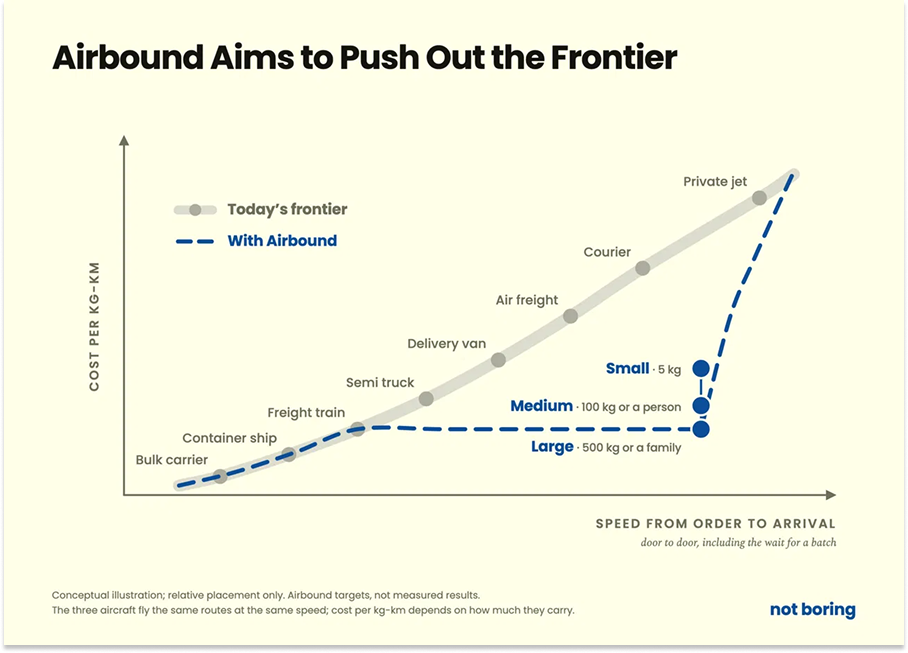
My bet, in investing in Airbound, is that Naman’s bet is the right one, and that if it comes even close to paying off, it has the potential to support an absolutely gigantic business.
S, M, L Aircraft → XXL Business
As we’ve been going back and forth in our conversations, Naman and I have tried to come up with one chart that clearly explains how Airbound wins more and more of a share of movement over time, and this is the best we’ve come up with.
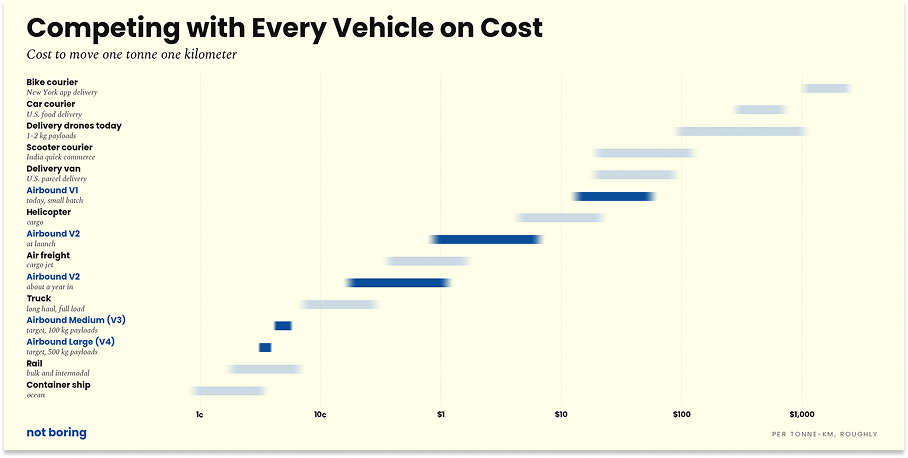
Each light blue bar is a way to move things today. The dark blue bars are Airbound’s costs and target costs, from V1 today to the Large. Each new aircraft targets a lower cost per tonne-kilometer.
Every vehicle Airbound beats on cost opens another market it can compete for. Beat more and more vehicles on cost and you capture their business.
It’s one clear bet, and Airbound is all-in on it. I fucking love it.
“Imagine,” Naman asked me, “what would happen if every single automobile ever made was just squished into three variants.” Like, if instead of cars from dozens of companies in countless makes, models, and configurations, instead of scooters, delivery vans, trucks, taxis, and family cars, not to mention helicopters and small private planes, just three vehicles captured all of that demand.
Imagine the scale you could achieve on those three platforms. Imagine Wright’s Law ripping those platforms down the learning curve with each doubling. Imagine the orders you’d place for all of the components you need, and imagine the margin you could squeeze out by making many of them yourselves. Imagine making those platforms cheaper and cheaper and more and more performant, such that the demand those three platforms would generate today is dwarfed by Jevons Paradox tomorrow.
The timelines at play are very long, as they can be for someone who’s only used up two of his many decades himself, and the costs that Airbound will need to achieve are very low, and they are, to be clear, just Airbound targets for now, but the idea is that the more different vehicle use cases Airbound can move onto its platforms over time, the more the advantages will compound in its favor.
“There’s something quite deep about the notion of using time horizons as a competitive advantage,” Stripe CEO Patrick Collison told Ezra Klein a decade ago, “in that you’re simply willing to wait longer than other people and you have an organization that is thusly oriented.”
Decades are an advantage, as is pushing all of those decades improvements onto a small number of platforms.
Automakers already understand the value of this, which is why many build both mass and luxury brands on the same architecture. By its tenth anniversary in 2022, Volkswagen’s MQB architecture had underpinned more than 32 million vehicles across the group. Standard interfaces nearly halved the number of engine and gearbox variants; versions of the heating and air-conditioning system fell from 102 to 28. When Wolfsburg began producing the new Golf in 2019, it was able to reuse around 80% of the existing body-shop installations. Customers got different cars, but underneath, Volkswagen repeated much more of the engineering and manufacturing.
Naman wants to extend that logic across categories that currently require different machines. The economic imperative for a scooter, a van, or a truck disappears if one aircraft can do enough of their jobs at a lower total cost, faster and more flexibly. And the more of those jobs it wins, the more resources Airbound can put into making that aircraft cheaper.
Some of the math is straightforward, simple industrial logic. Say it costs $10 million to develop a particular component. If you can only recover that investment over a thousand units, development alone contributes $10,000 to each one. If you can recover the cost over a million units, development costs only contribute $10 to each.
For cars, this kind of math is standard, but Naman argues that airplanes are made in such low volumes that their components are far more expensive than they need to be. Take avionics, for instance.
“An aspect that a lot of people miss,” Naman told me, “is that the reason why you have avionics that should cost tens of dollars to make, being sold for tens of thousands of dollars in aviation, is because this industry is just pathetically small. It is insane how small the scale of this industry is. Which means that you have these highly bespoke supplies. There is nothing expensive about making aviation-grade hardware. And honestly, the R&D required to get to that hardware is also not that expensive. Because it is low volume, the cost ends up being obscenely high. What should actually happen is if you get to automotive scale, aviation-grade hardware should maybe be 20% more expensive than automotive to compensate for the higher cost. The other part where this cost comes down is because if we can get to reasonable scales, we can expect industrial-grade costs for our internal components. We can start to expect to use more standard components for these aircraft.”
Would they just make the parts themselves then?
Naman’s answer is another reason it makes sense to start by moving things before moving people.
“The nice thing is that off-the-shelf hardware, the cheap off-the-shelf hardware works for cargo movement,” he said, before departing on another riff.
“Cargo movement is just less sensitive. This is generally acceptable for drone systems. Sure, maybe instead of like one small flight computer, I need 3. But I mean, even at small scale buying that’s what, less than $600 in flight controllers? And with scale, that number goes down massively. So that is what makes avionics really cheap. And as we get into passenger movement, we will need much better flight controllers. But there, what I would want to do is I would want to start by making these flight computers ourselves, creating this template, and then rather than going to aviation suppliers and saying, ‘hey, make this for me at scale,’ I would rather go to automotive suppliers and say, ‘look, you already have scale. Make this better component for me.’ This is in fact the same thing that we’re dealing with with drone components because the drone industry we believe just doesn’t have that quality and have that sense of scale. And the reason why we will be attractive for an automotive supplier is because we will give automotive volumes. And at the end of the day, this creates bigger companies. Like our idea is that we don’t want to create suppliers like the suppliers Boeing has. We want to create suppliers like Foxconn. And guess what? Foxconn is bigger than Boeing by revenue. It’s crazy how huge you can get with just low margin, high volume. And that’s what we really want to turn aviation into.”
So is that what Airbound wants to become, a Flying Foxconn?
Not exactly, because he wants to sell the product itself, and because despite its revenue, Foxconn is smaller than Boeing by market cap. Airbound wants its suppliers to become Foxconn.
“To some extent,” he told me, “we have to play the role of supplier for most things to kickstart this, but eventually, we want to vertically integrate into the things that matter most, and have suppliers build out the rest at scale.”
He thinks Airbound can become the world’s largest carbon fiber fabric consumer, for example, which would provide enough incentive for someone else to get really good at it.
Airbound’s advantage today is in turning carbon fiber into an aircraft: figuring out which structures carbon fiber allows them to make, how to make them, and how better manufacturing processes might change what the aircraft can do. As we’ve discussed, those things develop together.
At much higher volumes, it would be worth it to a supplier to spend the CapEx to solve those problems with equipment and automation. Nothing, I would imagine, motivates you to automate like the healthy percentage of his life that Naman has spent wrestling carbon fiber sheets by hand. Every small reduction in scrap becomes valuable when you have enough scrap, just as John D. Rockefeller found it worthwhile to use 39 instead of 40 drops of solder to seal each five-gallon can of kerosene. Every production improvement that saves ten minutes per aircraft saves almost nineteen years of continuous labor across a million aircraft. These little things compound.
Naman thinks the effect can eventually reach further upstream, into making the carbon fiber itself, not just turning it into sheets. “We will actually make carbon fiber cheaper,” he told me. “We will bring carbon fiber down to a point where it becomes a similar cost to steel.”
Ideally, at enough scale, and with enough proven demand, Airbound will incentivize other suppliers to invest in getting really good at making carbon fiber, so they can focus their capital and attention on new problems.
This is how Naman thinks about batteries.
In July, Naman told me that if Airbound captured the amount of movement he had in mind, it could become “the single largest consumer of lithium ion cells in the world,” they might even buy, he predicted, twice as many lithium ion cells as everyone else combined.
There is a bit of bravado in this answer, a sense that Naman is already living in the future that he can see, but the importance of batteries is a clear and present challenge today, and he’s already thinking about what it would look like to not have to use traditional lithium ion cells.
“Our cost numbers,” Naman explained, “are incredibly sensitive to our battery replacement cost, which means if batteries become cheaper, the cost comes down dramatically. But more importantly, if batteries become longer-lasting, the cost moves down dramatically. Think about solid state batteries. If they can work, they’re projected to have, I think, 10-100x the life of lithium ion, so that will be fun when we can adopt them.”
Fun. IF they can work is a big caveat, because the big challenges to commercialization today are precisely the longevity issues, like cracking, loss of contact, and dendrites. What he means is that, theoretically, they should be able to last longer, and the way he sees it, getting from theoretical to practical simply means solving a bunch of engineering challenges. Plus, they’d be more energy-dense, which means weight savings, which as you now know, compound too. They’ll be more expensive per kilowatt-hour for a while, but sometime before they become directly cheaper, they’ll make more sense as part of the system.
In the meantime, Airbound is looking at other novel battery system solutions.
“We’re also looking at some interesting problem statements on how do we integrate batteries into our structures, and I also think there’s a lot of ways to push past what exists here,” he said. “In fact, the structural battery thing is really cool because there are some nice, cute applications we can use it for right now. Like one interesting example is the payload basket we have right now. If we want to deliver to customers’ homes, we should have lights on it and the ability for the bottom to be kind of like a trapdoor that opens and closes to release the payload. You don’t want the drone to be waiting for the person to pick it up, then you run into a lot of issues, and the drone can’t fly without the payload box, because it’s part of the structure. So the problem is that if I want to put a battery in the payload box, that makes things really heavy. And if I want to deliver power through the wires, that gets really clunky. But if the payload box structure itself can be a battery, it’s a really tiny battery that serves all these purposes.”
“So we’re speaking to a research team that has worked on this,” he continued. “We want to see how far along the technology is and if we can push the boundary on that. Because, again, a lot of this stuff is making me realize that our entire goal is how do we make aviation, like, an order of magnitude more affordable? And so being able to figure out batteries is going to be a very core part of that.”
Structural batteries and solid-state batteries are research projects. They might not make commercial sense for a decade. That’s fine. Naman has decades. I’m not sure how, in the long run, you compete with someone who’s willing and able to obsess over those details for such a long time period.
Anyway, becoming the largest battery buyer in the world would require quite a lot of volume, given that the IEA estimates that electric vehicles alone deployed 1.2 terawatt-hours of batteries in 2025. Airbound would be entering a supply chain already serving an enormous and growing market.
(He thinks it won’t be large and growing for long. “If you believe in Airbound, you should short Tesla. There’s not much point to a self-driving car when you can have a self-flying car,” he told me once, half kidding I think.)
But the strategic logic is straightforward. A large, dependable buyer can negotiate supply agreements, support dedicated production capacity, and give a manufacturer a reason to develop cells around its requirements. For Airbound, those requirements would include weight, power, charging performance, and its real-world cycle life. Long before becoming the world’s battery buyer, it could command enough purchasing heft to accelerate those characteristics.
All of which should make the aircraft cheaper to manufacture and operate, cheap enough to manufacture and operate that people can own and rent them out like Robotaxis.
“Private ownership is not going to disappear,” Naman conceded. “Even if there’s an incredibly compelling air taxi, people are still going to own cars. For this to replace the car, it has to be consumed like the car. The best analogy I can think of is Tesla’s FSD, where you still own the car, but you can also lease it out as a Robotaxi when you’re not using it. You make some money from it, and Tesla takes a cut from each trip your car does. I envision a similar end state for us in the next one to two decades.”
“The next one to two decades.” All of the specific things discussed in this section – avionics, carbon fiber, batteries, whatever – those will change. Airbound will solve problems, which will create new problems and new opportunities; they’ll take advantage of the latter and solve the former, over and over. Above and beyond the specifics, the great advantage Airbound can achieve is to make small improvements, at increasing scale, over a very long time.
This business model vision also speaks to the power of vertically integrating from the carbon to the customer.
Imagine flying to work, getting out, and making your aircraft available until you need it again that evening. In the off chance that you need to leave in a hurry, there are plenty for rent nearby. Someone else could fly yours without buying one, and you can offset your cost of ownership. Airbound earns money when it sells the aircraft and can earn a fee when the aircraft works on the network. Owners can supply some of the capital needed to expand the fleet, so Airbound can spend more of its own capital on R&D. This also, theoretically, increases demand, giving more people more ways to afford and use Airbound’s aircraft, which… you get it.
The other thing that model does, though, is to give Airbound a second core moat, beyond Scale Economies.
The Movement Monopoly
Airbound, if it works, seems to be the rare business that’s capable of developing both Scale Economies and Network Effects, with the manufacturing know-how potentially adding Process Power as well. (I could make an argument for the other four of Hamilton Helmer’s 7 Powers, too, but I’ll leave that to the reader.)
When I brought that idea up to Naman, he’d been thinking along the same lines.
We had covered Scale Economies many times, and have done so above. It is Airbound’s raison d’etre. But what about Network Effects? That depends on whether more people using the network make it better for others, in a way beyond just creating more scale to lower costs, the way that X is more valuable the more of my friends shitpost on there.
I think there is a case to be made. More available aircraft in an area can mean shorter waits. Better availability attracts more customers. More customers create more paid work for aircraft owners, making it more attractive to put an aircraft on the network. More aircraft improve availability again.
It’s a similar argument to the one Uber makes. Back when I was launching Breather in New York in 2013, I asked Uber NYC GM Josh Mohrer for advice, and he said their whole game was about making sure there was always a car nearby to minimize wait times. The whole flywheel spun from there, and later, the theory went, benefited from adding Uber Eats to throw more demand into the system.
Airbound’s proposed network could serve goods and people using vehicles designed around the same manufacturing system, the dream of Uber Eats. Within cargo operations, an aircraft delivering for a hospital could find its next job with a retailer or a restaurant. Where the aircraft’s configuration and approvals permit it, passenger and cargo demand might also help fill different parts of the day. The valuable thing is always finding another useful job nearby, instead of spending time idle or flying empty. The more kg-km, the lower the cost per kg-km.
Network effects in the physical world are local and have to be earned market-by-market, but Airbound’s advantage over an Uber is that “local” covers a larger circle.
That gives Airbound two ways to make a trip more affordable – reduce the cost of supplying the aircraft, and increase the useful work the aircraft performs – which interact with each other. Cheaper aircraft make it easier to add supply to the network. A productive network makes an aircraft more attractive to own. More owners create more demand for aircraft, which supports further manufacturing investment. A larger customer base gives those aircraft more work to do. Etc.
What would a business whose Network Effects feed its Scale Economies, and vice versa, look like?
Naman had been thinking about that, too. He had been looking at the largest companies in the world and thinking about the combination of “having a deep moat and having great distribution.” His manufacturing analogy was “a Boeing moat multiplied by a TSMC moat,” while the customer relationship would have “the same distribution as Uber and DoorDash.”
The kid is not short on ambition.
The Boeing part is the difficulty of designing, manufacturing, and earning approval to operate safe aircraft. The TSMC part is the cumulative manufacturing capability, investment, and volume required to make them competitively. The Uber part is being the service people open whenever they want to move themselves or something.
None is a perfect analogy - you may be squabbling with each, right now, as you read them - but together they describe the business Naman wants to build, hard engineering and scale underpinning a service affordable enough for people to use routinely.
If he pulls it off, it could make competing with Airbound difficult in a bunch of ways.
A new manufacturer could design a good aircraft – a better aircraft, even! – and still struggle to match the price of components bought in much larger quantities, the production yields of an experienced factory, or the cost of maintaining a standardized fleet. Before Airbound gets to scale, of course, this is an advantage that goes against the company to the benefit of its larger competitors.
Its customers might also prefer an aircraft that can earn money on an established network.
A new network could offer attractive software, like Uber and DoorDash do, and still need aircraft that are economical to operate. If Airbound’s aircraft have a substantial cost advantage, the challenger would need access to those aircraft or an alternative that matches their economics.
A company trying to build both would have to win enough customers to support its manufacturing investment while supplying enough aircraft to make its network useful. Airbound’s ambition is to have the two sides already supporting each other by then.
This is why, despite the great demands of manufacturing, owning the network is also important to Naman. When I asked in July whether he planned to sell vehicles or manage them, he was still considering leasing models, but was clear about the strategic priority: “creating that network and owning that network is just so powerful.” When we’ve talked more recently, the ownership model had evolved to include customers buying aircraft and renting them out. His consistent ambition has been to retain the relationship with the end user and the jobs to be done.
None of this automatically creates a monopoly. Suppliers can sell improved components to competitors, customers can use multiple services, and a rival with substantially better economics could still win.
And the competition is moving. Uber invested in Zipline and signed a deal that will absorb all of Zipline’s currently planned production, aiming for a million drone deliveries a day by 2029. DoorDash, an Airbound investor, is building its own drones. The two biggest delivery apps have each already placed bets.
But if Airbound achieves the costs Naman is targeting, and uses those lower costs to build a more productive network, a competitor would have to overcome much more than Naman’s best aircraft design.
The business Airbound would create in that scenario would be truly massive.
Uber handled 13.6 billion rides and delivery orders in 2025, roughly 37 million a day, generating $193 billion in gross bookings and $52 billion in revenue. That is an enormous business, built around a fraction of the movement people already do.
Americans alone made an estimated 232 billion driving trips in 2024, or roughly 636 million a day. Plenty of those trips would remain better served by a car (for a while, at least), a bicycle, or walking. Still, it gives you a sense of the underlying frequency: movement is something almost everyone in the world does multiple times a day, and they command multiples of what they do themselves in the form of DoorDash deliveries, Amazon packages, and more. Airbound’s ambition includes 80-90% of the movement of goods and people around the world, plus the increased activity that will occur when movement becomes cheaper and faster.
Imagine, for illustrative purposes only, an eventual movement network handling a billion movements a day, at a dollar per movement. That would be $365 billion in annual revenue; at ten percent net earnings, it would produce $36.5 billion a year. At an illustrative thirty times earnings, that is a roughly $1.1 trillion business.
That isn’t a forecast and it is admittedly insane. It would require the network to process about twenty-seven times Uber’s 2025 daily trip volume, and the economics will depend heavily on the mix of small deliveries, cargo, and passenger journeys. A ten trillion dollar outcome would require another order of magnitude of earnings.
But it’s a quick back of the envelope calculation that shows what Naman is talking about when he says that he believes Airbound could become a $10 trillion company. His ambition is to earn a small amount, repeatedly, on an enormous amount of movement, while owning capabilities that make Airbound’s movement cheaper than a growing percentage of alternatives.
Scale Economies would give Airbound room to charge less, lower prices would make more trips affordable, more trips would make the network more useful and its aircraft more productive, all of which would lead to more scale, and so on. A chunky percentage of the world’s movement, on three platforms.
Taking generously low margins on high volumes, and winning on both cost and performance, is how you dominate a market.
“You want to build an unfuckable business, basically,” is how Naman put it.
There is a long, long, long way from a pre-commercial 5kg aircraft to a Movement Monopoly, and it should go without saying that Airbound’s ultimate success in achieving this vision is anything but guaranteed.
Trade-Offs, or Choosing What Not to Do (Yet)
There are some things that Naman hasn’t figured out, that he doesn’t think he needs to.
On one of our calls in July, I asked Naman something about customers, and he said something like, we have a couple of customers today, but the opportunity is so large that “it feels like a waste of time to get commercial traction for the sake of getting commercial traction,” and specifically that “It’s clear that the bottleneck to becoming a $10 trillion company is getting the tech right, and if the potential is that high, we should just focus on the tech until we get to $10 billion.”
I asked him, once, about a comment that he made on that Lightspeed podcast, to the effect of, we’re not really focusing on exactly how the handoff (the delivery getting from the drone into the customer’s hands) would work, that (and this is me paraphrasing) “we just need to make the aircraft and we’ll figure that shit out later.” He didn’t deny it. He said that “We have some more clarity on handoffs, but still not complete clarity. Like I don’t think the best solutions will be built out by us.”
On an earlier call, I’d asked about regulation, and while Airbound is engaged with regulators and acknowledges that existing regulations, in India and elsewhere, will be a bottleneck to growth, he agreed with my assessment of his position which is, basically, if you get the economics right, everything else follows. In the case of regulation, he thinks there are actually two separate jobs: making a safe aircraft and proving to regulators that the aircraft is safe, and that the latter is much harder than the former, so if you can make an aircraft cheap enough that there’s lots of demand to use it for logistics, you can walk into a regulator’s office with reams of data showing how safe it is.
All of this, in a way, is systems engineering, too. It is also the textbook definition of strategy. Airbound has only so many resources at its disposal, and it needs to choose where to focus them. Whether it’s good strategy depends on whether he’s identified the right bottleneck against which to focus.
Naman’s bet – and it is a bet, however steeped in historical comparisons and models it is – is that if Airbound can win on cost, speed, and versatility, the world will bend around the company. Flying things should beat grounded ones on speed and versatility, so the bet is really if he can beat other flying things, and then bikes, scooters, cars, vans, trucks, and trains on cost, he wins.
That may be the wrong bet. Naman believes that while the aircraft themselves will not be commodities, movement will become one, and in commodities, lowest cost wins. But what if it is a land grab? What if the broader movement industry’s bottleneck is simply the capability to fly, and the scarce asset is deep partnerships with companies, like the ones Zipline has signed with Uber and Walmart, with enough demand to pull you down the learning curve, until you’re cheap enough?
There is credible pushback on this bet, too. I mentioned this strategy to a founder friend, and he wondered whether switching costs away from drone delivery companies would prevent cost from mattering as much as Naman believes. In high switching cost businesses, he explained, cost matters less than cost + credibility with existing customers. Plus, customers pay the delivery fees anyway; would DoorDash or Uber really switch their operations just to save their customers a buck or two?
I texted Naman to ask about this, and he pushed right back in a rapid succession of texts. “I think the point that customer eats delivery fee anyway is incredibly untrue,” he texted. “Delivery fee is one of the biggest concerns for all of these last mile players. Low cost is Uber’s entire land grab strategy. Uber uses low cost to capture market share and eventually ends up in a scaled steady state where their unit economics are better than anyone else’s. If you can have structurally 10x better unit ecs than Uber it’s actually pretty easy to beat them. These companies are 90% cost games, it’s just that when nothing other than scale affects unit economics, then the other layers start to matter more. This is why Uber is so obsessed with autonomous cars. There are so many misconceptions on how these industries work.”
That is Naman’s answer, at least. He will need to prove it in the market, gram by gram and cent by cent.
It is too early to know whether Airbound can win enough demand to reach these costs. Zipline is an amazing company run by very talented people doing real business today, and more every day. Joby and Archer, too, are doing a ton of manufacturing and regulatory work to make their aircraft safe and prove to regulators that they are. If those solutions are good enough for consumers, there’s a chance that Airbound is never able to reach the scale it needs to become cheaper than bikes and cars and trucks. If those solutions are good enough for businesses, and tailored to their logistics networks, there’s a chance that those businesses decide not to bend their operations to fit Airbound’s shape.
There is also, to be sure, a world in which those companies win in America, and Airbound wins in India, where customers demand delivery that is fast and cheap, and in similar markets. It is hard to imagine a world where the vast majority of movement occurs on one company’s platform.
That’s the world Naman imagines, though, or sees. Imagine is too fuzzy a word.
Of course he wants to win India. It’s where he and Airbound are from. But he has no desire to build India’s best drone company.
Made in India, Made for the World
Way back in 2020, I wrote about Reliance Industries, India’s largest company. I was excited about investing in India then, and invested in a few startups there. The market was so large, its population so young and talented, its middle class growing, that there must surely be an opportunity to build large startups to serve it. I think I lost money on every one. One of the things that investors have to learn every few years is that the Indian consumer is so value-conscious that it’s hard to get them to pay much for software. And here I am again.
In that Reliance essay, I wrote about Prime Minister Narendra Modi’s Atmanirbhar Bharat Abhiyan, which translates to “Self-Reliant India Mission.” Mukesh Ambani, Reliance’s CEO, extended it, unveiling a new plan at the 2020 Annual General Meeting: “Made in India, Made for India.”
Naman is pursuing a Made in India, Made for the World strategy, and he thinks that the same characteristics that make India so hard for consumer software make it the ideal place to build flying machines cheap enough to become ubiquitous.
“India is a very value-conscious economy,” he told me, “and I think building for value is something that does not exist in Silicon Valley culture but exists in Indian culture.” Whereas Silicon Valley values capabilities, he believes India values efficiency. Way too many companies, in Naman’s opinion, treat making something possible as the critical thing, and making it affordable as something to address later. Serving a huge, price-sensitive market makes cost part of the initial requirements.
It is also, as we have discussed, a place where consumers demand more from their delivery companies. He cites Meesho and Zepto and Blinkit as examples of companies working intensely on delivery economics and speed. He recalls a conversation he had with a founder in SF. When Naman told the founder what he was building, the founder asked something like, “Well, how much faster could you make delivery than 45 minutes anyway?” “Food coming in 45 minutes in India,” he replied, “means that you must live in the middle of nowhere.” Recalling that conversation and his own experiences, he said, “I’m still continually amazed by the low standards that Americans have for deliveries in general.”
And finally, in India, serving a mass market with low prices is the path to profits. “It is by catering to that large demographic of people that you can really make money,” he explained.
If you can make it in India, the logic goes, you can make it anywhere. And if you truly want to move all movement to the sky, to not just deliver things people currently order faster and cheaper but to move people and change the way we store and move everything, you need to design a product that is cheap and ubiquitous enough to meet the exacting standards of the Indian consumer.
Building products and services affordable enough for everyone used to be what America did. “I feel like this is a deeply American value that has just been lost over the past century,” Naman said. Ford described the Model T as “large enough for the family, but small enough for the individual to run and care for,” priced so anyone with a decent salary could own one. Naman’s goal is similar, but airbound: “I want to offer an experience that everyone can afford.”
That is an ideological stand, and an economic one. If you move a little bit of movement to the air, you make people’s lives a little bit more convenient. If you move a lot of movement to the air, you change the shape of the world once again.
Reshaping the World Again
In his Manifesto, Naman predicts the ways in which the world will change if Airbound wins.

What it describes is that Airbound will fit into the existing shape of the world at first, making things a little bit better, faster, and cheaper. Over time, as the world metabolizes the new capabilities, it will begin to reshape itself around fast, versatile, and cheap flight, the way that it has around ships, containers, trains, planes, and cars.
Last-mile logistics will stop batching and send things as ordered, from distribution centers located outside of cities instead of on valuable real estate, and what people can and will order will change, too. They might order food from their favorite restaurant on the other side of town, or decide to rent outfits for each occasion instead of wasting apartment space storing clothes.
People themselves may choose to remain in cities that become more walkable, as drones enter from the top of buildings, like birds, and cars, roads, and parking lots go the way of the dodo. They may also choose to move somewhere with more land and more space, more nature, more family and friends, without giving up the economic opportunity that has long been bundled with urban centers. New York and Philadelphia, my two hometowns, which the Erie Canal sorted into winner and runner-up, will become one accessible metropolitan area. Humanity’s efficient frontier will move outward, and so will we. Marchetti smiles.
Of course, these are just guesses. Naman doesn’t think he needs to figure out delivery handoffs yet, let alone architect the cities and towns of the future.
But there is precedent. Every transportation technology to date has altered our geography in one of two ways: batch machines grouped us into hubs, and cars spread us out along roads reaching out from them. Cheap flight expands the map in every direction, all at once, connecting every point on the map to all others, making the physical world as traversable as the internet.
The internet, with its point-to-point connections, reshaped the way that information moves. It feels obvious now, the water we swim in, but it wasn’t always.
In 1945, Vannevar Bush wrote “As We May Think” about a world in which anyone could reach any piece of human knowledge, instantly, from their desk. At the time, information moved the way matter does now: in batches, on schedules, through hubs, with a human chaperone, a mailman carrying your letter or a paper boy chucking a newspaper onto your lawn. Bush imagined that information technology would offer a better way, and he was right. He didn’t predict which email clients, blogs, and YouTube channels would be popular, just that things like those would become possible.
Fast, cheap, and easy access to information, anywhere in the world at any time changed the world dramatically. It is the reason that a fifteen-year-old kid stuck in his parents’ house in India during COVID was able to learn physics, engineering, and manufacturing, find collaborators, and build his first drone.
His next drones, the ones he built with talented people and more resources and knowledge earned from making the first one, and then the next, and then the next might ultimately do to matter what the internet did to information.
We are so used to our world that we don’t appreciate how deeply we’ve transformed it to fit our transportation technologies.
We enter from the street instead of the roof, because our vehicles and feet are stuck to the ground. Even the stoop I sit on watching the birds is a consequence of our transportation technology. New York’s rowhouses got their high stoops, stairs climbing up a story to the main entrance, the story goes, to lift the front door above streets full of horse shit. Twice a week, garbage cans line up at the bottom of it waiting for a truck, because even trash moves in batches. The Amazon DC I run past in Red Hook takes up land that should be houses, because vans can only carry packages so far, so fast. My great-great-grandparents took a steamship into New York City instead of Philadelphia when they came over from Italy, because the Erie Canal made it economical to send that boat back to the motherland full of food. My wife’s parents came to New York from India because, thanks to those 19th century ships full of immigrants and food, New York became the city of opportunity in the land of opportunity. And my wife and I live here now for the same reason.
We may never move from here, or we might one day move to the suburbs to give our kids a backyard without sacrificing the opportunities this city offers. Either way, it would be a choice instead of a trade-off.
Neither Naman nor I pretend to know what we will choose, what anyone will choose when handed the keys to a new efficient frontier.
“I think my job,” he told me, “is just to make these possibilities obvious.”
Thanks to Naman, Relina, and to those of you who provided feedback.
That’s all for today. We’ll be back in your inbox with a Weekly Dose on Friday.
Thanks for reading,
Packy
Be better in every regard.
Noise is often a concern with drones, as highlighted in the NYT article, but here, less weight helps, too. Most of a drone's noise comes from its rotors, and the harder they have to push air down to hold the aircraft up, the louder they get. A fully loaded V2 weighs about a fifth as much as Amazon's drone, and once it's cruising, its wings do the lifting and the propellers only have to push it forward. Naman says that only the person receiving the delivery will hear the drones, and then for about 30 seconds. Plus, if he’s right, we’re going to be getting rid of a lot of noisy cars.
Marc Levinson’s excellent book The Box: How The Shipping Container Made the World Smaller and the World Economy Bigger is a 540-page ode to the idea that even a seemingly minor improvement in transportation technology can alter the global flow of goods, and therefore capital and people.