

Hi friends 👋,
Happy Friday, Happy Labor Day Weekend to my fellow Americans, and welcome to our 209th Weekly Dose of Optimism.
Right on cue, we have a week so full of celebration-worthy labor from the good guys that I don’t even know where to fit it all. We have a couple extra stories above the fold and a whole heaping for not boring world subscribers below.
If this is what acceleration feels like in the summer, hold onto your butts in the fall.
Let’s get to it.
This Week’s Weekly Dose is brought to you by… Reducto

The Only Document Parsing Product You’ll Need
Reducto is the document ingestion layer trusted by AI teams at Scale AI, Harvey, Toast, and Vanta to reliably turn complex files into structured, grounded data for production AI systems at scale. Processing more than a billion pages per month, Reducto has built its reputation on the long tail of difficult documents that break conventional OCR: dense tables, unusual layouts, handwriting, low-quality scans, strikethroughs, and formatting-dependent information.
Its new frontier parsing model, r-1, combines layout detection, reading order, tables, formatting, grounding, and granular citations in a single request. It reduces parsing errors by up to 20%, improves latency at high volumes, and costs 1¢ per page all-in.
Already using another parser? Apply for up to $5,000 in migration credits and hands-on support to benchmark r-1 against your current stack on the documents that matter most.
(Early Bonus) Any Human Ever
h/t Gina Gorlin

I’ve been saying for a while that the best thing the pro-progress people could build is a Counterfactual Machine. Run a simulation in which you remove certain technologies from humanity’s toolkit and let people experience that world in VR.
This isn’t quite that, but it’s pretty darn close. Someone built a site that lets you draw a life at random from any of the over 100 billion people who have ever lived. As they wrote, “most lives ever lived were Asian, poor, and brief,” and indeed, the life that I pulled was an Asian woman who lived in the 11th century and lost four of her six kids before age 5.
In a 2016 speech, President Barack Obama said, “If you had to choose one moment in history in which you could be born, and you didn't know ahead of time who you were going to be — what nationality, what gender, what race, whether you'd be rich or poor, gay or straight, what faith you'd be born into — you wouldn't choose 100 years ago. You wouldn't choose the fifties, or the sixties, or the seventies. You'd choose right now.” He was drawing on John Rawls concept of the Veil of Ignorance (and if you haven’t, stop what you’re doing and read Scott Alexander’s Being John Rawls).
People love to talk about the challenges of modern life, and there certainly are some, but there’s also never been a better time to be alive in human history. The only better times, I suspect, all lie in the future, thanks to the types of stories we’ll cover today.
What a time to be alive.
(1) World Model Week: Runway Solaris & GWM 2 and World Labs Atlas
World Model enjoyers stand up!
In March, General Intuition founder & CEO Pim DeWitte and I co-wrote an essay on World Models. “World models,” we wrote, “these systems that learn from watching the world and the actions taken in it — are a fundamentally new kind of foundation model. They can compute what was previously uncomputable.”
There are a bunch of different kinds of models that are called World Models, and in the essay we wrote that Runway’s were Video Models and World Labs’ were 3D Reconstruction and Generation Models, but both took a step closer to our definition with these releases (Runway a little more than World Labs), but whatever you call them… holy shit are these releases cool.
On Monday, Runway dropped Solaris, which it calls an “Interface World Model.” Instead of an LLM writing code that a browser renders into an app, Solaris generates the app itself, frame by frame, in real time, and when you click or drag something it generates the next frame. There is no code. “The image is the application.” This is a picture is worth 1,000 words situation, so just watch the video. Software is going to get so cool.
Not to be outdone, on Tuesday, Fei-Fei Li and the World Labs team showed off Atlas, an “omni world model” trained from scratch on text, images, video, camera poses, depth maps, and 3D all at once. It generates up to a minute of 1440p video with what they call pixel-perfect camera control, meaning you hand it real camera geometry instead of typing “pan left,” it will invent a coherent hallway between two unrelated photos if you tell it they’re in the same building, and it reconstructs real scenes into 3D from anywhere between one photo and a hundred. Ehhh.. you know what? Just watch this one, too:
And then, yesterday, Runway dropped another model - GWM World 2 - “a world model for real time environment simulation.” Instead of an interface or a scene, this one “generates full, interactive, real-time video simulations in one continuous 720p stream at 24 fps and audio at 48000 Hz, responding to your inputs as you explore.”
What a … world.
(1a) OpenAI Drops Astra 6
The launch video nails it. While I haven’t gotten to play with it yet, the demos from those who have seem unreal. Like this one, from Matt Shumer, who built a simulated world full of Astra-powered agents and watched them coordinate. (He also used Unreal to build a realistic Manhattan world.)

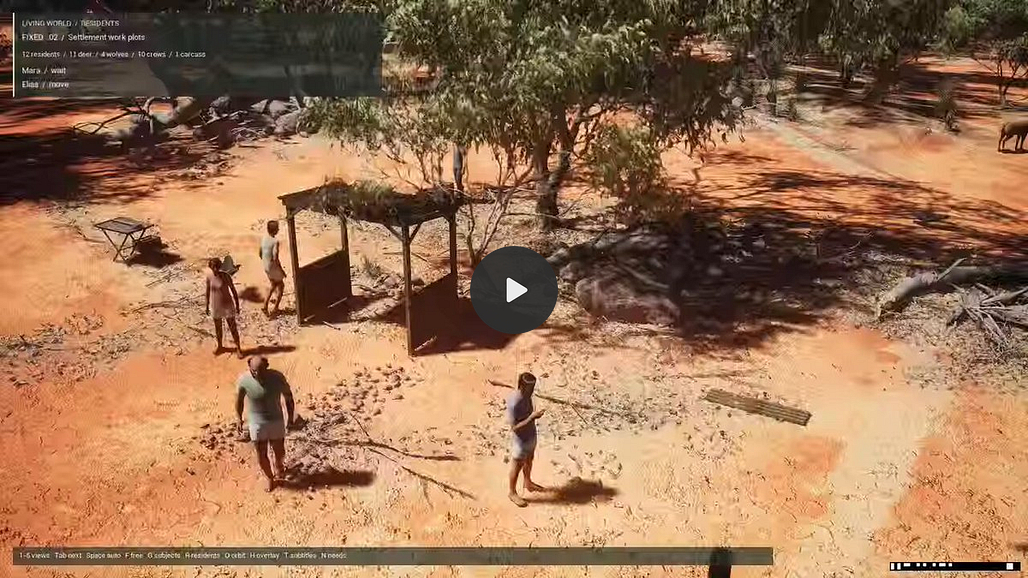
A lot of people are saying AGI is here, and I don’t know exactly what that means, but it does seem as if humans are going to be able to use these new models to do a lot of things for us that we shouldn’t be doing ourselves, and that it will let us be creative in entirely new ways. It’s the most excited I’ve felt to play with a new model.
(2) Fervo Signs Its Largest Geothermal Deal Ever with Google
Jennifer Hiller for WSJ
All of these models - World Models, Astras, whatever comes next - are going to need a lot of power.
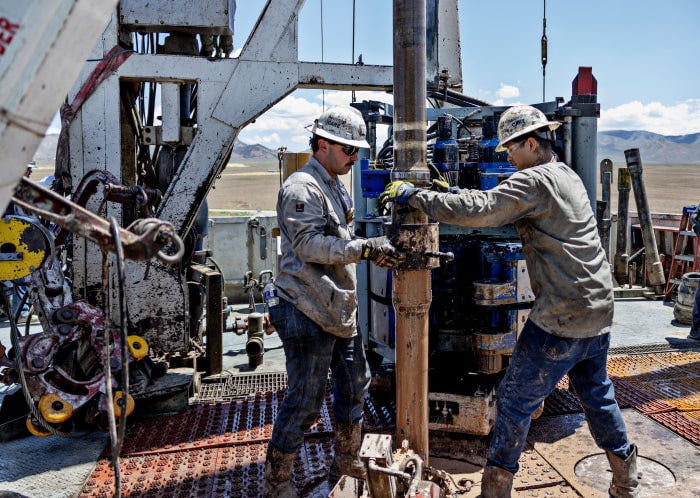
On Tuesday, Fervo announced a 396 MW power purchase agreement with Google, the biggest enhanced geothermal PPA any company has ever signed, to power a potential Google data center in Utah with 24/7 carbon-free electricity from its Cape Station project in Beaver County starting in 2028. Google also gets an option to take roughly 600 MW more by June 2030, which would bring the total to a full GW, from just one customer.
We’ve covered Fervo a few times here, most recently in #190 & #193 related to its IPO, but if you’re new, enhanced geothermal uses shale drilling rigs to hit hot rock. You don’t need a hot spring or a geyser, just heat within reach of a drill bit, which is a lot more places.
This isn't the first Fervo-Google deal. Project Red in Nevada has been powering Google's data centers there since 2023, and the two signed a 115 MW deal with NV Energy in 2024 that invented the Clean Transition Tariff (Google pays extra for more expensive clean energy so neighbors don’t have to).
Fervo says this new deal “unlocks new, around-the-clock electricity capacity at no cost to existing ratepayers,” and under a Utah law called SB132, it may be able to sell straight to Google’s load.
(Speaking of which, this WSJ article, See the New Building Techniques Turbocharging the Data-Center Boom, is short, sweet, and mostly visual, and its subtitle makes the case for DCs: “Hyperscalers’ need for speed is spawning timesaving products and building techniques.”)
(3) Tesla Launches Cybercab in Austin
The future of transport is safer, more enjoyable & gives you more time back
Yesterday in Austin, Texas, Tesla launched the Cybercab, and starting at 5pm today, anyone in the Austin geofence can hail one from the Robotaxi app.
The interior was designed for self-driving: it has two seats, butterfly doors, no steering wheel, no pedals, and no controls of any kind. The future should look like the future. It has nine cameras, a 48 kWh battery pack good for roughly 290 miles, one 219 horsepower motor, weighs 3,113 pounds, comes with Starlink in the roof, and, per Elon, is “basically a super comfortable lounge on wheels with a great TV and epic sound.”
Back in Dose #204, when Zoox got the first US approval for a vehicle without a steering wheel, I wrote that cars would start being designed like moving rooms. That was seven weeks ago. Now we have another one, designed explicitly to be an entertainment room.
Cybercab is starting small of course. Waymo does 500,000 paid rides a week across 14 cities with 4,000+ retrofitted Jaguars and Ojais. There are only 45 Cybercabs in the Texas fleet next to 269 Model Ys (one way they want to scale is by letting people sign up to purchase fleets of them).
But this is the first vehicle designed from a blank sheet to be autonomous and cheap and mass produced, by a company that has mass-produced impossible things before, and real people are riding in them. The Zoox is a $250,000-ish minivan-shaped thing. Waymo pays Zeekr and Jaguar and then bolts on $100K of sensors. Elon says the Cybercab costs under $30,000 to build and about 20 cents a mile to operate at scale, with 10 cities by the end of the year and positive unit economics by mid-2027.
As friend of Not Boring Sam D’Amico tweeted, “Cars are robots now.”
There may be tens of millions of these robocars on the streets one day. I still can’t wait to read about the horrendous things people do in them, as they’re whisked very safely from Point A to Point B.
(4) Humanity’s First Robotically Harvested Head of Iceberg Lettuce
Danny Bernstein and Pascal Labrecque
As fund theses go, Reservoir VC’s might be the most specific: “Reservoir VC invests in rugged AI startups that solve one high-value task in ag and then compound to adjacent industries.” Their answer to “let me know how I can be helpful” is unique, too. GP Danny Bernstein has a 40 acre farm / agricultural robotics playground in Salinas where the robots can get real-world practice.
There, this week, a Canadian startup called Sami Robotics had a robot cut and pick a head of iceberg lettuce, which seems pretty cool but is apparently a bigger deal than it looks. Danny called it "an AgTech moon landing moment."
NZ robotics company Sentinel Robotics added: “I don't think people understand how monumental this kind of thing is. Harvest has always been the hardest part of agricultural automation and leafy greens are the hardest of the hard.” Every head is a different size, you have to cut in exactly the right spot without bruising it, and a good crew of humans with knives is really fast as it is.
If I ever see a Sami iceberg salad on the menu, I’ll say to my friends, “Lettuce try that.”
(5) NASA’s Roman Space Telescope Launches Nine Months Early
NASA (h/t Matt Gialich)
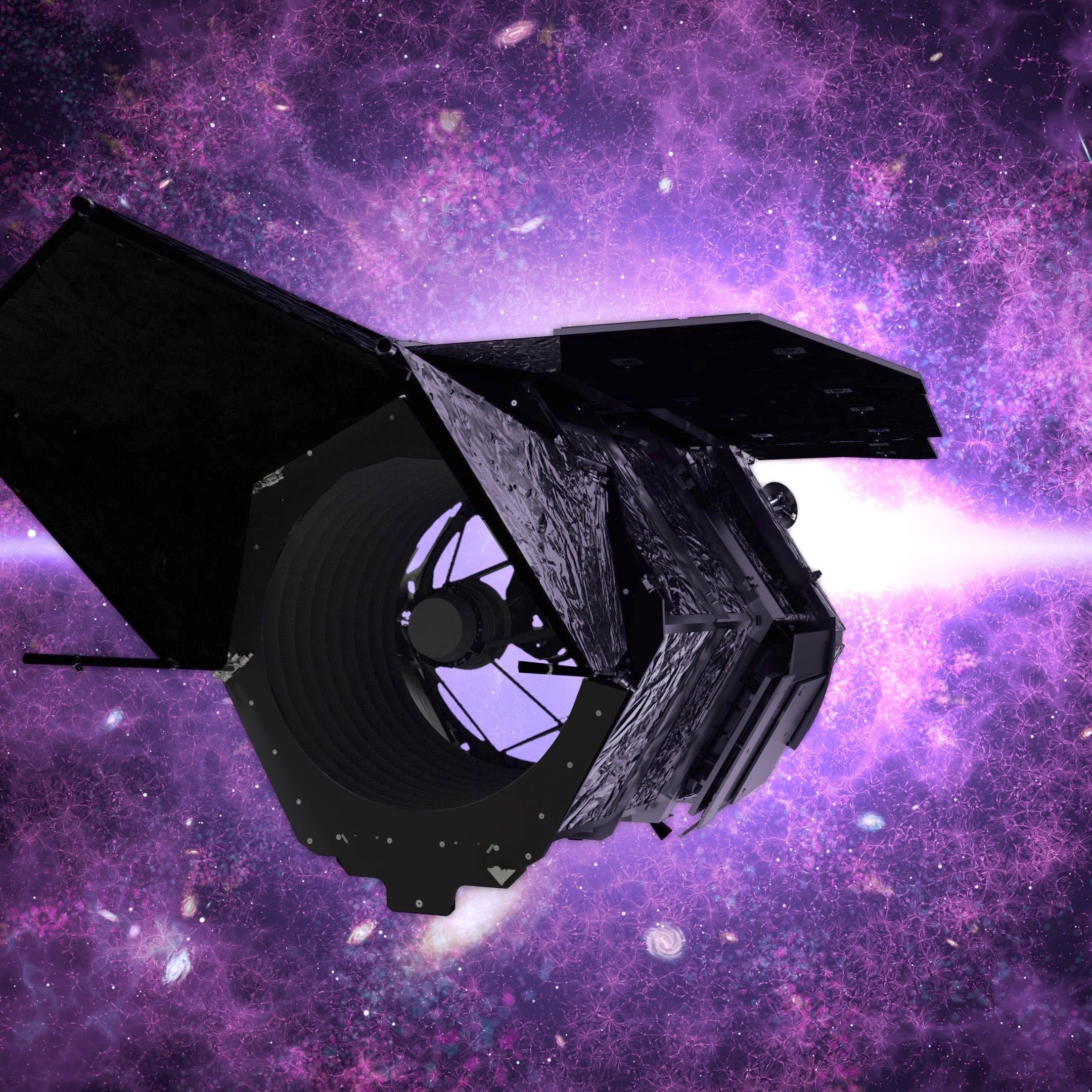
Last Sunday at 7:26am, a Falcon Heavy took off from Pad 39A with NASA’s Nancy Grace Roman Space Telescope on top, the start of its three month journey to Sun-Earth L2, almost a million miles away.
It’s going to hunt for exoplanets.
Roman’s mirror is the same 2.4 meters as Hubble’s (it’s actually a spy satellite mirror the National Reconnaissance Office gave NASA in 2012), but its Wide Field Instrument sees a chunk of sky at least 100 times bigger than Hubble’s infrared view at the same sharpness. Over five years, it’ll survey more than two billion galaxies, measure how dark energy has stretched everything out over time, and do a microlensing census of planets toward the center of the Milky Way.
This is Dose-worthy on its own because we love a good space telescope here. We shared the first images from James Webb way back in Dose #3!
But it’s even more Dose-worthy, because as AstroForge founder Matt Gialich noted, it’s… “9 months ahead of schedule. That is unheard of for a billion-dollar-plus mission.”
Casey Handmer, who’s been hilariously critical of his former employer NASA (please read NASA’s Orion Space Capsule Is Flaming Garbage), QT’d Gialich proposing that we “Promote the people responsible and give them another worthy project with performance-linked bonuses and lots of authority and responsibility!”
If Administrator Isaacson’s NASA keeps this up, we may get to Mars after all.
(6) Physical Superintelligence Raises $58M to for Physics Takeoff
Matthew Pines
For most of human history, genius was the rarest thing on Earth.
The last time I heard from Matthew Pines, it was when he was the guest on a 4+ hour American Alchemy episode a year ago titled UFO Physics & Disclosure Under Trump. Now, he and his team at PSI (which stands for Physical Superintelligence, but is also a nod to psi abilities) have $58 million to bring our physics up to the 21st century.
Pines is doing it with Dr. Alex Wissner-Gross, whose Eon Systems fruit fly brain we covered in Dose #184, and who graduated top of his class at MIT in 2003 as the last student to complete a triple major under the institution’s historical policy, and Alex Klokus, who created the Gravity Blanket and co-founded the UAP / psionic research group, Skywatcher.
Which is to say, we have a bunch of wide open minded geniuses with tens of millions of dollars to save physics from whatever path it went down decades ago. Hell yeah.
Yesterday, Starcloud CEO Philip Johnston announced a non-profit called The Fermi Explorer, which plans to launch “a minimum viable spacecraft to Alpha Centauri, the nearest star system, leaving in 3 years and arriving in around 80,000 years. We hope it will be both the first spacecraft to leave Earth for another star, and the last to arrive.” AstroForge’s Matt Gialich, who you might remember from the story right above, is an advisor.
I bring this up because the mission was designed by… PSI.
We’d spent three months and one billion tokens on it [the mission],” Johnston said. “In a week, they [PSI] spent 10 billion tokens on it, and it came up with this ingenious perihelion-pump maneuver that we then validated with the NASA guys.
And speaking of AI models doing crazy physics, our friends at Arena Physica, who you might remember from Electromagnetism Secretly Runs the World, which I co-wrote with its founder Pratap Ranade, released its new model, Heaviside-1 this week. Heaviside-1 is its second generation foundation model for electromagnetism, and can run sims like this in milliseconds instead of today’s simulators’ hours.

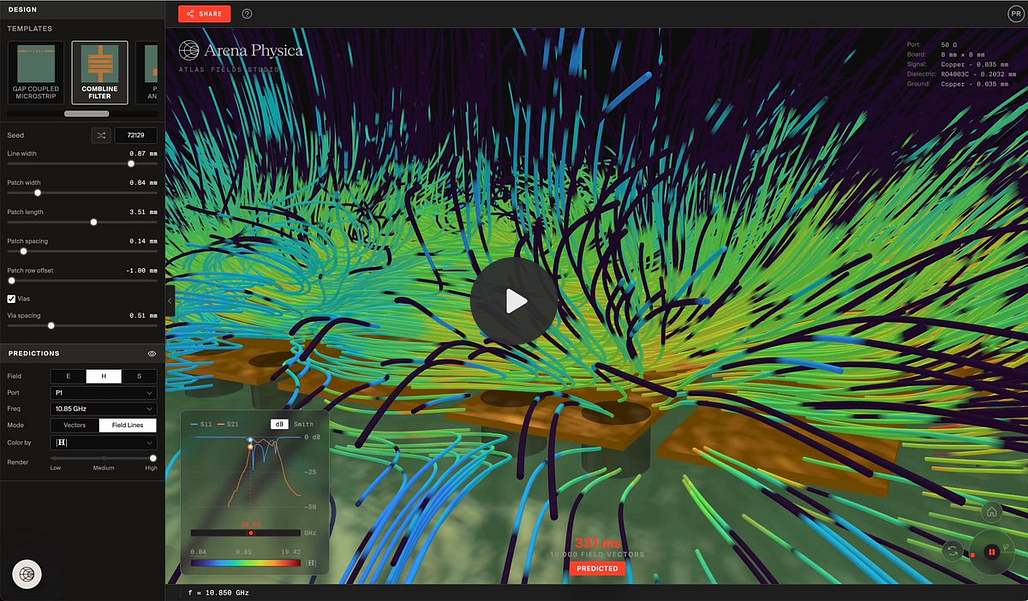

You can play with it yourself in the Fields Simulator here. Look at me. Look at me. I’m the [physicist] now.