

Hi friends 👋,
Happy Saturday! The past couple of days have been a technology business strategy nerd’s Super Bowl plus a Pro-Progress Person’s Super Bowl. Whenever you combine commoditizing complements with fighting the precautionary principle, I’m not going to be able to stop myself from writing something.
This is lightly edited and is just my quick thoughts, so I’m throwing a bunch of it behind the paywall for the real ones (not boring world subscribers).
Tell our enemies that they may take our lives, but they'll never take our freedom!
Let’s get to it.
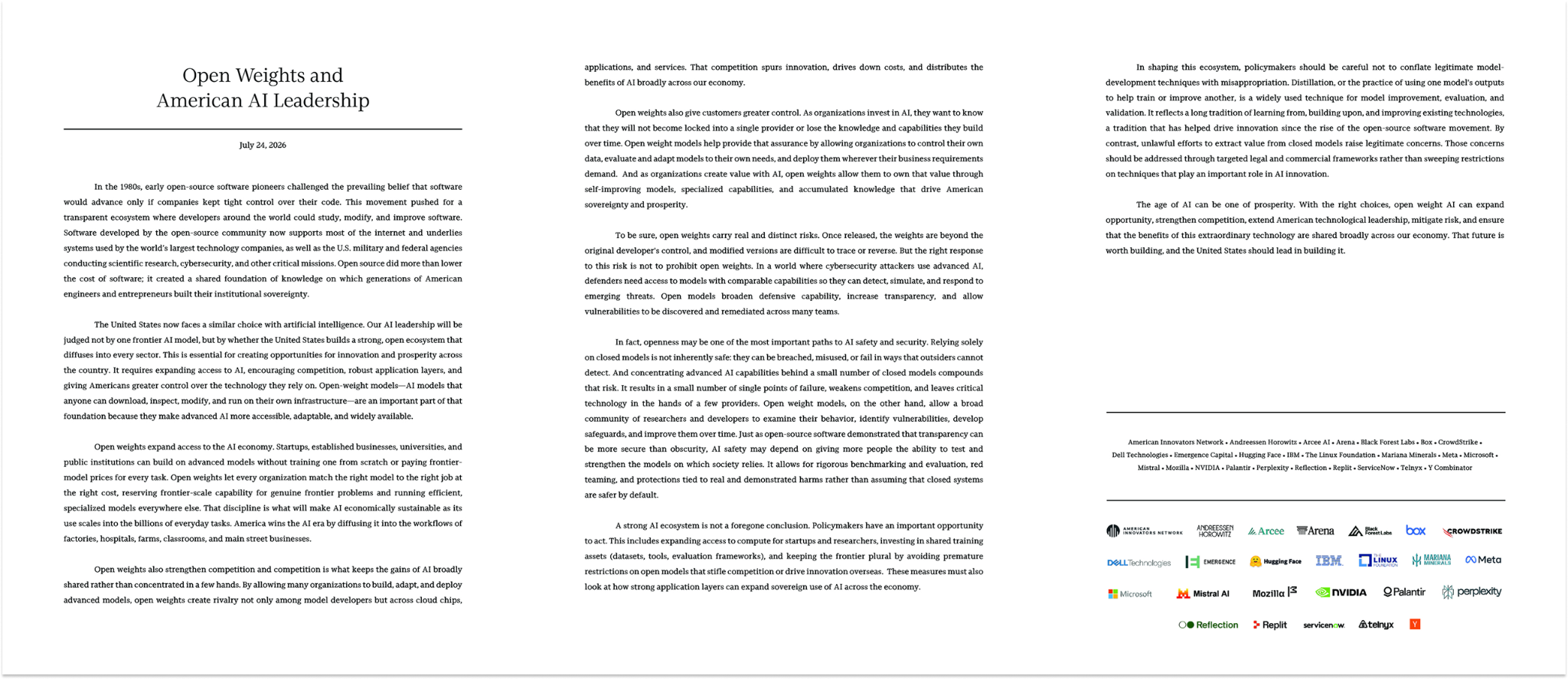
Yesterday, Satya Nadella and Jensen Huang, among other leaders in tech, signed and shared a letter in support of open-weight models. Jensen even set up a twitter account to share it.
I loved it, and tweeted that this was Capitalism at its best.


From a business perspective, this is classic tech strategy stuff.
“Smart companies try to commoditize their products’ complements.”
– Joel Spolsky, Strategy Letter V
All of the signatories either make open-weight models models or are complementary to them. Models run on Nvidia chips. They power Microsoft products. a16z and Y Combinator back companies that support, use, and compete with models. Palantir’s Alex Karp has been banging this drum because he wants to disintermediate models in the enterprise. Meta is more open source than the other similar American labs. Hugging Face is where open models live. Dell sells the machines they run on. CrowdStrike benefits if defenders have access to the same intelligence as attackers. Box, ServiceNow, Replit and Perplexity all get better when capable models become cheaper, more plentiful and easier to customize. Google, a new signatory, got off of its slow, bureaucratic ass and signed because Google will be fine either way, and maybe open source models will allow it to serve search ads more cheaply at some point. Mariana Minerals needs to give its comms person a raise, or send a big thank you to a16z.
The more competition there is at the model layer, the less Anthropic and OpenAI are able to run away with the frontier and build a duopoly, the more each of the signatories benefits.
Signing this letter is a selfish act that also happens to align with the interests of consumers and millions of businesses.
And that’s great! That’s capitalism, baby!
Their self-interests are aligned with our interests as consumers and businesses using these models and living in a world in which these models (and the leaders of the labs that create them) exist.
Not everyone agrees with me or the signatories. There are people who believe that it’s better to lock these models down because they might be dangerous.
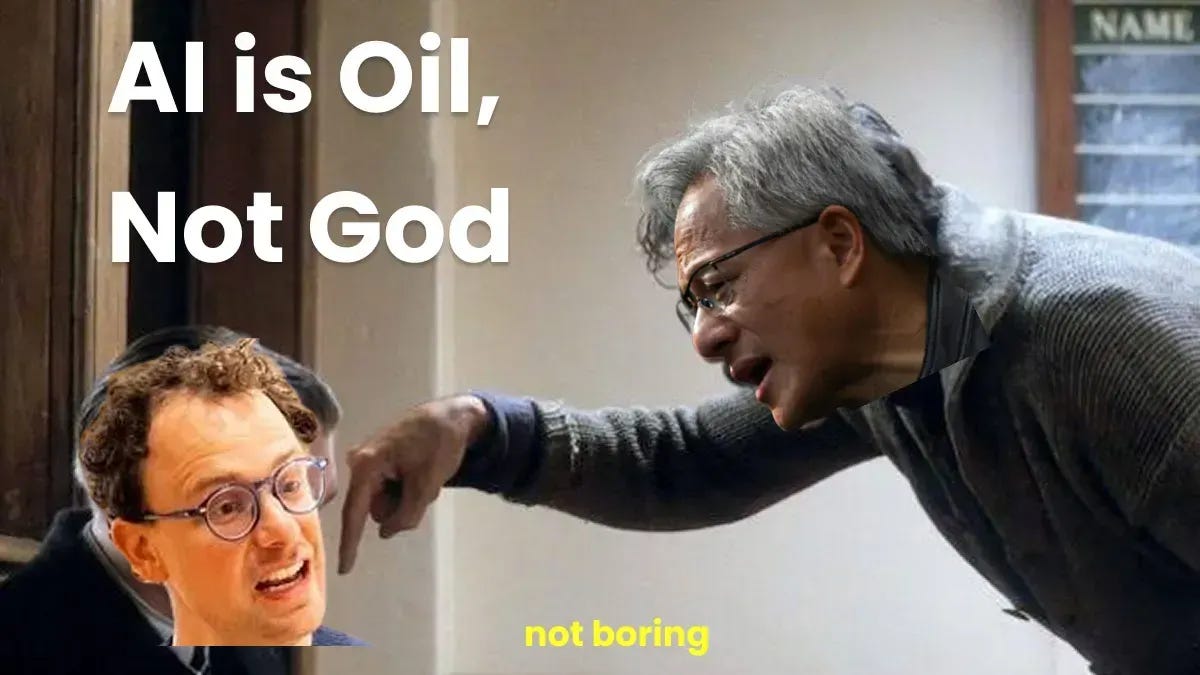
I think it comes down to whether you think AI is more Oil or God, more “an economically useful commodity that can be scaled and refined to act as a multiplier on everything we do” or “supremely intelligent and powerful being that’s going to wake up and make humanity subservient (if we're lucky).”
I am strongly on the Oil side, as I wrote in The Goldilocks Zone in June 2024. My belief is unchanged since.
In fact, I think it’s super interesting that Satya and Jensen, both of whom are at the very bleeding edge of this technology, wrote in support of open-weight models. Surely, if they saw something that made them believe that these models were going to become conscious and take over the world, they wouldn’t be as openly pro-diffusion, even if they were short-term incentivized to be. I think they know that AI is Oil, too.
But aren’t they going to be dangerous?
My friend Matt Kaufman at Collaborative Fund, who is a lot smarter than me, emailed me after seeing my tweet with just that concern:
Just saw your tweet on the Jensen note and I’ve seen a few others supporting open-weight model proliferation. I’m on the fence here and if you have 2 min to type out a quick reply, I’d be very curious how you’re thinking about it.
I’d definitely prefer a more open ecosystem were it not for risks like models being fine-tuned to remove bio / cyber safeguards, and then resulting in harm. This seems trivially easy and perhaps isn’t a big issue now, but likely will be once 1) the open ones are much more powerful and 2) dangerous actors outside our tech bubble catch on to the capabilities here.
I think there are many domains where LLMs more favor offense rather than defense so this feels like a scary reality and I therefore sympathize with arguments that they should be tightly regulated like weapons.
I quickly banged out a response and I wanted to share it with you, even though it was dashed off in a few minutes and a little messy, because I’ve been meaning to write something and this is close. I’ll add some footnotes on things I’ve thought more about since hitting send.