

Hi friends 👋,
Happy Friday, and welcome to our 195th Weekly Dose of Optimism.
Man, just when I thought it was going to be hard to top last week’s Dose, we have an LDL cholesterol-fighting gene therapy, evidence that GLP-1s slow cancer, supersonic flight, and nanotech, and a Moon Base. We also have the coolest Science Breakthroughs roundup yet. Even a massive Blue Origin explosion can’t slow us down.
If you get through this and want even more optimism injected into your veins, check out this week’s essay:

Let’s get to it.
Today’s Not Boring is brought to you by… Deel
Hiring globally doesn’t have to be complicated

Hiring globally can unlock growth, but local laws, payroll, and compliance often slow startups down.
Deel’s free guide breaks down what an Employer of Record (EOR) is, how startups use EORs to hire internationally without opening entities, and when it makes sense to use one so you can scale with confidence.
(1) Eli Lily Does it Again, Now with LDL Cholesterol Gene Therapy


For those keeping score at home, this is the second week in a row that we’ve led off with Eli Lily. Last week, their Reta Phase 3 trials showed astonishingly good results, and this week, they published the results of a phase 1, open-label, single-ascending-dose study on the VERVE-102 gene therapy targeting PCSK9, which is responsible for LDL cholesterol, which is in turn responsible for a lot of heart disease and deaths.
Now this is just a phase 1, and there were only 35 people involved, but a single dose gene therapy reduced PCSK9 levels “from 51% at the 0.3-mg-per-kilogram dose to 88% at the 1.0-mg-per-kilogram dose,” and showed corresponding reductions in the LDL cholesterol level “from 9% at the 0.3-mg-per-kilogram dose to 62% at the 1.0-mg-per-kilogram dose.”
This is a big deal! Globally, about 4.4 million deaths a year are attributable to high LDL cholesterol, roughly 7.8% of all deaths. Cardiovascular disease causes roughly 18.6 million deaths a year worldwide, so high LDL accounts for somewhere around a quarter of those.
Now, we might be able to knock out 4.4 million deaths a year with a shot.
PCSK9 inhibitors are not new. On a recent Invest Like the Best episode, Braidwell Managing Partner Alex Karnal called PCSK9 medicines “pretty much a free lunch”:
The headline here is PCSK9 medicines are amazing, because what they do is they today can lower our bad cholesterol, that LDL cholesterol, by 50%. And we now have outcome studies in patients at different degrees of having high cholesterol, having significant protection from ever developing and having a heart attack or a stroke. And so in patients that have previously had a heart attack or stroke, we can reduce that risk by over 20% in the future. And for people that are at high risk of having a heart attack or a stroke, the medicines that are approved and on the market today can lower that risk by about 25%.
With previous PCSK9 medicines, people would have to stay on them forever to continue to eat that free lunch. Now, if Lily’s early results hold, they will get all of the benefits in a one-and-done shot. Essentially, the drug edits your gene to be like the “population of people in the world that have a genetic mutation that conveys a massive advantage. They have a mutation in their PCSK9 gene, which means they don’t produce the PCSK9 protein.”
We are still a few years away from this miracle drug hitting the market, and there are still trials to be done, but this is a really big deal, not only because it’s an assault on LDL cholesterol and therefore heart disease, but also because it’s another example of our ability to see an advantageous mutation in a certain population, make a drug to mimic it, and knock more and more diseases off the list.
Plus, as the WSJ reported, a number of pharma companies are developing drugs to attack LDL’s cousin, Lp(a), or lipoprotein(a). Lp(a) is almost entirely genetic and currently untreatable. About 90% of a person’s Lp(a) level is fixed at birth, diet and exercise don’t lower it, and statins can actually raise it. So unlike LDL, which we have many tools for, there’s essentially no approved therapy for high Lp(a) today. Roughly one in five people globally have dangerously high levels, and that’s bad. Lp(a) hardens arteries and promotes clotting, which is why it’s so noxious in driving cardiovascular events.
So far, science has been powerless against Lp(a), both in treating it and in proving that lowering a person's Lp(a) will actually reduce heart attacks and strokes. Earlier drugs lowered the particle moderately but failed to reduce events in studies. The current bet from Novartis, Amgen, and, you guessed it, Eli Lilly is that new technologies can cut Lp(a) far more dramatically, with late-stage trials underway and Novartis's first Phase 3 results (pelacarsen) expected this year. Human genetics suggests it should work, but they don't know for sure.
Heart disease is the leading cause of death in the US, and now we have even more data points suggesting that you should really figure out how to stay alive for the next few years, because thereafter, you may be able to stay alive for a very long time. “Medicine keeps getting better and better.”
(2) Weight-Loss Drugs May Have Surprising Side Effect: Stalling Cancer
Xavier Martinez for The Wall Street Journal

You thought we were done with Eli Lily? We’re not done with Eli Lily.
Just as the ink was drying on last week’s Dose, The Wall Street Journal published an article about GLP-1s’ cancer-fighting abilities. “A suite of four new studies suggest that people taking so-called GLP-1 drugs like Novo Nordisk’s Ozempic and Eli Lilly’s Mounjaro saw reductions in tumor progression, lower overall chance of death and less risk of developing breast cancer.”
In lung cancer patients, the rate of progression to advanced disease was cut roughly in half—10% in GLP-1 users versus 22% in the comparison group. Breast cancer patients showed a similar pattern, with progression rates of 10% versus 20%. Colorectal and liver cancers also showed statistically significant reductions.
These studies are from places like UT MD Anderson, University of Pennsylvania, and Cleveland Clinic, and while researchers don’t yet understand the mechanism, the research points to yet another miracle for this miracle drug.
I’m not even sure what to say at this point, so say it with me… get fucked, cancer.
(3) Hermeus Quarterhorse Mk 2.1 Completes First Supersonic Flight
In Riding the Leopard, I wrote, “I would like to live in the future in which we have spaceships and abundant energy and supersonic planes, the future in which car crashes and cancer are a thing of the past.”
I wasn’t expecting that future to come quite so soon. While GLP-1s go to work on cancer, Hermeus became “the world’s first privately developed, unmanned supersonic jet and the fastest unmanned aircraft flying today” when its Quarterhorse Mk 2.1 went supersonic at Mach 1.21 in an unmanned test flight. Huge congrats to AJ and the Hermeus team. I got chills watching the video.
Now, they’ll have more fuel to go even faster, more often. Yesterday, they announced that the Defense Innovation Unit expanded its contract by $159M to $219M to tackle high-Mach flight and payload release.
I may have dreamed too small. Hermeus is now gunning for hypersonic flight.
(4) Atomically precise mechanosynthesis of carbon structures on hydrogenated Si(100) by inverted-mode STM


One thing that I forgot to mention in my vision for the future, but that I would like to add now and would very much like to see, is nanotechnology.
At the end of Where Is My Flying Car?, J. Storrs Hall paints a picture of the future we could have with abundant energy: flying cars, utility fog, the Weather Machine, a “space pier,” and maybe most tantalizingly, atomically precise manufacturing (nanotech), nanofactories and self-replicating machines that build objects atom by atom, collapsing the cost of physical goods the way semiconductors collapsed the cost of computation.
Nanotech is the vision Richard Feynman laid out in Plenty of Room at the Bottom, the one Eric Drexler theorized in Nanosystems, the one Hall imagines in Where Is My Flying Car?, and the one Neil Stephenson painted in The Diamond Age. If you can manipulate atoms one-by-one, you can build anything you can dream up.
Until now, though, it’s remained a dream. Drexler’s theory of positional mechanosynthesis, alongside Ralph Merkle and Robert Freitas, was attacked, most famously in the Drexler–Smalley debate, where Smalley's "fat fingers / sticky fingers" objection held that you couldn't do controlled positional chemistry at that scale.
Well, we can tell Smalley exactly where to stick his fat fingers now.
On Tuesday, Merkle, Freitas, and a number of researchers published a paper demonstrating simultaneous spatial and chemical control over the mechanosynthetic fabrication of carbon structures. Concretely, using a technique they call inverted-mode STM, carbon dimer (C₂) units are donated from surface-deposited molecules onto pre-patterned reactive sites on a hydrogen-passivated Si(100) surface. They show three escalating things: single-site C₂ donation, spatially patterned multi-site donation, and the stepwise assembly of polyyne structures through successive C–C bond formation. Their framing is that this establishes controlled mechanosynthetic donation as a foundational capability for programmable atomically precise fabrication.
For roughly forty years, Mechanosynthesis— using mechanical positional control to drive site-specific chemistry, building structures atom by atom — lived almost entirely in theory and computational chemistry. The canonical proposed primitive was a "dimer placement tool" that deposits C₂ units onto a workpiece to grow diamondoid structures. That is almost exactly what this paper demonstrates experimentally!
There is still a massive gap between this work and Hall’s nanofactory. They've built short carbon chains, one dimer at a time, with an STM tip, which is a primitive. The chasm to the vision is throughput and dimensionality: a single tip placing dimers serially is astronomically slow versus the massively parallel, self-replicating systems APM actually requires, and going from 1D polyyne chains to 3D diamondoid objects is its own huge challenge.
But come on! This thing that people said was impossible was just demonstrated to be possible! I am going to spend the weekend dreaming up all of the things I want to order from the nanofactory, like my own APM island a la The Diamond Age.
In the meantime, if you want to get smart on nanotech, I recommend Hall’s primer for the Abundance Institute and Jacob Rintamaki’s A Technical Review of Nanosytems.
(5) MOON BASE
On Tuesday, NASA Administrator Jared Isaacman and the NASA team held a press conference at its HQ in Washington to provide updates on the Moon Base program, a long-term lunar exploration and infrastructure initiative under the Artemis program aimed at enabling sustained human presence and expanded scientific and commercial activity at the lunar South Pole.
It also launched a Moon Base Website, complete with the hype video above and a timeline for the Moon Base. Because we are establishing a Base, on the Moon.
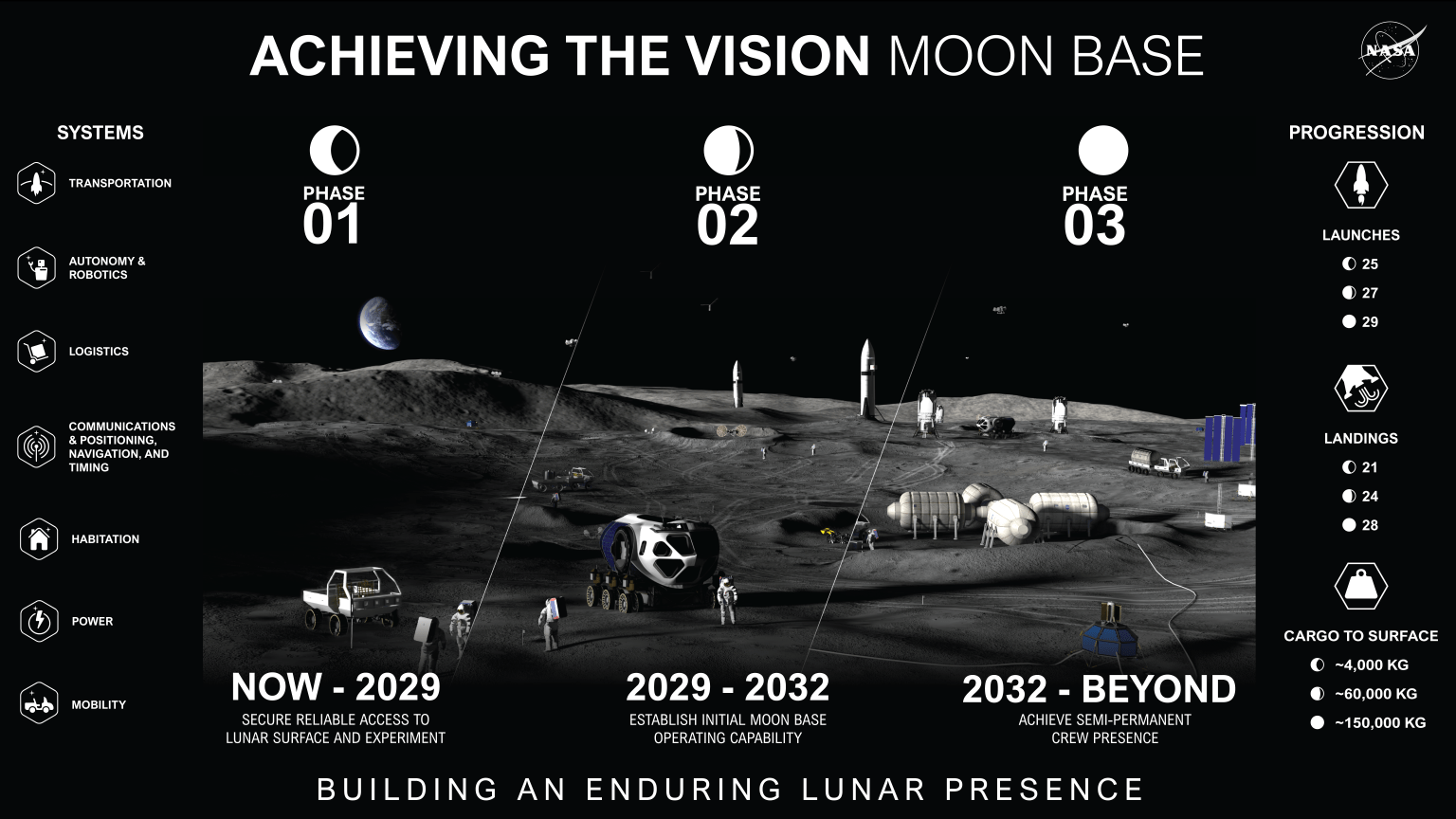
Isaacman & Co laid out the plan for three initial Moon Base missions. Moon Base I, targeted for no earlier than fall 2026, will use Blue Origin’s privately funded Blue Moon Mark 1 Endurance lander to deliver NASA science payloads, including the Stereo Cameras for Lunar Plume-Surface Studies instrument and a Laser Retroreflective Array, to the Shackleton Connecting Ridge. Moon Base II, planned for later in 2026, will use Astrobotic’s Griffin lander to deliver more than 500 kilograms (over 1,100 pounds) of cargo, including Astrolab’s FLIP rover, to mature lunar terrain vehicle mobility, autonomous operations, and logistics. Moon Base III will prioritize scientific payloads to expand understanding of the lunar surface.
Then, eventually, we’ll have people living on the Moon, which is a harsh mistress but a potentially perfect launchpad for humanity’s mission to Mars. What a universe.
EXTRA DOSES: Science Breakthroughs, Telescope Ranchers, Encyclical
Quick note: I think this might be the coolest Science Breakthroughs yet, with entries on the genetic architecture of complex traits, hallmarks of aging and mortality, homing pigeons relying on superparamagnetic macrophages for navigation, and armadillo-inspired morphing skeletons for robots. Science Breakthroughs is a roundup of the bleeding edge, the stuff that’s even earlier in its development than what we cover in the Dose.
I think it’s worth the subscription alone, and in general, I’m trying to share a lot more value with not boring world subscribers, including recent pieces like Riding the Leopard, Cowboy Space Corporation Case Study, and Thank God for Data Centers. I hope you’ll subscribe and join us.