

Hi friends 👋,
Happy Friday and welcome to our 188th Weekly Dose of Optimism!
I keep saying this, and then it gets cold again, but I think this is the one: it’s a beautiful morning here in New York City, spring is springing, and our fellow humans keep pumping out optimism-worthy work.
This week, for example, we have new funding for AI-assisted Alzheimer’s research and, in Science Breakthroughs, a peptide that degrades the amyloid-β linked with the disease. That, and much much more, in this week’s Dose.
Let’s get to it.
Today’s Not Boring is brought to you by… Silicon Valley Bank

There is a lot of noise out there about how AI is impacting companies. Of course, big AI lab CEOs are predicting massive job disruption and productivity increases. But to find out what’s really going on, ask the people who control where the dollars flow: the CFOs.
SVB surveyed 200+ startup finance leaders for its new State of the VC-Backed CFO report, and a few things jumped out:
AI adoption is now the #1 issue for startups, and 63% of CFOs rank it top-two
Companies are doubling AI spend this year (to ~$50K median)
Over half of CFOs surveyed are already seeing real ROI on AI spend
The biggest impact to staffing isn’t layoffs, it’s hiring fewer junior hires
In short, startups are getting leaner, faster, and more experimental. If you want to understand where company-building is going next from the people who control the spend, grab your free copy today.
(1) OpenAI Foundation Commits $100M to Cure Alzheimer’s
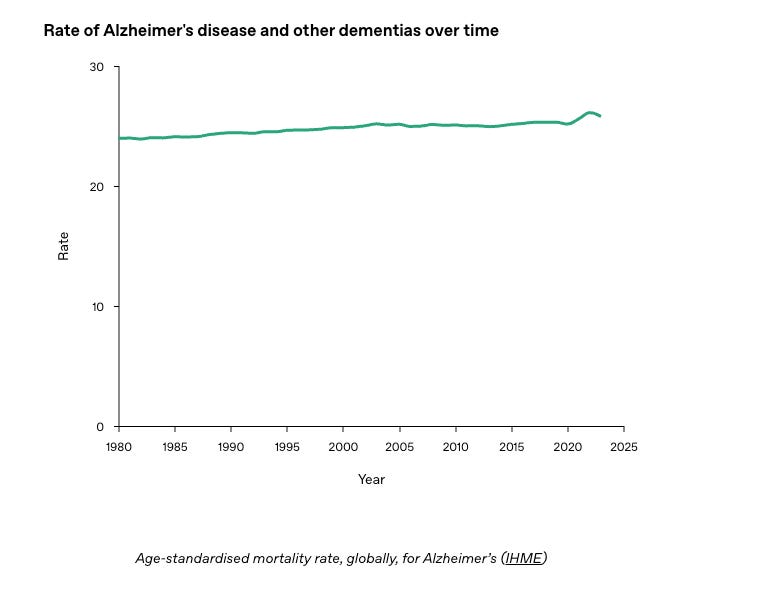
My grandmother had Alzheimer’s. One of my biggest fears in life is that me and the people I love will get it; it’s one of the reasons I started writing, to help me remember. Unfortunately, since my grandmother had it, we’ve made no progress on defeating Alzheimer’s. Measured by age-standardized mortality rate, while we’ve made strides against cardiovascular disease, cancer, and infectious diseases, Alzeheimer’s has only gotten worse. It is a complex disease with hundreds of environmental and genetic risk factors interacting across cell types over decades, and as such, treating it has been a sad game of whack-a-mole.
Maybe AI can help. This week, the OpenAI Foundation, the nonprofit parent of OpenAI, now sitting on a $25 billion life sciences and resilience commitment, announced it’s putting $100M+ into six research institutions to throw modern AI at the problem. Jacob Trefethen, who ran half a billion dollars of science grantmaking at Coefficient Giving before joining OpenAI, is leading the effort. The grants span AI-assisted drug design, biomarker discovery, mapping disease pathways, and personalizing treatment.
The most interesting grantee is Arc Institute, whose progress we’ve covered many times in the dose, which announced a parallel partnership focused on what co-founder Patrick Hsu calls an “AI lab-in-the-loop” approach. The idea is to systematically perturb human brain organoids guided by patient data, measure what happens, feed the results back into AI models, and iteratively build a causal map of the disease, the actual chain of cause and effect from genetics to protein misfolding to synaptic collapse. Arc executive director Silvana Konermann describes the goal as finding “perturbations that can click and drag a cell from a diseased state back into a healthy one.” The other grantees include David Baker’s Institute for Protein Design and EvE Bio.
NIH funds Alzheimer’s, and has for decades, and we are where we are. What Arc and the OpenAI Foundation are doing is what private capital and motivated foundations can do that institutional science usually can’t: pick a hard problem, fund a full-stack experimental-and-AI engine, and run the loop fast enough that we might actually get somewhere by the time it matters to my family.
I would very much like to forget about Alzheimer’s once and for all.
(2) Information to Atoms
Substrate x Google DeepMind
One big lab I have been consistently impressed with is Google DeepMind, and those wacky geniuses are at it again. This week, the American semiconductor foundry startup Substrate, whose launched we kicked off with in Dose #168, shared that GDM’s AlphaEvolve rewrote a chunk of its lithography software and made it nearly seven times faster while cutting compute costs by 97%.
Substrate is the James Proud-founded startup that came out of stealth last October with $100M and a crazily ambitious mission: build a U.S. foundry that uses X-ray lithography to compete with ASML's EUV machines by patterning features tens of atoms wide, on American soil, at lower cost than the Dutch monopoly. AlphaEvolve is DeepMind’s evolutionary coding agent, the latest entry in the Alpha lineage that runs from AlphaGo to AlphaGoZero to AlphaZero to MuZero to AlphaFold to AlphaChip.
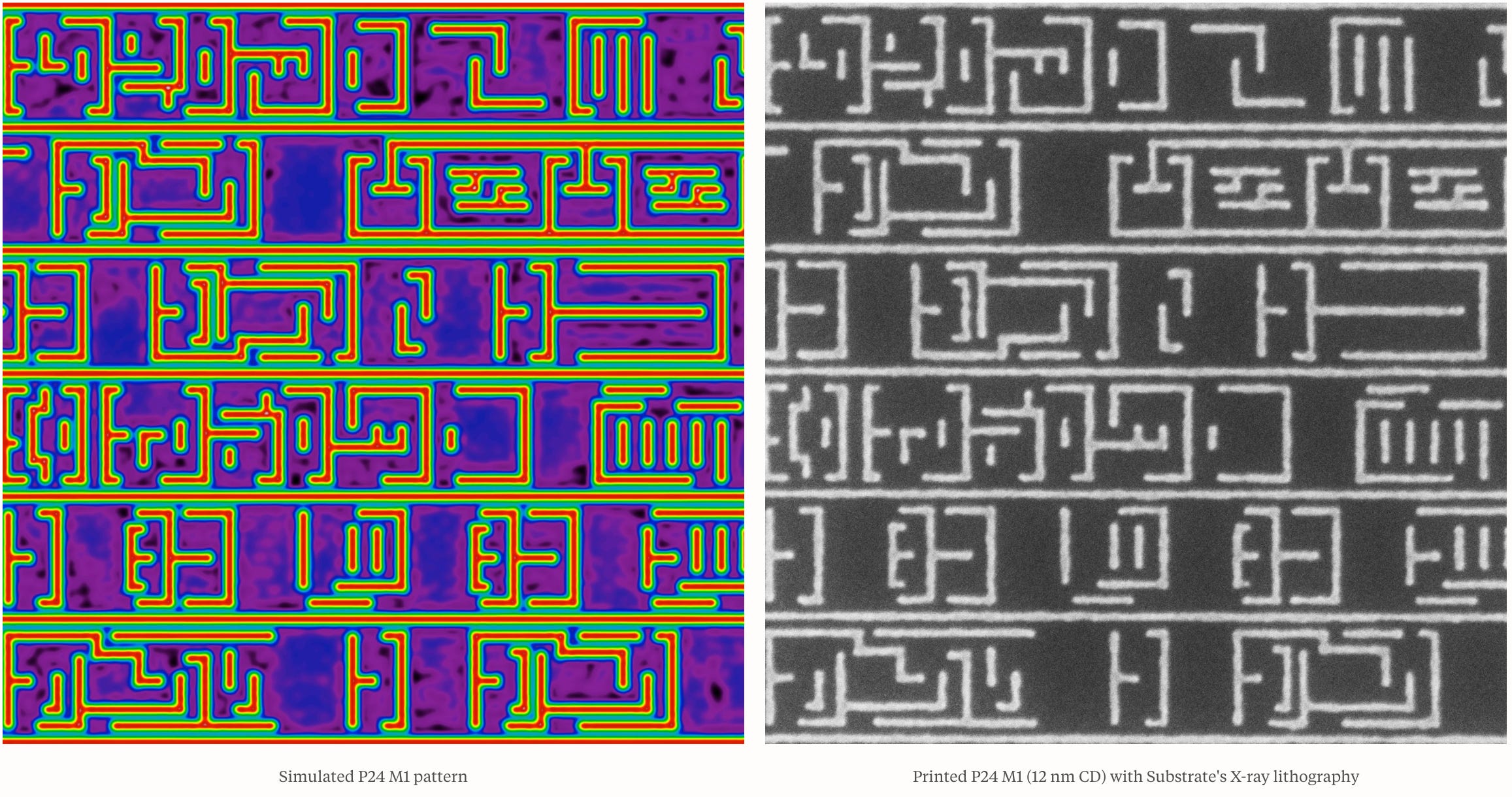
This week, Substrate pointed AlphaEvolve at its computational lithography stack, the software that simulates how trillions of photons interact with photoresist to print a chip layer. In just a few weeks, AlphaEvolve explored thousands of algorithmic variations and landed on lossless compression tricks and lower-precision representations that cut memory by 74%, sped up runtime 6.8x, and dropped the Google Cloud TPU bill by 97%. Now, Substrate’s tool can print metal-one layers (the hardest, most defect-prone layer in a chip) at a 24nm pitch in a single exposure, with bidirectional 2D patterns and sharp 90-degree corners. That’s 2nm-node territory, the bleeding edge. Without the speedup, the same patterns would have required multi-patterning: two or three exposures, which means more defects, more cost, and more time.
This is fun because: a) we are rooting for American ASML and b) it’s a combination of the stuff we’ve talked about in the last couple of co-written essays: World Models talked about the evolution of the Alpha line of models, which learn causality instead of rules, and Electromagnetism Secretly Runs the World talked about using AI to design better chips. It’s also an example of America’s best hope in the electric competition with China: using new technologies to find new, better, and cheaper ways to build the things we don’t build today. I suspect we’ll be hearing more from Substrate - it would be insane to compete with ASML at their own game, so they’re creating a new one.
(2a) Arena Physica Releases Heaviside

Speaking of EM modeling… A couple of weeks ago, in Electromagnetism Secretly Runs the World, Arena Physica CEO Pratap Ranade and I mentioned the new models and blog posts they would be releasing soon. Soon has come. Its new model, Heaviside, is its first EM foundation model, and you can play with it in the RF Studio.
(3) Syncere Unveils Lume Lamp That Folds Your Laundry
I have spent a lot of time thinking about robotics recently, and I’ve got to admit, I did not think of a lamp that folds your laundry. This is the future that Beauty and the Beast and The Brave Little Toaster promised.
Lume is a pair of six-foot bedside floor lamps with hidden six-axis robotic arms, cameras, and on-device AI processors. Toss your clean laundry on the bed, the lamps quietly extend their arms and fold it in under two hours for a full load. You don’t have to tell it to do anything, it just watches the bed and figures out when to get to work. (There’s a Lume sitting in the factory somewhere just praying Bryan Johnson orders it.)
The graveyard of laundry-folding robots is packed. Foldimate made you feed clothes in one at a time and quickly… folded. Laundroid was a $16,000 closet-sized monster that bankrupted its parent company in 2019. Laundry is so hard that every robotics company makes demos of their bots figuring out how to do it in a controlled environment, and people go wild, because folding laundry is decidedly a thing we want the robots to do for us.
The why now? is the perception stack. Vision-language models (VLMs) are now good enough that a small startup can train a thing to look at a balled-up t-shirt on a comforter, figure out what it is, grab it, and fold it.
It’s also a constrained problem. It doesn’t promise to do everything; it gets paid to do one thing well, and learn. Maybe it, like Standard Bots, will be able to take small steps across the spectrum. And you gotta buy a lamp anyway.
I want to wait to see the reviews before I drop $2,499 on two lamps, but if you want to be an early adopter, be our guest.
(4) Humans Travel Farther From Earth Than Ever Before
Jared Isaacman for NASA

Last week, we covered the launch of the Artemis II mission, which planned to take North Americans back to the Moon for the first time in more than half a century, and farther from the home planet than we’ve ever traveled (that we know of). As the crew rounded the Moon on Monday, NASA Administrator Jared Isaacman tweeted:
On the far side of the Moon, 252,756 miles away, Reid, Victor, Christina, and Jeremy have now traveled farther from Earth than any humans in history and now begin their journey home. Before they left, they said they hoped this mission would be forgotten, but it will be remembered as the moment people started to believe that America can once again do the near-impossible and change the world.
It’s rare for us to do back-to-back coverage of the same story, but unprecedented accomplishments call for unprecedented measures. Instead of writing about it, I’d just ask you to watch Astronaut Victor Glover’s Easter message back home:
(5) Primer Launches New Brand with The Orator
Primer is one of the not boring capital portfolio companies I’m most proud to be involved with. I’ve written about them here and talked to the CEO Ryan Delk on moving from software into running schools here. They take kids seriously, and exist to give more kids access to excellent education.
This week, they released a video narrated by one of its students and featuring others that highlights both its approach to education, and an optimistic vision for how we can all meet the future: “The next 200 years will look nothing like the last. We will face problems we can’t yet imagine, and possibilities we can barely dream of. We won’t just need answers. We’ll need resilience, flexibility, courage, mastery.”
Amen.