
Hi friends 👋 ,
Happy Friday and welcome back to our 185th Weekly Dose of Optimism. Fresh off the heels of my World Models primer with General Intuition’s Pim de Witte…

… I’m excited to bring you my favorite Dose in a long time. Kalanick, Bezos, copper, cancer drugs, meditation stimulation, and the return of Ulkar. I can’t wait any longer…
Let’s get to it.
Today’s Weekly Dose is brought to you by… Framer

Framer gives designers superpowers.
Framer is the design-first, no-code website builder that lets anyone ship a production-ready site in minutes. Whether you’re starting with a template or a blank canvas, Framer gives you total creative control with no coding required. Add animations, localize with one click, and collaborate in real-time with your whole team. You can even A/B test and track clicks with built-in analytics.
The weekend starts today, and the weekend is the perfect time for side-projects. Get to it.
Launch for free at Framer dot com. Use code NOTBORING for a free month on Framer Pro.
(1) Travis Kalanick is Back with Atoms
Travis Kalanick & TBPN
There’s a version of the story where Travis Kalanick disappears into the wilderness after his investors ousted him from Uber. He’s rich. He doesn’t need to deal with this shit.
If you watched the Uber saga, though, you knew that wasn’t how the story was going to play out, and luckily, you were right. Travis. Kalanick. Is. Back.
Kalanick spent nearly eight years in what might be the most extreme version of stealth mode any modern founder has pulled off: he’s hired thousands of employees, in 30 countries, bought and developed hard real estate assets, built a full-stack food infrastructure business, and did it all like lasagna. Employees weren’t even allowed to list the company’s name anywhere.
The company was called City Storage Systems. Its most visible subsidiary, CloudKitchens, operated ghost kitchens. It was valued at $15 billion in 2022. And it was just, to use a food term, a little amuse-bouche before the main course.
Last week, Kalanick unveiled Atoms: a robotics company spanning food, mining, and transport, built on everything CloudKitchens learned about physical automation. CloudKitchens is now Atoms Food, which includes Lab37's Bowl Builder robot (200 meals per hour, no humans), the Otter restaurant OS, and Picnic delivery.
With Atoms, TK is expanding into mining (via the acquisition of Pronto AI, an autonomous haulage startup for mines and quarries founded by Waymo founder Anthony Levandowski) and transport, where Atoms is building what it calls “a wheelbase for robots.”
Kalanick’s robotics bet is explicitly anti-humanoid. It’s the same bet that we wrote about in Many Small Steps for Robots, One Giant Leap for Mankind with Standard Bots’ Evan Beard and in yesterday’s World Models: Computing the Uncomputable with General Intuition’s Pim De Witte. “The recent humanoid Olympics in Beijing highlighted many advances in humanoid development,” Kalanick writes in the company’s Vision doc, “I watched the half-marathon and couldn’t help but think how much better it would be if they just had wheels.”
Uber was Kalanick’s first attempt to digitize the physical world. Atoms seems to be the rest of it.
It’s a bad idea to bet against Travis Kalanick. Watch the TBPN interview to get a taste of why. Which means it’s a good idea to bet on our autonomous everything future.
(2) Jeff Bezos Raising $100B AI Manufacturing Fund
The Wall Street Journal

THE BOYS ARE BACK IN TOWN. First Kalanick, now Bezos. Elon’s been living here.
Imagine going out to raise one of the largest funds in history, a SoftBank Vision Fund-sized whopper of an investment vehicle, one that exceeds the total amount of US venture capital funds raised in 2025… and that is less than 50% of your personal net worth. Jeff Bezos doesn’t have to imagine.

The WSJ reported that Bezos is looking to raise a $100B fund “to buy companies in major industrial sectors such as chipmaking, defense and aerospace.” The plan is to buy existing manufacturing companies, and then use Bezos’ new startup, Project Prometheus, which sounds like a World Models company (“building AI models that can understand and simulate the physical world”), to boost efficiency and profitability.
Basically, the fund is to AI rollup funds targeting accounting firms as new Jeff Bezos is to scrawny old Jeff Bezos. It’s the gigachad version of the AI rollup playbook.

Details are sparse, but if you told me a couple of years ago, in the depths of the bear market, when everyone said that America couldn’t build things anymore, that Jeff Bezos, Travis Kalanick, and Elon Musk were going to be competing to industrialize America harder, all while Chris Power launches a new Hadrian factory in Alabama, I would have told you… welcome to The American Millennium.
(3) Copper One: The World’s Only Autonomy-First Mine and Refinery
Mariana Minerals
Wait… and we’re mining and refining autonomously here, too?
Long time not boring readers will know that I am a big fan of mining startups, given how critical (get it) the industry is to the modern world and how critically underinvested-in it’s been. I think sell side analysts will write poems about Earth AI’s business model one day.

It’s also a unique industry in that it’s structurally not winner-take-all. Earth AI can build a very, very big business while Kobold, Durin, and Mariana Minerals do, too. If you have enough high-grade metal in your deposit and can get to it economically, you’ll make money.
So I was pumped to see Mariana announce Copper One, its first autonomy-first copper mine and refinery in Utah. The blog post in which they announced the project is one of the best company announcement blog post’s I’ve read in a while, with clear explanations and great graphics, so I encourage you to go read it. Here, I’ll just share the plan they laid out to turbocharge the existing copper mine they acquired last year
Deploy PlantOS at scale to maximize copper recovery and reduce copper refining costs throughout heap leaching, solvent extraction, and electrowinning.
Restart mining operations with autonomous equipment and orchestration via MineOS.
Integrate copper scrap processing into the refining circuit, leveraging PlantOS to manage feedstock variability and to put a meaningful dent in US copper scrap exports.
Scale combined output at the site to 50,000 metric tonnes per year from both geologic and scrap feedstocks (leveraging CapitalProjectOS to accelerate capital project delivery).
We’re going to need to find a lot of metals and minerals, we’re going to need to get them out of the ground and refine them more efficiently, quickly, and cleanly. I’m excited to see what improvements Mariana can dig up in Utah.
(4) Scientists Create Cancer-Fighting Immune Cells Right in the Body
University of California San Francisco
Long time not boring readers will also know that we have long taken a bold but important staunchly anti-cancer stance here in the Dose. We just don’t like cancer, and we want to see it gone.
Elliot Hershberg’s piece on Sid Sijbrandij’s extraordinary care journey, Going Founder Mode on Cancer, remains our favorite in the anti-cancer canon. It tells the story of one person’s against-the-odds battle to bend the medical system and cure his own cancer. But it shouldn’t have to be that hard. Enter this week’s entry.
CAR-T therapy is one of the most powerful weapons against cancer. It works by pulling a patient's T cells out of their body, genetically reprogramming them to hunt cancer, growing them up in a lab, and infusing them back in. Seven CAR-T therapies are now FDA-approved for blood cancers. The problem is, the process takes weeks, costs over $400,000, requires specialized manufacturing facilities, and demands lymphodepleting chemotherapy just to make room for the new cells. Most cancer patients in the world will never have access to it.
This week, a team at UCSF led by Justin Eyquem published a paper in Nature showing they can skip almost all of that. Instead of the extract-engineer-expand-reinfuse pipeline, they designed a two-particle injection system that reprograms T cells inside the body. One particle delivers CRISPR-Cas9 to make a precise cut in the T cell’s genome. The second delivers the DNA template for a chimeric antigen receptor (the cancer-targeting weapon). The whole thing is designed so only T cells get edited, and only at a specific, safe genomic location, avoiding the random integration that can, in rare cases, cause secondary cancers.
In mice with humanized immune systems, a single injection cleared detectable leukemia in nearly all animals within two weeks. The engineered cells made up as much as 40% of T cells in organs like bone marrow and spleen. The approach also worked against multiple myeloma and sarcoma, a solid tumor that is historically much harder for CAR-T to crack. Best of all, the in vivo cells actually outperformed lab-manufactured ones, because cells that never leave the body retain their “stemness” and ability to keep dividing.
As always, it’s important to remember that mice are not people, and we need to see this thing work in humans before we start popping the champagne. To that end, Eyquem and his collaborators founded a company, Azalea Therapeutics, to push toward human trials. If it translates, this could turn CAR-T from a last-resort therapy available at a handful of elite cancer centers into something closer to a vaccine, a single injection that any hospital could administer.
Just a quick shot, a follow-up, and back at it. Say it with us… get fucked, cancer.
(5) Facilitating Mindfulness Training with Ultrasonic Neuromodulation
Brian Lord, Erica N. Lord, Jessica Schachtner, Laura Beaman, Shinzen Young, John J. B. Allen, Joseph L. Sanguinetti
A little while back, I read Shinzen Young’s The Science of Enlightenment. It was one of the best books I’ve read on meditation. Shinzen is a Jewish-American who trained as a Shingon monk in Japan, did deep practice in all three major Buddhist traditions (Vajrayana, Zen, Vipassana), and then came back to the West to fuse contemplative practice with scientific rigor.
Most relevantly, near the end of the book, he makes a wild prediction about Maitreya, the prophesied “future Buddha” of Buddhist tradition. Maitreya won’t be a person, Shinzen argues. It will be a collective of scientists, technologists, and contemplatives working together to make liberation accessible at scale through tools and systematic methods, rather than requiring every individual to spend decades in a monastery.
This week, Shinzen and a team of researchers dropped a preprint on bioRxiv that might be a step in that direction.
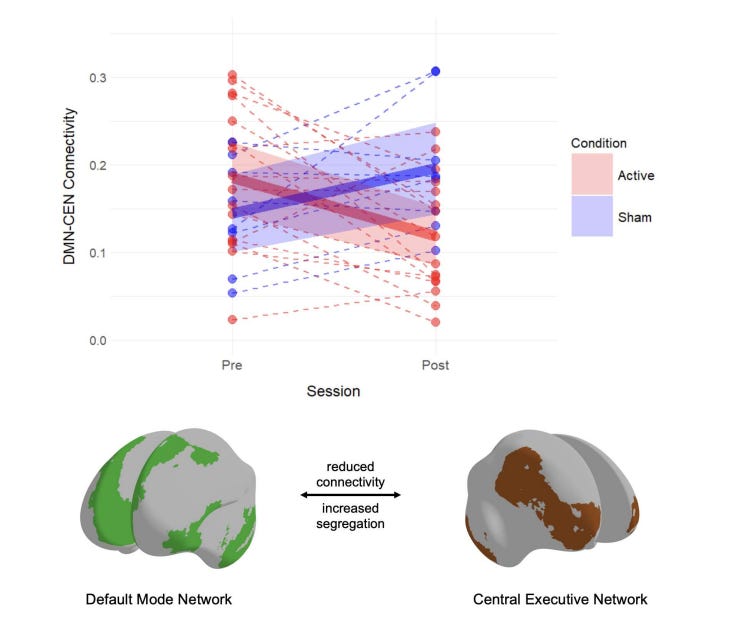
After dozens or hundreds of hours of sitting, experienced meditators have brains that look different from everyone else's. Their default mode network (DMN, the brain's self-referential chatter machine, the thing running rumination loops, and the thing that psychedelics seem to quiet) decouples from the central executive network, the system that handles focused attention. That decoupling is the neural signature of equanimity: letting experiences arise and pass without getting caught up in them. It's associated with reduced stress, lower depression, and generally being a calmer human. But it takes hundreds of hours to get there, and most people quit long before anything rewires, because the early stages are so uncertain and even boring.
What if you could use technology to do the same thing, much faster?
Shinzen and the team at the University of Arizona ran a randomized controlled trial with 24 meditation-naïve participants who did a two-week mindfulness program. Half received transcranial focused ultrasound targeting the posterior cingulate cortex (the hub of the DMN) during four in-person sessions. Half got sham stimulation.
After two weeks, the active group's brains showed the decoupled network pattern that normally takes experienced meditators hundreds of hours to develop (p < 0.001). The sham group's connectivity actually increased; they got more tangled up, not less, which is exactly what frustrated novices do. Within the active group, greater decoupling also predicted bigger increases in self-reported acceptance and longer voluntary meditation sessions. The ultrasound made the practice better and gave novices experienced meditator brains.
It's a small study and a preprint, so it needs replication, but as someone who has spent a lot of hours trying to go deep, it also seems remarkable.
I love this because I’ve written that the worst outcome would be for us to get all of the technological wonders we could have asked for and still be unhappy, and I think meditation, and the associated ability to pay attention, can help there.
It’s also just very cool to see someone who spent his entire career arguing that the cross-fertilization of Eastern contemplative technology and Western science would eventually produce something neither could produce alone being proven right.
“The next Buddha is a sangha,” indeed.
EXTRA DOSE:
Scientific Breakthroughs with Ulkar Aghayeva
My Favorite Essay of the Week