


Hi friends 👋,
Happy Friday and welcome back to our 215th Weekly Dose of Optimism!
Welcome to the flying flipping car era. As bad as things have been for my Philadelphia Eagles, that’s how good they’ve been for humanity.
Let’s get to it.
This week’s Weekly Dose is brought to you by… Reducto

The Only Document Parsing Product You’ll Need
Reducto is the document ingestion layer trusted by AI teams at Scale AI, Harvey, Toast, and Vanta to reliably turn complex files into structured, grounded data for production AI systems at scale. Processing more than a billion pages per month, Reducto has built its reputation on the long tail of difficult documents that break conventional OCR: dense tables, unusual layouts, handwriting, low-quality scans, strikethroughs, and formatting-dependent information.
Its new frontier parsing model, r-1, combines layout detection, reading order, tables, formatting, grounding, and granular citations in a single request. It reduces parsing errors by up to 20%, improves latency at high volumes, and costs 1¢ per page all-in.
Already using another parser? Apply for up to $5,000 in migration credits and hands-on support to benchmark r-1 against your current stack on the documents that matter most.
(1) Neural Networks Are Already Clean
Nick Cammarata · Goodfire
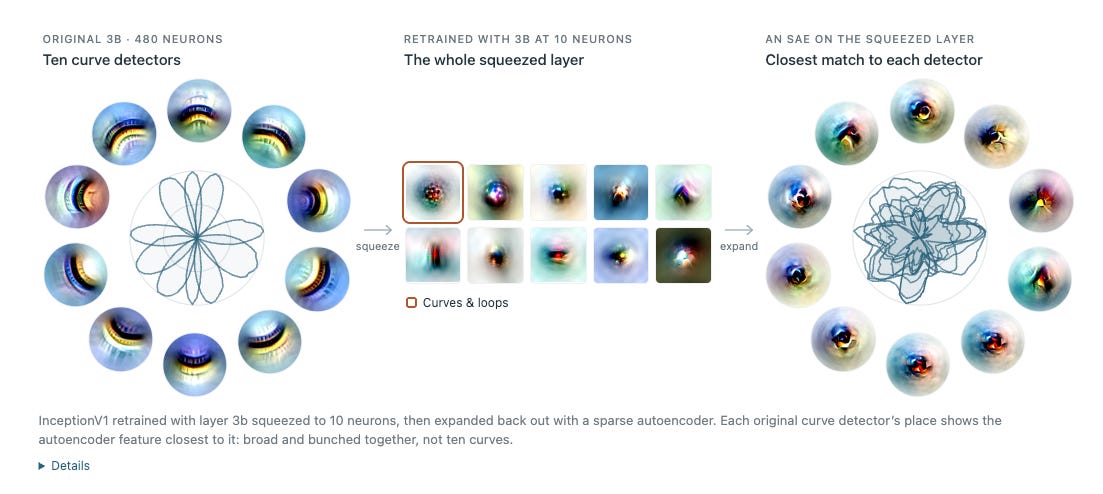
Good news - AI is probably way less likely to kill us all now because humans rock and one of us just kind of figured out how to learn to read their minds.
It is beautiful that a person I became aware of and started following because of his understanding of his own mind—I discovered Nick Cammarata through his tweets on meditation and the jhanas—seems to be the person who’s figured out how LLMs’ brains work.
In the “The Short Version” section, he writes:
I think I have good news about the nature of neural networks.
After many months studying neurons and circuits in image and language models, I’ve come to believe a network’s own mechanisms are its legible building blocks, and that the outlook for mechanistic interpretability may be far better than I’d feared. The canonical evidence of polysemanticity and superposition that convinced much of the field, including me, that networks pack concepts arbitrarily was misread. What looked like arbitrary packing was mostly a motif I’ll call recursive generalization, which is much less concerning. This means we can study networks directly, instead of first untangling them. Neural networks are already clean.
Basically, he thinks that we can understand what’s going on inside of models’ brains - “interpretability” - which means that alignment is probably solveble.
As he explains, “interpretability might be the most important scientific problem in the world right now, as I don’t think we can solve alignment if we don’t know what we’re building.”
Cammarata used to work on interpretability at OpenAI, and he himself “came away pessimistic, because neural networks appeared to fold into arbitrary tangled knots.” Now, he tweeted:
the picture looks totally different. the vast majority in models up to trillions of parameters are legible, and their circuits beautiful. many famous examples of tangled neurons turned out to be misunderstood. The roadblocks I expected mostly aren't there. I now think ambitious interpretability will be solved by the time we need it most, and possibly quite soon, as automated scientists keep improving. it may be a bitter lesson for interpretability: the simple thing, at absurd scale, works.
If he’s right, not only did the p(doom) from runaway AI just tank, but it’s also another win for using technology to solve problems that previously seemed unsolvable. Chalk one up for the optimists.
(2) Tesla Introduces Flying Roadster
Thank god we’re going to live, because it seems like the future is going to be as cool as advertised.
Last night, nine years and a number of delays after Tesla first teased the second-gen Roadster, Elon took the wraps off at a SpaceX test site near Waco. It was worth the wait.
The car went 0–60 in about a second, which would have been the coolest thing at any car reveal in history, except this one. Next, using 10 nozzles fed by a 600-liter compressed-air tank, plus some very large fans, it drove up an upside-down ramp, spun around, and set itself down on the pavement. Then it hopped over a Cybercab, Cybertruck, Semi, Model Y, and Model 3 while moving. Tesla said the car would go half the speed of sound (?!?!) at 380 MPH?
Musk said production starts in 2028 (for real) and joked, I think, that they’d try to jump the Snake River Canyon, the ramp where daredevil Evel Knievel attempted to cross the canyon on a steam-powered rocket.
Just… watch the video if you haven’t.
(3) Arrowhead Shot Cuts Tau in the Brain by 73%
Arrowhead Pharma, video created with Runway
Speaking of brains…
As I’ve written before, my grandmother had Alzheimer’s, and me or someone I love getting Alzheimer’s is one of my biggest fears in life. So whenever there’s a potential development on the Alzheimer’s front, we cover it, even if they’ve historically ended in disappointment.
The hard part of treating brain disease like Alzheimer’s is getting drugs to the brain. The blood-brain barrier is very good at its job, which is why RNAi drugs, which silence a gene before it can make a protein, have been ineffective against brain disease. They’ve mostly been effective in targeting the liver (which filters everything).
On Wednesday, Arrowhead Pharmaceuticals reported interim Phase 1/2a data on ARO-MAPT, which silences the gene that produces tau, the protein that tangles up in Alzheimer’s, frontotemporal dementia, and progressive supranuclear palsy. Healthy volunteers who got two subcutaneous doses at 12.8 mg/kg saw mean total tau in their spinal fluid fall 73% by Day 105, with one participant down 85%. Day 105 was 90 days after the last shot, which means the effect held for three months and the eventual dosing schedule could end up be quarterly or longer. Check the video to see how it works.
All from a shot in the arm!
It’s early, but early Alzheimer’s cohorts are enrolling now and Arrowhead expects to return data in 2027. I hope it works, and that we can all forget about Alzheimer’s once and for all.
(4) Another Very Big Week for Robotics
Nature Will, Pi, DeepMind, Flexport
On Tuesday, Runway co-CEO Anastasis Germanidis and I published Runway: Learning From Watching the World, in which we lay out the company’s bet that robots can learn most of what they need from third-person video. It’s been a big week for robots overall.
On Monday, Physical Intelligence opened its Pi API beta. With it, companies can upload their robot data, fine-tune a π model on π’s compute, and run inference right on their own robots. Early partner companies are using it on everything from picking strawberries to assembling servers, from driving autonomous wheel loaders in Utah to controlling a dual-arm robot that deburrs the spacers used in its own assembly, basically with an API call.
On Tuesday, the Beijing lab Nature Will run by Tsinghua professor Ning Ding released Natura-1, a 50 billion parameter model pretrained on one million hours of egocentric human video. Egocentric means its video from people’s perspective, not robots’, which is important, because robot data is harder, slower, and more expensive to collect. The model watched egocentric video of people using their hands from their own perspective. Only afterward did they post-train on a small amount of robot data, a la Runway.
Per Rohan Paul, what’s interesting about this is: “One model handles 3 things robots usually fail at together: fine 2-handed control after the grasp, new tasks without extra training, and long sequences where it has to remember earlier steps and recover from mistakes. Many robot systems show 1 of these in a narrow setting.”


That same day, GDM entered the fray. Personally, as a long time GDM fan and an unbiased observer, I think Google DeepMind’s demo was the week’s coolest. Norman Di Palo posted a video of Gemini Argon teaching an Apollo humanoid to play cornhole (above). They gave the model a video of a person throwing a beanbag, and Argon took control of the robot, generated its own simulation environment, ran system identification so the sim matched the real motors, trained the throw, and started sinking them. The team did not have to write any specific cornhole controller or anything. It missed a few first — who amongst us hasn’t — but then it gets the hand of it.
The dream: robots enjoying themselves playing cornhole while we humans work!
Unless… Warehouse robots are here! on Thursday, Ryan Petersen posted a video of Flexport’s newest automated fulfillment center, just outside Chicago, where robots move real freight for real customers.

Robot demos are notoriously bad at turning into actual, valuable robots, and Flexport’s certainly isn’t the first automated warehouse. I’m not smart enough to judge any of these approaches against each other, or to say whether any of them will be the one, but there certainly seems to be a lot of smoke in robotics recently. If there’s fire (metaphorically, of course), the near future could get real abundant real fast.
(5) Applied Materials Unveils $5B Chip R&D Center in Silicon Valley
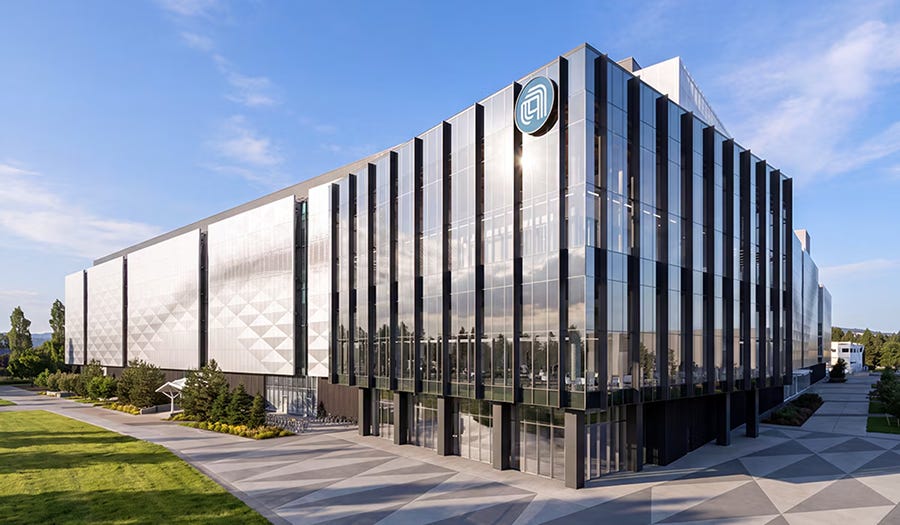
Applied Materials makes the machines that chipmakers like TSMC and Intel use to build chips: the deposition, etch, and inspection tools that lay down and carve the layers on a silicon wafer.
On Monday, it opened the EPIC (Equipment and Process Innovation and Commercialization) Center in Sunnyvale, California. It’s a big investment and a big building. It will cost five billion dollars, cover 600,000 square feet, include nearly four acres of cleanroom, use enough concrete to fill 34 Olympic pools and enough steel for two Eiffel Towers, and take six million construction hours to complete.
As impressive as the space is, this made the Dose because of the partners it’s bringing under one roof in the US of A: TSMC, Intel, Samsung, SK hynix, and Micron are all founding partners, alongside Broadcom, Advantest, KIOXIA, SCREEN, and Besi on the equipment side and Stanford, Berkeley, UCLA, Arizona State, and RPI on the research side. These are competitors, who occasionally sue each other, but have now agreed to put their engineers in the same cleanroom to work on process technology three to four generations ahead of anything in production today.
The point of EPIC is to speed up chip development, which normally runs in series, where materials research hands off to equipment development which hands off to pilot production, with many steps taking place in far flung locales around the globe. The whole process, as it stands, takes the better part of a decade. EPIC is built to run those stages in parallel under one roof, in order to compress the learning cycle on the slowest (and least glamorous) layer of the entire AI stack.
A few years back, I wrote a piece called I, Exponential praising the beauty of exponential curves in technology, the most famous of which is Moore’s Law. As Byrne and Tobias wrote in Boom, Moore’s Law happens because people believe it will happen and then invest ahead of future bottlenecks against that belief, which becomes a self-fulfilling prophecy. This is that in action.
(EXTRA 1) Ben Wilson on David Senra
Putting this one above the paywall because Ben is awesome, David is awesome for doing this, and if anyone the not boring community can help in any way, it would make me very happy. I’ll just leave you with David’s intro:
Ben Wilson has stage four cancer and four small kids. I wanted to have him on the podcast to talk about his work on the How to Take Over the World podcast, which is, in my opinion, one of the best podcasts ever created, and to talk about what it’s like dealing with terminal cancer at such a young age. I also want to ask you for help in any way that you can. Ben is a good man and he’s been dealt a bad hand. Please watch this podcast and see if you can help with medicine, introductions, or donations. It doesn’t matter if you have $5 to spare or 5,000. any little bit can help Ben’s family through this devastating time. He’s a good guy and a close friend. Please help in any way that you can.
Discussing his prognosis, Ben says, “the amount of new treatments that are coming out for all sorts of different types of cancers is remarkable. We live in a really remarkable age.” He’s right. We cover it every week.
Just this week, for example, Bristol Myers Squibb and RayzeBio's RYZ101 significantly delayed progression of neuroendocrine tumors in a 343-patient trial. Neuroendicrine carcinoma is exactly the kind of cancer Ben has. Get fucked, cancer.