
Hi friends 👋,
Happy Friday and welcome to our 211th Weekly Dose of Optimism!
Lock-in season is in full swing and the Dose is bursting at the seams. But I believe in you. Once you’re finished, you can find a lot more to read in the new not boring library, which includes many of the books and essays I’ve linked to most in not boring.
Let’s get to it.
This Week’s Weekly Dose is brought to you by… Reducto

The Only Document Parsing Product You’ll Need
Reducto is the document ingestion layer trusted by AI teams at Scale AI, Harvey, Toast, and Vanta to reliably turn complex files into structured, grounded data for production AI systems at scale. Processing more than a billion pages per month, Reducto has built its reputation on the long tail of difficult documents that break conventional OCR: dense tables, unusual layouts, handwriting, low-quality scans, strikethroughs, and formatting-dependent information.
Its new frontier parsing model, r-1, combines layout detection, reading order, tables, formatting, grounding, and granular citations in a single request. It reduces parsing errors by up to 20%, improves latency at high volumes, and costs 1¢ per page all-in.
Already using another parser? Apply for up to $5,000 in migration credits and hands-on support to benchmark r-1 against your current stack on the documents that matter most.
(1) A Cancer Trial Gives Ben Wilson Reason for Hope


Ben Wilson has spent years studying people who changed history on his podcast, How to Take Over the World (which is excellent if you don’t already listen). In July, the father of four shared that he’d been diagnosed with stage 4 high-grade neuroendocrine cancer, which had spread to his liver, lungs, spine, and brain. In The Cancer Episode, he said his doctors had told him to expect roughly another year.
He also said that we live in an age of miracles, and that he was working to find one.
On Tuesday, Ben shared some encouraging news about a treatment his family has been raising money to help him access: tarlatamab.
Amgen and AstraZeneca reported positive results from DeLLphi-305, a randomized Phase III trial involving 563 patients with extensive-stage small-cell lung cancer. After initial chemotherapy and immunotherapy, patients received either durvalumab alone or durvalumab plus tarlatamab. The combination significantly improved overall survival and the time patients lived without their cancer progressing. Tarlatamab connects cancer cells bearing a protein called DLL3 with the immune system’s T cells, helping them attack; durvalumab blocks one of the mechanisms tumors use to suppress that immune response.
The detailed survival numbers aren’t public yet, and results in the trial’s specific population don’t establish what will happen in Ben’s case, but it seems to be a positive result and one that might give him a chance to live longer.
Stage 4 cancer is always dangerous but I might have many more high-quality years in front of me.
Given the pace of progress in cancer treatments, slowing cancer’s spread and giving people more time might mean that they live long enough for a more complete cure, something that knocks the cancer out entirely.
We cover a lot of cancer studies here, but given that I’ve been a long-time listener of Ben’s podcast, this one is a reminder that behind every diagnosis and survival curve are people who want to see their kids grow up, spend more time with their partners, and keep doing the work they love. Progress means giving more of them that chance.
Rooting very hard for Ben. Get fucked, cancer.
(2) First Treatment for “Childhood Alzheimer's” Approved
Ultragenyx
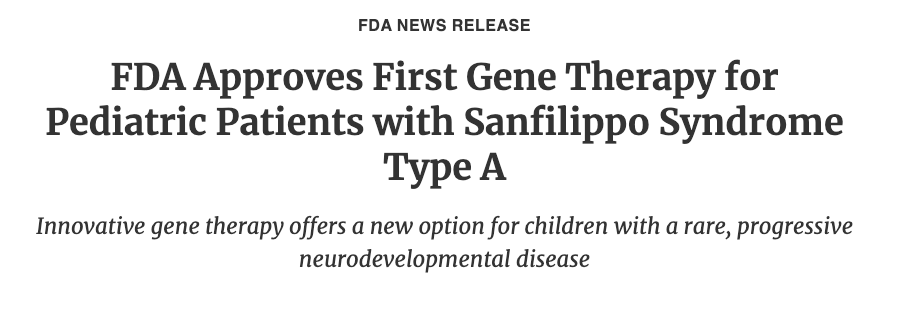
Until doing the research for this week’s Dose, I didn’t know there was a disease nicknamed “Childhood Alzheimer’s.” As someone terrified of getting Alzheimer’s in old age who also has two young kids, I can’t think of a more tragic disease than this one, Sanfilippo syndrome type A.
Kids are born seemingly healthy, start developing normally, and then, because they're missing a single enzyme, a sugar molecule called heparan sulfate builds up in their brains. They lose the words they've learned, then the ability to walk. The median life expectancy of those inflicted is 15.
There has been nothing doctors could do for these kids except manage symptoms… until yesterday.
On Thursday, the FDA approved Fayuvi, Ultragenyx’s gene therapy and the first treatment ever for Sanfilippo type A. It’s a one-time IV infusion that uses an AAV9 virus to deliver a working copy of the broken gene so the body can make the missing enzyme itself. In the pivotal trial, 17 treated kids scored 23.5 points higher on a standard cognitive scale than 27 untreated kids from a natural history cohort, with follow-up now stretching to nearly eight years. Treated kids kept learning during the years the disease would normally have stolen their ability to do so.
Despite the treatment’s massive potential to improve kids’ lives, it almost didn’t make it to this point. Haiyan Fu and Doug McCarty built the therapy at Nationwide Children's more than a decade ago and licensed it to Abeona, which ran out of money despite good data. They handed it to Ultragenyx, who submitted to the FDA for approval. Then last July, the FDA rejected it over manufacturing issues, even while calling the clinical data robust.
Now, Ultragenyx has fixed the plants, resubmitted, and expects to ship within 30-60 days.
It works best given early, before the damage is done, so the next thing that needs to happen is newborn screening. But there’s now a treatment for one of the most appalling diseases known to humankind.
Age of miracles.
(3) Natural General Intelligence
Ryan Orbuch for Lowercarbon
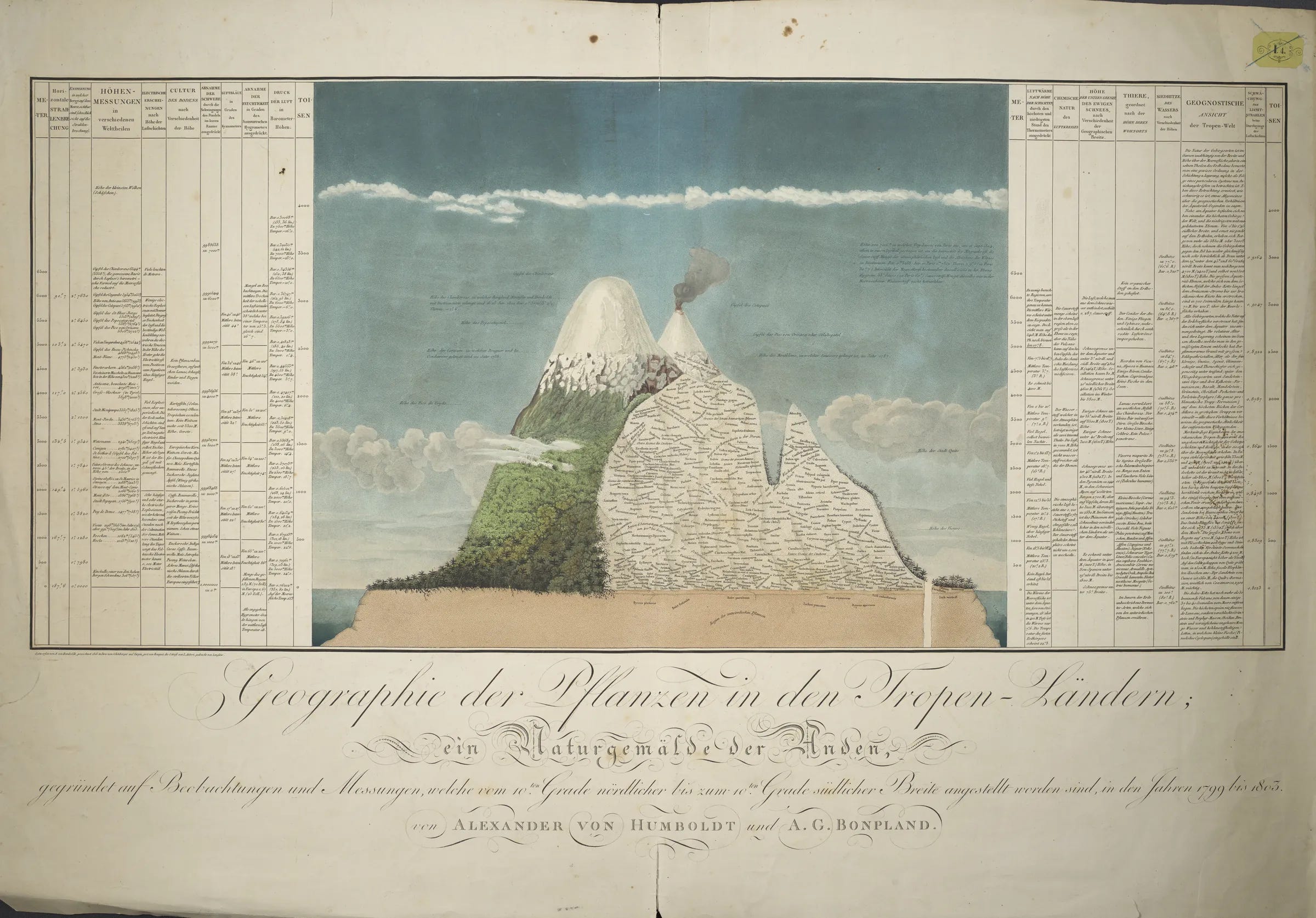
When Will O’Brien and I wrote about The Great Blue Frontier, he shared that “we have mapped only 27% of the ocean floor with modern sonar, and much of that is coarse, low resolution.” The ocean is just one very big domain that we don’t have enough data for, but in his latest essay, Lowercarbon partner Ryan Orbuch argues that we don’t know nearly enough about the planet generally, that we now have the tools to get all that data, and that we should get it and put it in a model for Natural General Intelligence.
I got a chance to read an early draft, and what struck me is that this problem is an awful lot like biology, where models have been useful in making sense of enormous amounts of ever-changing data that’s too complex for humans to understand holistically. Using models to better understand our planet so that we can intervene, like we do with our own bodies, is an ambitious goal, and I think a worthy one. We have the technology.
Since I read the early draft, it got even better, and Ryan added a bunch of beautiful and interactive graphics, so you should go spend some time better understanding the state of understanding our world.
(4) ChatGPT & RLHF Co-Inventor Releases TypeSafe AI
As smart as it seems to be, AI is still terrible at writing. So why not just make one that shuts up and gives you the answer?
Diogo Almeida, who helped develop the research behind ChatGPT, has spent the past two years building a model for software that needs decisions. On Tuesday, his company, TypeSafe, introduced Jev.
Jev takes information and questions with predefined answer formats, then returns decisions and probabilities. Which department should receive this support ticket? Does this transaction look suspicious? How likely is this customer to cancel? It produces those answers in parallel, without generating a paragraph one token at a time.
Almeida claims Jev produces 20–200× faster responses and 40–400× lower costs than frontier models on the decisions Jev is designed for. They’re company reported numbers, and I’m sure third-party benchmarks are coming, so take them with a grain of salt, but it makes sense. It’s not burning tokens writing long answers or figuring out how to get humans to understand what it does.
It seems like a smart way to increase companies’ Return on Tokens (ROT), and the idea is that if intelligence gets cheap and fast enough, developers can squeeze it into all the little decisions that previously required brittle rules or a human review.
People keep sharing examples of what Jev can do, and they’re very cool! Check out here, here, and here, or just scroll through the Quote Tweets on the original. The tools keep getting better!
As it gets cheaper and more efficient, we’ll use more of it. That’s why they named it Jev, after William Stanley Jevons, of Jevons paradox fame. It’s also a step towards recognizing what models are and are not good at and building capabilities around those strengths and weaknesses. I’m just happy that we might get to read a little less slop to get our work done.
(5) Thatch Raises $108M Series C at $1B
When I wrote about Thatch last October, my thesis was that changing who controls healthcare dollars could change the healthcare system. Give individuals choice in how they spend, and healthcare providers would need to develop offerings that compete for their dollars.
On Tuesday, Thatch announced a $108 million Series C at a $1 billion valuation. Its ARR has grown nearly 7× over the past twelve months, and more than 5,000 employers now use the platform. Investors include The General Partnership, Index Ventures, General Catalyst, and a16z, alongside strategic investors including Eli Lilly, ADP Ventures, and Paychex. Not Boring Capital has been an investor since 2022.
Thatch makes it easy for employers to give employees a tax-free healthcare budget through ICHRA. Employees choose their own individual insurance plans and can use remaining funds for eligible medical expenses. Thatch handles the financial and administrative work behind the scenes so that individuals can focus on picking the best plan for themselves and their families.
The bet is that insurers and providers behave differently when the person receiving care controls where the money goes. They have to compete for that person’s business. And if someone can keep their insurer when they change jobs, the insurer has more reason to invest in keeping them healthy over time. Capitalism, baby!
In order for Thatch to change the big, sclerotic, heavy, embarrassing healthcare system, though, it needs to get big enough to matter to insurers and providers. Thatch needs to aggregate enough demand to persuade carriers to build better products, which could attract more people, which would pull still better products out of the market.
More capital is both a sign that the company is scaling well, and fuel to scale further still. There’s maybe nothing with the same combination of size and dysfunction as the US healthcare system; if Thatch can help fix it, there’s nothing we can’t do.