

Welcome to the 2,250 newly Not Boring people who have joined us since our last essay! Join 263,454 smart, curious folks by subscribing here:
Hi friends 👋 ,
Growing up, I sailed a little sailboat called a Sunfish. I was OK, not great, which is a shame, because had I been a little more competitive, I would have raced against the next town over, whose team included a young Taylor Swift.
When I turned 16, I became a beach lifeguard, which is pretty much the greatest job ever for a 16-year-old, and I held onto it for the next four summers. I wasn’t a great swimmer or a great rower, but I was a good enough runner to make up for it so they kept me around. Over those summers, I fell in love with Wes Anderson’s The Life Aquatic with Steve Zissou, which was based, red knit cap and all, on the life of Jacques Cousteau.
All of which is to say, while I spent a lot of time by the ocean, I had a tourist’s relationship with it. I enjoyed it, swam in it, sailed in it, and then went back to the real world, where classes and eventually a real economy awaited.
This, Will O’Brien argues, is how we’ve all handled the ocean until now. We come, we explore or exploit, and we get back to dry land. This, Will thinks, is no longer how we will handle the ocean. With Ulysses, The Ocean Company of which he is co-founder and President, Will plans to help build the infrastructure that would allow us to treat the ocean as a permanent fixture of the economy, and potentially even as a new home for humanity. The way our grandparents and JFK thought we would.
Since meeting Will two and a half years ago, he’s become one of my favorite people in tech to talk to about everything from Irish omnipresence to religion to aliens to vertical integration. I’ve been asking him to put his gift of gab to paper with me for a while, and now that the company has successfully raised $46M from a group of investors led by a16z American Dynamism, he finally had the time to oblige.
Note: not boring capital is not an investor in Ulysses, but I am a huge fan.
In this co-written essay, Will tells a history of the future of the ocean that I’d never heard, before making the case that the ocean is the last great frontier and one of the greatest economic opportunities available to humanity. It’s an adventure, and in the words of Steve Zissou, “Anyone who wants to tag along is more than welcome.”
So throw on the most underrated soundtrack of the 2000s…
And let’s get to it.
Today’s Not Boring is brought to you by… Framer

Launch fast. Design beautifully. Build your company's website on Framer.
Framer helps teams design, build, and launch their marketing sites lightning fast. With the ability to publish hundreds of CMS pages in a single click, operate at a global scale with seamless localization, and even host unified content across multiple domains, teams have never been able to ship faster. Companies like Miro, Bilt, and Perplexity trust Framer to achieve:
Speed without chaos: ship pages and updates faster without turning the site into a fragile set of one-off hacks.
Reduced dependency: shift routine brand and marketing work out of product engineering queues.
Production-grade foundation: Run real marketing systems (CMS, SEO, performance optimization) with governance and collaboration.
👉 Build your company's site on Framer today
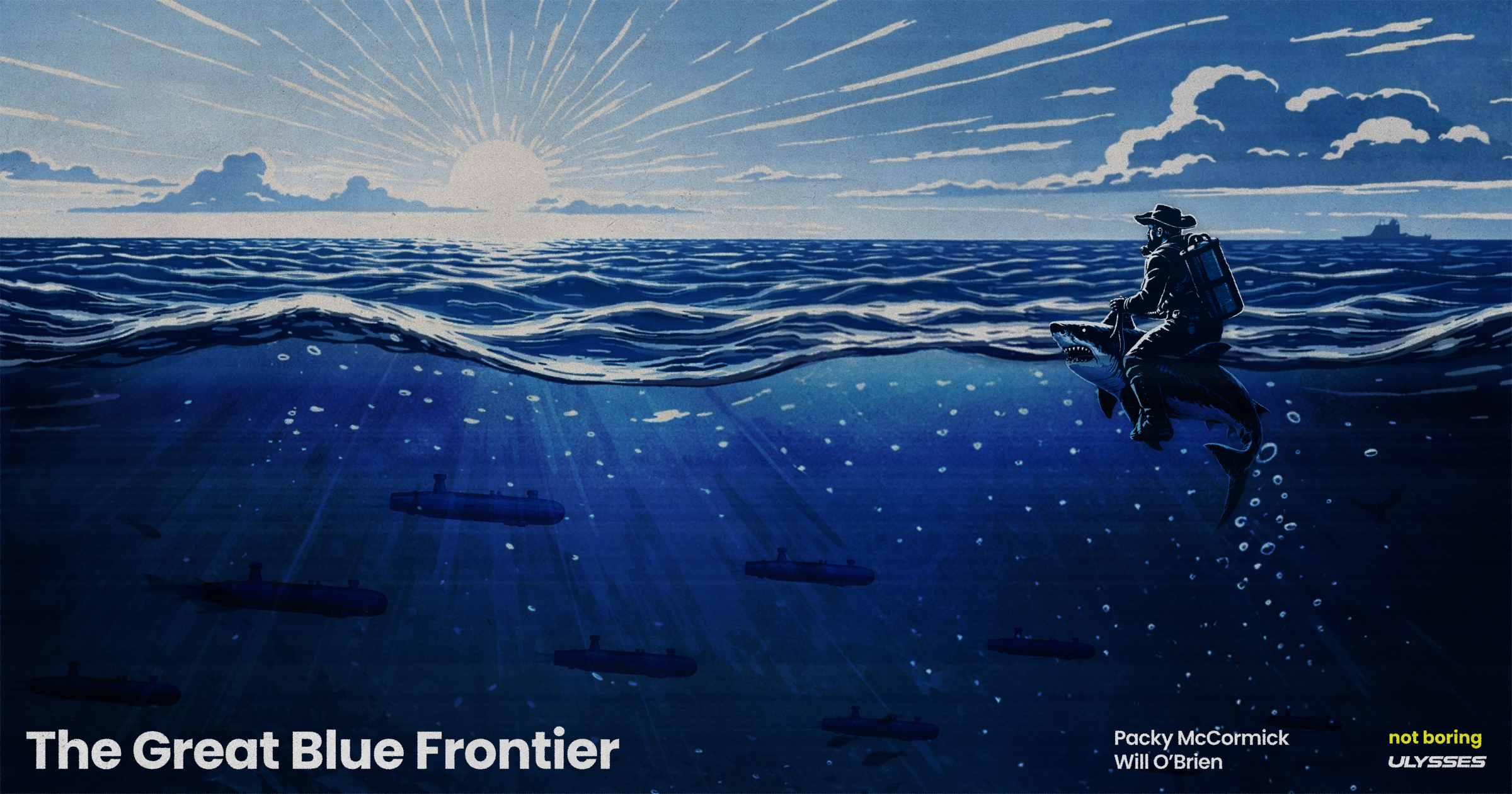
The Great Blue Frontier
With Ulysses President Will O’Brien
The Death of the Ocean Dream
At 4 AM on February 17, 1969, Berry Cannon was lowered 610 feet below the surface of the Pacific in a steel personnel transfer capsule to make repairs to the Navy’s “yellow submarine,” Sealab 3. At that depth, normal air becomes toxic to humans and the nitrogen can send you delirious, so Cannon was breathing helium instead. Helium keeps your mind clear, which was helpful for Cannon. He had been awake for twenty straight hours. Unfortunately, helium also strips heat from your body six times faster than air does. This was a problem. That particular morning, the capsule’s heater was broken.
No matter. Cannon, one of history’s greatest maritime frontiersmen, was running on amphetamines and conviction. When the capsule reached the seafloor, he dropped through the hatch into open water and began swimming through pitch darkness toward a leaking underwater habitat. This habitat, the U.S. Navy believed, would be humanity’s first permanent foothold on the ocean floor.
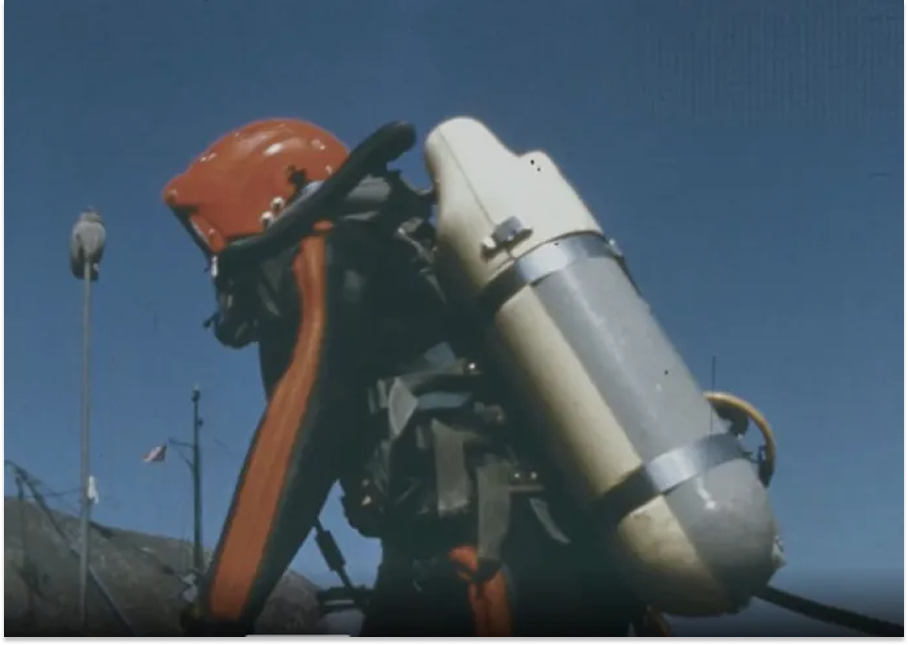
It was a routine fix as far as deep sea habitat fixes go. Except for one fact: Cannon’s rebreather’s CO₂ scrubber canister was empty of Baralyme. He didn’t know that. Nobody did. On a TV monitor topside, Captain George Bond watched Cannon swim gracefully—and then he watched Cannon’s body suddenly jackknife.
“Any time you see rapid motion in a diver,” Bond would say later, “you know he’s in trouble.”
Berry Cannon was dead. And with him died America’s plans to conquer the ocean.
Five months later, Neil Armstrong walked on the Moon, fulfilling one of JFK’s most ambitious promises. It’s been over half a century, and we all know Neil Armstrong’s name.
But nobody remembers the man who died trying to live on the seafloor. Nor do we remember the ocean dream he represented.
I grew up in County Cork, on the south coast of Ireland, and spent every summer at Garrettstown jumping off the pier or the cliffs, bodyboarding and pulling crabs out of rock pools, or heading out in the boat with my dad to catch mackerel. I loved the ocean the way you love something before you understand it. The textures, the cold, the endlessness of it. As a kid, I loved explorers too. Steve Irwin, especially. He wasn’t an ocean guy, but he had that renegade explorer energy, that willingness to just get in there and figure it out. I think I always assumed someone was figuring the ocean out, that there was a Steve Irwin of the Deep. That someone was down there, mapping it, understanding it, and protecting it.
As I got older, I realized nobody was.
So I’ve made the oceans my life’s work. In just the past few months, my office has rotated between Washington D.C., San Francisco, Los Angeles, London, Western Australia, Maine, Virginia, Florida, New Orleans, and San Diego. I would do this for free; I might even pay to do it. But as I’ve been living out my childhood dream, I’ve found that the ocean economy is something like a sunken treasure that’s been waiting on the bottom of the sea for anyone intrepid enough to go grab it.
Today, I’m going to let you in on the secret I’ve discovered down there: Earth’s largest domain and last great frontier is also its grandest economic opportunity.
The Two Frontiers
In the 1960s, America was a country dreaming at full volume. You could taste optimism in the air — and in the sea.
Most of us alive today never learned how important ocean exploration was to the future our grandparents imagined. Americans were fantasizing about ocean exploration in the same way they were about going to the Moon. They were as captivated by The Great Blue Frontier as they were by the Space Race.
At the 1964 New York World’s Fair, GM’s Futurama II ride carried more than 26 million visitors past a vision of the near future. Alongside the lunar base and the Antarctic weather station, guests saw ocean-floor oil rigs, submarine trains hauling minerals to shore, and Hotel Atlantis, a sub-oceanic resort around which vacationers explored in various personal oxygenated craft.
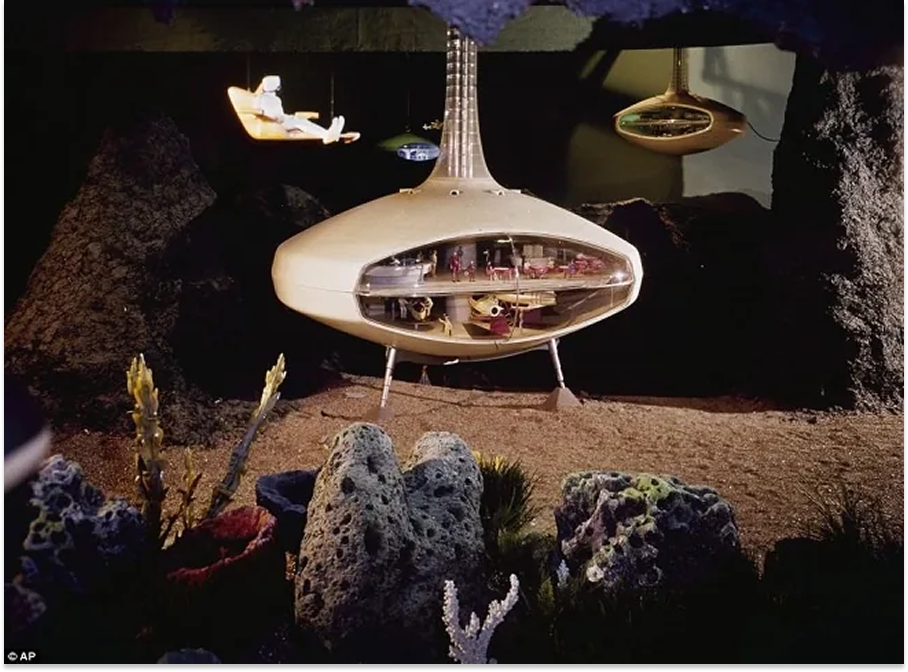
The ocean stood right beside the Moon in the American imagination, and it promised just as much: food and living space for a rapidly growing country, minerals and energy for a booming industry, and the upper hand in the Cold War.
President John F. Kennedy saw the problem clearly. “We know less of the oceans at our feet, where we came from, than we do of the sky above our heads,” he told the National Academy of Sciences in 1963.
His administration had been trying to close that gap from the start. In a March 1961 letter to Congress, he called for “a national effort in oceanography,” warning that “knowledge of the oceans is more than a matter of curiosity — our very survival may hinge upon it.” Kennedy’s FY1962 budget request nearly doubled federal oceanography spending, funded ten new research vessels, and expanded shore facilities fivefold. Two years later, he sent Congress a ten-year, $2 billion plan called Oceanography: Science for Survival, and directed the Navy to begin SEALAB — an underwater habitat program explicitly conceived as the ocean floor’s answer to the Space Race.
President Kennedy placed the ocean alongside space as the twin frontiers of American ambition and coequal national priorities, and his ambition was matched by action.
While Kennedy persuaded Americans about the ocean’s importance as a governmental priority, French naval officer, explorer, and filmmaker Jacques Cousteau charmed them in their living rooms.
Cousteau had co-invented the modern scuba regulator and was one of the most famous people in the world. He built Conshelf, a series of underwater habitats where teams of divers lived for weeks at a time on the seabed. Conshelf II, built in the Red Sea in 1963, was essentially an underwater village: a starfish-shaped structure at a depth of 33 feet with bedrooms, a kitchen, hot showers, and a television.
A parrot named Claude served as the carbon dioxide detector. If Claude fell off his perch, the air was bad. You couldn’t whistle because of the helium. Matches wouldn’t light, although the crew still managed to light cigarettes. Sparkling wine went flat under pressure. Fried food was forbidden because greasy fumes couldn’t be scrubbed from the air.

The documentary about this village, World Without Sun, won the Academy Award. The Undersea World of Jacques Cousteau ran on prime-time American television from 1966 to 1976. The ocean was mainstream culture, Academy Award-winning cinema, and prime-time television. It had become a fixture of the popular imagination.
Simultaneously, the U.S. Navy was building permanent undersea infrastructure with the same seriousness that the Army had when it built forts across the American West. Its program, SEALAB, consisted of three progressively deeper underwater habitats that were designed to prove that humans could live and work on the ocean floor for extended periods. We were going to settle the ocean. On SEALAB II, astronaut Scott Carpenter, one of the original Mercury Seven, spent 30 consecutive days underwater, becoming the only astronaut-aquanaut in history.
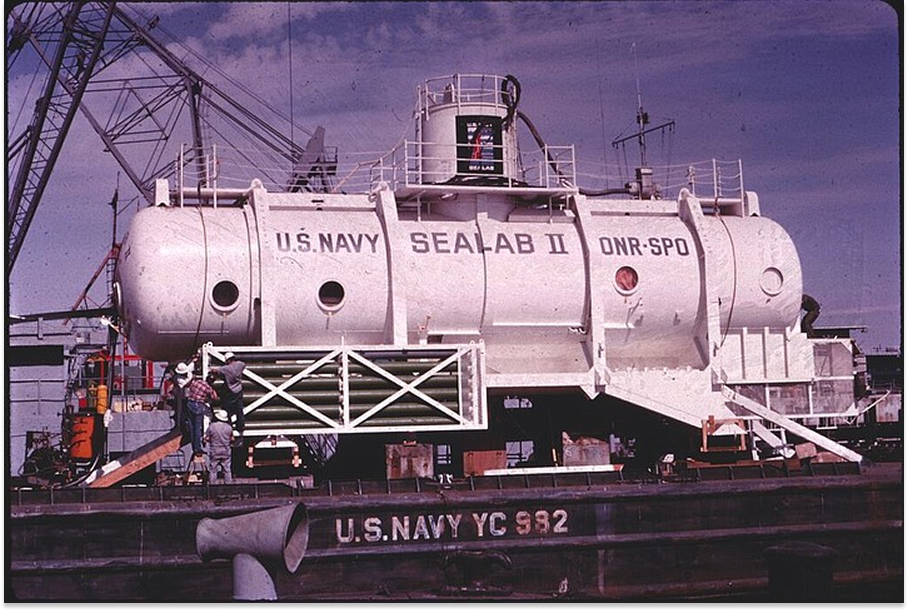
By the late 1960s, more than 60 underwater habitats dotted the world’s seabeds: Hydrolab, Helgoland, Tektite, Aquabulle, Hippocampe, dozens more.

Kids wanted to be aquanauts the way they wanted to be astronauts. The ocean was a national obsession on par with the Moon.
Then, in roughly five years, it all died.
SEALAB was suspended immediately after Cannon’s death. The Navy, which could invest in the future during peacetime, was pulled into the Vietnam War. Even Jacques Cousteau, the man who had done more than anyone alive to prove humans could live underwater, the man who had unmatched cultural authority on anything to do with the ocean, pivoted from exploration to activism. He founded the Cousteau Society in 1973 to protect and preserve the oceans instead of exploring and settling them.
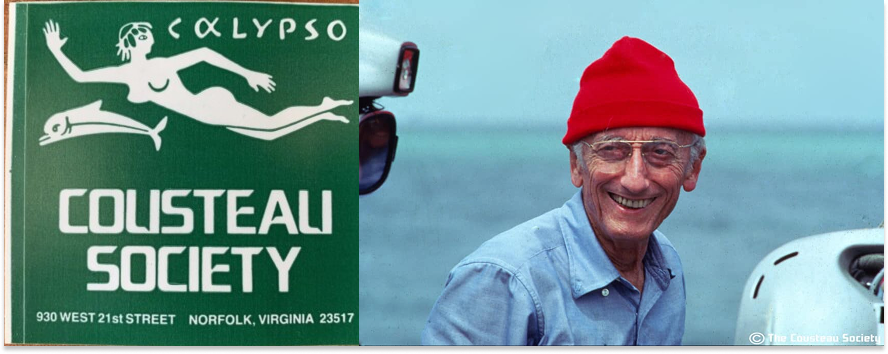
By the 1992 Rio Earth Summit, he was dubbed “Captain Planet.” America, in some sense, always followed Cousteau’s lead on the ocean. When he explored, we wanted to explore. When he said “protect,” oceanic policy and funding priorities fell in line. The regulations that followed, including the Marine Mammal Protection Act, UNCLOS, the IWC whaling moratorium, and the High Seas Treaty, were individually important protections, responding to real ecological crises that demanded our attention. But their cumulative effect, compounded by Cousteau’s cultural reframing, led to a collective shift in how we considered the ocean as a domain to build in. Within a generation, any proposal for persistent ocean activity faced a default presumption of harm.
In the 1960s, America set its sights on two frontiers. By the 2010s, we had all but stagnated on those hopes. We landed on the Moon, went back a few times, and then decided to keep our eyes on the ground. We gave up on settling the ocean altogether.
But we are going back to the Moon, this time to settle it. Just this month, the Artemis II astronauts orbited the Moon for the first time since 1972 in an important step towards settlement. NASA Administrator Jared Isaacman has laid out a plan to begin building a permanent base in 2028, a mission made possible by progress in the commercial space sector over the past two decades. We are going to be an interplanetary species! The Moon should be a state, experts are saying.
It’s time that we settle the ocean too.
This forgotten frontier is no less economically or geopolitically important than space; in fact, it is both larger and more urgently strategic. Through our forgetfulness, the ocean has become a wild and lawless domain whose potential to benefit humanity lies dormant, one which is being abused by those who care nothing for protection or preservation.
What Happens to a Frontier Forgotten
In 2015, a wooden fishing boat washed ashore on the coast of Japan carrying the skeletal remains of its crew. Then another arrived. And another. Over the next several years, hundreds of these “ghost boats” drifted onto Japanese beaches, small wooden vessels with many carrying only bones and tattered North Korean flags.
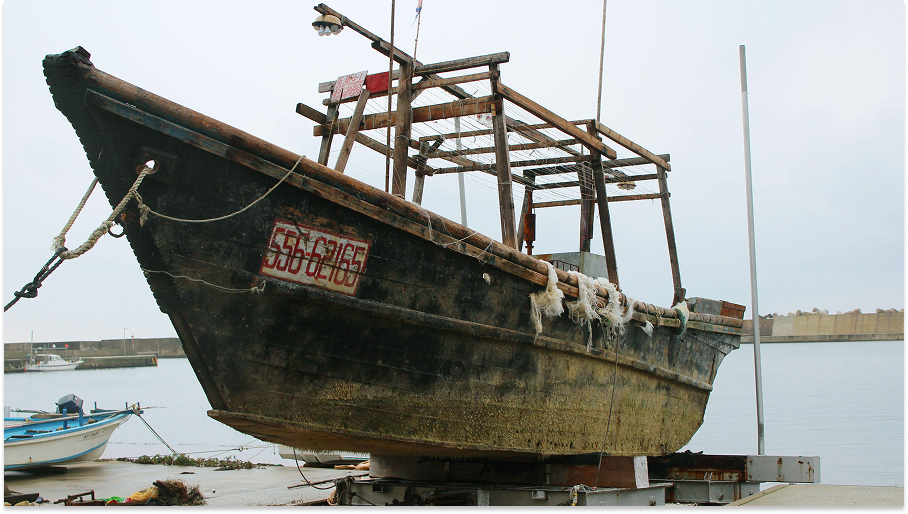
Investigators eventually pieced together the story, which turned out to be more tragic than supernatural. 900 Chinese distant-water fishing vessels had moved into North Korean waters in violation of UN sanctions (sanctions that China itself had signed and ignored), strip-fishing the stocks and pushing local fishermen further and further offshore in boats not built to take on the open ocean. Those fishermen starved at sea, and their boats drifted east until Japan’s coastline caught them. Nobody stopped the Chinese fleet, and nobody rescued the fishermen, because there was nobody out there to stop or rescue.
A 2024 study in Nature found that three out of four industrial fishing vessels are invisible to public tracking, which is wild in a modern society that tracks everything.
Consider the pandemonium that broke out when MH370 went missing, because planes, unlike fishing vessels, don’t just go missing. Last weekend, I spoke with a man who was in a terrible car accident on a Canadian highway in 1994; his right leg and hip were crushed, but he lived because a helicopter arrived to whisk him to the hospital within five minutes. In the air and on land, we track our people and our critical assets with stunning accuracy.
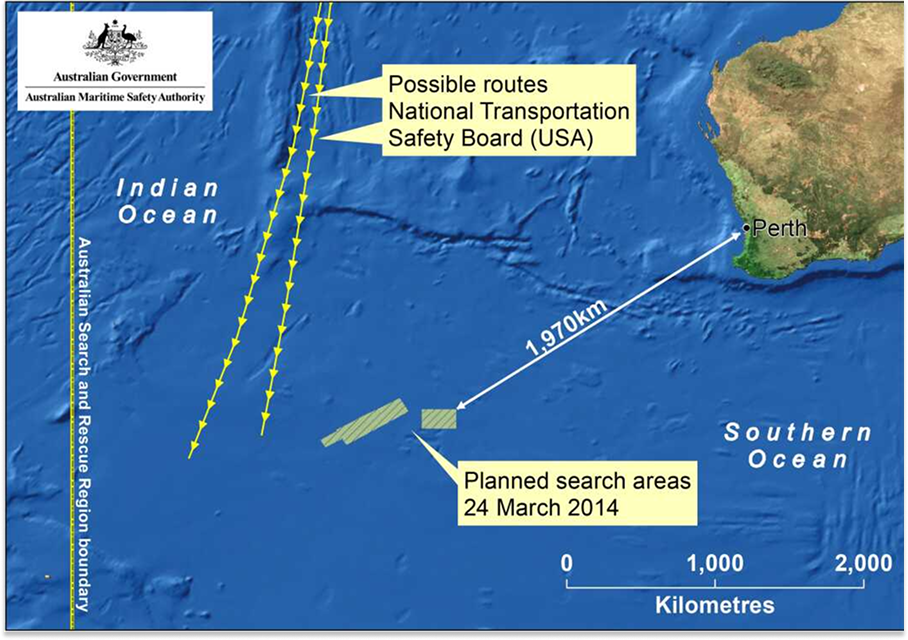
But the ocean doesn’t operate like that, in large part because we don’t have the infrastructure to make monitoring possible. So we’ve kind of given up. Two-thirds of the ocean falls outside any country’s jurisdiction, and there is no police force or coast guard with global reach. There is a reason that so many ocean movies involve protagonists lost at sea, hoping that someone chances upon them.
As a result, we often find boats doing bad things, too late. Fleets of hundreds of Chinese vessels have been caught operating illegally off the coast of Ecuador, right at the edge of the Galápagos Marine Reserve, one of the most ecologically sensitive places on Earth. In 2017, Ecuador intercepted a single vessel, the Fu Yuan Lu Leng 999, which was carrying 6,000 sharks, many of them endangered species, fished from Galápagos waters. Workers on distant-water fishing vessels are held for years, passports confiscated, in conditions that meet every definition of slavery.
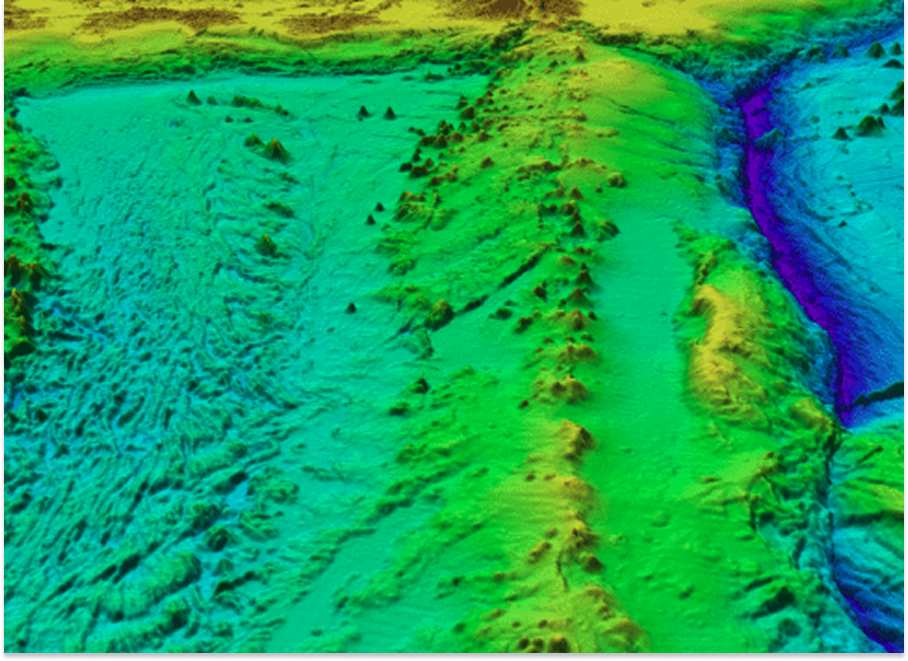
There is no way of knowing how many illegal vessels go undetected, because so much of the ocean remains unmonitored, and we have less of a clue the further beneath the surface we go. While humanity has mapped 100% of the surface of Mars, a planet with no known life 140 million miles and seven months (if you time it just right) away, we have mapped only 27% of the ocean floor with modern sonar, and much of that is coarse, low resolution.
“If you just look at the size of the ocean,” Bob Lazar (yes, that Bob Lazar) recently told Jesse Michels, “you can hide an entire civilization down there. Especially if they’re immune to the effect of the ocean. You just gotta be deep. We’ll never find ‘em.”
While we can neither confirm nor deny the existence of subsea civilizations (except for maybe Atlantis), the fact is there is certainly enough space and little enough visibility to get away with it. The ocean is unfathomably large, and we haven’t even begun to fathom what’s happening all those fathoms below.
This, as President Kennedy warned in 1963, is more than a matter of curiosity. Our survival, or at least our flourishing, may hinge upon it.
Sixty-three years later, we have failed to heed his words, and to capitalize on the opportunity. The ocean covers 70% of our planet, carries 99% of our internet traffic and 80% of our trade. It contains more critical minerals than all known land reserves. And we still know critically little about any of it.
A full 91% of ocean species remain unknown to science. When researchers sequence DNA from deep-sea sediments, they can’t match it to any known organism by species or taxonomic group. The largest library of biological information on earth is functionally unread. Chances are, that library contains a well-stocked pharmacy.
Marine organisms have already given us Ziconotide (a painkiller 1,000x more potent than morphine, from cone snail venom) and Trabectedin (a cancer drug, from a sea squirt). The alien-looking jellyfish Aequorea victoria provided researchers with the green fluorescent protein (GFP) that won them the 2008 Nobel Prize in Chemistry, which now “enables scientists to track, amongst other things, how cancer tumours form new blood vessels, how Alzheimer’s disease kills brain neurons and how HIV infected cells produce new viruses.”

Presumably, there is more where that came from inside the other 91% of sea creatures we have yet to discover. If AI for bio is data-limited, we have a library full of it in the ocean.
There is much for a knowledge-loving people to discover down below, so… let’s just go find out what else is down there. Let’s send people and instruments and start intervening.
Alas, there is nothing to intervene with, because we never built anything that could intervene, and little more to listen with, because we let our ears rot.
Back in the 1950s, back when the nation had aquatic ambitions and a Cold War foe against which to sharpen them, the US Navy built a classified network of undersea hydrophone arrays called the Sound Surveillance System, or SOSUS. By exploiting the deep sound channel, or SOFAR channel, SOSUS could track Soviet submarines across enormous swaths of the Pacific and Atlantic Oceans. Individual listening stations could pick up a submarine across entire ocean basins thousands of miles away.
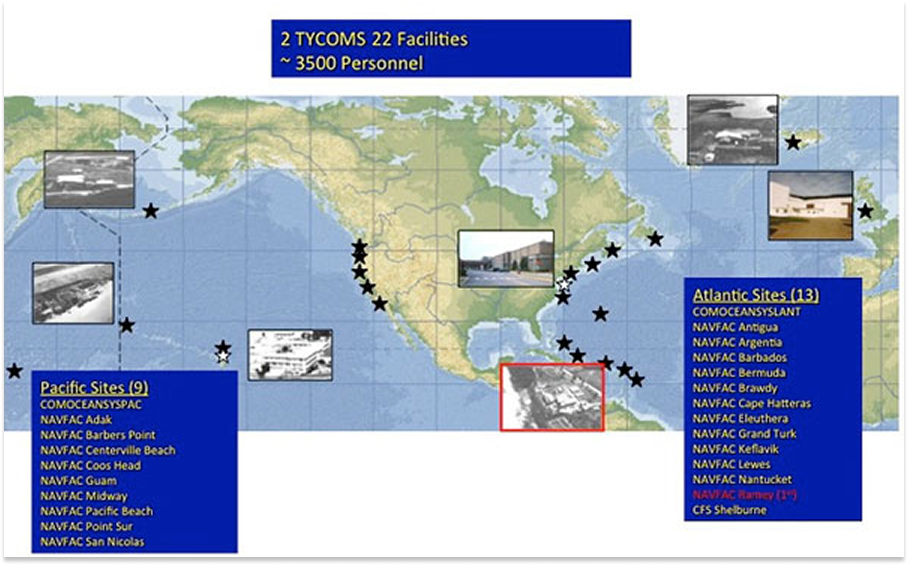
Turns out, SOSUS could track whales, too. When it was partially declassified in the 1990s, marine biologists realized the Navy had been accidentally collecting the richest dataset on ocean biology ever assembled. They’d captured volcanic eruptions, seismic events, whalesong, species migrations, and, in 1997, the “Bloop,” a mysterious sound that has still not been fully explained…
But the Cold War ended in the ‘90s, and by then, our ocean dreams were already long dead. The US government declassified SOSUS, celebrated its scientific contributions, then cut its funding. Some assets were folded into another program, IUSS, a bunch of the hydrophone arrays were put into standby status, and stations at places like Bermuda, Adak, and Keflavik were shut down.
Today, our greatest effort at ocean observation is a network of 4,000 robotic floats called Argo, the 27-year-old “crown jewel of ocean observing systems.” Each of the 4,000 floats monitors an area larger than Portugal, surfacing once every ten days to transmit a single temperature reading. They are deployed like this…
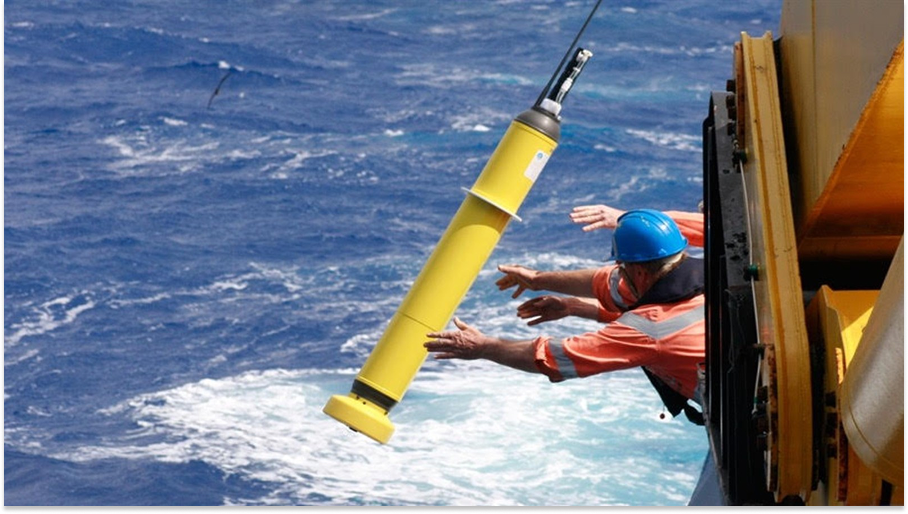
Or, like this...
The entire program is tax payer-funded. And despite running on just six cents per American per year, those 4,000 floats now generate more subsurface ocean data every month than the entire rest of the observing network combined. Argo is great, but that is much more an indictment of the state of our ocean awareness than a celebration of the system.
Plus, Argo can only observe, just like SOSUS could only listen. If a float detects a chemical anomaly, a biological collapse, or a dangerous trend, there is nothing and no one for miles around to respond, in much the same way a thermometer can tell you that you have a temperature but can’t do a damn thing about it.
The question is, in a time of technological wonder, why the ocean remains dark.
The Ocean is Pre-Industrial
Frontiers are tamed when there’s money to be made from taming them and the technology to tame them is viable.
President Thomas Jefferson sent Lewis and Clark west to wrest the fur trade from the Canadians and establish commercial routes. The Forty-Niners went to find gold. These were risky and potentially highly profitable expeditions, and when they paid off, America built the railroad to connect the West with civilization.
The railroad meant that normal people, not just bold or desperate explorers, could establish their homes, families, and businesses in the West, and it made new industries possible: ranching, mining, commercial agriculture, towns, and cities. The railroad industrialized the Western Front.
Something similar happened in space, a domain accessible only to national governments and a handful of intrepid telecommunications pioneers in search of vast riches before SpaceX collapsed launch costs. Before SpaceX, the biggest satellite constellations were measured in dozens. Today, SpaceX has more than 10,000 Starlinks in orbit; people make fun of Jeff Bezos for flying “only” a couple hundred satellites.
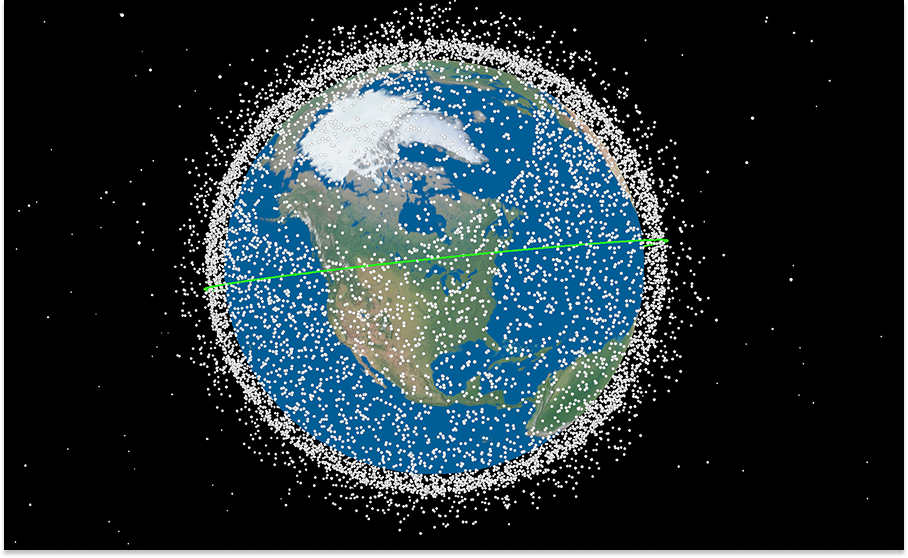
Reusable rockets are the space railroad, and on them fly hundreds of businesses seeking to get to space and stay. SpaceX industrialized space, and the effects of that industrialization are just beginning to be felt.
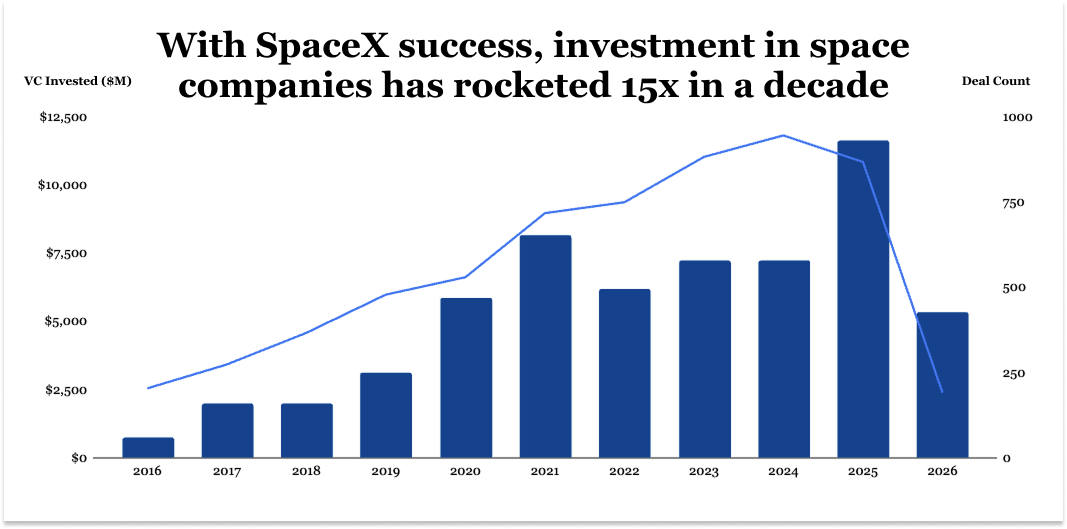
For all of the exploration and trade we’ve done out there, the ocean has never had this moment. We’ve fished it, laid cables across its floor, drilled rigs into it, plopped wind turbines in it, raced around the globe on it, and shipped goods across it, but nobody has ever cracked the economics of operating within it, broadly and persistently, as a domain. The ocean still runs on an 1800s-era expedition model that puts expensive humans on expensive ships for expensive campaigns, then brings them back to dry land.
There’s a word for a frontier that hasn’t had this moment yet. The ocean is pre-industrial.
To industrialize a frontier means to transform it from a place with industries in it, exploring and opportunistically extracting, to a place built to support industries persistently and economically, at scale.
An industrialized frontier is a platform, not a series of projects. Each new piece of infrastructure makes the next one cheaper and unlocks activities that weren’t possible before. An industrialized frontier compounds.
The railroad industrialized the West and SpaceX is doing the same for space. Nobody has industrialized the ocean yet.
If we want to gain dominion over Earth’s oceans and steward them properly, we need to make it a place where industry can thrive.
Creating more industry in the ocean would decrease crime, increase our understanding of our home planet, accelerate scientific discovery, grow existing maritime industries and enable new ones altogether, unlock resources that are literally sitting on the floor, and, counterintuitively, incentivize our stewardship of it.
A Note On Industry and the Environment
Industrialization has dirty connotations. As you read the word, you might be picturing smokestacks, or worse, the soot-darkened faces of pre-pubescent factory workers.
I’d argue that the industrialization of new frontiers has been one of the most powerful engines of human progress. So I want to tell you how I think about industrializing the ocean while protecting it, because a desire to protect it, to restore it, is where I began this journey.
When we started Ulysses, we set out to help restore the oceans by using underwater robots to replant seagrass more efficiently. Seagrass meadows cover less than 0.2% of the ocean floor but store up to 18% of the ocean’s carbon, support roughly a fifth of the world’s fisheries, and have been declining at about 7% a year since the 1990s. This means we’ve lost roughly a third of all seagrass globally in the past few decades. Restoring these meadows is an important part of bringing back the vitality of the oceans.
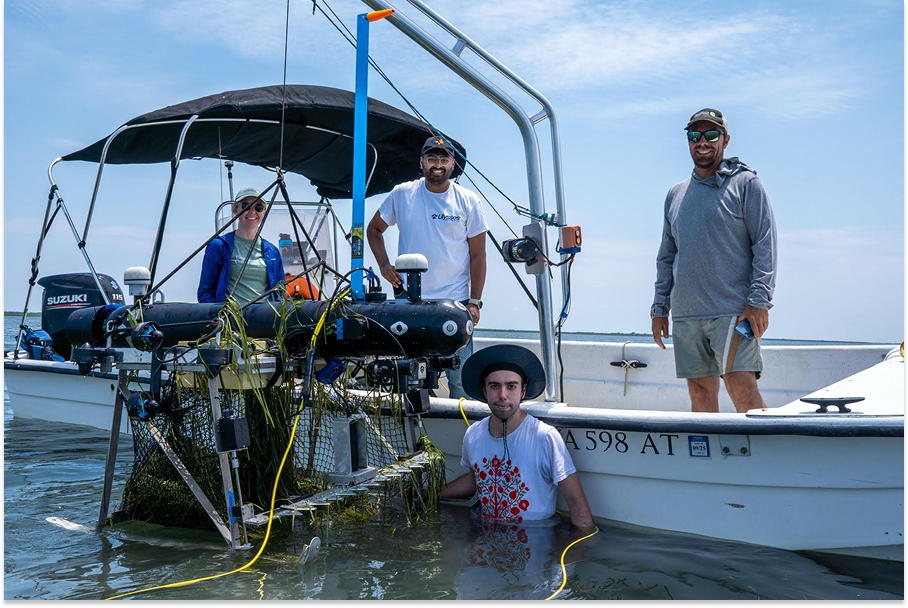
That work is underway in Florida, Virginia, Western Australia, and in the Great Barrier Reef. As we waded into the ocean, however, we realized a few things.
First, we realized that the infrastructure we’d need to do restoration well didn’t exist. We’d have to vertically integrate and build most of it ourselves. Soon, we realized that the infrastructure we had to build was exactly what everyone else working in the ocean needed too. We’ll talk about that below.
Second, there are big differences between 19th-century industrialization and modern oceanic industrialization, the biggest of which is the difference between combustion and electric machines. Unlike those factories, or even modern oceanfaring vessels, our vehicles won’t emit smoke or smog. They run on electrons and don’t emit exhaust or greenhouse gases during operation. We will discuss this, too.
Third, we realized that when we expanded our economic ambitions, we also increased our environmental ones. I’ve just shown you what a pre-industrial ocean looks like. There is slavery, overfishing, the extinction of entire species, and ignorance of endless pots of gold. A pre-industrial ocean doesn’t mean an untouched ocean; it just means that the pirates are the ones doing the touching. Commerce brings law and order, if only selfishly, but that law and order has positive externalities. You are far less likely to be murdered in a Western Saloon today than you would have been in 1826. We believe that by industrializing the ocean, we are incentivizing its protection and restoration.
The ocean is too precious to leave to the pirates.
How to Industrialize a Frontier
So if we want to industrialize the ocean, how do we do it? There seem to be four stages that frontiers go through on the path to industrialization.
Discovery → Expedition → Access Breakthrough → Industrialization
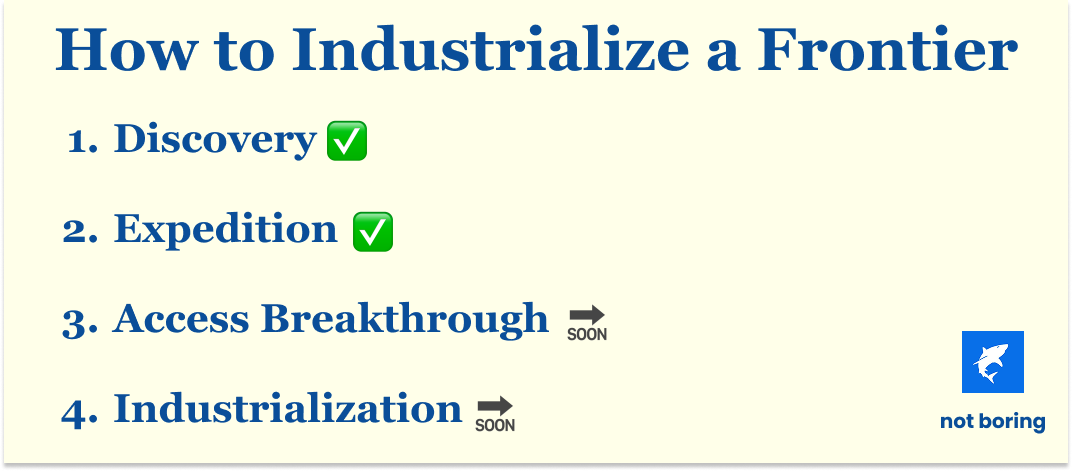
Discovery proves the frontier is real and reachable. Expedition explores it, maps it, and finds the resources worth pursuing, but it does so episodically and expensively (or illegally). The fruits of expedition incentivize the development of the access breakthrough: a technology that dramatically collapses the cost of reaching and operating at the frontier, making entirely new categories of economic activity viable for the first time. That triggers industrialization: the frontier integrates into the broader economy, and industries emerge that couldn’t have existed at the old cost structure.
The American West went through all four stages. The early explorers proved it was there. For sixty years, wagon trains, fur traders, and the Oregon Trail explored it episodically. Then, in 1869, the Transcontinental Railroad met at Promontory Summit, Utah, collapsing the cost of access, and what followed was the industrialization of half a continent. The Homestead Act alone distributed 270 million acres, an area larger than France, Germany, Italy, and Spain combined. Western mines produced the copper that wired America’s cities, the gold and silver that backed its currency, and the timber and beef that fed its industrial workforce. Over the century that followed, the frontier compounded into trillions of dollars of real economic value and provided the physical substrate of the American century.
Space has followed the same arc. Sputnik proved it was reachable. Apollo and the Shuttle explored it at $1.5 billion per launch. Then SpaceX spotted that rocket materials cost about 2% of the selling price, vertically integrated them, built reusable boosters, and cut costs 20x. The space economy has tripled over the past two decades, reaching $613 billion in 2024, and is projected to hit $1.8 trillion by 2035.
Both of these examples are gross oversimplifications, but what I want to establish is that there is economic activity on the frontier even before industrialization. Risk-seekers are captivated by the promise of the untamed. But true market creation occurs when early economic activity incentivizes and funds access infrastructure, and access infrastructure facilitates normal business creation. Industrialization moves frontiers from limited, risky, low-volume, potentially high ROI trades to higher volume, safer, lower-individual-ROI but higher-overall-output activities.
Today, the ocean’s pre-industrial economy is already enormous. We spend $2.6 trillion a year across shipping, offshore oil, fishing, subsea cables, and coastal ports. That is an order of magnitude larger than the space economy was when SpaceX was founded.
But the economics of the ocean severely limit where we can operate, and therefore the size of the ocean economy.
We ship across the surface because the surface is the cheapest layer to traverse, and the only one where our GPS and WiFi work. We drill oil from expensive fixed platforms because oil is valuable enough to pay for the helicopters and the two-week crew rotations. We fish from the top of the water column because that is where our tools reach, and as a result, we decimate the stock.
In short, we are limited to the easiest-to-access parts of the ocean, unless an extremely valuable and fairly predictable commodity can justify deeper exploration, just as the fur trade did during America’s westward expansion.
To the extent that we can decrease the cost of access, we can increase the size of the ocean economy. We need the ocean’s railroad. It is surprising that, if $150 billion of activity was enough to trigger a railroad for space, $2.6 trillion of pre-industrial economic activity didn’t trigger one for the ocean long ago.
Why have we not built the ocean’s railroad?
The Ocean Fights Back
Two factors must be simultaneously present for industrialization to occur: suitable technology and urgent demand.
Humans have had boats for a very long time. As early as 3000 BC, the Austronesian people migrated throughout the islands of the Indo-Pacific using sailboats like this one.
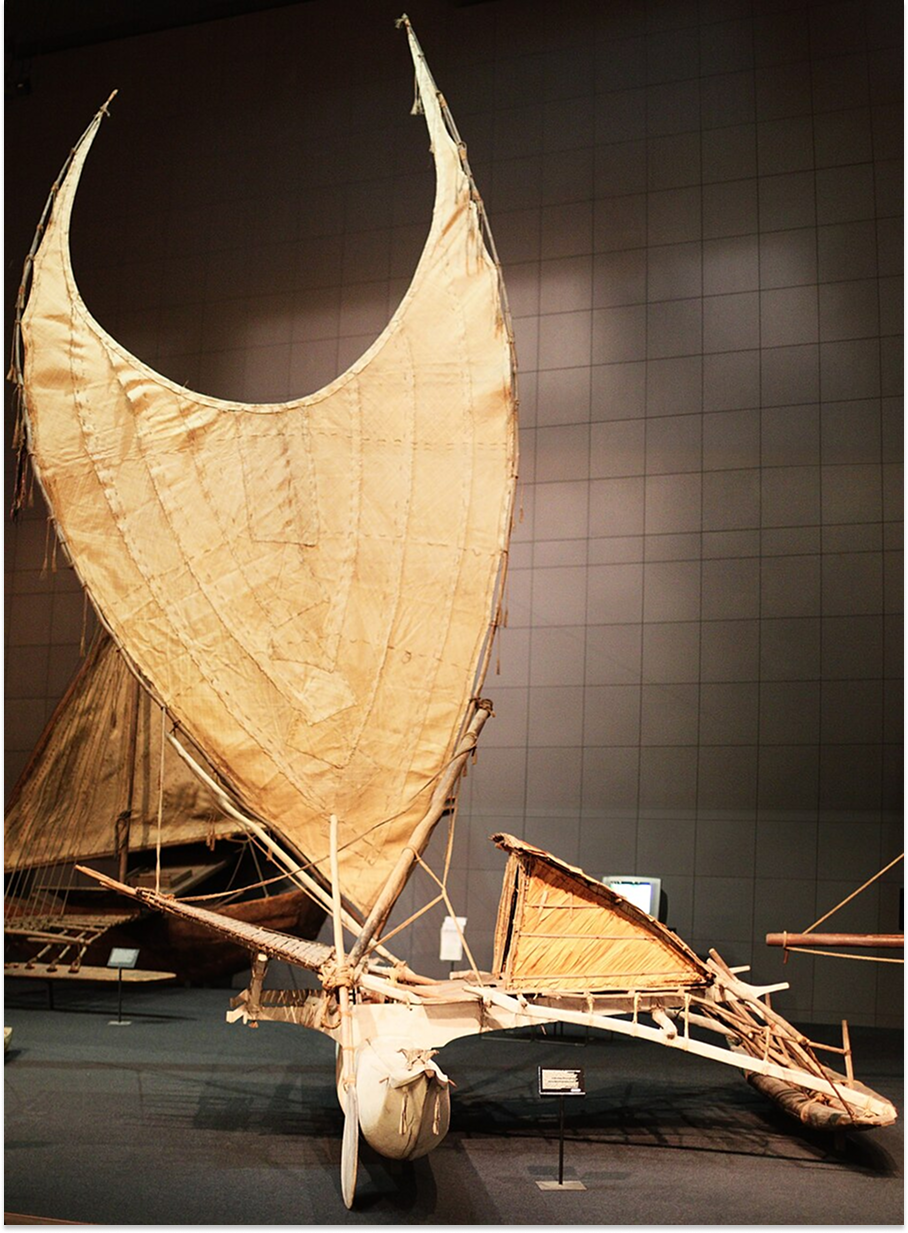
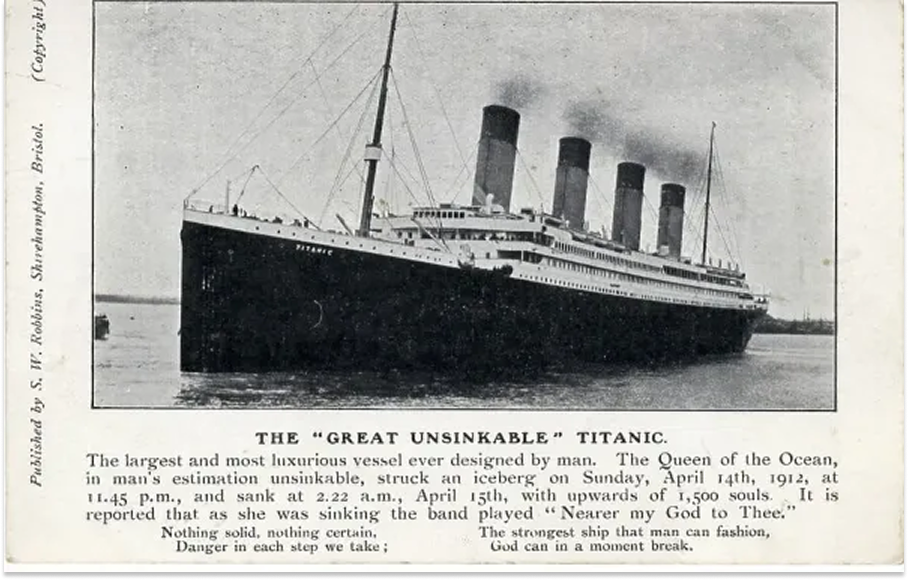
But the ocean has never made traversing its surface easy. During the Age of Sail, an estimated 3-5% of merchant fleet ships were lost per year. Rather than being retired, most wooden ships ended their careers by being wrecked, foundering, or being lost at sea. Over time, we got better at making sturdier boats. But even still, the 1990s’ most popular movie was about the sinking of the “Great Unsinkable” Titanic.
Stewart Brand recently published Maintenance with Stripe Press. He chose to open the book with the story of the 1968 Golden Globe Race, the first solo, non-stop circumnavigation of the earth by sailboat. The race’s sponsor, The Sunday Times, charged no entry fee and laid down almost no rules. Sailors simply had to leave from a British port, travel around the globe, and come back to it without stopping.
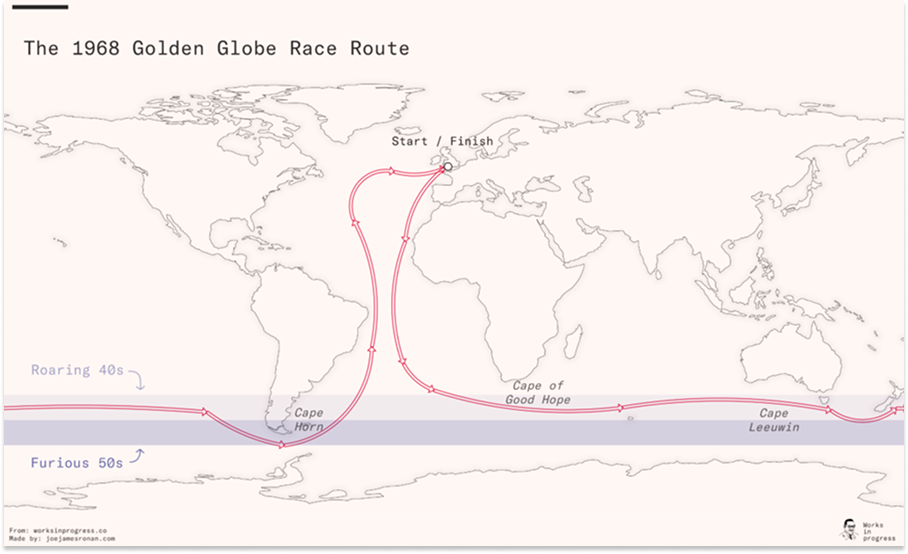
Nine sailors entered the race, and historians mainly focus on three of them.
Donald Crowhurst, a brilliant inventor with arguably the most technologically advanced boat in the race, never made it past the Atlantic. His electronics failed, his hull leaked, and the isolation broke him. He falsified his logbook, drifted in circles, and eventually stepped off the back of his trimaran into the sea. His body was never found.
Bernard Moitessier, the most gifted sailor in the fleet, abandoned the race despite being far in the lead. Months alone in the Southern Ocean convinced him he’d rather keep sailing to Tahiti than return to civilization.
Robin Knox-Johnston spent 312 days at sea, and most of them were spent not sailing but repairing. Where the others designed their sailboats for technological superiority or speed, Knox-Johnston designed his to be fixed:
To prepare SUHAILI for a ten-month passage, most of it in the world’s roughest waters, he packed into his small boat all the ‘materials and tools’ he could imagine he might need – specialized wrenches for every exotic nut on the boat; ditto for screwdrivers; a sailmaker’s bag full of needles, sewing palms, and twine; a bosun’s bag with every kind of shackle, thimble, and marlinspike for managing all his steel wire rope; a spare bilge pump and extra rubber pipe; 12 yards of canvas; caulking chisels and cotton; plenty of oil, glue, and Stockholm tar; spare parts for everything mechanical; and medical supplies for repairing himself.
It was the right move, because he spent most of his 312 days on the water fixing. And yet… “I realized I was thoroughly enjoying myself,” he said later. Still, the enjoyment was the enjoyment of a man who understands that the ocean is in a permanent state of war with anything humans put in it.
Knox-Johnston won the race, “and the prize of £5,000 – which he gifted to Donald Crowhurst’s bereaved wife and young children.”
Typically, the story is told as a story of different flavors of the human spirit, and it is certainly about that. But Brand chooses to tell it as a story about maintenance. The universe tends towards entropy, but it does so particularly quickly on the open sea. There is no environment on earth that so persistently attacks those who dare challenge it.
Which is to say that the ocean is the hardest frontier on Earth. It fights you every day that you’re in it. The ocean doesn’t necessarily want to fight you. It is simply a matter of the ocean’s constitution.
Saltwater is one of the most corrosive environments on earth, eating through steel, degrading composites, and attacking every electronic component it reaches. Since water flows happily through cracks, it ultimately reaches almost everything. The North Sea, one of the most developed ocean regions on Earth, is so punishing that corrosion alone accounts for roughly 60% of maintenance costs on production platforms, and lifetime operating spend routinely exceeds the original construction cost. Offshore wind has struggled to meet expectations because maintenance costs 2-3x more than onshore wind, components break down more frequently, and turbine performance degrades by an average of 4.5% per year. The global cost of marine corrosion runs to $50 to $80 billion a year, and that’s just for the structures we’ve bothered to build.
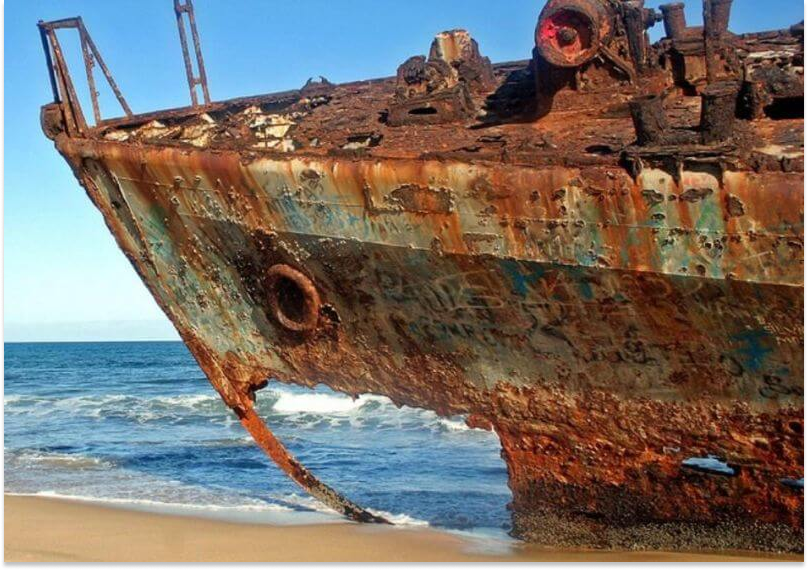
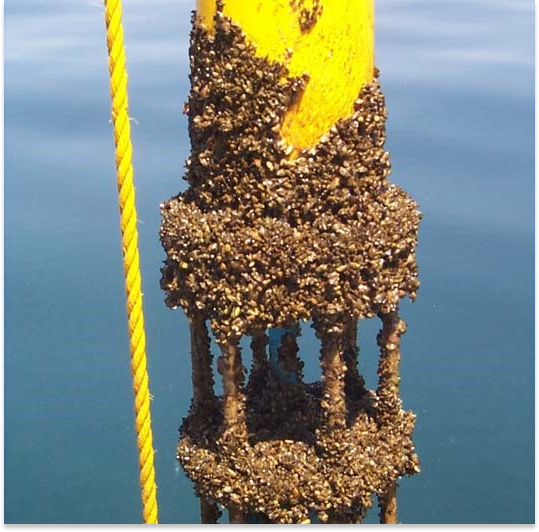
Then there’s biofouling (think barnacles): the moment you put something in the water, organisms begin to colonize it. Within weeks, without active maintenance, a clean sensor is blind, and a clean hull is dragging tons of extra weight. The offshore oil industry spends billions per year fighting exactly this. Everyone who chooses to operate on the ocean must become a Robin Knox-Johnston.
Below the surface, the battle only intensifies. Pressure increases by one atmosphere every ten meters of depth. At the average seafloor, you’re looking at 370 atmospheres. Everything on a subsea vessel must be engineered for forces that have no analog on land or in space, and which vary continuously with depth. Space is extreme, but the vacuum is a single, well-understood engineering problem. In the ocean, every meter deeper you go changes the engineering envelope.
We have thus far described fair weather conditions, but the ocean is a stormy place. Storms routinely destroy purpose-built infrastructure: Hurricanes Katrina and Rita alone destroyed 113 offshore platforms and ruptured 457 pipelines.
In each one of these cases, unless you are right there with your vessel, you’re unlikely to even know when things go wrong, because the ocean is a communications desert. GPS doesn’t work underwater at all. Radio and optical signals penetrate about 20 meters before the water absorbs them. Acoustic signals can travel further, kilometers in some cases, but at painfully low bandwidth, about a million times slower than surface 5G. To get around these constraints, you can tether a vehicle to a surface ship with a cable, but that limits your range and requires an expensive crewed vessel overhead, at which point, you’re still stuck in the expedition model.
The ocean is a domain that degrades everything you put in it, crushes anything you send deep, destroys what you bolt to the surface, and isolates whatever survives.
This is before we even address the immense scale of the ocean. So even if you solve every engineering problem, you still face the question of how to cover a domain that dwarfs anything we’ve ever tried to operate in while fighting corrosion, biofouling, pressure, storms, and the comms desert. None of these is impossible to overcome, but every one of them is a tax. A tax currently paid in steel thickness, redundant systems, $20,000/day ship time, mobilisation windows, insurance premiums, and in the engineers you have to send offshore to fix what can’t be fixed from shore.
And on top of that, the industry that grew up around this domain never got what aerospace and automotive got: scale, software, modern supply chains. Maritime is still largely a cottage business of bespoke parts and hand-built systems. So you pay the tax twice: once to the physics, and again to the pre-modern industry that evolved to serve the physics.
We call it the Ocean Tax: the compounding cost the sea, and the industry that grew around it, extracts from anyone who tries to do anything in it. Every existing ocean company is, at heart, a machine for paying the Ocean Tax.
So the natural question is, how do we get around it?
What It Would Take to Industrialize the Ocean
The good news about the ocean being such a challenging environment is that every problem that the ocean throws at you doubles as a design requirement. If we solve for the challenges, we know what kind of system to build.
The ocean is vast. Instead of a few expensive, exquisite vessels, you need a lot of cheap ones.
This is the same trend that we’ve seen in space, going from a few billion-dollar communications satellites to thousands of small, cheap ones. The latter means that the network can cover more area more reliably than single satellites can, and inevitable damage to a single satellite doesn’t knock it out. It is resilient. We are seeing the same trend in defense, with the move towards high-volume, attritable drones instead of a few exquisite platforms.
Like space, it is hard to comprehend just how much room there is to cover in the ocean. The 361 million square surface kilometer number hides just how big it is, because it also goes deep. Industrialization requires coverage of the X, Y, and Z axes. The ocean is more than two miles deep, on average, and its deepest trenches are so deep that Mount Everest could be dropped into the Challenger Deep with 2km of clearance above it. Its total volume is something like 1.3 billion cubic kilometers, which is so large that I’m not even sure what to tell you, other than to say that the number of vehicles we put in it each year stands absolutely no chance.
Today, the entire global autonomous underwater vehicle (AUV) market produces roughly 1,000 vehicles per year, and the incumbents’ AUVs cost on average $500k to $5 million each. For scale, a thousand units across the entire ocean is equivalent to just 27 vehicles across the entire United States. Imagine trying to patrol the entirety of the United States with just 27 vehicles. And that is just the surface comparison! These vehicles are precious, and are treated as such, which is no way to build an economy.
We think the answer to making ocean infrastructure possible is manufacturing at radically lower costs. At Ulysses, we build AUVs for as little as $50,000 per unit, a 10x to 100x reduction over the most commonly sold incumbent models. At that price, we and our customers can think in terms of fleets rather than individual vehicles, and fleets, we believe, are the unit of infrastructure the ocean demands.
The ocean demands you operate at the surface and subsea as a single integrated system.
How do you design a vessel meant to operate on the surface and in the deep ocean, when the two are almost entirely separate domains, with radically different physics? Well, you don’t.
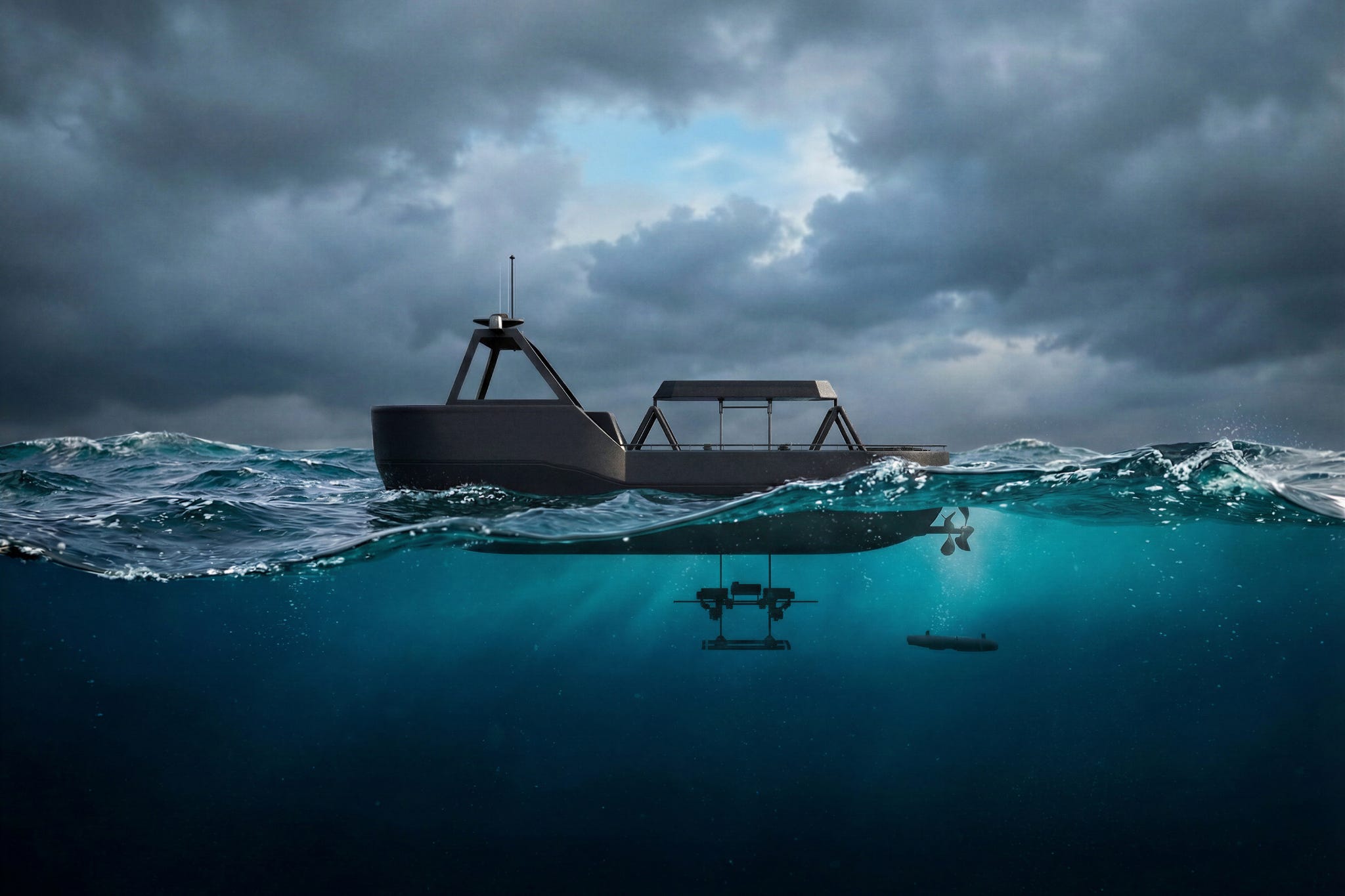
You design a system that handles both, consisting of separate vehicles optimized for each. The surface is where GPS and Starlink work, and doesn’t face the same pressure challenges as lower down, so that’s where communications, fuel, power, and logistics live. But most of the work is below the surface, where the undersea cables, seafloor, and marine ecosystems lie. You need vehicles that can go where the work is, and you need surface platforms that can deploy, recover, recharge, and connect them to the rest of the world.
A fully autonomous system is a much cheaper system, because the cheapest AUV in the world is still expensive if it’s hand launched and recovered, and requires a crewed ship to operate it. There’s a joke in the maritime industry that “unmanned” systems are only unmanned in the sense that the people aren’t on or in them, but right beside them while they operate. As long as humans have to babysit autonomous vehicles, they’re not really autonomous, and it will be impossible to achieve scale.
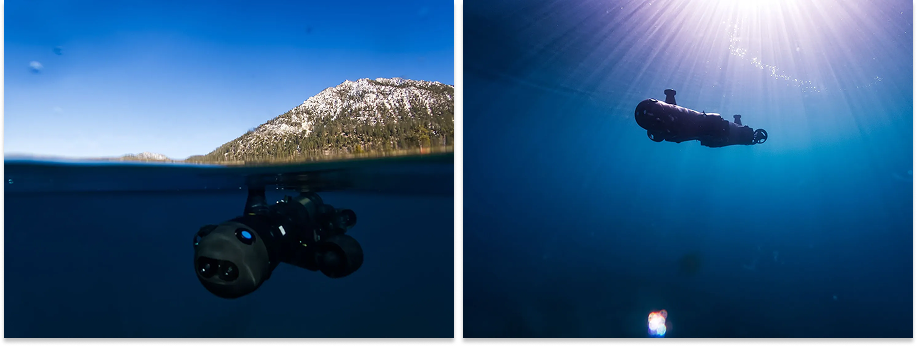
We’ve designed the system at Ulysses with those requirements in mind. Our underwater vehicle Mako goes deep and does the work. Our autonomous surface craft and mothership, Leviathan, equipped with our autonomous launch, recovery, and recharge platform, Kraken, remains on the surface and serves as the fleet’s connective tissue: deploying Makos, recovering them, recharging their batteries, and relaying their data to onshore operators via satellite. Leviathan is a working asset in its own right, a node in a domain awareness network that can carry its own sensors and serve its own missions. Together, linked by Kraken, they form a single integrated system that can persist at sea without retreating to port.
The underwater environment demands autonomy.
Because of the underwater communications desert we described earlier, you cannot supervise an underwater vehicle in real time the way you would a drone in the air. The bandwidth simply isn’t there, and the latency would make remote control dangerous and unreliable.
AUVs need to think for themselves. Because we’re talking about large fleets of small, inexpensive vehicles, there is no room in either the cost structure or the vehicle itself for a human pilot. Each AUV needs to navigate without GPS, make decisions based on what they see, avoid obstacles, adapt to changing conditions, and execute complex missions with only periodic check-ins.
This is as much a compute problem as it is a software one. At Ulysses, we pack over 100 times more onboard compute than anyone else in our underwater form factor, data-center-class GPUs running inside an AUV. Since we can’t talk to our vehicles, they need to be smart enough not to need us.
Industrializing the ocean demands both observation and action.
Most ocean technology stops at sensors, which are valuable in their own right. However, sensors are not by themselves industrial infrastructure. To industrialize a domain, you have to be able to act on what you observe.
Consider a vehicle that can only observe. It would swim around, notice that a pipeline was in need of repairs, ascend to the surface, and send a message back to a team of humans, who would then schedule and weather permitting, get on an expensive vessel, travel out to the site of the damage, and send a human or ROV (remote operated vehicle) below to make the necessary repairs. That process costs an unnecessary amount of time and money. Conversely, a platform that can both observe and act would be able to both inspect and repair the pipeline, quickly and cheaply. More persistent monitoring would also mean that each individual repair is likely to be simpler.
Here, modern robotics is key. The fleet of machines we send into the ocean must be able to manipulate, intervene, and repair, which means that they need arms, tools, and the dexterity to do meaningful work at depth. If they can, you’ve turned a sensor network into an industrial presence. This is the hardest part of the stack to get right, but given our heritage in sea grass planting, it’s the part that we started with.
The ocean demands a fully integrated system.
You may have noticed, reading this section, that each requirement builds on the others. If you want low costs, for example, vehicles need to be autonomous and they need to be able to act. As soon as you introduce humans back into the equation, coverage and persistence drop while costs rise. If you want vehicles that are truly autonomous, persistent, and can act at depth, you need surface vehicles and subsea vehicles that work together to do what each can do best.
We think this is how you industrialize the ocean, and we believe that the solution has to look more like a network of Starlinks than a railroad: a distributed network of coordinated assets, surface and subsea, each playing a different role. Together, they collectively give you persistent coverage of the hardest domain on earth and the ability to do something about what you find.
This is not a novel insight. Mariners have understood it in theory for at least a few decades. But there have been two challenges: it wasn’t possible to build, because the underlying technologies weren’t ready, and it wasn’t easy to fund, because the urgent demand for such capabilities didn’t exist.
Within the past five years, both of these aspects have changed.
Why Now?
There is perhaps no more important question that a technology startup can answer than “why now?” I argued earlier that every frontier becomes industrialized when supply-side technology and demand-side urgency converge. For the ocean, that convergence is happening right now.
Supply Side: The Ocean Stack
In Cable Caballero, Packy coined “Curve Convergence“: if multiple component technologies improve on exponential curves as industry architectures remain frozen around outdated assumptions, it’s possible to create the opportunity for disruption with a better product.
The ocean is experiencing its Curve Convergence right now. Four exogenous technology curves all crossed critical thresholds in the same window, roughly 2020 to 2025. Each crossing has removed a specific barrier that previously made persistent ocean work impossible, and together they enable a total rewrite of how mankind can work at sea.
Connectivity
Before Starlink, communicating at sea meant paying over $5,000 a month for slow, unreliable satellite connections with multi-second latency. That meant any “autonomous” ocean vehicle was really just pre-programmed and running a script with no ability to adapt in real time.
Starlink Maritime changed this completely: it offers roughly $250 a month for 100+ Mbps with sub-70-millisecond latency, or a 100x improvement in price-performance in about three years.
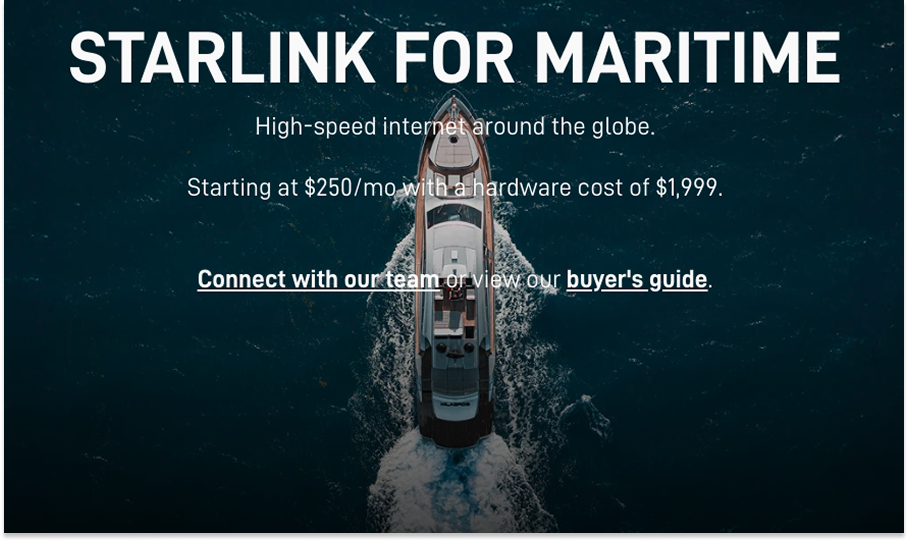
Starlink gives you high-bandwidth, high-fidelity visibility into what your fleet is doing, at a cost that scales. Before, you might have gotten a trickle of compressed data over a satellite phone. Now, if one of your vehicles surfaces or relays data through a surface platform, you’ll get full sensor feeds, video, vehicle health, and mission statuses. The full picture will be streamed in real time to an operator who might be sitting in Dublin or San Francisco. The cost also helps: $250 a month instead of $5,000 or more has meant that connectivity can be placed on every surface asset in a fleet, making it possible to coordinate hundreds of vehicles across an ocean basin. Underwater, the vehicles can think for themselves, and when they’re back above ground, you can see everything they saw.
Energy
Energy is one of the most critical binding constraints of ocean work. Vehicles need to stay on or under the water for days, weeks, or indefinitely, and that requires generating, storing, and efficiently using energy in ways that simply weren’t possible a decade ago. Improvements have come on those three fronts simultaneously.
On generation, solar costs have fallen 75% in a decade, and that drop has reached the water. Solar- and wind-powered surface vehicles have already stayed at sea indefinitely on harvested energy alone. Below the surface and beyond solar, wave energy is reaching viability, achieving capacity factors around 90% (compared to 30–40% for offshore wind and 25% for solar) because waves run round the clock.
On storage, battery energy density has doubled in a decade, from 150 Wh/kg in 2015 to over 300 Wh/kg today, while pack costs have collapsed from $1,191 per kWh in 2010 to $115 per kWh in 2024. As Not Boring readers will understand intimately, increased battery density is important for everything from drones to AVs, but nowhere is it more important than it is underwater: every increment of energy density directly extends mission duration. Five years ago, a subsea vehicle on the best available batteries could run four-hour sprints before it needed to be recovered and recharged. Today, double the energy density, dramatically cheaper packs (which means you can afford to carry more total capacity), and more efficient motors and drive systems combine to make multi-day deployments possible.
All of these improvements compound. Each one matters, but it’s the combination, more energy per kilogram, cheaper per kilowatt-hour, less energy consumed per kilometer, that transforms the operating model from sprint-and-retrieve to deploy-and-sustain.
Compute and AI
The vast majority of underwater work today is still performed by remotely operated vehicles (ROVs), tethered to a surface vessel by an umbilical cable and piloted in real time by a human operator watching a screen. The ROV goes where the pilot tells it, sees what the pilot looks at, and does what the pilot commands. It’s capable and proven, but it means every subsea operation requires a crewed ship overhead, which is why day rates for subsea work start at six figures.
Truly Autonomous Underwater Vehicles exist, but their capabilities have been narrow. They can run pre-programmed survey routes and collect data (sonar mapping, pipeline inspection, environmental monitoring), but that’s essentially read-only work. When it comes to acting on what they find, making a decision, adjusting course, manipulating something physical, the vehicle surfaces and a human takes over. The ocean has been a domain where machines can look but not think, and certainly not act.
That’s changing fast as the AI-driven terrestrial compute bonanza reaches the water. Onboard processing power has increased by orders of magnitude in the past five years, and the cost of edge inference is plummeting. Vehicles can now run real-time object detection, navigate around unexpected obstacles, and make mission-critical decisions without surfacing for instructions. The trend is moving from read-only to read-write: not just gathering data but interpreting it and acting on it autonomously. A thousand vehicles can’t each have their own human pilot. They need to think for themselves, and for the first time, they can.
Motors and Sensors
An underwater vehicle is, at its core, a collection of motors, thrusters, actuators, sensors, seals, and structural components held together inside a pressure housing. Until recently, every one of those parts was bespoke, sourced from specialist defense suppliers who charged accordingly. This is one of the reasons that incumbent AUVs built by legacy defense contractors with artisanal production methods cost so much.
What has changed recently is that adjacent industries built new supply chains for us. The commercial drone industry commoditized motors, ESCs, and flight controllers. The EV industry drove down the cost of power electronics, drive systems, and battery management. Consumer electronics made high-performance sensors and embedded systems cheap and abundant. Packy has written about this phenomenon as the modern electric tech stack: the convergence of commodity components that lets you build sophisticated electromechanical systems at a fraction of what they used to cost.
A new generation of ocean vehicles, built on these supply chains, can be produced for hundreds of times less than incumbent vehicles.
That cost collapse makes the fleet model possible. We couldn’t possibly cover 361 million square kilometers of ocean with million-dollar vehicles, but we can with fifty-thousand-dollar ones. Thanks to these curves, we can make cheap vehicles useful enough that we need a lot of them, and by building more of them, we will make them even cheaper and more useful.
All four of these curves had to converge for ocean industrialization to become possible, and finally, they have. It’s the convergence of what I call the Ocean Stack that makes the phase transition possible.1
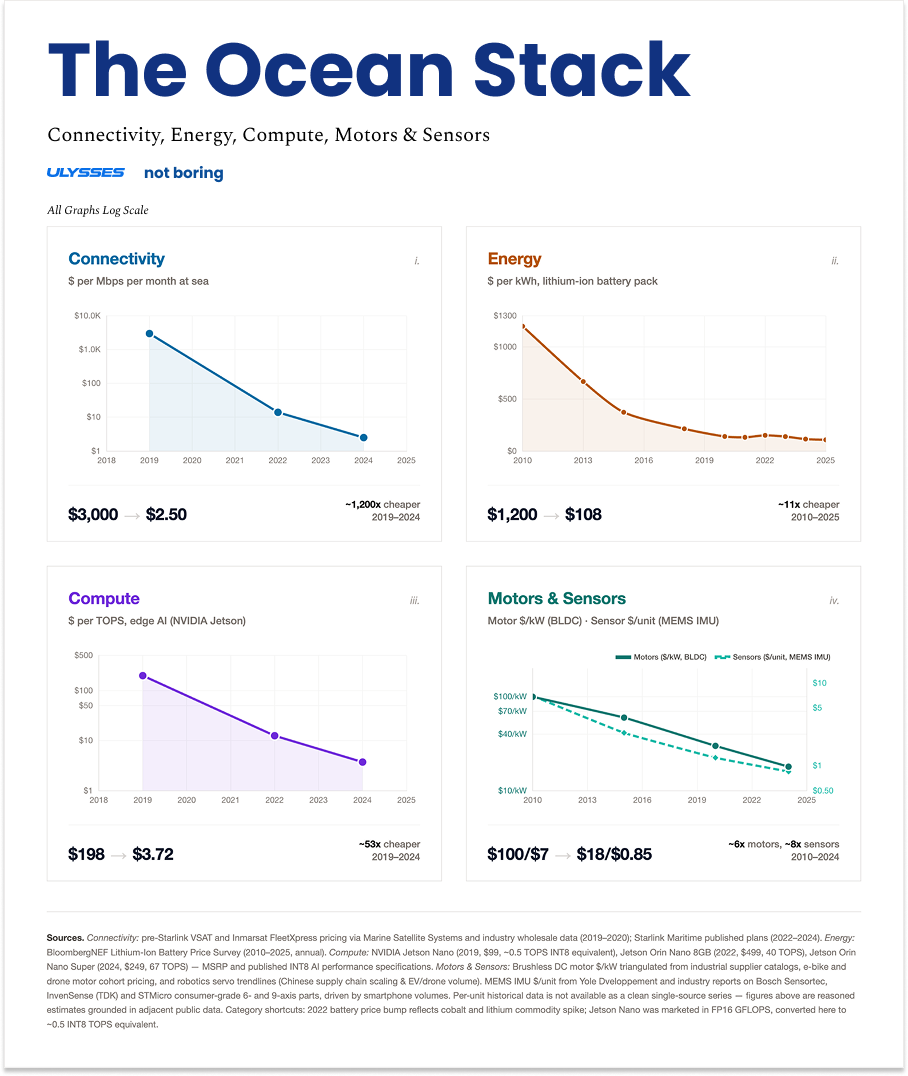
These curves are a thing of beauty, and we are fortunate to be alive at a time when so many of them are converging at once. I view it as our role to combine the Ocean Stack into useful products that are better, faster, cheaper, and entirely different in capability than previous generations of hardware.
Demand Side: Everything, Everywhere, All at Once
No matter how good the technology, in order to reach the scale that both affordability and industrialization require, the supply needs to be met by demand, which it currently is, from all angles. What makes right now different from every previous decade is that the demand drivers are independent of each other. Any one of them would justify building ocean infrastructure, but all of them are accelerating simultaneously.
Undersea Cables
Ninety-nine percent of intercontinental internet traffic travels through submarine fiber-optic cables. Over a million kilometers of cable sit vulnerable on the ocean floor with essentially zero persistent surveillance. Now, there is simultaneously more demand for new cables and greater threats to them, natural and deliberate.
First, AI is driving an explosion of new builds: Meta announced Project Waterworth in 2025, a 50,000-kilometer cable spanning five continents --- the longest in history.
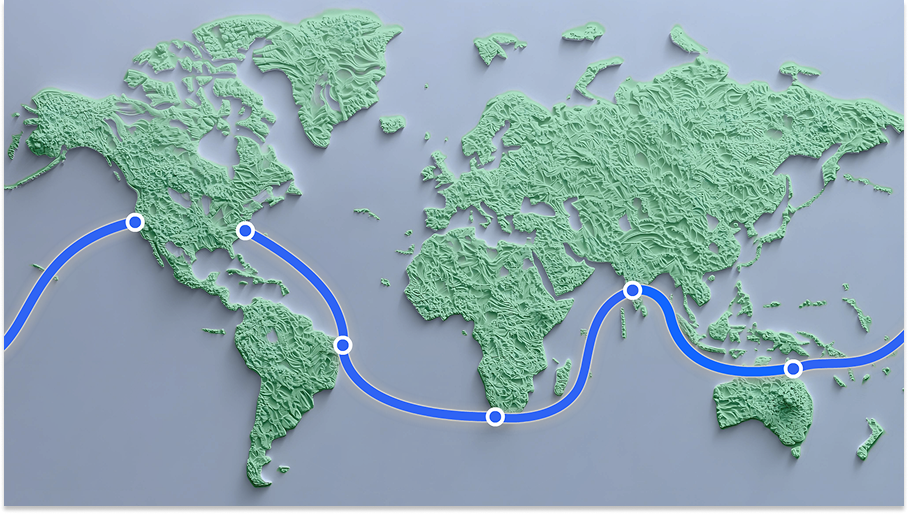
Amazon, Microsoft, and Google are all commissioning major new transoceanic routes. Investment in subsea cables is expected to nearly double between 2022 and 2027, with tech giants now controlling roughly half the market.
Second, those cables break 100 to 200 times per year due to accidental damage --- trawlers, anchors, earthquakes, and sharks --- and each break requires expensive, slow, ship-based repairs with no persistent monitoring in between.
Third, and most urgently: deliberate sabotage is escalating. In November 2024, two Baltic Sea cables were severed simultaneously --- the Lithuania-Sweden interconnect and the 1,200-kilometer C-Lion1 linking Finland to Germany. A month later, on Christmas Day, a Russian shadow-fleet tanker dragged its anchor through the Estlink 2 power cable and four telecom cables, cutting Estonia’s cross-border electricity capacity by two-thirds. NATO launched Operation Baltic Sentry in January 2025, sending frigates, patrol aircraft, and naval drones because no other assets were available to detect or deter these attacks.
Just two weeks ago, the UK accused Russia of running covert submarine operations over its cables and pipelines. Addressing Vladimir Putin, UK Defence Secretary John Healey said, “We see you. We see your activity over our cables and our pipelines, and you should know that any attempt to damage them will not be tolerated and will have serious consequences.”
In short, more cables are being built, more value is flowing through them, and more bad actors are learning what sharks have known since humans started laying subsea cables: that, Healey’s warning aside, they’re basically unwatched and undefended.
Today, subsea cable monitoring and repair is a ~$3B market expected to double by the early 2030s. That, however, underestimates the size of the opportunity, because the market is constrained by vessel supply, not demand. There are something like 60 specialized repair vessels in operation worldwide, and proactive monitoring is still in its infancy, as are novel approaches to using the cables themselves as sensors in a method called Distributed Acoustic Sensing (or DAS). Lower the cost of supply, and we will expand the market.
Critical Minerals
The Clarion-Clipperton Zone in the Pacific alone contains more cobalt than all known land reserves, along with polymetallic nodules rich in nickel, manganese, and copper.
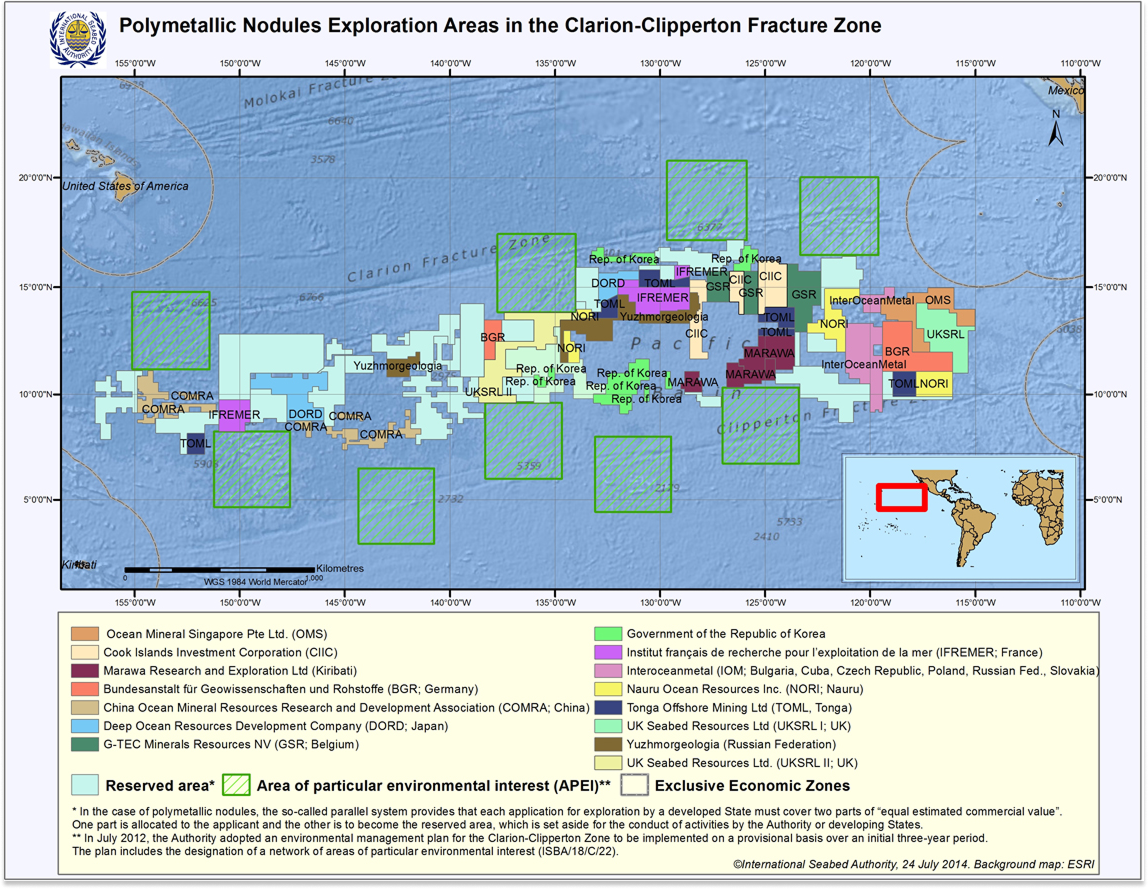
Providentially, these are the exact minerals that EV batteries, wind turbines, and AI hardware are consuming at accelerating rates. Regulation, along with cost and technology, has kept these from being mined, but the regulatory dam seems to be cracking. After years of stalled negotiations at the International Seabed Authority, The Metals Company forced the issue in 2025 by filing the first-ever application for a commercial deep-sea mining license, bypassing the ISA entirely via a US regulatory pathway established in 1980. Whether you think deep-sea mining is the answer or not, the pressure to access these resources is intensifying, and you cannot extract, survey, or even responsibly monitor extraction without ocean infrastructure that does not yet exist.
It is not worth trying to pin down real numbers here, because the field is so nascent and the numbers so large. The Metals Company estimates the NPV of its first two projects to be $24 billion. The U.S. Geological Survey study on polymetallic nodules projects that if deep-ocean mining follows the evolution of offshore petroleum production, about 35–45% of the demand for critical metals will come from deep-ocean mines by 2065. And there is an estimated $233 trillion worth of value in polymetallic nodules worldwide, although, as with asteroid mining, these reserves will be difficult to access and, if accessed at scale, should dramatically decrease prices. For our purposes, it is safe to say that there is a lot of value down there.
Defense
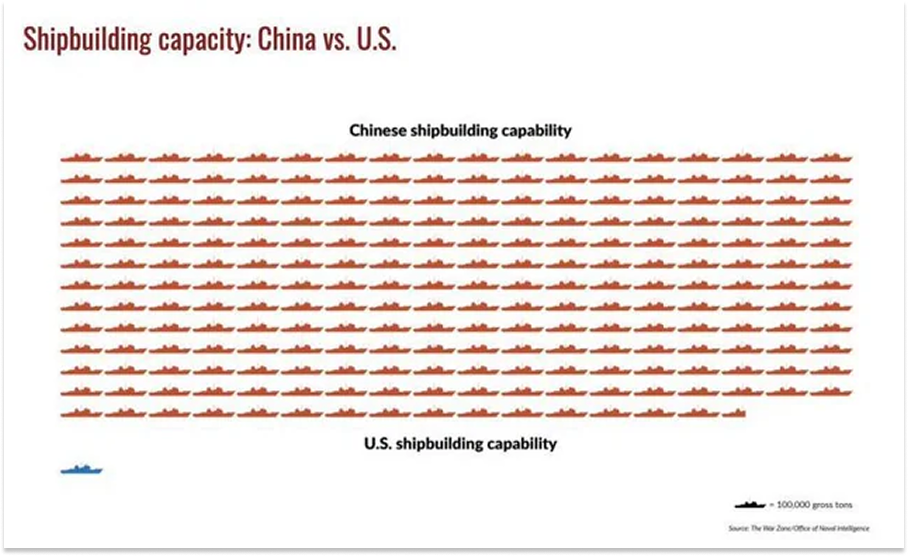
When we started discussing writing this piece, maritime defense was already an important topic. We’ve all seen the chart comparing China’s shipbuilding capacity to the United States’. The ability to manufacture ships, traditional or autonomous, big or small, will be a deciding factor in any conflict between China and the U.S. Ideally, this ability will also be instrumental in deterring conflict in the first place.
Over the past couple of weeks, however, the question of maritime defense has become urgent. I’m writing this in April 2026, as the IRGC and United States are locked in a conflict over whether to reopen the recently closed Strait of Hormuz, the passage through which a fifth of the world’s oil supply normally flows. When Iran first closed the Strait, tanker traffic dropped 70%. On the surface, ships passing through the Strait have been struck by missiles, and below the surface, Iran has planted mines. In a dark confirmation of everything we have been arguing in this piece, Iran was unable to comply with President Trump’s demands to allow more ships to pass through the Strait, because it is unable to find the mines it just recently put there.
In the Red Sea, Houthi attacks forced global shipping to reroute around Africa, adding 11,000 nautical miles and 10 to 15 days per voyage, at a cost of roughly $1 million per ship. Container rates on the Shanghai-to-Europe route quadrupled. A trillion dollars worth of goods were disrupted in the first six months of the Houthi effort alone.
Meanwhile, China is building submarine-sized autonomous underwater drones with ranges exceeding 18,000 kilometers, developing cable-cutting tools that operate at a depth of 4,000 meters, and constructing an “Underwater Great Wall” of seabed sensors across the Indo-Pacific.
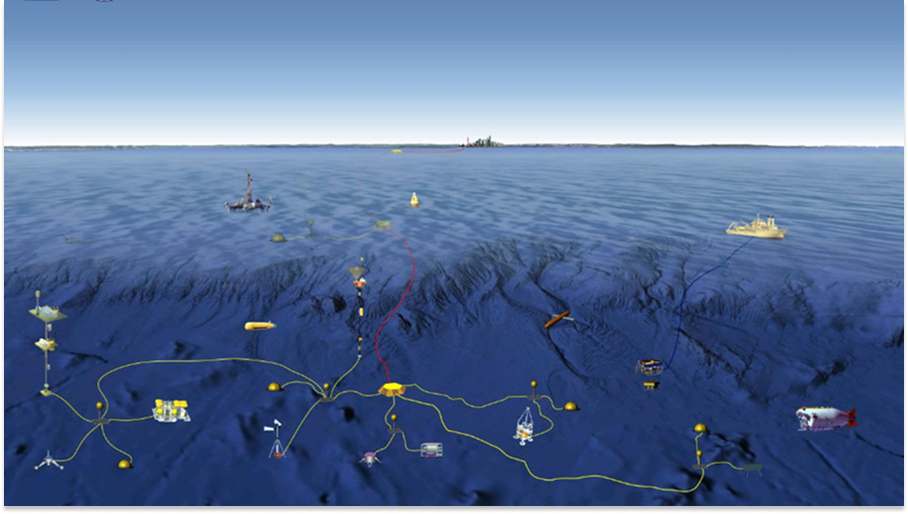
The post-war international order was fundamentally underwritten by the United States’ ability to make the ocean safe for trade. That either has broken or is breaking, depending on who you ask.
The United States is aware of it and is putting resources behind maritime superiority in the modern paradigm. The FY2026 Pentagon budget allocates $13.4 billion for autonomous systems. This is the first time autonomy has been its own budget line. The Navy alone gets $5.3 billion, a 70% year-over-year increase.
This is another truth about frontier industrialization. Every frontier in history was industrialized when powerful competition demanded it.
America pushed West to fulfill our Manifest Destiny. We raced Russia to the Moon to achieve superiority in the Cold War. The drive to industrialize the ocean is now fueled by China, Iran, and a world waking up to the fact that America is no longer capable of guaranteeing the maritime safety that has underpinned global trade since World War II.
Beyond the specific demand drivers, though, there is something more fundamental driving the Oceanic Renaissance.
If you look at the sweep of human history, there is an inexorable, consistent drive to pursue the frontier. We make the most of everything. We find everything. Technology, capitalism, human ingenuity, creativity, and sheer stubbornness combine to produce extraordinary outcomes from the resources available to us. Every frontier that could be industrialized eventually was.
The ocean is the last frontier. The technology is finally ready at the same time as demand is coming from every direction at once. This is going to happen. The only question is who builds it and how fast.
The New Ocean
One thing is certain: the incumbents cannot lead this transition.
Other than the water, the ocean industry looks like any other that’s dominated by sclerotic incumbents too content with the world that was. You’ll even recognize many of the names.
Maritime defense primes include old faithfuls like Lockheed Martin, RTX, L3Harris, Leidos, and Thales. They sell everything from combat systems to sonar suites to legacy AUVs, often in a cost-plus model. Shipbuilders, like HII, General Dynamics Electric Boat, BAE Systems Maritime, Kongsberg, and the big three Korean yards, turn out hulls on multi-year contracts, which are cost-plus as well. Then there are companies that you’ve probably never heard of, the subsea service primes like Fugro, DOF, Oceaneering, Subsea 7, and ASN, which run thousands of campaign-based vessels for oil majors and telcos.
Between the ocean’s incumbents, hundreds of thousands of people generate tens of billions of dollars a year, every cent of it organized around the assumption that the ocean is expensive and will stay that way. You can forgive them for operating as if nothing will change, because that’s how their customers buy.
This is textbook Innovator’s Dilemma.
Christensen’s point is that incumbents fail by doing everything right for their best customers. Here, ocean incumbents’ best customers (navies, oil majors, telcos, shipping companies) are conservative, risk-averse, and demanding. They want proven, crewed, campaign-based services with mil-spec redundancy and rigorous SLAs. Autonomy-first, priced-for-scale platforms don’t meet those requirements yet. So the incumbents, rationally, keep investing in the fleets they already own in order to protect their margins and serve their best customers better.
By the time the new cohort is good enough to matter, the incumbents will have a decade of sunk cost in crewed vessels, a specialist workforce that has never shipped an autonomy stack, a mil-spec supplier network that cannot pivot, and an entire organization whose every incentive points at the existing business. The incumbents never lose because they’re stupid, or even because they don’t listen to the market. In fact, they listen to the current market too closely.
Once again, space is the case study. For fifty years, launch was owned by a small cohort of cost-plus primes – Lockheed, Boeing, and Northrop Grumman – whose economics depended on expendable rockets, government contracts, and scarcity. Then a new generation showed up, looked at the same physics, and decided that if you vertically integrated the supply chain, built for reusability, and priced for scale instead of scarcity, everything changed. That cohort, led by SpaceX and including Rocket Lab, Astranis, Planet Labs, Relativity, Varda, K2, and far too many to list, has a name now: New Space. As the cost of a kilogram to orbit fell by more than an order of magnitude, entire industries, including Earth observation, satellite-IoT, constellation broadband, and even space drugs, space-laser energy, and orbital data centers became possible and potentially profitable.
The same thing is happening in the ocean right now.
A new generation of companies is rebuilding the ocean from first principles. They operate less like modern versions of the rusty old ocean incumbents, and more like New Space companies that happen to work in salt water instead of vacuum.
While each of these companies is different, they tend to share some common characteristics:
Vertically integrated instead of subcontracted.
Autonomy-native instead of crewed-first with autonomy bolted on.
Software-defined instead of hardware-frozen.
Built on commercial supply chains (drone motors, EV battery packs, Jetson-class compute) instead of custom mil-spec.
Priced for scale instead of for scarcity.
We call this cohort the New Ocean.
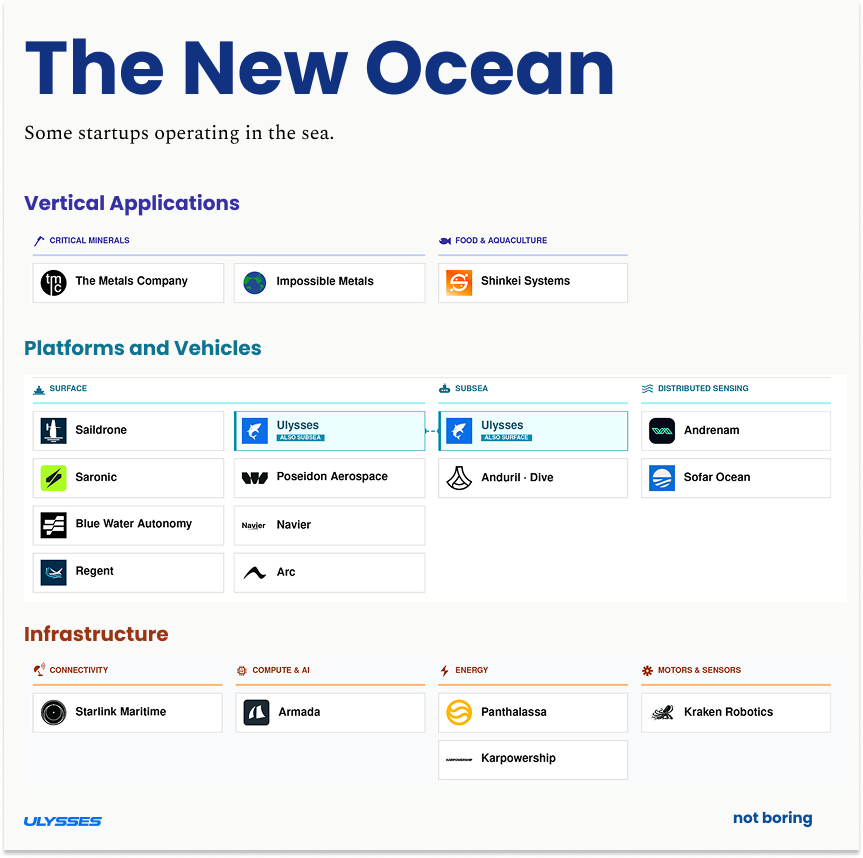
As with any market map, there are a number of ways that we could slice and dice our fellow ocean startups, but the simplest is to group them into three buckets: infrastructure, platforms and vehicles, and vertical applications.
At the foundation are the Infrastructure companies that enable the Ocean Stack. These are the companies that are bending the curves on which the rest of us ride.
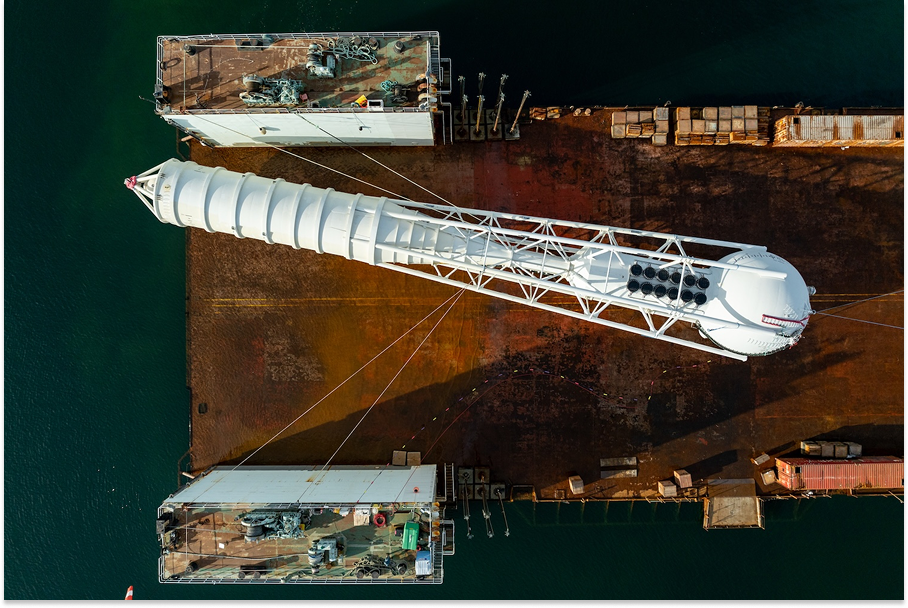
Starlink put a high-bandwidth, low-latency pipe to every square meter of ocean for the price of a weekly Uber habit. Panthalassa will generate persistent electricity at sea from wave energy, a marine renewable that runs through the night at much higher capacity factors than solar or wind.
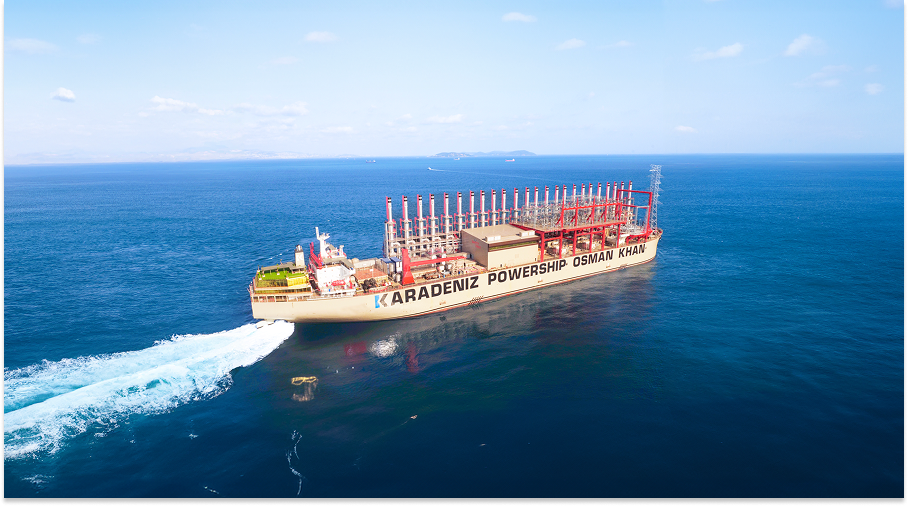
Karpowership already operates forty floating power stations delivering 7.5 gigawatts across multiple continents, proving that energy supply at sea can be mobile and matched to demand.
Armada is deploying full compute clusters at sea, bringing the data center to the data with nearly free cooling from the ocean itself. Kraken Robotics builds the synthetic-aperture sonar that turns a cheap AUV into a survey-grade mapping platform. Each new capability that one of the Infrastructure players provides is a capability that the rest of the Ocean Stack can snap in and use.
In the middle of the stack are the Platforms, or Vehicles. These companies, including Ulysses, take advantage of the infrastructure layer and enable vertical applications. Collectively, these are the railroads of the ocean’s industrialization.
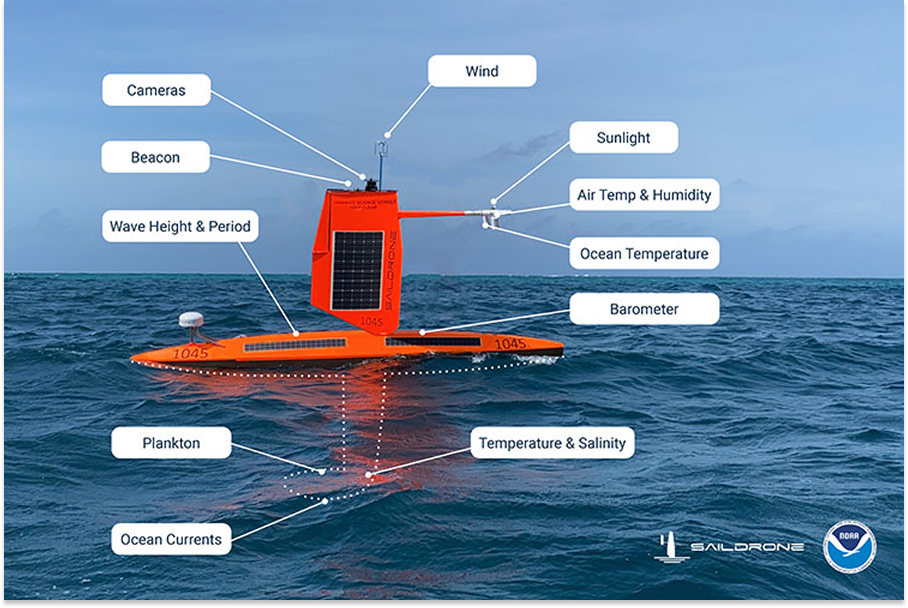
Above water, Saildrone has sailed more than two million autonomous nautical miles across the world’s oceans on solar and wind power alone. They are proof that persistent surface presence without humans or fossil fuel is an operational reality.
Saronic is rebuilding American shipbuilding around autonomous surface vessels for defense, attacking the same capacity gap that keeps the US Navy dependent on decades-old hulls. Blue Water Autonomy is designing 190-foot Liberty Class uncrewed naval ships from a blank sheet. The ships would be larger than any USV afloat today, built for the open ocean rather than the coastline.
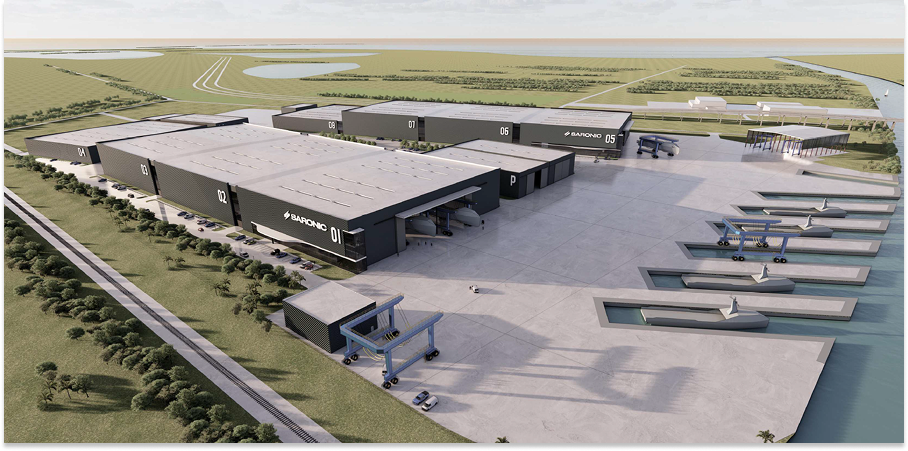
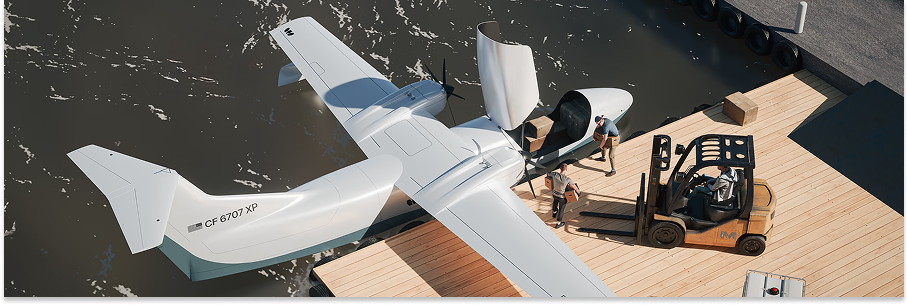
Regent is electrifying coastal transport with all-electric seagliders that skim above the water faster than a ferry and don’t need an airport. Poseidon Aerospace is flying autonomous cargo aircraft to move freight across ocean basins at a fraction of the cost of a container ship and a fraction of the time of a plane.
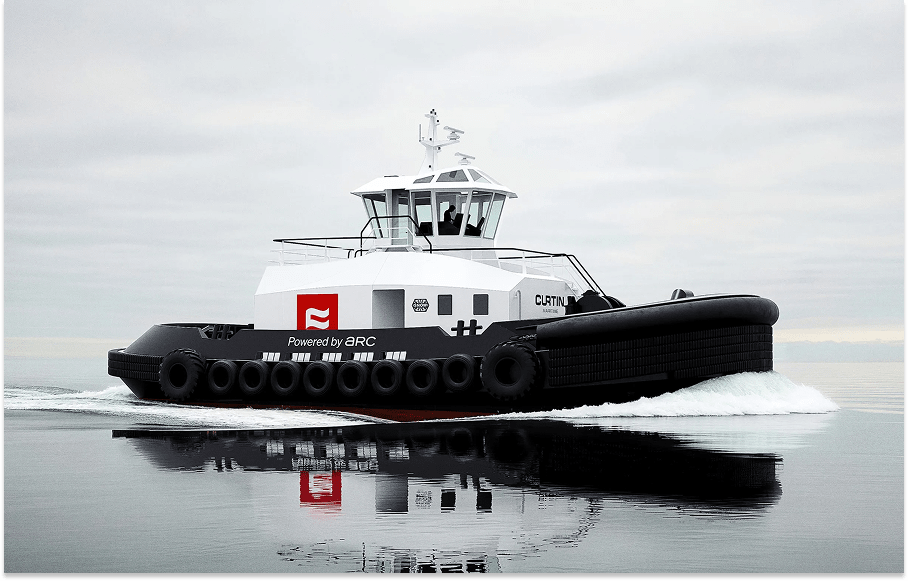
Navier is building electric hydrofoiling boats that use 75% less energy than traditional hulls. Arc is rethinking how boats are built entirely: electric-first, hull-up, designed for modern manufacturing instead of inherited from the combustion era. In addition to its electric sport boat (which is incredibly fun, fast, and quiet), Arc is now moving into commercial tugboats on the same electric platform.
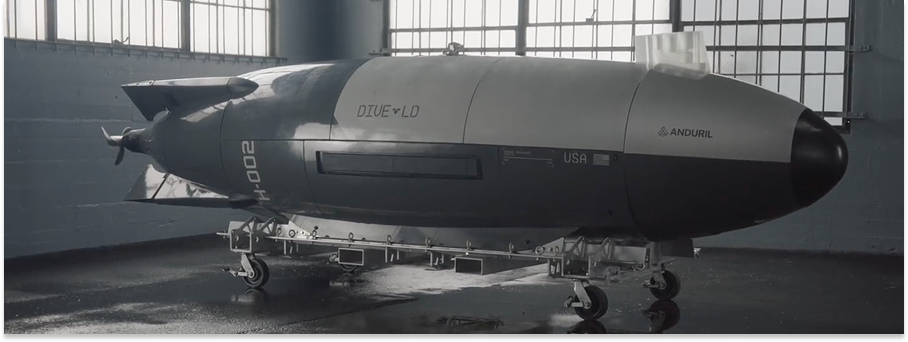
Beneath the surface, Anduril’s Dive division is producing the Dive-LD large-displacement AUV and leading Australia’s Ghost Shark program, bringing a defense-tech mindset to underwater warfare.

Across the sensor layer, Andrenam is weaving low-cost AI-powered sonar buoys into persistent maritime domain awareness meshes to string together a distributed listening grid from surface to seabed. Sofar Ocean is doing something similar for ocean observation, operating the largest privately-owned network of ocean sensors on Earth and turning real-time wave, weather, and current data into a platform the rest of the stack can build on.
With modern Infrastructure and Platforms, new Vertical Applications become economical.
The Metals Company and Impossible Metals are making the case that the ocean floor holds the cleanest path to the critical minerals the energy transition demands. TMC is filing the first-ever commercial deep-sea mining license, while Impossible builds robots that selectively pick nodules off the seabed rather than vacuuming it.
Shinkei Systems is using robotics and computer vision to automate the ancient Japanese ike jime harvesting method. They put their machines right on fishing boats to instantly, humanely, and precisely kill fish, eliminating the stress response that degrades most of the world’s wild-caught seafood and tripling its shelf life.
A market map of the New Ocean today looks platform-heavy, because that’s what new frontiers looks like at this stage. The platforms always show up early. But even among the platforms today, we think something is still missing. Each company on this map is solving a critical slice, but to truly industrialize the ocean — to turn it from a domain of campaigns and expeditions into one of systematic, repeatable, economically productive work at scale — you need all of those pieces operating as one integrated system: persistent surface and subsea vehicles, edge autonomy, real-time communications, and the ability to act. You need the whole stack in one.
That’s our thesis at Ulysses, and that is what we are building.
We’ve always believed that the ocean was Earth’s most mismanaged resource, and if it had better tools, it would be transformative for society. We looked at how SpaceX had approached space — the bet on vertical integration, the bet on pricing for scale instead of scarcity, the refusal to accept that the physics of the domain justified the legacy cost base — and decided the ocean needed someone willing to take the same approach. Our bet is that if the whole stack is built together, as one autonomous system, you can dramatically collapse the cost of working in the ocean.
My co-founders and I think about the opportunity through a single governing metric: the cost of ocean work, which we define as the cost of active operation over one square kilometer of ocean for one month ($/km²-month).
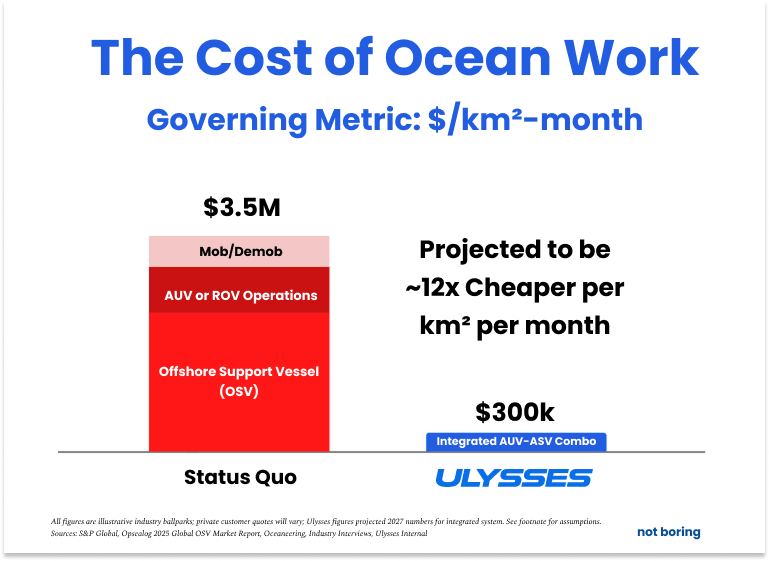
We believe the ocean is a constrained economy, severely limited by the tools available to work in it. Every constrained economy has a governing metric, the one number that, if you move it, everything else follows. For space, it was $/kg to orbit. For the ocean, it is the cost of ocean work.
That cost is unreasonably enormous today: covering a meaningful area of ocean with incumbent methods (crewed vessels, campaign-based operations, six-figure day rates) costs millions of dollars per month. If we can collapse it, we’ll make it economically viable to monitor cables, survey mineral deposits, manage fisheries, patrol shipping lanes, and do a hundred things nobody has thought of yet, at a scale that was previously impossible.
The ocean economy today is $2.6 trillion, built almost entirely on transit, extraction, and coastal adjacency. Imagine what it becomes when you can actually afford to work in the ocean, persistently, at scale. We are very early on the cost curve.
We collapse the cost of ocean work in two ways: on OpEx and on CapEx.
On OpEx, we integrate surface and subsea vehicles into a single autonomous system, removing the crewed surface vessel that drives the majority of incumbent operating costs. Our surface platform, Leviathan, deploys, recovers, and recharges our subsea vehicles via our autonomous launch, recovery, and recharge platform, Kraken, without returning to port and without requiring a crew of 80 to 150 people on board.
On CapEx, we design and manufacture the vehicles ourselves. Our underwater vehicle, Mako, is a modular AUV that starts at $50,000 per unit, compared to $500k to $5 million for incumbent AUVs. It carries more onboard compute than any small or medium AUV on the market, and we build for read-write, not read-only: these vehicles are designed for robotics from the start, not just data capture. The modular design means we and our customers can reconfigure the same vehicle for entirely different missions in minutes.
We’re deeply vertically integrated because we have to be. The existing supply chains and component manufacturers for ocean hardware are slow, expensive, and not built for scale. So we design and build many of our sensors in-house, we do our own manufacturing, we do our own PCB assembly, we develop all our own software from the autonomy stack down to the middleware, and we’re progressively bringing more complex components (navigation systems, advanced sensors, motors) under our own roof. And we believe the best way to capture the value of collapsing the cost of ocean work is to sell the work itself: we operate these vehicles for customers as a service, selling outcomes rather than hardware.
Build the fleet, deploy the fleet, sell the coverage.
The demand thus far has validated our thesis. Just this month, a major commercial customer requested a network of 10,000 vehicles operated as a service. Another requested at least 1,000. We have never seen numbers like this before, and they keep getting bigger. I fully expect this year to be the year demand outstrips our ability to supply, and our challenges shift from market creation to manufacturing and scaling.
Scale, after all, is what it will take to truly industrialize the ocean.
What an Industrialized Ocean Looks Like
We’ve drawn many parallels between the ocean, the American West, and space in this essay. We expect that there will continue to be many similarities between those stories and the one that plays out at sea. Permanent infrastructure will replace episodic missions, and it will enable new types of businesses to operate at high volume and affordable prices. Governance will replace lawlessness, because those businesses will have assets they need to protect.
Space and the ocean share the same incumbent problem. Their incumbents are incentivized to keep things the way they are, which shows up as a high cost-physics gap, or what Elon Musk calls the “Idiot Index.” Prices are too high for all but the most profitable or profit-agnostic use cases. The same strategy to beat the incumbents applies to both, as well: vertically integrate and collapse the supply chain, and sell what used to be expensive hardware as an affordable service.
But the ocean is unique. Where space inspires sci-fi, the ocean inspires poetry. And the ocean has structural advantages that space doesn’t.
The ocean economy is already seventeen times larger than the space economy was at its inflection point. The ocean contains physical resources (minerals, energy, protein) that we have not yet been able to access (or find) in space. And the regulatory environment is the most permissive of any frontier: international waters begin 12 nautical miles from shore, with no FAA equivalent beyond that. The ocean is where modern cowboys roam.
The exciting part about operating among the cowboys is that it’s hard to predict exactly how things are going to play out. But I have a few thoughts and predictions.
Permanent autonomous infrastructure will replace episodic campaigns. Fleets of autonomous vehicles will operate continuously across ocean regions, persisting there as Starlink satellites do in orbit. Docking and charging stations will create underwater and surface logistics networks. Energy nodes will harvest wave and solar power. Compute clusters will float at sea. The ocean’s infrastructure will be networked instead of physically connected, but it will be no less permanent.
Resource management will move from blind to precise. Fishing will evolve from blind harvesting to precision management, replete with real-time stock assessment, targeted harvesting, and sustainable yields at scale. Mineral extraction on the seafloor will become viable with proper monitoring. We will harvest from the ocean itself at an industrial scale while stewarding its resources. The resources have been there since long before we were, but it’s only now that humans are cracking the economics of managing and accessing them with technology, as we once did with agriculture to great success in the Green Revolution.
Governance will follow infrastructure and economy. Sunlight is the best disinfectant, they say, and they haven’t even seen what sunlight does to a surface covered with salt water. The era of lawlessness will end through better visibility. The Bad Guys can’t fish illegally if the good guys can track every vessel, can’t cut cables if the routes are patrolled, and can’t dump waste if the water chemistry is monitored. The Wild West tamed down when the railroad brought people and their economic interests. More generally, lawlessness ends when persistent infrastructure brings visibility and an economy produces something people are incentivized to protect.
Infrastructure will beget infrastructure. Autonomous vehicles will create demand for energy nodes, which will enable longer missions. Longer missions will generate more data, which will create demand for communications networks. Each layer will make the next layer viable and necessary at greater scale.
Commercial activity will overtake military spend. Defense is always the early customer for frontier infrastructure. Before the Gold Rush transformed it into a commercial hub, San Francisco began as a Catholic mission and a military fort, the Presidio; today the Bay Area generates $1.4 trillion in GDP and would rank as the world’s sixteenth-largest economy if it were a country. Just as military forts preceded commercial towns in the West, military satellites dotted the skies before telecommunications satellites. The military cares more about capabilities than cost and can therefore bootstrap markets before the economics pencil out. But as always, the commercial market will dwarf defense in time via cable monitoring, offshore energy, fisheries, shipping, and a number of unknown but inevitable use cases that always emerge when costs come down.
New industries will emerge that nobody can predict today. I’m cheating a bit here, because this happens every time. The most valuable businesses that emerge from frontier industrialization are often the ones that people figure out once they have time to get their hands dirty with new capabilities. It’s not a coincidence that a disproportionate number of the richest people who have ever lived (Vanderbilt, Carnegie, Rockefeller, Musk) built the access infrastructure at exactly the right moment and then created new markets around the new capabilities they brought into the world.
That said, we can imagine some specific opportunities, including but not limited to: managed fisheries at scale; critical mineral extraction with proper environmental monitoring; persistent maritime domain awareness sold as a subscription; autonomous shipping and smarter logistics; ocean energy at industrial scale; offshore compute powered by ocean energy and cooled by seawater; an undersea acoustic and optical communications network (the subsea equivalent of Starlink), connecting every vehicle and sensor in the water; a persistent ocean observation layer (the subsea equivalent of Planet Labs) continuously mapping the ocean in three dimensions; systematic scientific exploration of the 99.9% of the deep seafloor that nobody has ever studied.
There are an estimated three million shipwrecks on the ocean floor, most of them never found, collectively carrying billions of dollars in treasure and untold secrets about the human story. And we may finally realize our parents’ and grandparents’ dreams of permanent ocean habitats (seasteading, seriously: I think it could actually work in the next decade with the right supporting logistics, communications, and energy infrastructure). A new Atlantis is at hand.
The scale of what opens up when you collapse the cost of persistent ocean presence is difficult to overstate. The ocean economy today is built on transit, extraction, and coastal adjacency, and it’s already worth trillions. Imagine what happens when you add persistent infrastructure, domain-wide monitoring, in-water energy, autonomous logistics, undersea communications, and a continuous observation layer covering 70% of the planet. The new economy will dwarf the old one. We just can’t see most of it yet, and that’s exactly what you’d expect at this stage.
We return to the question at the heart of my mission. What does industrialization mean for the health of the ocean itself?
There is a widespread assumption that economic activity in the ocean and ecological health are in tension and that industrialization means exploitation. I believe the opposite is closer to the truth.
Counterintuitively, with all of this economic activity, we will get conservation that actually works, practically for free.
The technologies that industrialize the ocean are the same technologies that make real conservation possible for the first time.
Consider the state of ocean conservation today. Marine protected areas cover roughly 8% of the ocean on paper. In practice, many of them are “paper parks,” with no enforcement and no monitoring. We protect the ocean by drawing lines on maps and hoping people respect them. I know this because I have worked in marine protected areas on both coasts of Australia and the US. I can tell you that it doesn’t work for the same reason that protecting the Amazon didn’t work until Brazil launched real-time deforestation alerts in 2004, after which Amazon deforestation fell 70%. Visibility is what made the difference. You can’t conserve what you can’t see.
Persistent ocean infrastructure gives you that visibility, as well as the ability to intervene. We won’t know what’s possible until we experiment with the right equipment and measurement.
Consider the story of Russ George.
In 2012, George, a Californian entrepreneur, tried one of the boldest and most controversial experiments in the history of ocean science. He decided to implement the work theorized by the controversial oceanographer John Martin, the father of an idea called “ocean iron fertilization”. A few decades earlier, Martin stood up at a scientific conference and declared: “Give me half a tanker of iron, and I’ll give you an Ice Age.”
Martin’s hypothesis was that iron fertilizes ocean plankton, which multiplies and absorbs enormous quantities of CO₂. This then feeds the base of the marine food chain, which, if done at scale, might be able to alter the planet’s climate and restore fish stocks. He died before he could test it properly.
In 2012, Russ George picked up his work and convinced a First Nations village on Haida Gwaii, a remote archipelago off the coast of British Columbia, to invest $2.5 million in the experiment. He loaded 100 tonnes of iron sulfate onto a fishing boat and dumped it into the Pacific about 200 miles offshore.
And by George, he did it. NASA satellites confirmed a plankton bloom covering 35,000 square kilometers — an area so large that it was visible from space. The following year, the pink salmon run returned at 226 million fish, the largest run in Canadian history.
The scientific establishment lost its mind. Researchers disputed the causal link. Environment Canada executed search warrants on his office. The Canadian government investigated George for violating international dumping conventions. The UN imposed a moratorium on ocean fertilization.
None of his opponents argued that the idea was wrong, nor even that it didn’t work. The problem was that nobody could verify what had actually happened. There was no persistent monitoring to measure the bloom’s full effects, no way to track downstream consequences across time and space, and no ability to adjust the intervention as conditions evolved.
George had a hypothesis and a budget, but he was intervening blind. One rogue entrepreneur with a fishing boat had produced what looked like one of the most successful ecological interventions in history, and nobody could prove it, so nobody has reproduced it.
Now imagine that same experiment in a fully instrumented ocean. Autonomous vehicles monitoring the bloom in real time across its full extent. Sensors tracking nutrient levels, oxygen, pH, and biodiversity indicators continuously. The ability to see unintended consequences developing and respond before they cascade. Real-time data flowing to scientists and regulators who can assess the intervention as it unfolds, not years later from fragmentary satellite data. Iron fertilization is just one example. Targeted reef restoration, invasive species removal, pollution response, managed rewilding: these are the kinds of active stewardship that become possible when you can actually see what’s happening in the ocean and respond to it. The problem was never the idea of active ocean management. The problem was attempting it without the infrastructure to close the feedback loop.
The same sense-intervene-measure-adjust feedback loop that George’s experiment lacked is exactly what persistent infrastructure provides.
The dual-use nature of ocean infrastructure could make all of this work. The same vehicles monitoring subsea cables will collect environmental data. The same platforms enabling offshore energy will measure ocean chemistry. The same communications networks connecting autonomous fleets will transmit scientific data. It is inefficient to build one system for commerce and another for conservation when you can run both on the same system.
Economic growth and biodiversity health can and should be genuinely symbiotic. The fishing industry benefits from healthy stocks, which require monitoring. The offshore energy industry benefits from accurate ocean data. The insurance industry benefits from better climate models. Every commercial use case generates data that improves our understanding of the ocean, and better understanding leads to better stewardship. We still need to respect the ocean as a living system, and there will be hard decisions about where and how to operate, but we need to have the ability to decide. The virtuous cycle only works if the infrastructure is in the water.
I am not naive about this. There are real risks. Poorly managed extraction can damage fragile ecosystems. Increased activity in previously untouched areas brings the possibility of contamination. Geopolitical competition over ocean resources could intensify rather than stabilize. The fact that international waters have no FAA equivalent is an opportunity, but it is also a governance gap that will need to be filled as activity scales. Getting this right requires exactly the kind of persistent monitoring and real-time visibility that ocean infrastructure provides. The best argument for building the infrastructure is that without it, the ocean’s resources will continue to be exploited blindly and unsustainably by those who can already afford to be there.
When you fix the cost of doing persistent work in the ocean, you fix everything downstream of it. Conservation, commerce, defense, science, and discovery are all bottlenecked by the same constraint. If we remove it, we can unblock all of them.
We Must Return to the Great Blue Frontier
Berry Cannon died at 610 feet, breathing helium in the dark, because somebody forgot to fill a scrubber. That was 1969. That was the best we could do back then.
We can do much better today. The technology exists to build persistent, autonomous infrastructure across the ocean without sending human beings into the abyss. But the point of this essay is not that we can finally do it safely. The point is convincing you that we have to do it at all.
We have the means now to conquer the Great Blue Frontier and do what our grandparents dreamed of. Frontiers matter. Conquering them matters. Not just economically, though the economic case is extraordinary, but for what they do to us and more broadly, the soul of civilization. Their pursuit lights a fire in the heart of men that leads to civilisational greatness.
Every great era of advancement has corresponded to an active frontier. The Renaissance had the Age of Exploration. The twentieth century had aviation, then space. When there is somewhere new to go, the best minds build toward it. When there isn’t, that energy turns inward. It optimizes. It litigates. It fights over what already exists. I think we’ve all felt that. The creeping sense that the great adventures are behind us. That the best we can do is make what we have a little more efficient.
Civilization is a lot like sharks in this regard. Many species of shark (e.g., Great Whites, Makos, Whale sharks) die when they stop swimming. They need the forward motion to oxygenate their gills. Stop, and they suffocate. Humans are the same. Without forward motion, we stagnate, and stagnation is a kind of death.
The ocean is the answer to this stagnation. It has been there the whole time, covering 70% of the planet, largely unknown, barely touched, immensely rich. We mapped its surface and called it quits. We drilled through it and called it industry. We fished from it and called it the economy. But we never truly entered it, and we certainly never built the infrastructure to stay, steward, and leverage its full potential
The last great frontier on Earth isn’t behind us. It’s below us.
I grew up jumping off the pier at Garrettstown, pulling crabs out of rock pools, heading out in the boat with my dad to catch mackerel. I loved the ocean before I understood it, before I could have told you anything about technology curves or governing metrics or the cost of persistent presence. I just knew there was something down there worth knowing. I still believe that. And now we can finally go find out.
Come build it with us. There is no greater adventure than settling a frontier.
Will O’Brien is the co-founder and President of Ulysses Maritime Technologies, the ocean company, building the fleets of autonomous underwater and surface vehicles to solve the most critical tasks in the ocean.
Thanks to Will for sharing his knowledge, to Badal for my favorite cover art yet, and to all of the oceanic explorers buried beneath the waves.
That’s all for today. We’ll be back in your inbox tomorrow with another Weekly Dose.
Thanks for reading,
Packy
Note: curves may be slightly different from The Electric Slide because these are measuring specific components ocean companies might use and because, in the case of batteries, starting in 2010 vs. further back means the ability to use one canonical data source on pack costs. All the curves are pointing in the same direction, though.
woah this is so fascinating
"taste optimism"
I like your expression, "In the 1960s, America was a country dreaming at full volume. You could taste optimism in the air — and in the sea.