
Hi friends 👋,
Happy Friday and welcome back to our 198th Weekly Dose of Optimism.
I spent the week at the third annual Reindustrialize conference, which has the highest density of people we’ve covered in the Dose and in not boring more generally than any other event I know of, so the optimism is flowing particularly smoothly through my veins.
Let’s get to it.
Today’s Weekly Dose is brought to you by… Mercury

The hidden cost of banking* isn’t fees. It’s navigating all your tabs and dashboards.
Every finance task takes multiple steps. Check runway? Find the right report, cross-reference your burn, interpret the graph. Pay a contractor? Track down the invoice, navigate to transfers, fill in the details. Freeze a card? Dig through settings.
Mercury Command eliminates the switching tax. It’s AI built directly into your Mercury account that understands natural language and executes from one place — payments, invoices, categorization, team management. You review and approve every action. Command does the rest.
Try Mercury Command →
*Mercury is a fintech company, not an FDIC-insured bank. Banking services provided through Choice Financial Group and Column N.A., Members FDIC.
(1) Midjourney Announces Midjourney Medical + Scanner
When the AI image and video company Midjourney said that they were going to be hosting a demo of their first hardware product this week, most people, understandably, assumed that they would unveil something related to AI image and video. A digital canvas, perhaps. Glasses. VR. Art-immersed physical environments, even.
Wrong. All wrong. Thinking way too small.
“Today we're gonna announce something a little weird and a little crazy,” the company wrote, “but also spectacular and filled with hope.”
When I wrote a Deep Dive on Ezra a couple years back, I started the piece with a vision of the future:
In the year 2050, each time you step in front of the mirror in your bedroom, it runs a quick and dirty MRI on you. The MRI won’t be as high-resolution as something you would have gotten in a tube in 2023, but it doesn’t need to be. AI fills in the gaps and pulls signal from noise.
Most days – 99.9% of days – you don’t even remember you’re being scanned. There’s nothing to report, so your mirror reports nothing.
Very occasionally, though, it might notice enough of a change in your cells that it recommends a higher-resolution, localized scan on, say, your prostate, moves some things around on your calendar, books you an appointment, and summons your car to whisk you away to an imaging facility for a closer look.
That is basically the weird, crazy, spectacular, hopeful product that Midjourney announced, the first from the newly-formed Midjourney Medical: the Midjourney Scanner, “something as powerful as MRI, and as casual as a trip to the spa.”
It’s not an MRI, but the idea is to use lots of ultrasound and compute to get to the same place. From Midjourney’s (very well-done) announcement post:
It starts by stepping into a shallow pool of golden light. You then begin to descend into the water. Your body passes through a ring of underwater sensors, each acting like a dolphin, using its echolocation. The sensors send ultrasonic sound waves through your body from every angle. With enough waves, and enough angles, we form an image of what’s happening inside your body.
The goal is for this process to take no more than 60 seconds.
You go into the water, you come out of the water, and you’re done.
While you’re in there, ultrasonic waves hit your body and ripple back millions of times per second, producing terabytes of data. Then, computers turn all of those waves into images to form a 3D map of your body down to the millimeter.
Midjourney calls the process Ultrasonic CT (computer tomography), a whole body ultrasound scanner. They explain it in more detail here:
Of course, this is just an announcement, and there’s a lot to build and a lot to prove. Some people are unsurprisingly more skeptical of the Scanner, and others are more measured about what it is and isn’t. I really like Friend of Not Boring and Ezra co-founder Emi Gal’s breakdown.
Having said that… a few thoughts beyond the technology itself:
It’s very cool to see a company branch out so aggressively. It’s imaging-adjacent, and it requires a lot of computation, but the company admits that “It’s not related to anything you’ve seen from us so far.” But, they write: “However, we feel an obligation as people standing on the frontier to look at the foundations of the human experience and ask: ‘What do we want to be different?’ ‘How do we want to be different?’ and ‘What do we want to become?’” That’s a very cool way to think about it, and I hope more companies get creative with what they can do given a bunch of smart people, money, and attention, even if many fail in the process of unfocusing.
Midjourney hasn’t raised VC and is profitable, which gives them the leeway to do this (or whatever they want).
The reason they’re able to do this so quickly is because they’re partnering with Butterfly Network, which is a fascinating company that makes ultrasound-on-chip. Interestingly, Matthew de Jonge, the founder and CEO of hearing aid company Fortell, which we covered in Dose #172, is the ex-VP of Product at Butterfly. You can do magical things with hardware when you’re willing to go all the way down to the chip.
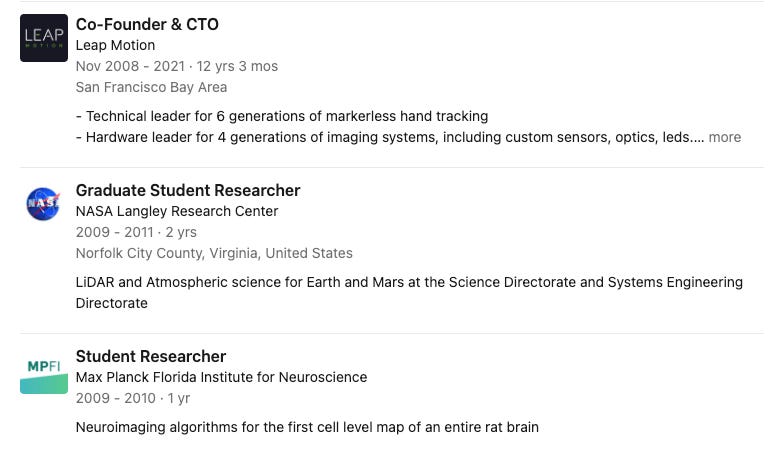
If you look at David Holz’s bio, this isn’t as crazy as it looks. He’s built hardware as the co-founder and CTO of Leap Motion, worked on planetary imaging at NASA, and researched neuroimaging algorithms at Max Planck Florida to map an “entire rat brain” to the cell level.
Holz said the Scanner is the first of eight major announcements it plans to make in 2026. MOAR.
This is a new entry into The Great Differentiation canon, and it’ll be interesting to see how the other seven fit in (or don’t). Different products as differentiation would be fun.
(2) Making the Invisible Visible with the Laser Phase Plate
CZ Biohub & UC Berkeley
Bigggg week for seeing litttttle things.
Zuck’s CZ Biohub, in partnership with UC Berkeley, announced their Laser Phase Plate last week, which looks and sounds cool, but which honestly I didn’t understand until I saw a lot of very smart people tweet something to the effect of “most people won’t appreciate how huge this is but I do because I’m very smart” so I looked into it.
Basically, scientists can’t see the proteins inside of a cell in real-time in their natural environment. They can image ~10% of the proteins once they’re pulled out and purified, using cryo-electron microscopy (cryo-EM), or < 1% when they’re actually working inside a cell, but most of our cell’s proteins operate in the shadows. They stay too faint to see because current imaging techniques can’t create enough contrast.
In light microscopes, the normal ones, scientists have understood how to solve the contrast problem since Fritz Zernike won a Nobel for it in 1942. With an electron microscope, though, it’s way harder, because anything you place in an electron beam gets zapped and fried. So fifteen years ago, Berkeley physicist Holger Müller proposed swapping the physical part for a laser. Cool idea, but “because light barely interacts with electrons, the laser would have to be extraordinarily intense,” so intense as to be impractical.
Until now! The CZ Biohub and UC Berkeley researchers (led by Müller himself) published two papers (Science and Nature Communications) and a preprint explaining their laser phase plate, including Müller’s solution to the laser intensity problem:
Müller’s solution was a so-called Fabry-Perot cavity: a pair of mirrors that bounce a laser beam back and forth roughly 10,000 times. Each bounce amplifies the intensity until the light focused between those mirrors reaches roughly 100 million times the intensity of the surface of the Sun — the brightest continuous-wave laser in the world.
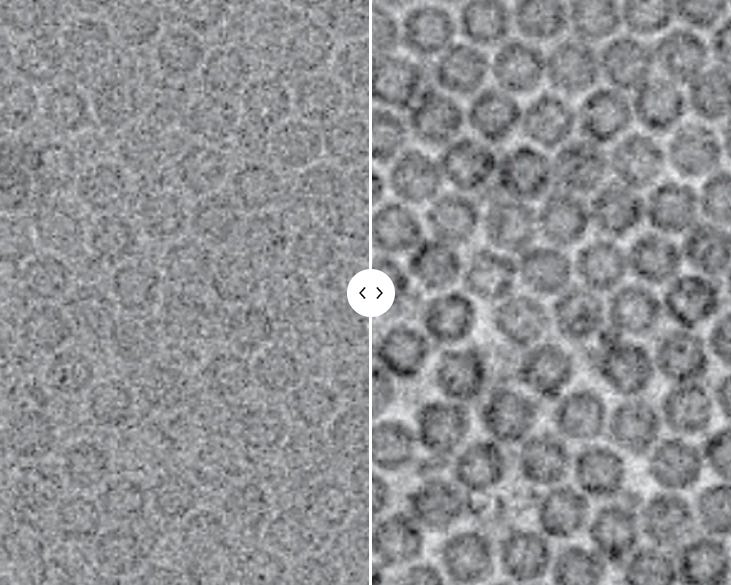
See the results for yourself. The image on the left is with the beam off, and the right is with the beam on (you can drag it on the Biohub blog).
Interestingly, better contrast also unlocks cryo-electron tomography, or cryo-ET, which “builds three-dimensional reconstructions of structures inside intact cells — revealing not just protein shapes, but how proteins interact with their neighbors,” and which I bring up because how often do I get to cover tomography in back-to-back entries?
The hope is that the better we can see, the better we can fix. We down with LPP.
(3) Valar Atomics Goes Critical
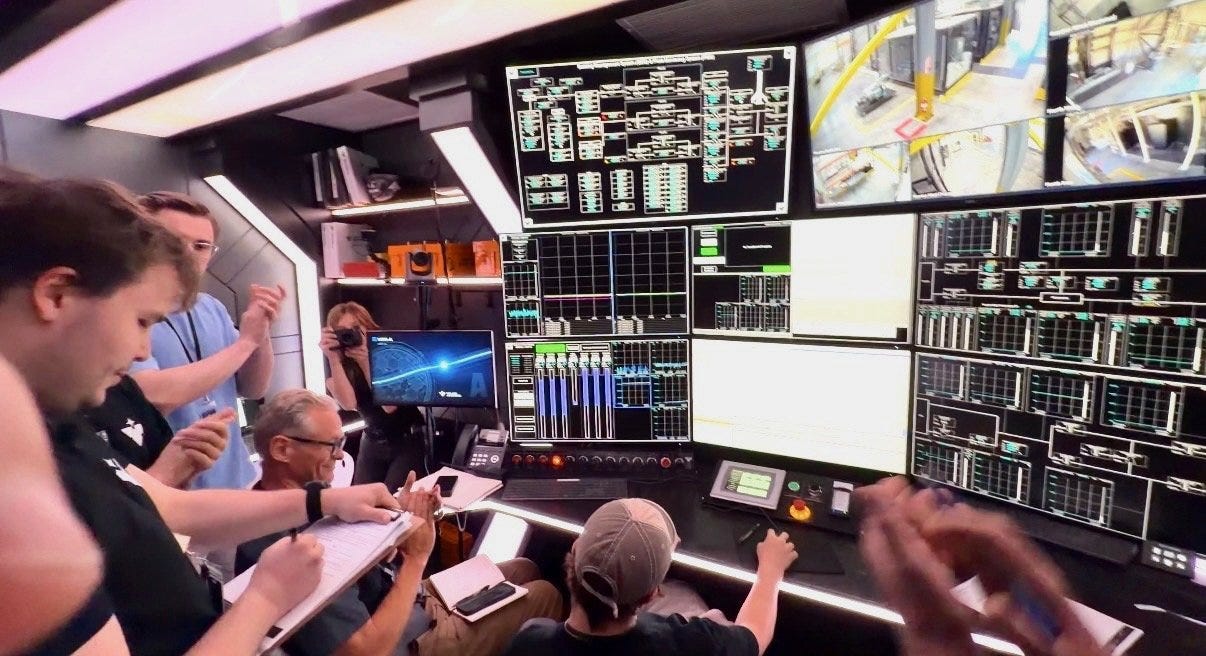
Out in Emery County, Utah, Valar Atomics’ Ward 250 reactor went critical. This makes it the second new advanced reactor to go critical before America’s 250th Birthday on July 4, 2026.
What makes this one particularly sweet is how much doubt Valar founder and CEO Isaiah Taylor faced when he initially announced the company a little over two years ago. He didn’t have a traditional background - no college degree, let alone nuclear physics PhD. The way that he talked about building a lot of reactors really fast, and even using them to produce hydrocarbons if that’s where the first market was, was just Not How Things Are Done Here.
His reputation preceded him. And it was totally wrong.
When I got to speak with him for Age of Miracles, it was obvious that Isaiah was a rare actual example of that thing that everyone claims to be: a first-principles thinker, which is something it’s easier to be when you come from outside the industry.
He did things like start with the market and work back to the specific technology, make systems-level trade-offs for speed over efficiency, and compare the cost of machines of different sizes (like buses and gas plants) to nuclear reactors instead of just taking for granted that nuclear reactors are expensive. He became one of our go-to people for Age of Miracles because he was so clear in his explanations and novel in his approaches.
Anyway, it’s cool to see him just do the thing in such a short amount of time. Now, he and the Valar team have to fulfill the rest of the mission: first, power operations by July 4th, then, print tens of thousands of reactors across the globe to make energy 10x cheaper than it is today with mass-scale nuclear fission.
Being Critical: 0
Going Critical: 1
(4) Anduril Wins Production Contract for U.S. Air Force CCA Program

Wayyyy back in Dose #91, in April 2024, we led with Anduril’s selection for the U.S. Air Force Collaborative Combat Aircraft Program. In that early phase, for which it beat out a number of incumbent primes, “Anduril will design, manufacture, and test production-representative CCAs.” Then, we wrote, “Ultimately, the USAF will make a final, multibillion-dollar production decision in two years from now — it said that it wants ~1,000 craft — with the goal of having fully operational crafts by the end of the decade.”
Two years is up ladies and gentlemen, and … drum roll please… we have a winner.
This week, the Air Force picked Anduril’s FQ-44 “Fury” as one of two jets going into production for the CCA fleet: uncrewed fighter jets designed to fly alongside human pilots as autonomous wingmen.
Anduril went from prototype award in 2024 to a production contract this June, which is the fastest any fighter has gone from prototype to production in more than half a century. The decision landed four months ahead of schedule, so good on the Air Force, too. It’s also the first time a new company has won a fighter aircraft program since the 1970s, before the F-16 existed.
The Air Force wants more than 150 FQ-44s by the end of the decade.
Anduril didn’t get the W solo. General Atomics won an identical contract for its own jet. But the Air Force resolicited Boeing, Lockheed, and Northrop, the incumbents who’ve owned fighter programs for fifty years, and it passed over them in favor of Anduril once again.
It’s time to produce now, lots to prove, but it’s a great step on the way towards “saving western civilization by saving taxpayers hundreds of billions of dollars a year as we make tens of billions of dollars a year.”
(5) Notes from Reindustrialize

This week, I went on my annual pilgrimage to the Motor City for Reindustrialize. This was my third, and in my opinion, the best yet.
The thing that’s stayed consistent is the density of great people. They save me like 10 discrete trips by pulling so many good people to Detroit.
Where else can you eat Westmag hot dogs with your favorite founders, investors, and policy people while watching a drone show in a metal factory?
What’s changed is that where Reindustrialize 1.0 focused on arguing that we should build things in America again, Reindustrialize 3.0 was packed with examples of companies actually building in America. It was much more focused on execution details than before, because Reindustrialization is happening.
I got to moderate two panels - one with Micah Springut of Monumental Labs and Alexis Ohanian of 776 on AI and the Workforce (and how to build beautiful things), and one with Sam D’Amico (Impulse), Justin Lopas (Base), and Adam Warmoth (Chariot Defense) on The Electric Slide. Both got very specific - the right balance of automation and craft, how to decide where to integrate and where to buy, etc…
It’s wild how much can change in two years. At Reindustrialize 1.0, I moderated a panel making the case for nuclear. To my left were Valar Atomics’ Isaiah Taylor and Decisive Point’s Tommy Hendrix.

This week, just this week, Isaiah’s company went critical, and the company that Tommy founded after Reindustrialize 1.0, Standard Nuclear, filed its S-1 to go public. Not Boring Capital is an investor in Standard Nuclear because of Reindustrialize.
There’s a ton of momentum, capital, and talent going into making big things again. I can’t wait to see what this year’s crop announces during Reindustrialize week two years from now.