

Hi friends 👋,
Happy Friday and welcome to our 194th Weekly Dose of Optimism. I’m emailing you from beautiful Utah, where I attended the Abundance Institute Gala last night and got to talk nuclear with Oklo’s Jake DeWitte and General Matter’s Scott Nolan, and where I’ll be spending today at the state’s Operation Gigawatt Conference.
It’s hard not to feel the optimism in the mountain air. When we started writing the Dose a few years back, nuclear was a controversial dream. Today, we’re heading into the Memorial Day Weekend that kicks off the summer during which multiple new reactors will go critical for the first time.
Plus, you’re about to read one of the most action-packed Doses in Dose history.
Things are moving fast, and mostly for the better. Happy Memorial Day Weekend, y’all.
Today’s Weekly Dose if brought to you by… Lightwork

It turns out, my house has been making me worse at writing. Sorry about that. I have it under control now.
Lightwork came by my place recently and tested our air and water quality, light sources, likelihood of mold, electromagnetic exposure (turns out electromagnetism does run the world), and household products. It was an awesome experience. I learned a lot, including that my home’s air quality and lighting were undermining my energy levels, our shower water was full of VOCs whose vapor I was inhaling, and a whole lot more.
Lightwork’s assessments are concierge evaluations where they test every aspect of your home that could be impacting your health, produce a science-backed, in-depth report on all their findings, and then help you fix all the issues they uncover. I recommend them. Check them out!
(1) Retatrutide Stuns In Phase 3 Obesity Trial
Eli Lily
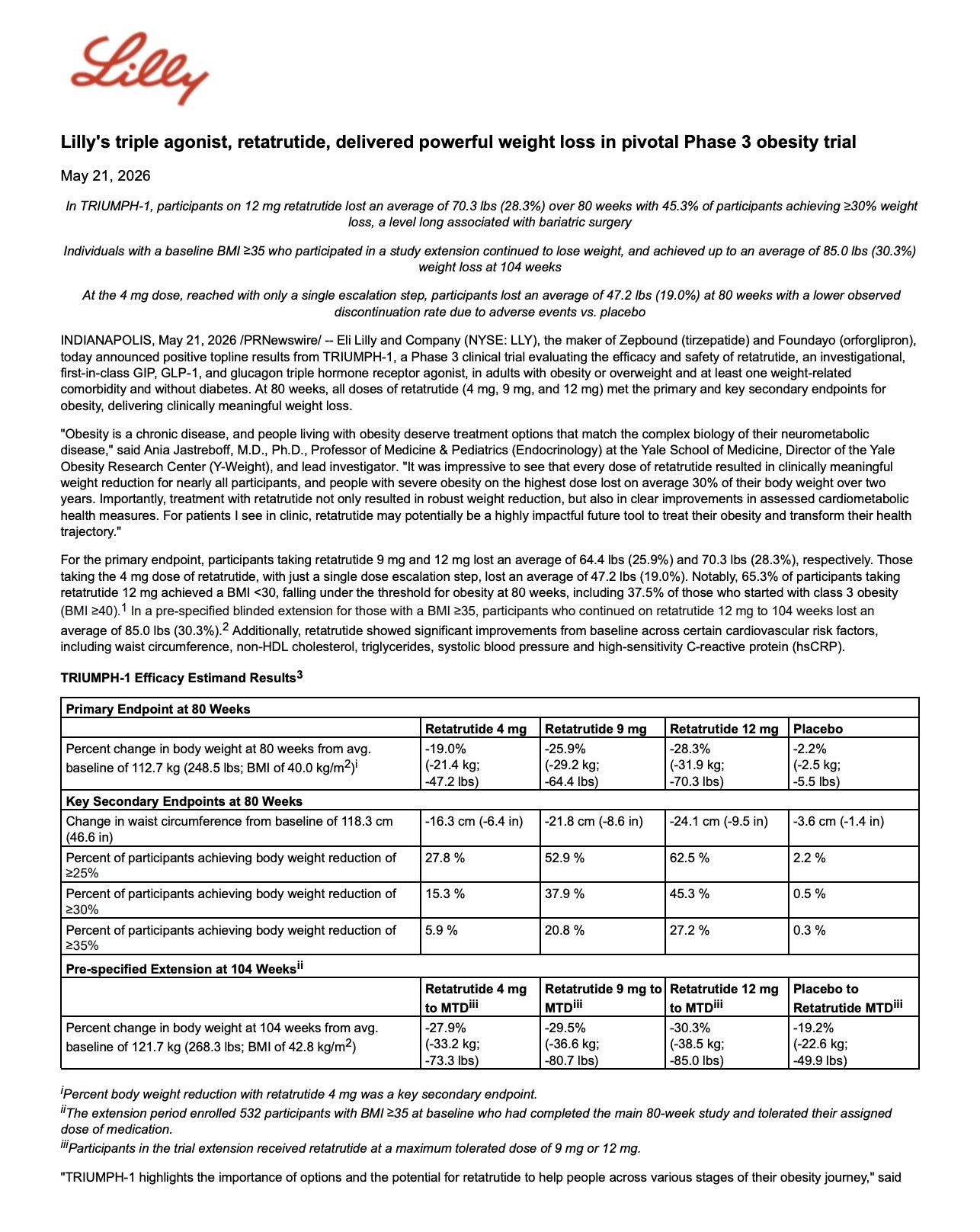
Yesterday morning, Eli Lilly reported topline results from TRIUMPH-1, the Phase 3 trial for retatrutide in adults with obesity and at least one weight-related comorbidity. Here’s a summary of the results from Superpower founder and peptide enthusiast Max Marchione:
28.3% bodyweight lost on 12mg over 80 weeks
70.3 pounds on avg. or 31.9 kg
45.3% of patients hit 30%+ weight loss (this is bariatric surgery territory)
30.3% weight loss (85 lbs) at 104 weeks in higher-BMI patients
65.3% of 12mg patients dropped below the obesity BMI threshold
19% loss on 4mg over 80 weeks (47.2 lbs) with fewer dropouts than placebo (4.1% vs 4.9%)
significant drops in blood pressure, triglycerides, non-HDL cholesterol, waist circumference, and hsCRP
no cardiac or liver signals
These are bariatric surgery results in a shot, with a bunch of freebies thrown in.
People have been excited about reta on social media for a while, but it’s still gray market, so this is a key step towards getting it to the general public, and just an astonishing set of results. People are losing 28.3% of their bodyweight, or 70 pounds, in less than two years!
For context, Zepbound (tirzepatide) tops out around 20-22% weight loss in its big trials, and the previous-generation Wegovy (semaglutide) at around 15%.
Retatrutide is the first triple hormone receptor agonist (GIP + GLP-1 + glucagon). We previewed this back in Dose #175, in our piece on grey-market peptides and Gen3 GLP-1/GIP/glucagon agonists. The author of the essay we covered, Not for Human Consumption, called these drugs “the holy grail of weight loss medications” before any of them had a Phase 3 readout. Now one of them does.
This is Lebron-level. Unbelievably hyped out of the gate, and then exceeds the hype.
As with all of these miracle drugs, there are positive side effects beyond weight loss. Retatrutide reduced osteoarthritis knee pain by an average of 75.8%, with more than 1 in 8 patients reporting they were completely free of knee pain at the end of the trial. LDL cholesterol dropped 20%. 72% of prediabetic participants returned to normal blood sugar levels. Seven more Phase 3 readouts are expected this year, including diabetes, sleep apnea, chronic back pain, and cardiorenal outcomes.
Get ready to get hot and healthy. It’s Reta Summer (in 2027).
(2) Colossal Biosciences Hatches Chick From Artificial Eggs
“Before we named the stars, before we mapped the atom, we asked ourselves an impossible question: which came first, the chicken or the egg?”
On Monday, Ben Lamm's Colossal Biosciences announced that it has hatched 26 healthy chicks from a fully artificial egg, an oval printed shell coated in an oxygen-permeable membrane that lets an embryo develop from poured-in yolk to pipping bird, without a biological eggshell. Researchers crack a freshly laid fertilized egg, pour the contents into the artificial shell (Colossal adds ground-up calcium back in, because the embryo eats the shell as it grows), and watch through the top window as eyes form, vasculature spreads, and, 18 days later, a chick taps its way out.
Real scientists will tell you (and MIT Tech Review's Antonio Regalado dutifully did) that growing birds outside the shell isn't new. A Japanese group hatched quail in 1998. Katsuya Obara hatched chickens under transparent plastic film in 2024. Colossal's marketing is, per Regalado, "pure Hollywood." Which is kind of fair but too clucking cynical.
Colossal’s real engineering advance is the membrane, which lets the embryo pull enough oxygen from ambient air that the system doesn't need supplemental gas. Previous shell-less methods did, and chicks tended to die. I like the version in which the chicks live, Regalado.
While this experiment was on a chicken, we have plenty of those. Colossal likes to de-extinct. Its stated goal is the 12-foot, 500-pound South Island giant moa, which laid four-liter eggs no living bird is large enough to surrogate. Colossal staff are reportedly already calling the prototype scaled-up version the "salad spinner." More immediately, the artificial egg is a tool for genetic rescue of endangered birds and, as per our discussion in Dose #186 with not boring capital portfolio company Neion Bio, a substrate for transgenic chickens producing therapeutic proteins in egg whites at a fraction of mammalian cell culture costs.
This is the first member of what Colossal calls its "exogenous development" family. Up next: artificial wombs for marsupials.
With this chicken breakthrough, it feels like humans have crossed a road.
(3) SpaceX Launches S-1
For the entirety of its existence, human civilization has lived on a single celestial body: Earth. The current paradigm, in which human civilization is confined to one planet, exposes humanity to existential threats that are unpredictable and uncontrollable on a planetary scale. By moving beyond the only home we have ever known, we ensure species-level redundancy and that the light of consciousness will not be tied to a single planet subject to the inevitable hazards of a harsh and vast universe. We do not want humans to have the same fate as dinosaurs.
On Wednesday, SpaeX dropped what may have been the most highly-anticipated S-1 in the history of the planet (until Anthropic files later this year). You can read it here.
Financial highlights include:
Revenue: $4.69B (run-rate ~$19B)
Operating loss: $(1.94B), but Adjusted EBITDA of +$1.13B
Connectivity (Starlink) prints cash: $3.26B revenue, $1.19B operating income in just the first quarter. Its revenue is growing ~50% per year, and profitability is growing faster.
AI is losing money for now…: $818M revenue, $(2.47B) operating loss in Q1. Capex on AI alone was $7.7B in Q1, more than Space ($1.05B) and Connectivity ($1.33B) combined, by far.
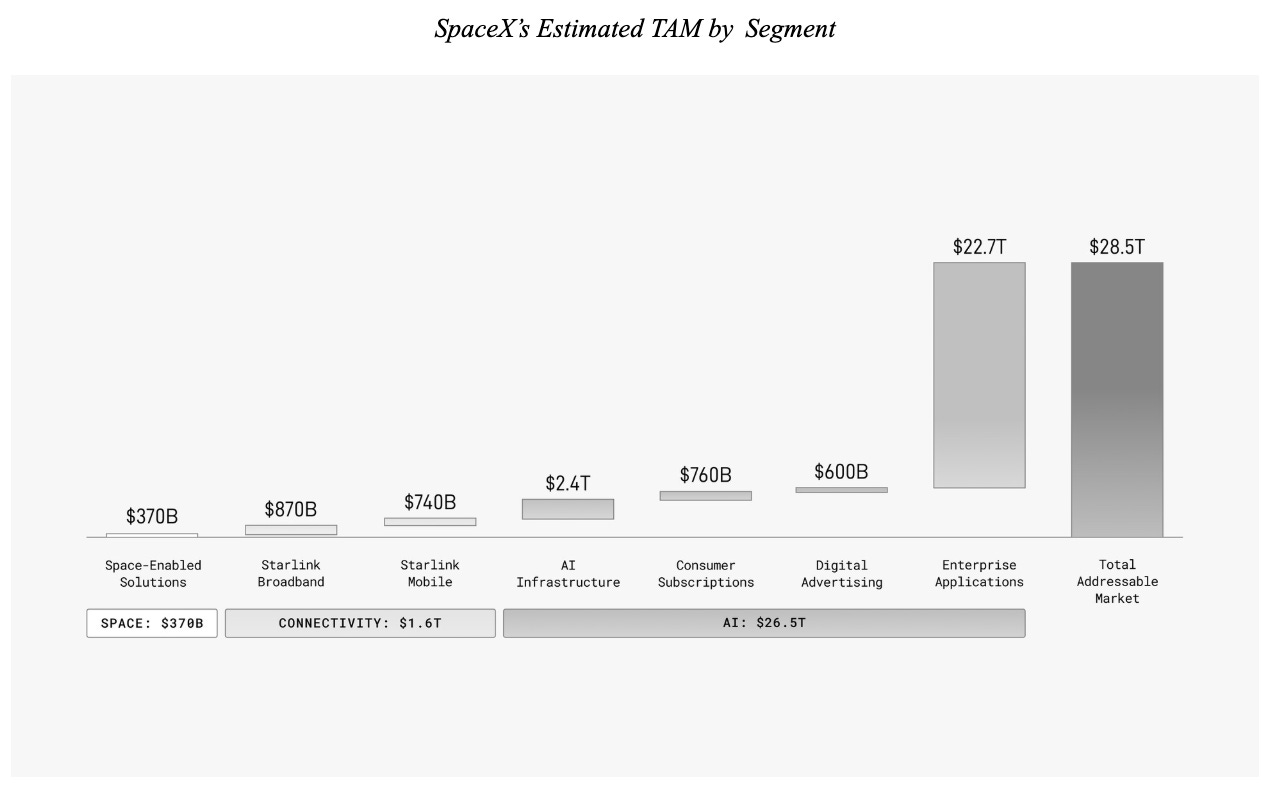
But has the monster TAM: AI infra, consumer subscriptions, digital advertising, and enterprise applications - the AI segment - has a company-estimated TAM of $26.5 trillion, which seems small when you consider the size of the universe and the potential to spread Enterprise Applications throughout it.
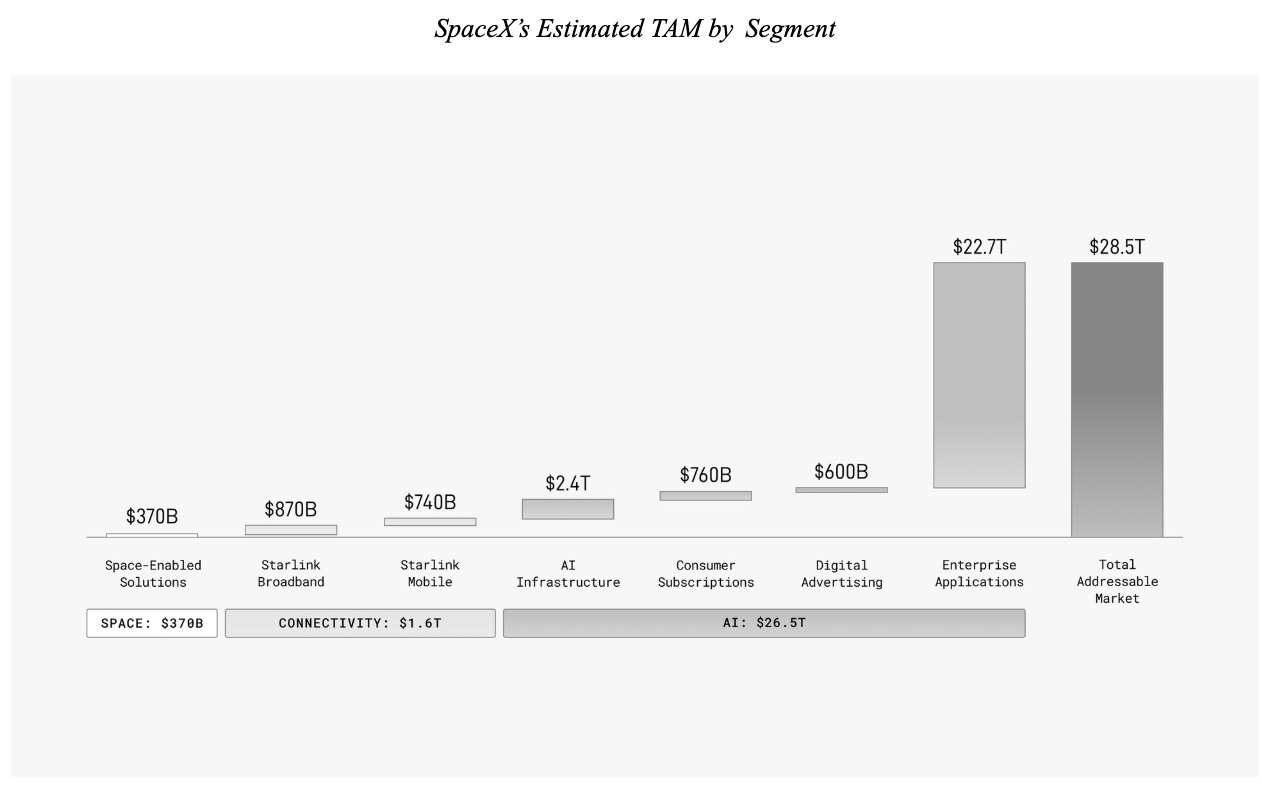
SpaceX also disclosed that it’s doing a second compute deal with Anthropic, in which Dario & Co. will pay SpaceX $1.25 billion per month for Colossus 2, which is nearly as much as entire SpaceX makes now. For now, it’s selling compute on earth, but per the S-1, it plans to begin deploying orbital compute in 2028 and scale it to 100 GW of compute launched annually, which would make Colossus seem like a pale blue dot.
Starlink, which had been the bull case until AI, is at 9,600 satellites, 10.3 million subscribers across 164 countries, and now accounts for ~75% of all active maneuverable satellites in orbit.
There is no one operating at a higher level than Elon and the SpaceX team, across everything from terrestrial data centers to rockets to satellites to, soon, Terafab. After more than 20 years, it’s awesome to see the company go public (and generate some much-needed DPI for the venture and seven-layer-SPV ecosystems). Is the price a little high? Maybe, yeah, sure. But what would you pay to own a Scarce Asset that catches Statue of Liberty-sized rockets with chopsticks…
We’ll find out in June.
In the meanting, after scrapping the launch of Starship v3 last night, SpaceX is giving it another go today. What a way to launch summer.
(4) GPT 5.5 Pro Makes Breakthrough on Erdős Planar Distance Problem
Take n dots on a piece of paper. How many pairs of dots can sit exactly one unit apart from each other?
Paul Erdős posed this in 1946, conjectured the answer grows just barely faster than n, and offered cash for a resolution. For 80 years, the best constructions anyone could find were boring square grids, and most of combinatorial geometry treated Erdős's upper bound as essentially right.
This week, an internal general-purpose OpenAI reasoning model produced a proof that disproves it. The model isn’t math-specific, it just thought for a long time and burned an estimated ~$1,000 max worth of tokens, which is pretty affordable for an 80 year old unsolved problem! It found that there's an infinite family of point arrangements that beat the grid, polynomially. Erdős was wrong, and his “favorite problem” is settled.
How’d it pull it off? Instead of more clever geometry, it pulled in algebraic number theory (specifically, infinite class field towers and Golod–Shafarevich theory, of course, why didn’t I think of that) to construct number systems with the right symmetries, then read the geometric configurations off of those. No human had tried this connection. Thomas Bloom thinks it will unlock other long-stuck problems in discrete geometry.
And, importantly, it’s verified. Last October, OpenAI claimed GPT-5 had solved ten Erdős problems; on inspection, it had just surfaced answers from the literature. This time, it got external review by Fields Medalist Tim Gowers and Will Sawin at Princeton, with a companion paper. Gowers's verdict: "if a human had written the paper and submitted it to the Annals of Mathematics, I would have recommended acceptance without any hesitation." It also got endorsements from Noga Alon, Melanie Wood, Arul Shankar. Shankar said the models “are capable of having original ingenious ideas, and then carrying them out to fruition.” The full proof is available as a public PDF.
Ten months ago, frontier models were at IMO-gold level. Really smart high schoolers, basically. Now, they’re doing Annals-worthy novel work.
I’ve been more skeptical about AI than I normally am about new technologies, and less excited than the average person in tech. Per the evidence that keeps coming out, I’ve been wrong. On the business side and the capabilities side, the pace has been truly remarkable, and I can’t wait to see what problems they’ll solve for us in the years ahead.
(5) SendCutSend Raises $110M at $1B Valuation
Jim Belosic (SendCutSend)
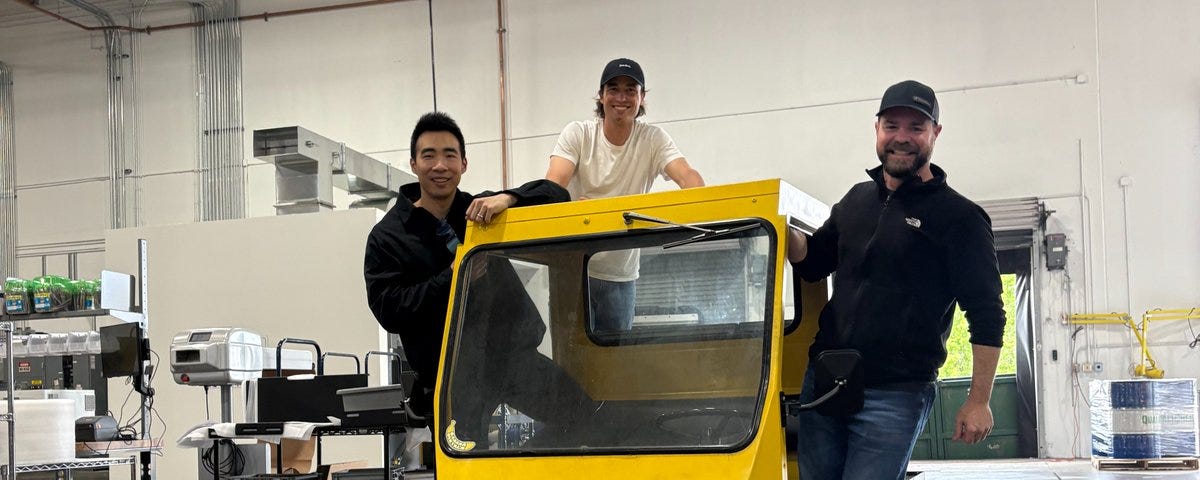
Jim Belosic started SendCutSend in 2018 because he couldn't get custom metal parts fast enough for the cars and motorcycles he was restoring. Eight years later, bootstrapped to this point on credit cards, savings, a PayPal loan, and bank-financed machines, the Reno laser-cutting and bending shop is doing roughly $200 million in revenue, growing 100% year over year, and turning into one of the most important on-demand manufacturers in America.
Austin Vernon's February essay Speed Can Reindustrialize America is the best piece on why the company is so impressive and potentially important. Vernon's argument is that the US is great at high-volume manufacturing and terrible at low-volume, short-lead-time custom work because soft costs (quoting, programming, billing, all the white-collar overhead) swamp the actual fabrication cost on small orders. SendCutSend's whole company is an attack on soft costs: instant quotes, one-click buying, software-routed production. It’s generating ~$275K revenue per employee, and the market would support a hell of a lot of employees.
Interestingly, Patrick Collison was the one person Vernon thanked for feedback, right above the “Funding Opportunities Apendix.”

And I guess Collison took it literally, because he reached out to Belosic about investing, and although SCS had never taken outside capital, he decided to take money from the Collisons, Sequoia (Andrew Reed), and Paradigm (Matt Huang) to go bigger, faster.
Jim and SCS are easy to root for and have become a cult classic over the past few years. Now, the cat’s out of the bag, the money is in the bank, and IT’S TIME TO BUILD.
In other great news for building stuff here, Amca raised $300M at $1B+ from Caffeinated and crew. Amca builds and modernize factories to design and produce critical aerospace and defense components that are supply-constrained and often sole-sourced.


Jai Malik’s eighteen-month-old El Segundo startup already runs factories in California, Iowa, and New York, supplies components for the F-35, and uses its RAPID software platform to deliver parts to BAE, Airbus, Textron, Honeywell, and GE Aerospace 67% faster than the legacy defense supply chain. Now, it can make more of the critical components on which the country runs.