

Hey friends 👋,
Happy Friday! The sun is shining here in New York City, Duke plays in the Sweet 16 tonight, and there are so many incredible stories this week that I kept having to change what made the cut as new news came out.
Grab a cup of coffee and catch up on all of it in one place. And if you have a second cup, take an hour this weekend to read Electromagnetism Secretly Runs the World.
Let’s get to it.
Today’s Weekly Dose is brought to you by… Quince

Last week, it was cold and rainy in New York. Today, it’s warm and sunny. Aside from the renewed joie de vivre, that means it’s time to switch out the wardrobe.
More and more, when people are thinking about refreshing (and upgrading) their … anything, they ask, “Does Quince make this?” More and more, the answer is yes. Quince is the default starting point for quality, across cashmere, luggage, furniture, fragrance, fine jewelry, and new spring wardrobes.
I have been lucky to be a Quince investor for years. They recently raised at a $10.1 billion valuation. The reason is that they’re able to deliver high-quality across a growing number of categories at surprisingly affordable prices. 100% Grade A Mongolian cashmere. 100% mulberry silk. 100% European linen. 0% brand tax.
They can pull it off because Quince built an M2C (Manufacturer-to-Consumer) operating system with AI demand forecasting, real-time production planning, and direct factory partnerships that cut out distributors, wholesalers, and the retail markup entirely. This week, they even hit #1 in the App Store for shopping. The machine is humming.
Look, I’m biased, but I’m also writing this while wearing Quince jeans and a Quince q-zip. We dress our kids in Quince. And I’m about to do a big spring haul. If you haven’t started shopping at Quince, or haven’t checked out everything they have to offer in a while, join me.
(1) NASA Goes Nuclear (and to the Moon)
Jared Isaacman’s NASA is shaping up to be as cool as we expected.
On Monday, Isaacman went onstage at the Hill & Valley Forum in Washington for a conversation with Founders Fund / Varda’s Delian Asparouhov and laid out his plans to build a permanent base on the Moon and send a nuclear-powered spacecraft to Mars.
In a normal week, either one would get its own top billing in the Dose, but since JI dropped both at once, let’s Start with the Moon Base. NASA is committing $20 billion over seven years to construct humanity's first permanent outpost near the lunar south pole. “The moon base will not appear overnight,” Isaacman said. “We will invest approximately $20 billion over the next seven years and build it through dozens of missions.” The plan has three phases, with Phase 1 starting now: up to 24 launches and 20+ landings in the next 35 months. That's roughly a mission every six weeks, which sounds like SpaceX cadence.
The first wave will MoonFall surveillance drones to map terrain around the south pole, fission reactors and RTGs for power, and enhanced rovers for scouting. Phase 2 adds pressurized rovers built in partnership with Japan's aerospace agency and semi-habitable modules after Artemis IV. Phase 3 is the full base: permanent infrastructure for sustained human presence. We’re going, and we’re staying. Moon will be a State.
Between NASA and SpaceX, the Moon has been getting a lot of love recently, and Mars has been pushed out. But Isaacman also announced some Mars plans.
SR-1 Freedom will be the first spacecraft to use a nuclear fission reactor for propulsion beyond Earth orbit. A HALEU-fueled reactor delivers 20+ kilowatts of electrical power, driving xenon ion thrusters via a closed Brayton cycle. It launches in December 2028 (likely on a Falcon Heavy) and should arrive at Mars about a year later. Once there, it will deploy three Ingenuity-class helicopters carrying cameras, ground-penetrating radar, and radios to scout human landing sites and hunt for subsurface water. To summarize, we’re sending a nuclear-powered space craft to Mars to release scout helicopters.
SR-1 repurposes the already-built Power and Propulsion Element from the scrapped Gateway program. Rather than shelve expensive hardware when priorities shifted, Isaacman's team pointed it at Mars. The reactor will activate within 48 hours of launch, then it’s off to the Red Planet.
Nuclear is going to be critical to our space ambitions, whether going or staying. We wrote about it in our Deep Dive on Radiant. Fission reactors will power the Moon Base and a fission reactor will propel SR-1 to Mars. Eventually, we’ll have nuclear-powered civilizations as far as the eye can see.
Looks like putting Isaacman in charge of NASA set off a … nuclear chain reaction.
(2) Terraform Industries Breaks Ground on Synth Hydrocarbon Site
Casey Handmer on TBPN
We’re going to need a lot of energy here on earth, too, and even as we add a ton of clean nuclear, solar, and even geothermal, we’re going to need those sweet, sweet hydrocarbons. We just want them to be clean, too.
Good news. Casey Handmer and the Terraform Industries team have been hard at work figuring out how to turn sunlight and air into pipeline-grade natural gas for less than the cost of drilling it. In March 2024, his team in Burbank proved the chemistry works by producing synthetic methane end-to-end for the first time. Now, two years later, Terraform Industries has broken ground on a manufacturing site in Kern County, California, to scale up production.
Kern County is a lucky place: it’s one of California's biggest oil-producing regions and it's also absolutely sun drenched. Those rays are what Terraform wants. The Terraformer system is straightforward in concept: solar electricity powers water electrolysis for hydrogen, direct air capture pulls CO2 from the atmosphere, and a reactor combines them into carbon-neutral methane. What's hard is making it cheap enough to compete with drilling a hole in the ground. Terraform's bet is that plummeting solar costs will get them there, and their qualified electrolyzer stack (under $100/kW) and full-scale reactor suggest they’re heading in the right direction.
Last week, we wrote about one Australian, Chris Power, launching a huge new manufacturing site in Alabama. This week, another Aussie, Handmer, is launching a hydrocarbon manufacturing site in the California desert. Chris and Casey are two of the smartest people I’ve met. With them working on the country’s behalf, it’s a very g’day in America.
(3) Arbor Energy Lands Billion-Dollar Turbine Deal
TechCrunch
But wait… how are we going to turn all of our natural gas into power to feed the data centers? I’m glad you asked.
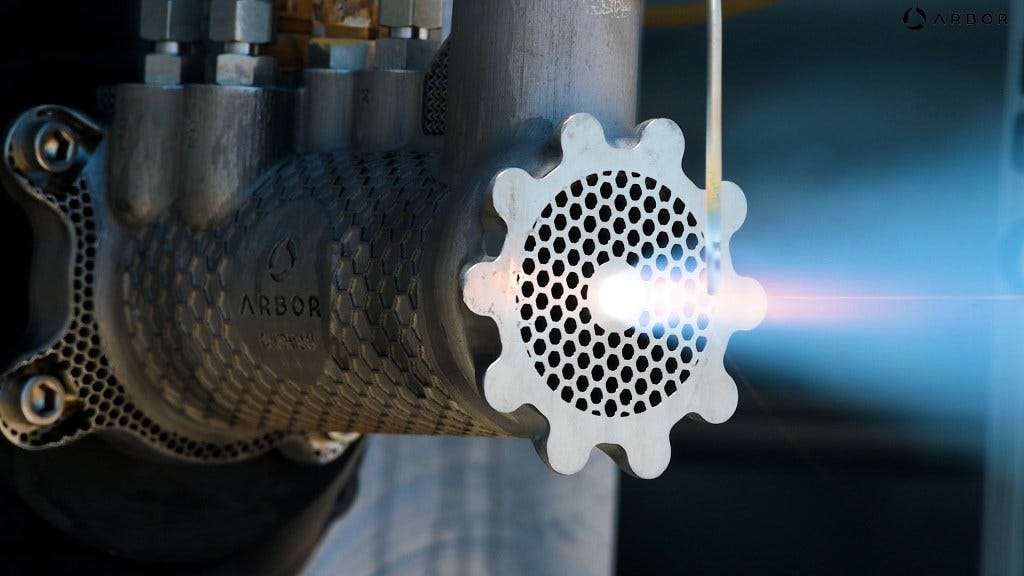
Arbor Energy, founded by former SpaceX engineers Brad Hartwig and Andres Garcia Clark, just landed a deal with GridMarket to supply up to five gigawatts of its Halcyon turbines, or roughly 200 units, valued in the single-digit billions. They expect the first turbine to connect to the grid in 2028 to be manufacturing 100+ per year by 2030.
Turbines are so hot right now. They’re such a big bottleneck to the data center buildout that their shortage is a big driver behind the rush towards orbital data centers, where they can be powered by the sun. Traditional gas turbines from the big OEMs are backordered until 2032. Hartwig puts it simply: “Everyone wants more power. They wanted it yesterday. The time frames are compressing and the scale is getting larger.”
Arbor takes rocket turbomachinery designed for spaceflight, 3D-prints it into 25-megawatt modular turbines, and sells them to the data centers that needed power yesterday. The turbines run a supercritical CO2 cycle with oxy-combustion, which means zero operating emissions on natural gas, or carbon-negative operation if you feed them biomass waste. They're fuel-agnostic, pre-assembled, and 3D-printed, which is important because it decouples manufacturing from the supply chain bottlenecks (specialized blades, vanes, castings) that plague conventional turbine production or even alternatives proposed by companies like Boom Supersonic.
Our friends at Cantos can’t stop winning.
(4) Centivax raises $37M to advance universal flu vaccine
Katherine Davis for Axios

All of this progress in rockets and energy is sick… but you might not have to be.
Last month, we covered research on a single vaccine to protect against all colds and flus. The company behind that research, Centivax, whose homepage reads “smash the mutants,” just announced that they’ve raised $37 million in follow-on funding led by Structure Fund, with Meiji Seika Pharma, Sigmas Group, Kendall Capital Partners, and Stripe founders Patrick and John Collison joining. The company has now raised $133 million, including from our friend Elliot Hershberg at Amplify Bio.
When we get the flu vaccine every year, we line up for a shot that's been reformulated to match whichever strains scientists think will circulate that season. Sometimes they guess right and sometimes they don’t. Centivax wants to change that with a single dose that protects against all flu strains, with a booster needed only every two to four years instead of annually. The company's universal flu vaccine is in a Phase 1 trial, with results expected by end of year.
“If our data looks good by the end of this year,” CEO Jake Glanville said, “effectively, the pandemic era for influenza is over.”
Centivax is applying its approach, targeting conserved regions across strains rather than trying to keep up with seasonal mutations, beyond flu, too: universal snake venom, Alzheimer's, malaria, and cancer vaccines are in the pipeline. As Glanville puts it, “You want to treat all the flus, not just one strain. You want to treat all the snakes, not just one snake.”
Of course, it wouldn’t be a medical miracle entry without some FDA hair. Last month, the FDA about-faced on Moderna’s mRNA flu vaccine proposal and put it back under review. Just to be safe, Centivax is hedging by running trials in Europe and Australia alongside the US. “If something unexpected happens with the FDA, we would just proceed in Europe,” Glanville says.
The possibility that Europeans get a universal flu vaccine before Americans because of regulatory dysfunction is both absurd and completely believable. Hopefully, if the FDA blocks the universal everything vaccine, they will also watch my kids during sick season.
(5) How to Turn a Chicken Egg Into a Drug Factory
Carl Zimmer for The New York Times
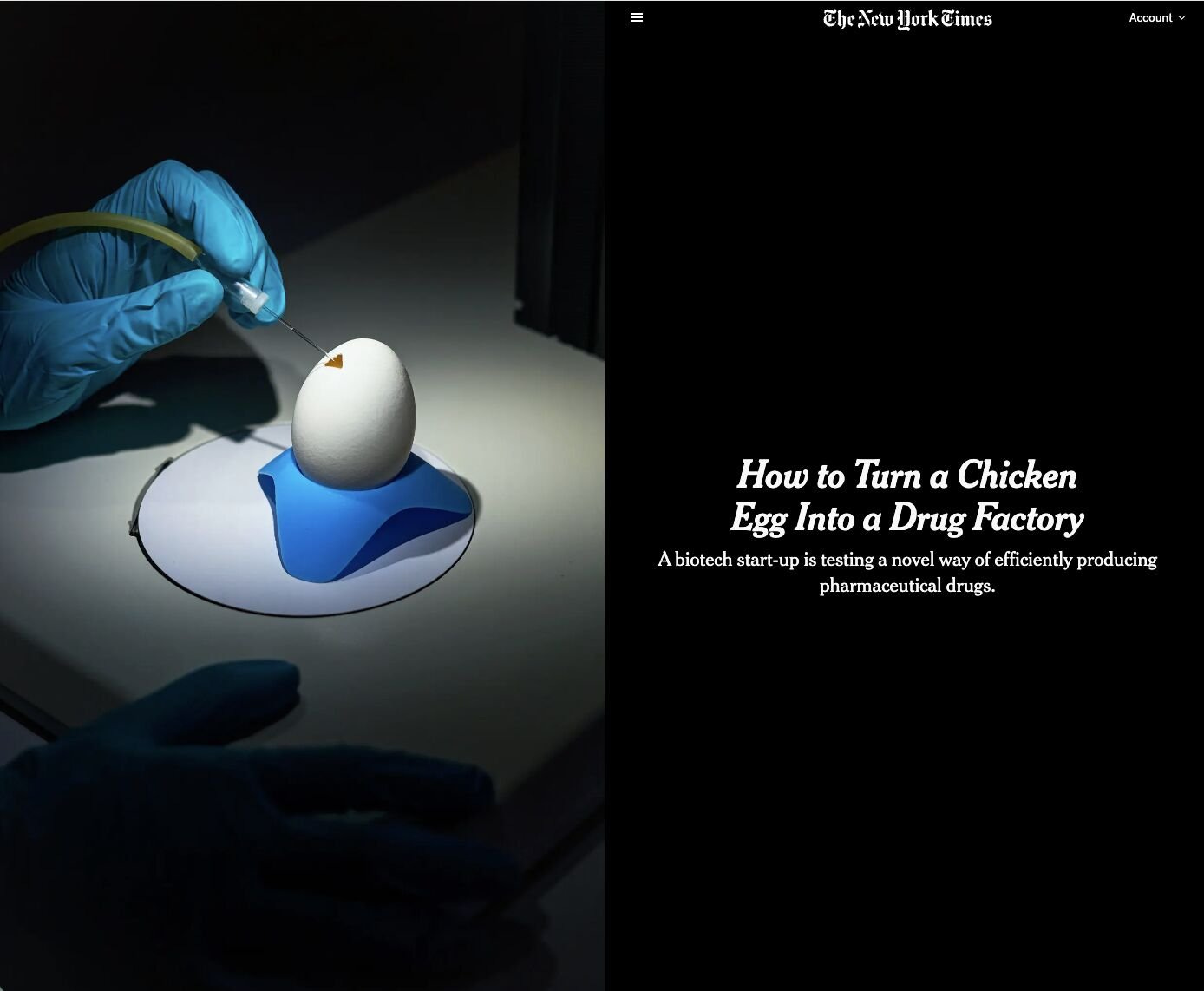
I am so clucking eggcited that Neion Bio is finally coming out of its shell.

Today, pharma uses Chinese hamster ovary (CHO) cells to produce biologics like Keytruda and Humira in huge stainless steel bioreactors. Merck recently spent $1B on a single Keytruda facility.
In early 2024, Elliot wrote that chicken eggs are much more efficient bioreactors. They run on grain and water, produce six grams of protein per unit, and we already farm them at massive scale.
As the (excellent) Neion website says, chicken egg drug manufacturing can be “extremely low COGS, hyper resilient, CapEx avoidant, ultra scalable, very high reliability, and lower environmental impact.” Nature evolved the chicken egg to be that way. The hard part has been that the science hasn’t been able to modify what’s inside the egg fast and reliably enough to actually manufacture drugs.
Sam Levin, who we previously backed at Melonfrost, and Dimi Kellari explored the frontiers of chicken egg research, which they could get their arms around because the cutting edge stuff is happening in a very small number of labs around the world. They went to all of them, and they realized that the time was right to build a company that uses nature's bioreactors to produce drugs at a fraction of the cost.
In today's NYT article, Sam predicts that the cost can be 1/10th or even 1/100th of the current cost, and that just 3,900 hens could meet global Humira demand.
I'm proud to back Sam, Dimi, and the Neion Bio team out of not boring capital as they work to hatch the balk of the world's biologics and dramatically lower the cost to produce critical drugs, right here in NYC. And I'm sure they're happy that I can share my chicken puns with all of you instead of just replying to investor updates with them.
Extra Dose: Science Breakthroughs, GPS, Memory Without Brains, Astro Mechanica
Join not boring world to get an even bigger Dose of Optimism.