

Hi friends 👋,
Happy Friday and welcome to our 190th Weekly Dose of Optimism!
Busy week: cures for cancer, autonomous everything, Sixers actually stole a win off the Celtics, lots of Extra Doses. No time to waste…
Let’s get to it.
Today’s Not Boring is brought to you by… Silicon Valley Bank

Climate Tech is in a weird spot in 2026. The problems are getting bigger, but the money is getting tighter.
SVB’s latest Future of Climate Tech report shows a market that’s easy to misunderstand right now:
$29B was invested in Climate Tech last year, one of the biggest years ever… however, most of that funding went to a only a few companies
Government support is pulling back, making things slower and harder
52% of companies are cutting burn
The conversation is getting quieter. Mentions of climate on public company earnings calls are down 70%.
The market is cutting hype, forcing discipline, and rewarding the companies that actually build. Which is uncomfortable in the short-term, but probably exactly what the category needs long-term.
If you want a clear look at where Climate Tech actually stands in 2026, read SVB’s Future of Climate Tech report.
(1) Pancreatic cancer mRNA vaccine shows lasting results in early trial
Kaitlin Sullivan, Marina Kopf and Anne Thompson for NBC News
Pancreatic cancer is often a death sentence. It kills about 87% of the people it’s diagnosed in within five years. Worse, it’s sometimes called the “silent killer” because symptoms don’t show up until very late, and by the time they do, only about 1 in 10 patients has a tumor that’s still operable. For the rest, there are no good options. And for a long time, oncologists thought the disease was biologically incapable of mounting a meaningful immune response at all. Pancreatic cancer was supposed to be the cancer that immunotherapy couldn’t touch.
This week at the AACR annual meeting in San Diego, Dr. Vinod Balachandran of Memorial Sloan Kettering presented six-year follow-up data from a Phase 1 trial of a personalized mRNA vaccine for pancreatic cancer that strongly suggests otherwise.
The trial enrolled 16 patients with early-stage, operable pancreatic cancer. After surgery, each got a custom-built mRNA vaccine (autogene cevumeran, developed by BioNTech and Genentech) alongside the checkpoint inhibitor atezolizumab and standard chemotherapy. Each patient’s tumor was shipped to BioNTech in Germany, sequenced to identify up to 20 mutations most likely to look foreign to the immune system, and then turned into a one-of-one vaccine that was shipped back to New York and infused into the patient.
Eight of the sixteen patients mounted a T-cell response to the vaccine. Six years out, seven of those eight responders are still alive (87.5%), versus two of the eight non-responders (25%). One of those seven — Donna Gustafson, who was the first person in the world to receive one of these vaccines in February 2020 — just hiked Mt. Etna for her 50th wedding anniversary. The immunologic data are equally encouraging: 85% of the T-cell clones primed by the vaccine persisted into memory phase, and the memory T cells were still functional even after chemotherapy, producing cytokines and attacking cancer cells on re-exposure to the original neoantigens.
Of course, there are caveats. This was a 16-person Phase 1. There was no randomization. Half the patients didn’t respond at all, and we don’t know why yet. Operable pancreatic cancer is already the most survivable version of the disease, and a subgroup of patients always lives longer than expected. Phase 2, now running globally under Genentech and BioNTech, will tell us a lot more.
With those out of the way, this is awesome, at the very least for these seven people and their families, and hopefully for a lot more. The belief for years has been that pancreatic tumors were an immune desert because it has too few mutations to flag and too dense a stromal wall to penetrate. This trial suggests the wall can be climbed, if you give the immune system the right map: a personalized neoantigen set, manufactured in weeks, and delivered as mRNA.
As Elliot wrote in Going Founder Mode on Cancer, personalized cancer therapeutics hold a ton of promise, and they’re both expensive and complicated for wide-scale usage today. That said, these are exactly the kind of thing that will get radically cheaper and faster to produce as the underlying biotech stack matures.
If this holds up at scale, it’s a twofer for our anti-cancer canon. One: pancreatic cancer is not immunologically untouchable. Two: the personalized mRNA playbook that Moderna/Merck have been running in melanoma is generalizable, and generalizing fast.
As we like to say here at the Dose: get fucked, cancer.
(2) Cursor and SpaceX: In Search of a Complete Loop

Speaking of two-fers… SpaceX basically purchasing a call option on Cursor for $10 billion is the kind of story we would have covered in the Dose anyway, and we get to throw in the first Kevin Kwok essay in nearly a year for free.
On Wednesday, SpaceX and Cursor announced that the newly combined SpaceX / xAI was basically buying a $10 billion option to buy Cursor later this year for $60 billion. SpaceX will most likely buy Cursor after its planned IPO for $60 billion. If it doesn’t, it will pay Cursor a $10 billion breakup fee / fee for the work they did together this year.
It sounds a little confusing, which is why I was so happy to see Kevin explain the deal, both from a deal mechanics perspective and the strategic perspective.
On the deal mechanics side, he expects to see more deals like this.
On the strategy side, the deal makes a lot of sense. Cursor has a great coding product and model, but not enough compute to compete with Anthropic and OpenAI. SpaceXAI is really good at building out compute, but pretty bad at making coding models. Put the two together, and you might have something that can compete with the leading labs in a use case that they all agree is incredibly important to win.
In short, the world’s greatest rocket company bought a product that can write code as it prepares to colonize the Moon and then Mars, obviously.
(3) Fervo Energy Files S-1 for IPO
M&A. IPOs. Oh my. We are back.
Last week, we led the Dose with Quaise breaking ground on the world’s first commercial superhot geothermal plant. Superhot is a drilling problem, and Quaise is looking to solve it.
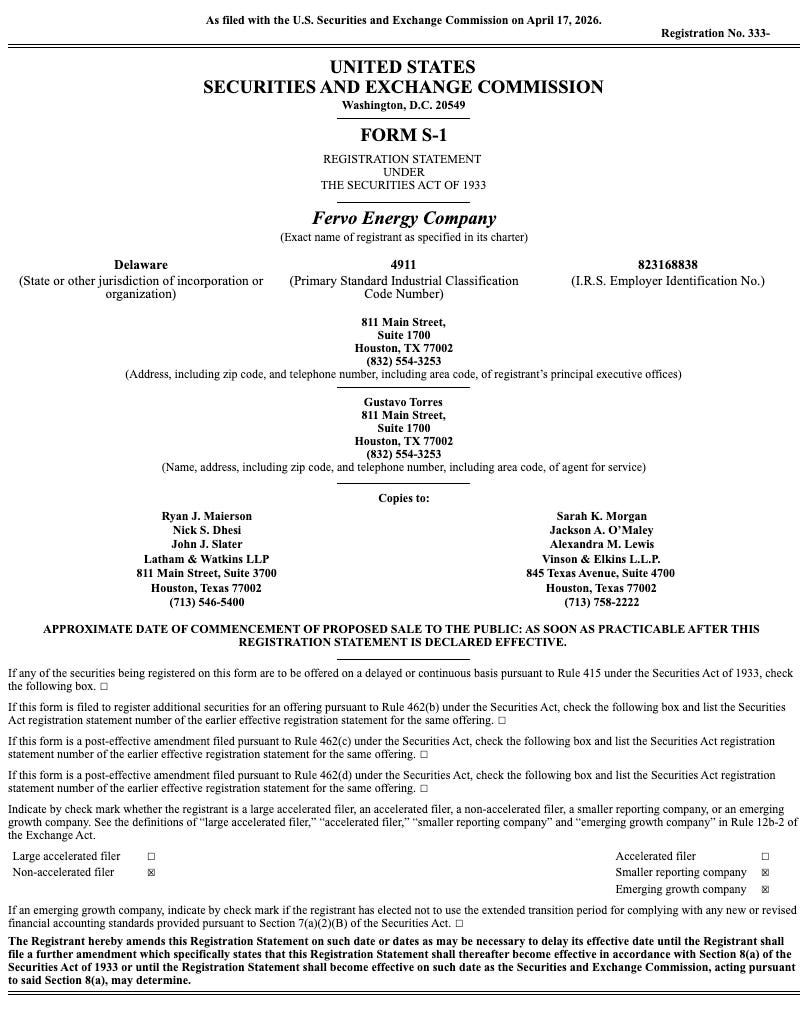
This week, the company doing the most to solve geothermal’s economics problem at commercial scale filed to go public. On Friday, Tim Latimer and Jack Norbeck’s Fervo Energy filed an S-1 with the SEC to list on Nasdaq under the ticker FRVO, with J.P. Morgan, BofA, RBC, and Barclays leading.
It’s great to see a new clean power generation source hit the public company milestone, with a real, traditional IPO and all, because it will hopefully mean more money for the space. But it’s also fun because it gives us a better look into what Fervo is up to.
Fervo is operating or developing 3.65 gigawatts of geothermal capacity, a number that, if fully built, would nearly double the total installed geothermal capacity in the United States. Its flagship Cape Station project in Beaver County, Utah, breaks ground to first power later this year; 500 MW is under construction at the site and Fervo has permits in hand for another 1.5 GW on the same piece of land. There’s also a 150 MW site in Nevada under a Google + NV Energy deal, targeting 2030.
The economics are even more interesting, because they give us a firmer sense of where geothermal sits today and where it’s headed. Fervo says Cape Station will deliver carbon-free 24/7 power at $7,000 per kilowatt of installed capacity, which is in the same ballpark as advanced nuclear. The company’s goal is to cut that to $3,000/kW, which would beat natural gas on an unsubsidized basis for always-on power. That would be a massive unlock.
Fervo is able to pull this off by bringing well-worn horizontal drilling and completion techniques over from shale (Latimer was a drilling engineer at BHP before founding Fervo in 2017) to geothermal.
To which we say, drill baby drill and let’s get this frackin’ thing public.
(4) Humble unstealths with a cabless autonomous electric truck & $24M
Ana-Maria Stanciuc for TheNextWeb
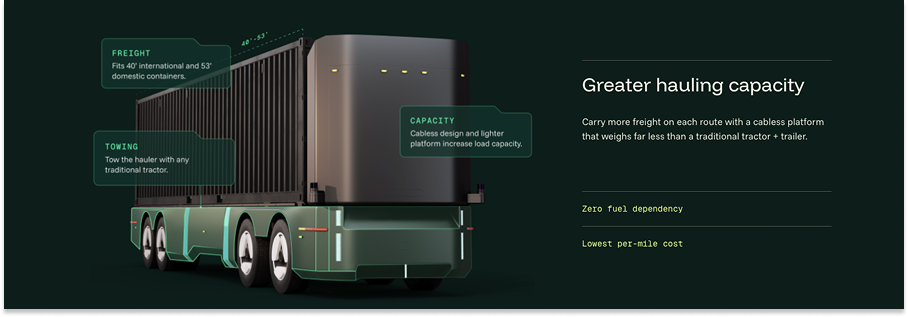
On Tuesday, a San Francisco startup called Humble came out of stealth with $24 million in seed funding and a design that is so obvious once you’ve seen it that it makes you wonder why no one had done this before. Basically, they got rid of the cab where human drivers sit, because these trucks won’t have human drivers.
Every existing autonomous trucking company, including Aurora, Kodiak, Waabi, and Einride, retrofits driverless tech onto a tractor-trailer architecture designed around a human sitting in front of a steering wheel. As founder Eyal Cohen put it, “Trucks were never designed to be autonomous.”
Humble built one that was. Remove the cab, and you get 360-degree sensor coverage, a significantly lighter vehicle, and a geometry you can optimize for intermodal containers. The Humble Hauler is built for 40- and 53-foot shipping containers and goes dock-to-dock, unloading at the destination rather than handing off to a human driver at a yard near city limits like Aurora does. Eclipse led the seed with participation from Energy Impact Partners.
Cohen, Humble’s CEO, has been on this problem for a while, and on hardware even longer. He previously worked at Apple, Uber ATG, and Waabi, and co-founded Spark AI (acquired by John Deere in 2023). That experience helped him get to a prototype in under 6 months.
This is an idea that keeps popping up as we talk about autonomy: when you design around the actual constraint instead of the inherited one, you end up with a different machine. Kalanick’s Atoms is explicitly anti-humanoid because most jobs want wheels, not legs. Tesla’s Cybercab has no steering wheel, because they won’t have human drivers. Humble is making an analogous bet with trucks.
Better, faster, cheaper. Ship it.
(5) Medra Launches Robotic Bio Lab
Jolie Gan for Core Memory & Michelle Lee on X
Here in the Dose, we’ve written a lot about the software side of the AI-for-bio boom: IsoDDE can suggest drug candidates against previously undruggable pockets, Evo 2 can design entirely new genomes, Boltz and AlphaFold have collapsed structure prediction, and Chai is cranking out antibody candidates at a pace that would have sounded insane five years ago. It’s all fantastic and futuristic.
Having said that… a designed molecule is not a validated molecule. Every one of those candidates still has to be synthesized and tested by a physical lab staffed by physical humans who have to sleep and take weekends. Or, I guess that’s an assumption, certainly these candidates need to be synthesized and tested in a physical lab, but…
This morning, Michelle Lee’s company, Medra, formally opened the doors on a 38,000 square foot warehouse in San Francisco where roughly a hundred robotic arms are running biology experiments simultaneously, 24/7, linked by a small courier robot that ferries pipette tips and sealed plates between stations like an extremely focused junior scientist. A pair of scientists could run maybe a dozen antibody-binding experiments in a day. Medra’s arms run hundreds at a time, don’t clock out, and get better at it every week. We love a good robot arm.
Lab automation has been overpromised for two decades. What’s different about Medra is that it doesn’t require the lab to buy new robot-native instruments. Only about 5% of bench equipment in biology has APIs that legacy automation can plug into; the other 95% (centrifuges you open by hand, pipettes you tilt and time, etc…) was built for humans. Medra’s robots use computer vision and manipulation models to operate the same instruments a human would. Lee says the combination can push the share of bio-tech tasks that can be automated from 5% to 75%.
There’s a second layer on top of the hardware that is maybe even more interesting. Every arm and bench is instrumented with cameras and nine kinds of sensors, so the system logs the exact pipette angle, the exact depth of insertion, the exact timing between reagent additions. The AI scientist on top reads the results, proposes protocol changes, and rewrites the protocol itself. Lee describes one customer whose antibodies weren’t binding at all (the readout came back at zero); the AI scientist narrowed the cause to two hypotheses, proposed adding a vortexing step, and watched binding jump to over 70%.
Lee’s frame for what she’s building is TSMC for biology. TSMC is what makes it possible for chip designers to exist without owning a fab. Medra wants to be what makes it possible for drug discovery companies to run experiments without owning a wet lab.
Just yesterday, in The Great Blue Frontier, Will and I wrote that AI for bio is data-limited, and suggested the 91% of sea creatures we’ve yet to discover as one source. Madra is another. Lee believes that with more throughput, we “cure cancer, Alzheimer’s, infectious disease.” This, she thinks, is also how we keep American bio competitive with China by speeding ourselves up.
All sounds great. Get to work, robots.