

Welcome to the 1,738 newly Not Boring people who have joined us since our last essay! Join 273,329 smart, curious folks by subscribing here:
Hi friends 👋,
Happy Thursday!
Just about three years ago, I was having coffee with another VC, someone whose portfolio I really like, and I asked him which one he was most excited about. He asked, “Do you know what wire harnesses are?” and I said something like “like bundles of wires?” and he said “kinda” and then told me about Jordan Black and Senra Systems.
Ever since then, it’s been a company that I’ve wanted to understand better, and as robotics has begun to take off and reindustrialization is underway and aerospace and defense are booming and the future looks more and more electric, it’s become even more relevant. I keep hearing about it from people I respect, too.
The reason wire harnesses are interesting, aside from the fact that they’re in everything electronic, from toys to Jeeps to satellites to F-35s, is that it’s devilishly hard to automate their manufacture. They’re high-mix, low volume, 3D, bendy, and floppy, among other tricky attributes. They’re often the component holding up the production of our most advanced machines, because you need them to turn everything else on, and once they’re in, a faulty harness can precipitate recalls or worse.
And because skilled assembly, and especially skilled assembly of wire harnesses, is one of the most challenging parts of the manufacturing process to automate, figuring out how to help workers build more of them, faster and more reliably, even as many of the skilled workers who know how to make them retire, may set the pace of American manufacturing.
Plus, I’m a sucker for giving humans superpowers instead of replacing them, and Jordan argues that “the more the easy stuff gets automated, the more valuable skilled humans will become.”
When Alexa Liautaud at GC introduced me to Jordan, I thought it would be a great opportunity to learn everything I can about wire harnesses and skilled assembly and what the future of manufacturing in America looks like from him, Senra’s Head of Strategic Finance Greg Brainard, and one of their investors, Sam Rohr at JAWS. And of course, to write something with them to share what I learned with you.
So to celebrate Senra’s $65M Series B from Lowercarbon & Interlagos with Sequoia, Founders Fund, General Catalyst, Andreessen Horowitz, Founders Fund, Dylan Field, CIV, 8VC, The Friedkin Group, JAWS, Sozo Ventures, and Alumni Ventures…
Let’s get to it.
Senra Systems: Harnessing Human Skill
A Co-Written Essay with Senra Systems CEO Jordan Black
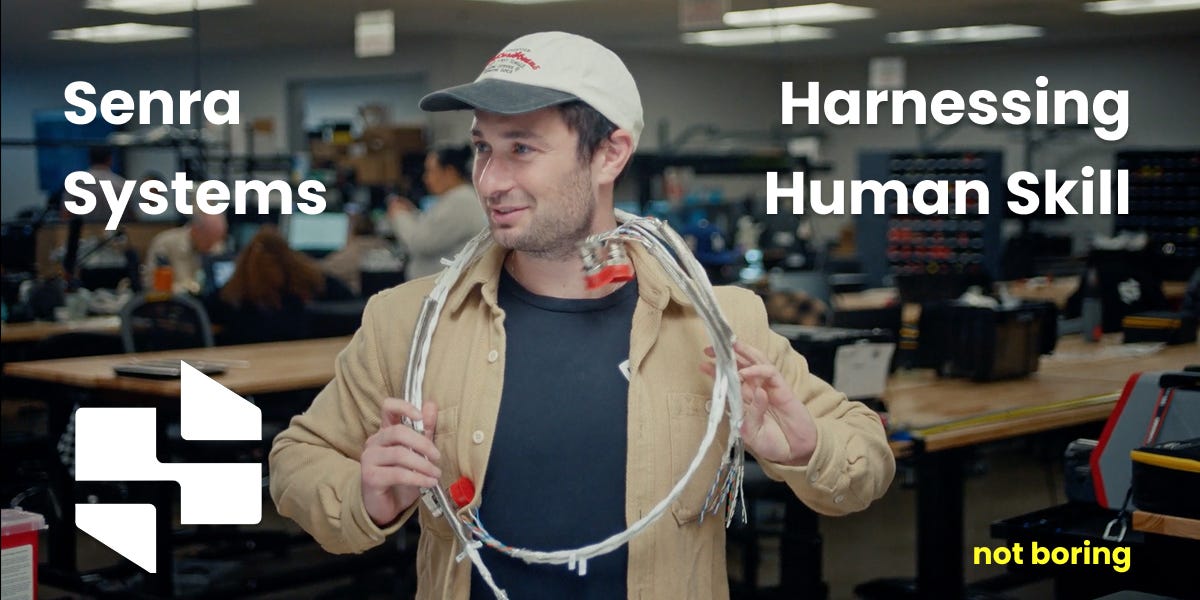
One of the most notable things about Senra Systems is that so many people who don’t have to work another day in their lives are choosing to work there. What makes that even stranger, to the casual observer, is what they’re choosing to work on: wire harnesses.
Some of you will know what a wire harness is. It is the nervous system of a machine, hundreds of wires, bundled and crimped by hand, routing power and signal to every component that needs to turn on in any modern electrical system, from a satellite to a coffee maker to your car. But many of you won’t, which is fine, and even many of those of you who do won’t understand what makes them important or challenging, and an even smaller number of you will understand why so many people who have made tens of millions of dollars, or more, building reusable rockets in order to make life multiplanetary have decided to dedicate their next chapter to building them instead of angel investing from a beach.
One difference between them and the rest of us is that they have been bottlenecked by wire harnesses. They’ve done the ridiculously hard work of, say, building chopsticks that can catch a Statue of Liberty-sized rocket as it stumbles back to Earth, only to have to wait for the wires to turn the whole thing on. They’ve undoubtedly attempted to just do it themselves, because that’s their whole thing, only to find out firsthand what makes it so tricky to do well.
So when two of their own went and started a wire harness company, they’d seen enough to look a little more, and the more they peeled, the more they liked.
In the US alone, annual spend on wire harnessing for just aerospace and defense is something like $25-50 billion. Maybe the money itself isn’t that important anymore, but it says that the problem is big. It’s also getting bigger. This is one of those classic stories of an industry whose demand is ripping just as the old skilled hands who were trained during America’s manufacturing golden age are aging out. So the problem is big, and it’s urgent. And the answer is obvious, on the surface: automate!
And that’s where Senra really gets ya, if you’re the kind of person who likes solving really hard problems, because automating skilled assembly is probably the hardest thing you can do in manufacturing, especially when you’re talking something that’s high mix, low volume, flexible, and very complex, like aerospace and defense wire harnessing.
If you view America’s ability to manufacture as one big engineering challenge, and your goal, ultimately, is to automate as much of it as you can, you arrive pretty quickly at skilled assembly, manufacturing work that requires trained human judgment and dexterity instead of simple repetitive motion, as the place the machine gets stuck. Within skilled assembly, wire harnesses are perhaps the trickiest to get right, or at least the trickiest that we need a lot of, the trickiest without which nothing else turns on. So if you’ve been trained to heatseek bottlenecks at the system level and throw everything you’ve got at them until they’re knocked out and you can move on to the next one, then wire harnessing is the logical place to start.
And it turns out you can’t automate it, yet. In Elon’s five-step design algorithm - make requirements less dumb, delete the part or process, simplify or optimize the design, accelerate cycle time, automate - automation comes last. You can’t automate until you can configure.
What you need to do with skilled assembly generally and wire harnessing in particular, and what Senra is doing, is to make everything around the skilled assembler better, so that the skilled assembler can deliver wire harnesses at 4x the speed of traditional vendors while maintaining exceptional quality and accuracy.
Senra gives skilled workers superpowers and trains up tons of them so that they can make wire harnesses faster and with fewer defects so that everyone else can make whatever it is that they make faster and cheaper so that America might be able to manufacture competitively again.
We’d like to tell you a little bit about how, and why.
Why, er, harnesses?
Wiring harnesses are like referees - most people only notice them when they mess up.
President Kennedy promised that America would go to the Moon and that we would be first, not “first but, first and, first if, but first period.” The Apollo Program was the vehicle through which this promise would be made real over eleven years, through the toil of 400,000 engineers and workers, and roughly $25 billion (nearly $200 billion in today’s dollars) of concentrated national will directed at a single goal.
What we remember is that America posthumously proved him right, when Apollo 11 astronauts Neil Armstrong and Buzz Aldrin walked on the moon as Michael Collins orbited above. What we forget is that the very first Apollo mission, Apollo 1, ended in tragedy.
In January 1967, three NASA astronauts, Gus Grissom, Ed White, and Roger Chaffee climbed into the Apollo 1 command module for what was supposed to be a routine pre-launch dress rehearsal on the launchpad at Cape Canaveral.
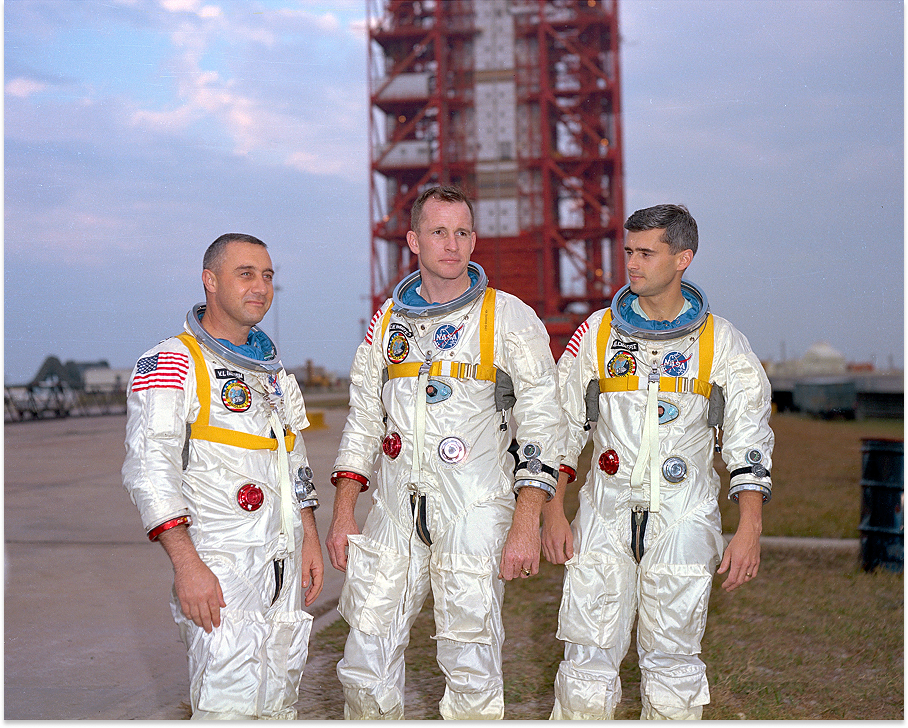
As the three men sat in the oxygen-rich capsule, behind a hatch that was designed to open inwards in a process that took 90 seconds, a fire broke out. It killed them within a minute. Investigators later determined the fire was sparked by a wiring fault. The review board cited poor workmanship and vulnerable wiring design as underlying causes. It was a bad wire harness that took the lives of those three astronauts.
That was a long time ago. Surely we’ve gotten better at bundling a bunch of wires together since?
On June 9th, Jeep recalled more than 1 million Wranglers and Gladiators, warning that they may catch on fire and advising owners to park them outside and away from other vehicles or structures.
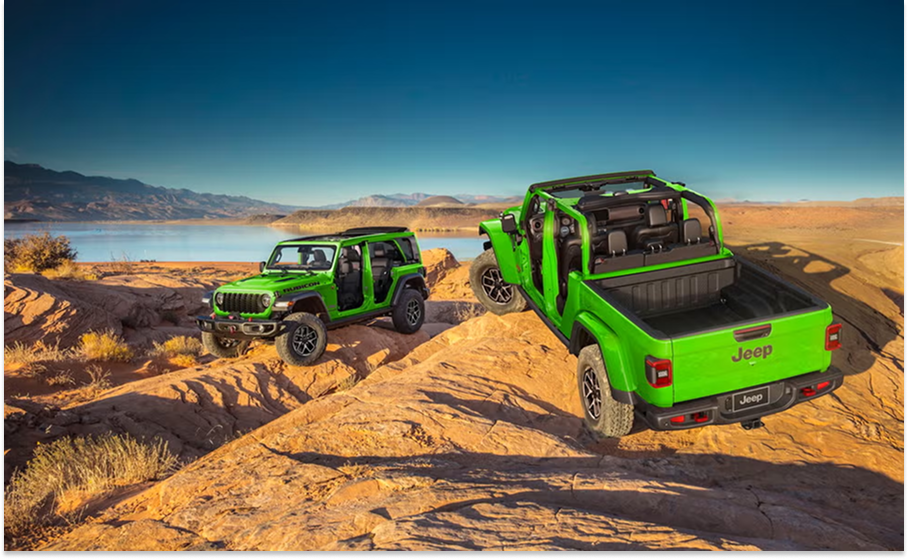
The issue, as you might have guessed, was a wiring harness, specifically an electrical connection issue in the power-steering-pump wiring harness, something like this:
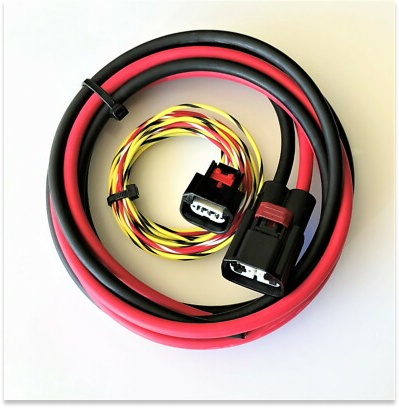
Drivers are advised to “inspect and, if necessary, repair or replace the wiring harness.”
Wiring harnesses can kill people when done wrong, but even in business-as-usual situations, they can kill production timelines.
Few people in the world know this better than Jordan Black.
Since working as a host at a burger restaurant at 16, Jordan has mixed service and engineering. He’s manned pizza joints, barbacked, bounced, and bartended, and even worked as a librarian. In each, he was obsessed with making customers happy and in each, he learned how to work with people. He loved solving hard physical problems, too. Back in his freshman year of college, high school, Jordan began working as a technician fixing roller coasters at the Santa Monica Pier. He parlayed that experience into internships at Enerpac and then The Ford Motor Company, which is where he expected to return after graduating from University of Wisconsin-Madison until SpaceX called and hired him as an Avionics Manufacturing Development Engineer. What that meant in practice was a lot of wire harnesses, wire harnesses for Starship and Dragon Spacesuits and Radio Frequency Cables and more.
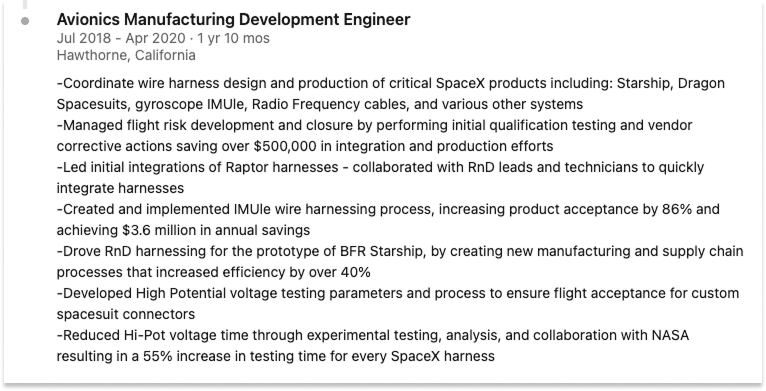
Over the next five years at SpaceX, Jordan worked his way into the center of advanced hardware manufacturing, eventually running an Avionics R&D team with visibility into nearly every component that went into rockets and satellites. He saw firsthand how SpaceX would bring capital-intensive manufacturing capabilities in-house to increase iteration speed. He was often the one doing it. But highly skilled assembly work, the craftsmanship layer underlying nearly every advanced hardware system, remained dependent on fragmented suppliers operating with outdated systems and limited scalability, even at SpaceX.
A wire harness is in everything, nothing turns on without them, and everybody hates them, for two reasons.
One, to design it, it’s all in Excel spreadsheets and PowerPoint slides.
Two, to manufacture it, it’s all done by hand, arts and crafts style.
“It’s a really screwed up supply chain from start to finish.”
Because the wire harness supply chain is screwed up, everything else is. The wire harness is one of the last designed but first needed parts of any modern aerospace and defense system. You can’t know where your wire harnessing should go in a missile until you’ve figured out how you’re going to build the entire missile. You don’t know how long the missile is going to be, where the sensors are going to go, what needs to connect to what, where, until you’ve actually figured all of that out. Then and only then can you design the wire harnessing that connects it all. But then you have to design and produce custom wire harnessing as quickly as possible, because you won’t be able to turn the thing on in order to demonstrate it to the customer until you have it.
The wire harness is kind of like the fartlek of manufacturing; when it’s your turn, you have to sprint from the back of the back to the front as fast as you can. “You can get as far ahead on everything else as possible,” Jordan puts it, “but you can’t make a grilled cheese sandwich without the cheese.” (Wire harnesses are both cheese and fartlek here, for those keeping metaphor score at home.)
Sourcing high-quality harnesses is harder than you’d expect, too, because it sounds so simple. “Just give me a cable that plugs this thing into this thing.” But some of these designs end up being really complex - you need a cable that has 45 different offshoots, and they all need to be built to spec, so they’re highly custom products.
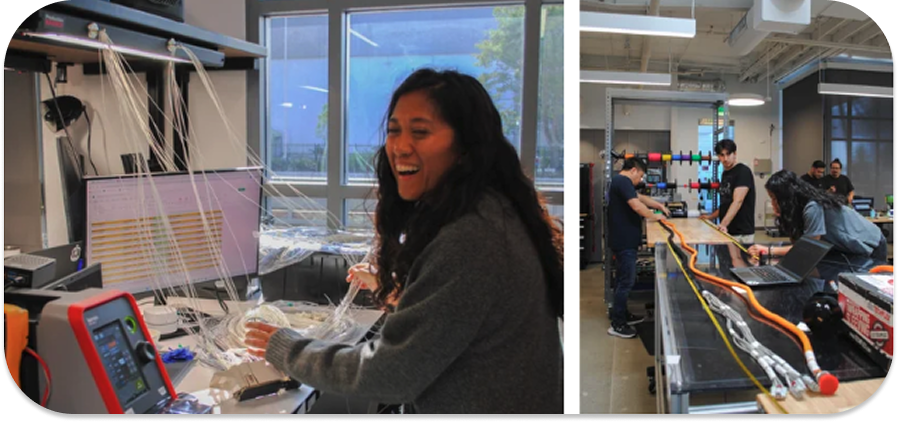
And for customers like SpaceX they’re really high mix, which makes them almost impossible to automate. One SpaceX wire harness will look totally different from this other SpaceX wire harness, and they might need five of this one kind but 100 of another kind, and so maybe it’s not surprising when you read it, but it was surprising to Jordan when he just needed wire harnesses pronto, that smaller wire harness shops would quote four to six month lead times on new programs.
Jordan learned this the hard way, going around to suppliers when he needed harnesses to make whatever he was working on work, and they’d come back with “Oh, cool, we can do it in four months,” but he’d need it way faster than that, because think about it; as an engineer, whether you’re building rockets or stringing a Christmas tree with lights, the first thing you actually need to do is to make sure that when you plug it in, the thing turns on.
A longstanding theme of Not Boring is that if a company is a bad customer or supplier, they might make a very good competitor.
So Jordan decided to leave SpaceX and start a wire harnessing company, teaming up with Ben Shanahan, a neuroscientist turned SpaceX software engineer who worked on WarpDrive, the company’s ERP / manufacturing execution system (MES), the software that runs the factory that is the product.
In March 2023, they founded Senra Systems.
Senra’s Strategy
In its early years, Senra has focused primarily on manufacturing wire harnesses for aerospace and defense (A&D) customers.
A&D is the highest-margin segment, the most fragmented slice of the market, and it’s ITAR-protected, meaning that customers are effectively required to source American. It is also the most challenging part of the market, and the least amenable to automation in the near-term, given the high mix and low volume compared to, say, a Toyota Camry. It is where America’s skilled workforce crunch is felt most acutely, because the work can neither be automated nor outsourced.
Put simply, the American wire harness workforce is on the decline while the demand for wire harnesses for A&D is taking off. There are fewer technicians to make more harnesses.
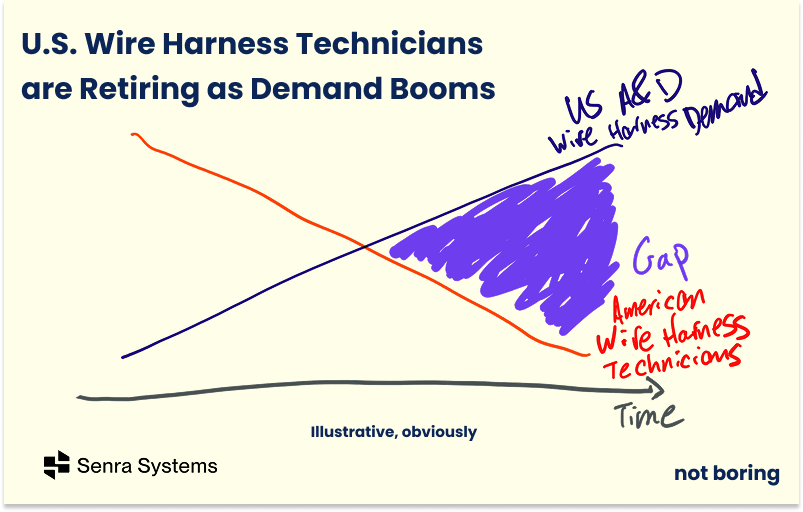
There is no government statistical category for “wire harness technician,” but the closest public workforce category - electrical, electronic, and electromechanical assemblers - has a median age of 47.2. More than a quarter of the workforce is 55 or older, approaching retirement age, while only 8% is under 25, stepping in to backfill the roles. Even if there were more people excited about taking the roles you still wouldn’t be able to scale up in time because that training period takes 18 months. In a typical shop, you’ll have a year and a month apprenticeship, and it’s like, “There’s this guy Doug, he’s been building Boeing harnesses for 25 years. Just go follow him around and see if you can learn something.” The industry isn’t training replacements at anything close to the rate at which it is losing experienced hands. The IPC, the electronics manufacturing trade association, calls the shortage of adequately skilled workers “chronic.”
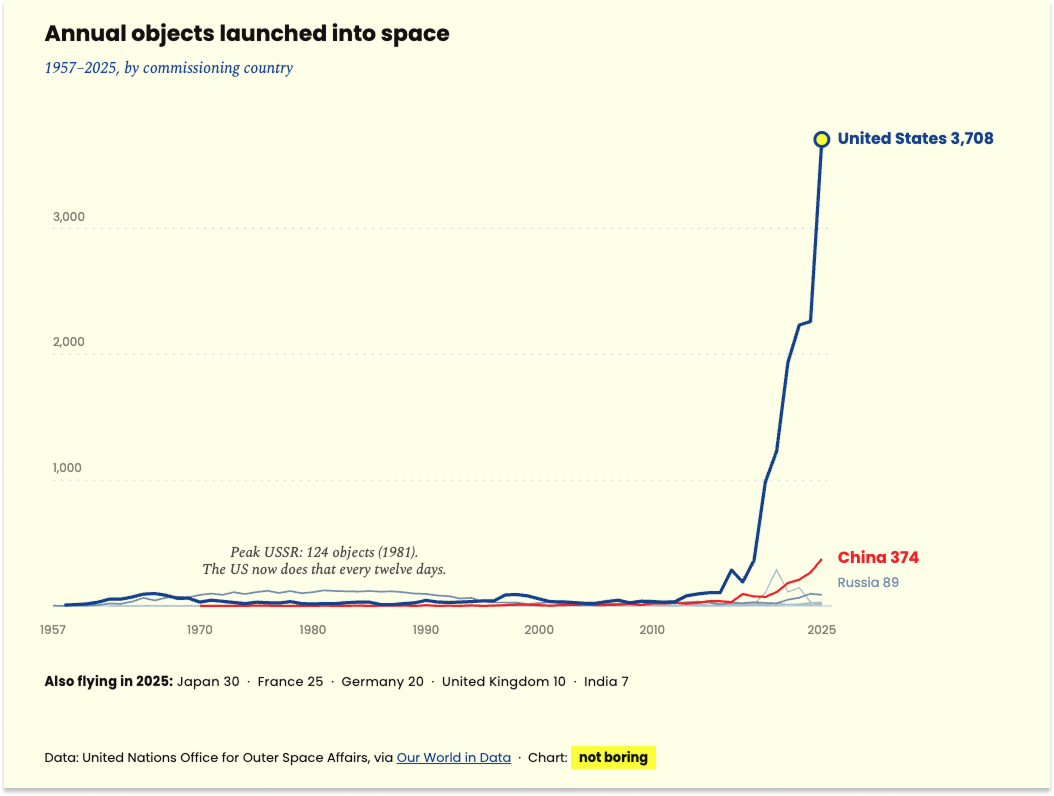
Even if demand were flat, that would be a problem. Demand, however, is not flat. America sent 3,708 objects into space in 2025, up from 2,261 in 2024, and those numbers should look tiny in a decade.
Meanwhile, the fiscal year 2026 national defense budget request crossed $1 trillion for the first time, including $153.3 billion for procurement and $142 billion for research & development. And the systems that the DoW will be purchasing and developing will require a lot of wire harnesses. As we wrote in Electromagnetism Secretly Runs the World, “Electronics comprise 35% of the cost of the F35 Lightning II, more than the cost of the engine itself, and 15% of the Pratt & Whitney F135 engine, which costs $20 million. By the 2030s, when it’s projected that defense contractors will be building the F-47, they’ll be spending over 40% of the $300 million airframe on electronics.” The more electronic our vehicles and weapons go, the more wire harnesses they’ll need.
The government knows its suppliers are not prepared. In a 2024 review of the commercial aviation supply chain, the Government Accountability Office (GAO) found that 15 of the 17 manufacturers it interviewed had struggled to hire enough skilled workers to meet demand. Nine of 15 suppliers said they had also struggled to fill orders as demand rebounded. There’s no reason to believe this is any better for the Defense sides of these Aerospace businesses.
The roughly 800 American harness shops that make up the supply base are largely small, owner-operated businesses. Their ability to grow is constrained by the amount of veterans they have to train apprentices, but the veterans are retiring, training takes years, they’re swamped with the growing demand, and apprentices aren’t signing up anyway. Worse, when they retire, their knowledge is gone with them, because they aren’t spending precious time writing it down.
So as much as Senra is manufacturing wire harnesses, its more important role may be “manufacturing” wire harness technicians to make all of the wire harnesses and increasingly electronic world needs.
This supply/demand imbalance also creates the market foothold for Senra. Because declining supply is buckling under growing demand, A&D is also where there is the most room for improvement: lead times on a new program are 4-6 months, only 25-50% of wire harnesses pass on the first try (first-pass yield), and quality is so inconsistent that many customers have to employ in-house technicians whose job it is to fix the wiring they receive from their wiring suppliers.
All of those characteristics make wire harnessing for A&D particularly amenable to Senra’s approach, which is to get configuration right long before worrying about automation.
Automation can be thought of as replacing humans with machines. Configuration is creating a system with any combination of humans, machines, software, materials, and processes to turn a design into a product. It is the layer above automation, and counts automation as one of its tools.
You can’t automate until you can configure, and long before getting to automation, there’s a lot that you can do to improve wire harness manufacturing by redesigning the system.
In a traditional shop, practically everything runs on tribal knowledge locked in veterans’ heads. This is the same challenge that Hadrian identified in precision machine factories; to fix the problem, it’s “turning tribal knowledge into scalable software and processes.” It also rhymes with what Poetic does; instead of just magically throwing AI at a problem, “We need people to get out there into Minnesota to be like, what the hell do you guys do all day?”
Relying on veterans’ head-knowledge works decently well as long as it’s the veterans doing the work, but people-as-operating-system doesn’t scale. Take training. In a typical shop, you’ll have an 18-month apprenticeship, and it’s like, “There’s this guy Doug, he’s been building Boeing harnesses for 25 years. Just go follow him around and see if you can learn something.” And that’s really it. There’s no trade school for skilled assembly work.
Jordan compares wire harnessing today to a Cheesecake Factory recipe where skilled workers can just look at the menu and kind of figure out how to make everything that’s on there. The hope is that other metaphorical chefs will watch them do that enough that they, too, can look at the menu and reverse engineer the recipe.
That doesn’t work that well now, let alone when the skilled vets retire, or when demand continues to grow and manufacturers need to bring on a lot more people to meet it.
So you have this situation where the incumbents actually do a pretty poor job…

… that is not fully automatable yet, but where there is an absolute ton of low-hanging fruit for a player with scale ambitions to make the investments into getting the configuration right.
Which, at its simplest, is what Senra does.
You know what, I’m just going to hand the mic to Jordan for the rest of this piece to explain.
Standardize → Optimize → Automate
The way we see it, you need to standardize, then optimize, then automate, in that order.
What Senra is doing is taking that Cheesecake Factory menu item, then reverse engineering, in software, what the recipe is, then training cooks over a few weeks to be able to cook to that recipe, reliably. That’s standardization.
To end the food metaphor, what Senra does today is take a wire harness design and turn it into work instructions, which break down the component parts of building a wire harness and serve it up on a silver platter to a technician.
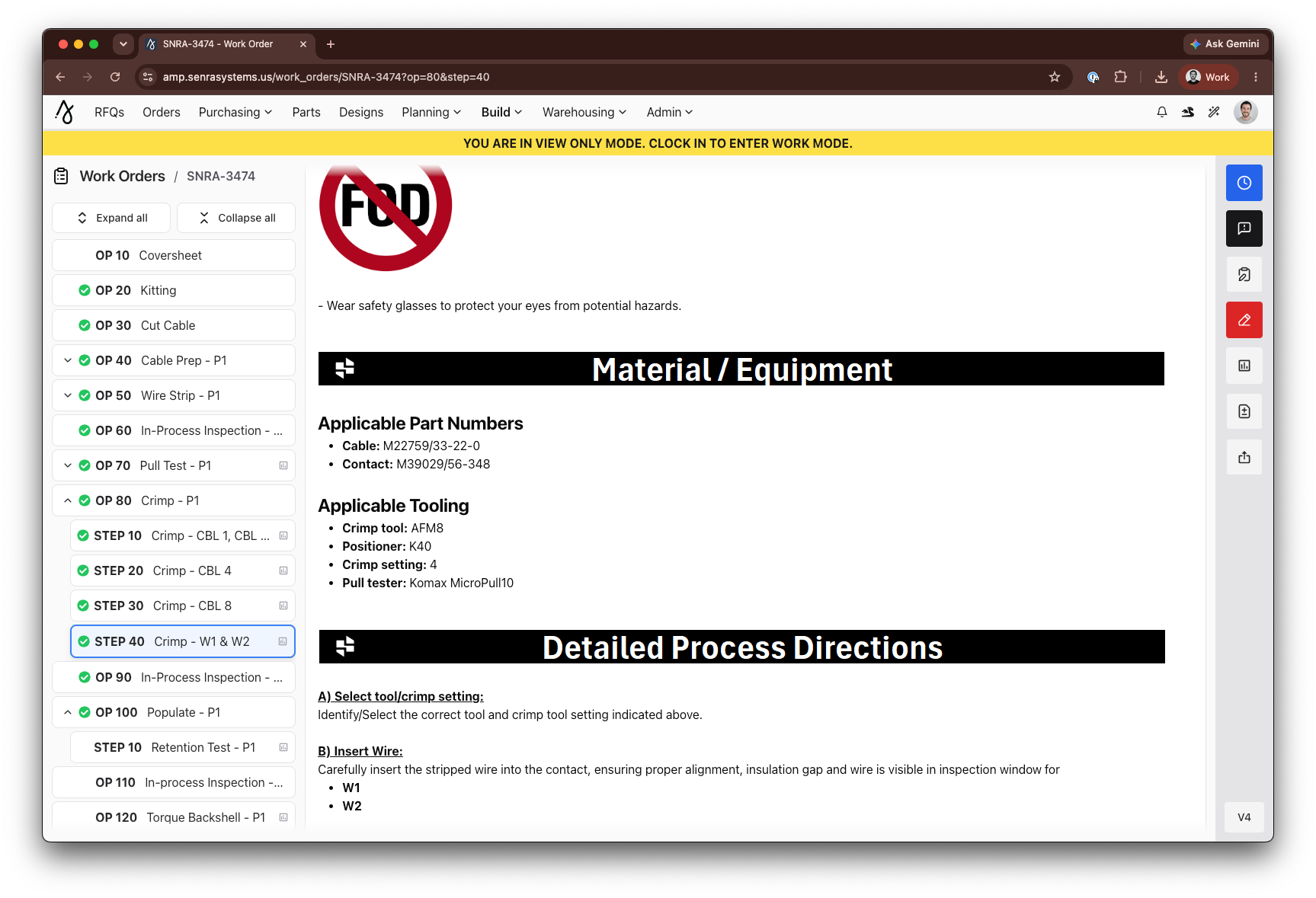
Get everything as step-by-step as possible. This is how you cut the wire for this specific harness, this is how you strip it, this is how far back you strip the rubber that encloses the metal, this is how you connect it to this connector, and this is how you lay everything out on the form board. Check check check check check, until you have a working wire harness.
Today, Senra takes in a wire harness drawing from a customer, and then have a team of engineers look at the drawing and convert it to work instructions. Right now, the process is like 20% automated, which is fine, because even having work instructions is a step-up. Over time, it can use those human-crafted work instructions to train models that can get to somewhere like 90% of the way from drawing to work instructions, with an engineer doing the final check-off, which would speed up the process and increase accuracy. This is optimization.
Even before then, though, there’s a lot that you can do with really good work instructions, each of which feeds on the others.
To start, you can train people up much more quickly and effectively. The question is how you can grab someone who has never seen a wire harness, certify them through Senra’s apprentice program in a month instead of a year or two, and get them to work meeting customer demand. The key is that because workers follow a recipe for each harness, they don’t need to keep all that tacit knowledge in their head.
Senra hires people who have never touched a wire harness, and after the four-week program, they’re building harnesses on the production floor for SpaceX and Anduril.
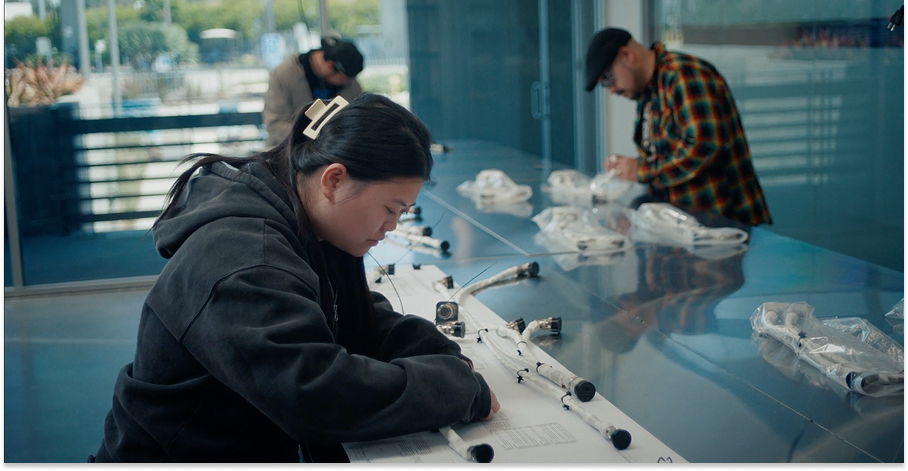
Those same explicit steps mean we know which parts are needed where when, so we can optimize our supply chain and inventory. It would surprise you how big a source of error just giving technicians the wrong components is. With work instructions in software, we can make sure that the instructions on how to kit components for each job, including what goes in the kit, are accurate. All of that can tie back to our inventory, to purchase orders. Then our inventory tracking system goes from being a kind of crazy startup system to fully optimized and ready to scale.
If inventory runs smoothly, then it becomes even easier to get someone trained up and productive more quickly, because they have everything they need at their fingertips. The machine runs more smoothly through a bunch of mutually reinforcing improvements.
We are basically creating a digital twin of the manufacturing process, capturing and digitizing data at every point so that we can optimize each and every part. Then we build custom machines that integrate with our software.
For something like cutting and stripping a wire, since our software knows what’s in each kit and what it’s being used for, our technician can scan a barcode from the machine and input the wire, and the machines cut and strip exactly to the specification we need.
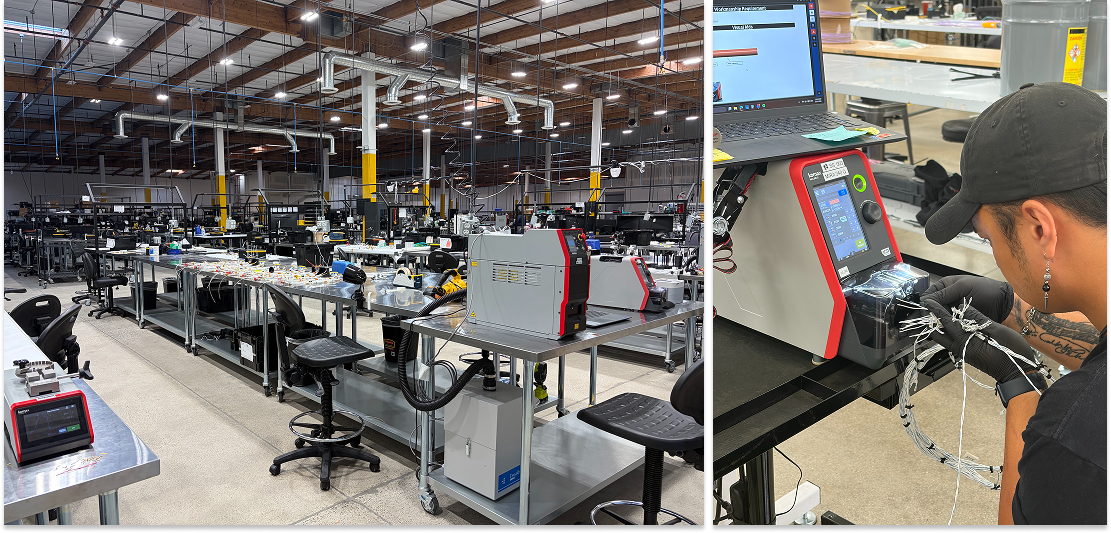
The line between optimization and automation gets a little blurry here.
Something like cutting and stripping is relatively easy to build a machine for; that machine is a tool for the human technician, who drives the process.
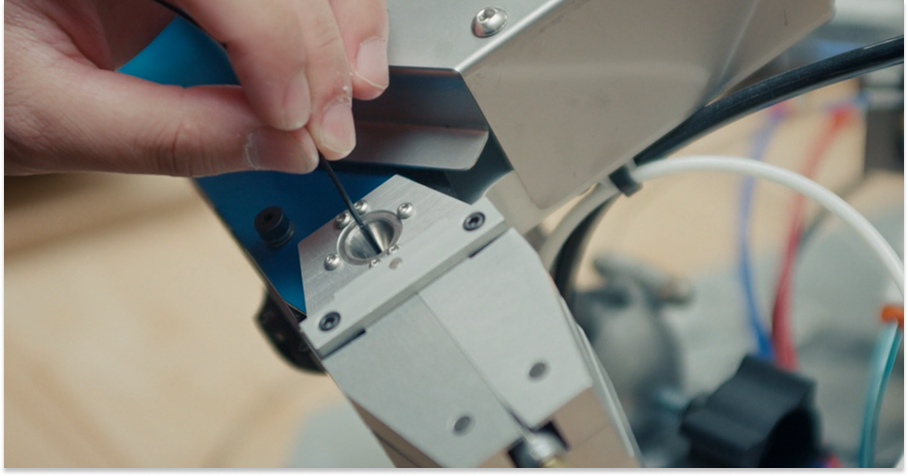
Crimping – taking a piece of metal, putting a wire in it, and squeezing down with a tool - we can make a machine for that next. Something like connector insertion is such a high-dexterity operation that we probably won’t automate it for a very long time.
Our intent is to train our technicians, optimize everything around them, give them custom machines, give them better tools, and remove any of the non-value-add work from their plates.
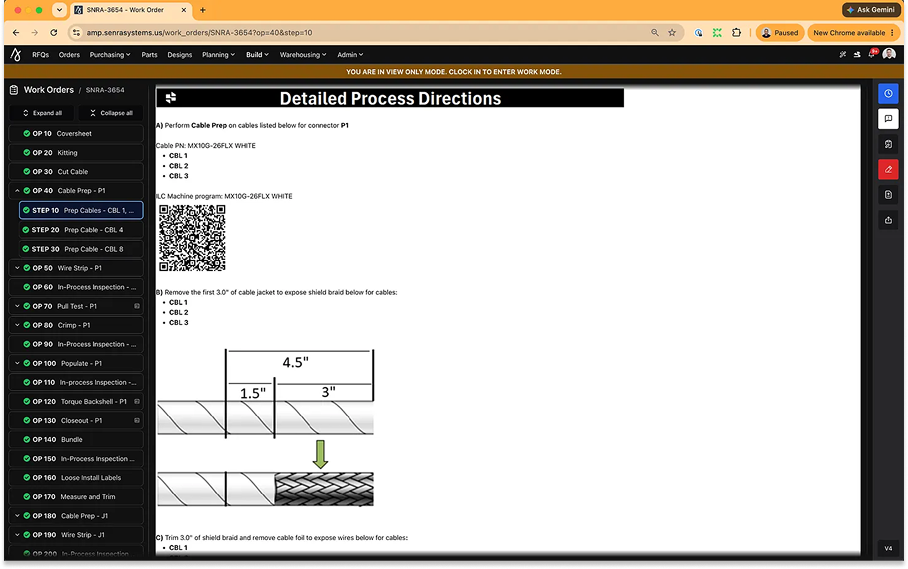
We think we can make our technicians 3x more productive than industry average simply by optimizing everything else around them. We care a lot more about that than we do about full lights-out automation.
Meanwhile, again because we can track the process step-by-step, we embed quality control throughout the process, so we catch things when they go wrong. Inspection during the process is something we’ve already begun to automate, and thanks to a combination of everything we just described and that automated inspection, we’re at a 99% first-pass yield, versus 75% for our competitors.
And we’re tracking and collecting data at every part in the process, from inventory to quality control, in our Amp platform, which is like our operating system, Senra’s version of SpaceX’s WarpDrive. It spans the full thread: Design (ITAR-compliant cloud harness design tool) → Quoting & BOM (AI reads messy aerospace RFQs) → Procurement & Warehousing (kitting) → Manufacturing Planning (work-instruction generation) → Build (a 100% digital thread for every crimp, connection, and serial) → Quality (real-time enforcement + traceability).
The operating system, training environment, data infrastructure, and years’ worth of data give our workers superpowers, and the results have been strong. We are higher-quality, higher-reliability, and faster-turnaround than the incumbents. We can deliver in four weeks something better than they’d be able to turn around in four months. And we can bid on jobs at a 20% margin to win the business with the comfort that we’ll be able to optimize the process to well north of 50% over the life of the contract. And of course, the more we do, the more we learn, the faster we optimize, and the better we get.
In the near-term, our focus is on scaling wire harness capacity while improving efficiency and maintaining quality in order to meet the tremendous demand that is currently underserved.
For a sense of scale, individual customers of ours are doing hundreds of millions of dollars a year in wire harnesses, and they are impatient for us to expand capacity to take on more of that business. Our customers don’t like having to employ people to fix their wire harness suppliers’ mistakes, nor do they like waiting four months to turn on their new product.
If we can continue to execute, we can continue to grow our share of the market even as the market expands, and we hope that by offering a better product, faster, to our customers, we’ll be able to speed up American manufacturing on the whole. Our job is to eliminate this bottleneck for the industry.
For now, the fact that this is really hard to do well is our moat, but as we scale, we dig traditional 7 Powers moats in the form of Scale Economies and Process Power. We should be able to offer a better, faster product than the fragmented incumbents, or than any would-be venture-backed challenger if we continue to execute.
More than that, we want to be the company our customers turn to whenever they have any wire harness needs because we know how to help them from the very beginning, the same way that the expert at Blockbuster could point you to the right horror movie or classic Western or “I’m going through a breakup and I need a great romcom,” the same way that I could Norm from Cheers a patron with a fresh drink and open ear when I was a bartender. The practical way we do this is that we’re on contract with our customers to provide design and engineering feedback on their harnesses, even before they get to the manufacturing stage.
All of that said, this opportunity is way bigger than wire harnesses for aerospace and defense.
Optimizing All Skilled Assembly
We started in wire harnesses for A&D because it’s what we know best, and because it’s the most challenging, highest-willingness-to-pay portion of the skilled assembly market. At $25-50 billion annually, it is a big enough market to keep us busy for a while.
But we want to fix all of skilled assembly. That’s why we’ve been able to attract the team we have, to solve the biggest challenge in manufacturing. As we get good at the hardest part, adjacencies are already opening up. In the past month alone, we’ve been hit up by companies making chillers for data centers and mail trucks for the US Postal Service, and a lot in between. Both the AI data center buildout and the electrification of everything means that there’s going to be a lot more wiring everywhere.
The fun part, and the part that we debate internally, is that expanding into automotive and industrials requires a different skillset than A&D. One satellite company inside of one Prime builds something like 8,000 unique wire harnesses every year. That electric truck company has just 25 that they put on every single truck, over and over again. This would move us into low-mix, high-volume, which can be more (although not fully) automated today. Doing this work wouldn’t build the same hard-to-replicated skilled workforce bench that high-mix A&D work does, but if we can do it at a positive (and expanding) margin, it allows us to get to scale more quickly and establish a foothold on the commercial side.
It’s a matter of when, not if, because we want to own as much of the $200 billion total wire harness market as we can eventually. We want to be in the data centers, the trucks, the nuclear reactors, the aircrafts… in everything, because wire harnessing is in everything, and we think we can offer a better wire harnessing product across the stack.
Moving into lower-mix, higher-volume wire harnessing also serves as a bridge to the rest of the skilled assembly market. Things like sensors, electromechanical assembly and testing are skilled assembly jobs adjacent to what we do now, and demanded by the same customers. If we do a great job on wire harnesses for our customers, we can say, “Oh you have a problem with sensors, too? Let us give it a shot.”
As we figure out how to standardize, optimize, and automate as much of wire harness manufacturing as possible, everything else becomes much easier. Because we tinker at the configuration level, we can copy-and-paste a lot of the processes and software from wire harnessing into sensors and electromechanical assembly, and tweak specifics like which machines and components we need. We built Amp to generalize; it’s a design and manufacturing software platform, not a wire harness-only tool.
Wire harness manufacturing is really a wedge into our broader ambition: how do you make the products of skilled assembly available more like Amazon than like manufacturing?
You should be able to go to our website, design your harness or your sensor or whatever you need, click buy, and get it two weeks later.
A lot needs to happen for that vision to come to life. We probably need to pony up for senra.com, for one thing. We need to offer better design software; the stuff people use today sucks. It’s really fragmented and not standardized, and there’s an opportunity for us to do it better, and turnaround outputs faster when customers design to our standards. We need to standardize and optimize across a growing number of products, and turn designs into work instructions and kits of parts smoothly. We need our people to be able to turn those work instructions into anything quickly and at high-quality. We need to inspect it all in real-time to maintain quality. We need to make new machines when it makes the work better, and look for opportunities to automate once we’ve standardized and optimized all we can.
Ultimately, we need to build up massive capacity so customers can get whatever they need really, really quickly, so that they can build, iterate, and scale their main products really, really quickly.
It’s that opportunity to unblock American manufacturing that’s why so many people who don’t need to work anymore are choosing to work at Senra.
Gathering the Grinders
In the past month, we’ve made two ex-SpaceX hires that we’re really excited about.
Ken Venner was the CIO at SpaceX, where he architected WarpDrive, which we’ve modeled Amp after. He’s a legend. He’s joining us as CTPO (Chief Technology and Product Officer) because, as he told us during the process, “This is the most excited I’ve been about a startup since SpaceX.”
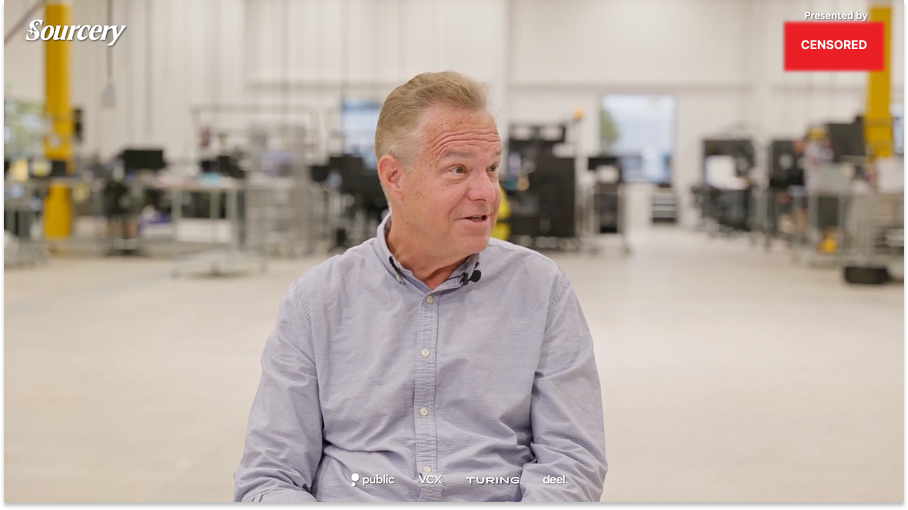
Jessica Chavarria started her career in contract manufacturing, moved to SpaceX as a Requirements Planner in 2011, and worked her way up to Supply Chain Manager over eight years at the company. She has worked increasingly senior supply chain roles at a number of A&D companies, and just joined us in June to go back to her contract manufacturing roots as our Head of Supply Chain.
We’ve noticed something with the SpaceX alumnae. There’s a group that will make like $3-5 million and take it easy. Then there are the people who have been there long enough, and in important enough roles, to make hundreds of millions of dollars who have negative desire to retire and sit on a beach sipping pina coladas. These are people who worked for over a decade at a crazy company and loved the rush. They want to do it all over again. You can’t take the grinder out of them.
We’ve created a place where the grinders can grind on a challenge that’s endlessly deep and deeply important. We see it as validation of the opportunity that the people who’ve been at SpaceX long enough to know where all the bodies are buried are saying “If we could solve this, this is the most important thing we could work on.” Now it’s up to all of us to actually go solve it.
If you’re reading this, you’re probably bored of hearing that the US forgot how to build. That we sent the jobs overseas in search of profits, and hollowed out the golden goose. That you’ve heard it a lot doesn’t make it any less true, but the interesting question isn’t what happened in the past, but what we’re going to do to fix it.
We think that skilled assembly is the fulcrum point. It’s a really fucking big problem waiting to happen; you can’t necessarily feel it today, but you’ll feel it in the next two to five years. Our skilled workforce is retiring, just as the demand for their skills is surging. We’ve realized that we need to build big things here again, but all of those big things are made up of a lot of little, complex, custom things that a shrinking group of people know how to make.
A lazy solution to this coming crisis is that we’ll just let the robots take care of it. As you understand by now, most of our industrial base’s skilled assembly isn’t standardized or optimized, and until you standardize and optimize, you can’t automate.
When the time comes - when the brains are smart enough and the hands are dexterous enough - we believe that robotics adoption in manufacturing will be constrained less by hardware and more by the absence of structured, well-configured operational environments. We’re solving that problem first, by encoding manufacturing into executable, measurable, and machine-readable systems.
Far before automating skilled assembly becomes possible, we will reindustrialize by giving humans better work environments, environments that work for them. That’s little things – our attrition is comically low because we offer air conditioning and a pleasant workplace - and big things, like making sure they have the tools, components, and instructions they need at all times.
All of this is really hard. It’s not as clean or as sci-fi as throwing robots and ASI at the problem. But we love that. We’ve been out here screaming into the ether: humans matter, we need to figure out how to scale them.
Ours is a belief that the more the easy stuff gets automated, the more valuable skilled humans will become. We agree with ex-Uber-now-Atoms founder Travis Kalanick, who predicted on TBPN that skilled workers will get paid like LeBron James because, “Humans [are going to] become more and more valuable because they will be the long pole in the tent to progress - and that progress is going to accelerate and get faster and more robust.”
The future, like the past, is human. It’s just that we can give humans superpowers now.
If you’re out there and you hear our scream, come join us.
Thanks to Jordan, Greg, and Sam for working with me on this piece, and to Alexa for the introduction!
That’s all for today. We’ll be back in your inbox tomorrow with our Weekly Dose.
Thanks for reading,
Packy
the sequencing here is the whole lesson, standardize the work before you touch automation, not after.. everyone wants to skip to the robots and ends up automating chaos..
Super interesting. Nice blend of context and detail. Make sure these co-written essays don't cross the line into VC "puff pieces". Keep the detail and the length - that will help. Keep them coming!