

Hi friends 👋,
Happy Thursday! We dropped a new notboring.com website this week, and this is our second essay of the week. Lock-in season.
This one is a continuation of the series arguing that strategy is important and moats matter. It’s still popular for startups to say that they don’t need them, that they’re just faster and better at product, that it’s too much to ask such young companies to have Network Effects or Scale Economies in place.
But startups don't get a pass on strategy because they're young. Luckily, there’s one moat that they can use to buy time. This is an ode to that one.
Let’s get to it.
Today’s Not Boring is brought to you by… Arena Magazine

Arena Magazine is the print magazine of American technology, capital, and industry. They publish four beautiful issues per year, printed to last on archival paper, with great writing about people chasing frontiers in America. Their latest is Issue 009: Hello World, with 136 pages of writing and art on the epic story of software.
Subscribe to get Issue 009 delivered to your doorstep.
An Ode To Counter-Positioning
There are 7 Powers, but if you made me choose a favorite, I’d pick counter-positioning.
In his primer on Hamilton Helmer’s 7 Powers, Mind the Moat, Lindy CEO Flo Crivello defines it as “the practice of developing your business model such that incumbents have conflicting incentives preventing them to compete effectively.”
The definition contains the reason I enjoy it so much: before they’re old enough to access the other 6 powers, it’s the moat with which startups are able to attack incumbents. Incumbents have bigger businesses and more resources, and it is those advantages startups use to attack them. Their business is too good to mess with.
When I wrote about Ramp for the first time back in December 2020, I compared counter-positioning to the Five Point Palm Exploding Heart Technique from Kill Bill. When a startup hits them with counter-positioning, the incumbent might not realize they’re dead; take a step in the startup’s direction, though, and they topple over.

If incumbent corporate cards incentivized customers to spend more by giving them points, Ramp built its business on helping customers spend less. Incumbents couldn’t match that for a number of reasons, including the fact that they were nowhere as good at software, but mainly because if customers spent less, they made less, which their shareholders would not appreciate. Other startups like Divvy and Brex played the same game incumbents did, offering rewards and points for spend. They both had good outcomes: Bill.com bought Divvy for $2.5B and Capital One bought Brex for $5.15B. Today, Ramp is valued at $44 billion and launching a flotilla of products that help customers save time and money, including a model router.
If you come at the king, you best not [play their own game but with better technology].
I am thinking about counter-positioning today because of Base Power Company CEO Zach Dell’s conversation with David Senra on David Senra. At 16:18, discussing how he and Justin came to their business model, he gives a sermon on counter-positioning.
“If you’re going to take on an incumbent,” he says, “my view is the best way to do it is to have a counter-positioned business model.”
If I showed up and said, ‘I have... the best home battery on the market... and I’m going to sell it to you for 10% below the big guys,’ your margin is my opportunity, right? Like these big guys are going to compete on price. First they’re going to copy my product, then they’re going to drop their price and they’re going to run me out of business.
But if I show up and say, ‘I don’t sell batteries. I sell electricity,’ and we’re going to install this battery on your home, and because of our different business model, you pay 1/20th or even 1/40th of what you’d pay to own it outright, then I can win.
And if you want to compete with me and you’re one of the incumbents, you’ve got to completely change your business model, which as you know for a public company is very hard, right?
Base won’t be able to use counter-positioning forever. The moats it digs to protect its margins from competitors will come from the other powers: Scale Economies, Cornered Resources, Switching Costs, Brand, and perhaps even Network Effects and Process Power. But as Zach points out, there is no better way to start taking on an incumbent than by counter-positioning.
This is a theme that Ben and David bring up again and again on the Acquired podcast: “As Hamilton [Helmer] would put it, counter-positioning is usually a take-off phase power.” Helmer himself went on the pod and explained why: “It’s the only one that’s a partial source of power. If you want real durability… you want to have another source of power.”
Counter-positioning is here for a good time, not a long time. Which is part of what makes it so fun. It’s the trickster power. Counter-positioning buys you time against the incumbent — which is positioned in some way against which you can counter-position — but it doesn’t necessarily protect you against another startup. You need other moats for that.
Poetically, Helmer chooses Dell to make the point. Dell was counter-positioned against Compaq because Compaq’s dealer channel made direct sales painful. Eventually, though, everyone could adopt direct sales, and Dell’s counter-positioning power disappeared. By then, Dell had used the window to build Scale Economies around its direct, just-in-time model.
The Acquired canon is chock full of examples.
When Google launched Android, it could afford to give it away for free because the mothership made its money on search. It could afford to just subsidize the losses completely, but it also didn’t have to, because more mobile search on Google meant more revenue. Nokia, on the other hand, had to make money from the mobile stack itself; giving it away for free would have killed the business.
This is one good way to think about counter-positioning: can Challenger A do X because it makes its money somewhere completely different from Incumbent B?
It, to be clear, is easier to do if you have Google’s cash machine behind you, but it’s always worth thinking about how you can fuck with the way that your incumbent competitor makes its money.
Amazon, born on the internet, was built around direct-to-consumer fulfillment. Barnes & Noble was optimized around stores. For B&N to go all-in on Amazon’s model would have meant reallocating capital, executive attention, and distribution infrastructure, and tolerating lower near-term profitability from its existing stores. The Amazon model “would be less profitable for them… versus the hugely profitable stores,” Ben said. Amazon “counter-positioned against everyone whose cost structure was set up” for physical retail, David added.
This is another way to think about counter-positioning: the more an incumbent has invested in building out its infrastructure, the less able it is to adapt.
Startups with less money than Google can certainly use this form. My favorite example is Somos Internet. As I explained in Cable Caballero, Somos designed a new network architecture and built its own hardware to run it, and incumbent telcos can’t respond because doing so would require ripping up the billions of dollars of CapEx they’ve spent buying and upgrading third-party hardware in the old network configuration. You can see their stuckness. Plus, given their reliance on vendors, most don’t have the technical wherewithal or nimbleness with which to re-architect the whole thing anyway. Plus plus, they’ve used so much debt to finance the network buildouts that they can’t really lower prices to hurt Somos, let alone fund an uncertain new network buildout.
There’s the flip side of both of the above, too, which is familiar to anyone who’s watched a movie where a bad guy gets leverage on a good guy by kidnapping their family: having nothing to protect is freeing.
When Microsoft took on the company nobody got fired for buying, IBM, “Microsoft basically had no baggage,” Ben explained. IBM sold integrated computer systems - software, hardware, everything - through the greatest enterprise salesforce in the business. To launch its PC, urgently, Big Blue broke with its normal model, used off-the-shelf components, an Intel processor, and even an operating system supplied by Microsoft. But Microsoft didn’t license exclusively to IBM; it licensed DOS non-exclusively, and was incentivized to make PCs as cheap and abundant as possible in order to get its software onto as many desks as possible. Per Ben & David, they could say: “We don’t need to make any money on hardware. We don’t need to even make hardware.”
Microsoft didn’t win because it wrote better software than IBM. IBM wrote software that was just fine eventually. But IBM needed its software to sell high-margin machines, whereas Microsoft benefited when the hardware layer got commoditized. As hardware commoditized, the software layer became the one with which all of the hardware providers had to be compatible. Or as Ben put it, Microsoft was “free to become the whole point of integration for the entire ecosystem just by shipping bits.”
This is a vicious form of counter-positioning: an entrant can be counter-positioned not just because it is willing to cannibalize a profit pool, but because it actively benefits from the destruction of the incumbent’s profit pool.
Then there’s Facebook, which faced off against MySpace and its 1 million users when it launched in 2004. MySpace is a joke now, but was a rocketship then. It launched in 2003, got to 1 million users in February 2004, passed Friendster the next month, and quintupled to five million users by November.
Facebook counter-positioned by saying that mashing a lot of users in one network to start was bad, actually, and that it was better to start small, to seed a network with the gentlemen and ladies of Harvard and to grow in little circles.

If you’re MySpace, and growth is good, and these nerds are building a little thing for their nerd friends, what are you going to do? Stop growing?
But it turned out that it was better to start small, to seed a network with the gentlemen and ladies of Harvard and to grow in little circles. Not forever, of course, but in the beginning. Facebook used the counter-positioning period to build a ravenously passionate network of people talking to their new college friends and poking each other and made the product so appealing to those on the outside, younger and older, that when they opened the floodgates, it FLOODED, and they moved on to Network Effects.
People haven’t learned.
Earlier this week, a16z partner Josh Elman tweeted, “The new moats are the same as the old moats. Every few years, we fall in love with shiny new tech and forget the basic physics of consumer software.” I’d expand it to say that we forget the basic physics of business strategy, but we’re on Facebook, so let’s stick with consumer.
Assistants are the buzzy product du jour, and Instinct the buzziest of those. It’s a wonderful experience, a better product than the assistants that came before it.
But as Ben says, “Being better is not counter positioning.” The Strategy Don, Michael Porter, writes that “Operational effectiveness means performing similar activities better than rivals perform them. Competitive strategy is about being different.”
Better is a benefit; Power requires a barrier. Counter-positioning exists when the incumbent sees that you’re better but cannot copy what makes you better without damaging the business it already has.
(For the avoidance of doubt: you can’t just pick a model that’s so bad that anyone, including you, would be damaged by pursuing it.)
Who would be damaged by releasing helpful agents? The Labs have kind of done it in their desktop apps, Grok Bot has done it, other new startups are doing it (and it is definitionally impossible to counter-position against new startups), and still Instinct is better. Because it’s better, it raised a $350 million Series B at a $2.5 billion valuation in late August, and one of the theories was that they raised so much so they could continue to offer it for free and drown competitors on the way to new business models (i.e. transaction fees).
Better, though, is not a moat, and good luck drowning Meta’s cash machine.
Meta (née Facebook) released their Assistant this week, too. Its name is Muse.
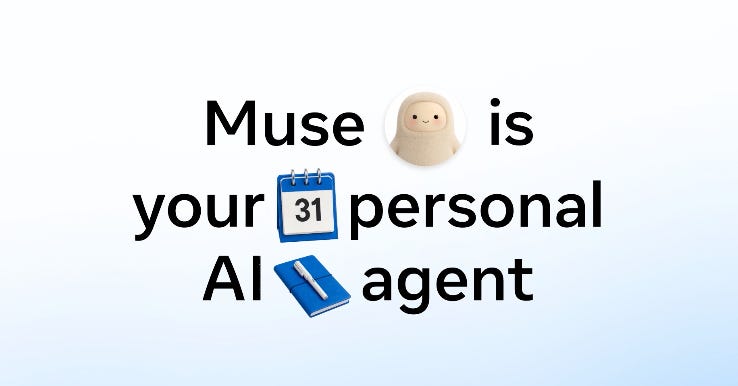
Some early reviews say that it’s better than Instinct. I still need to try it; better is not the point.
The point is that not only is it not painful for Meta to copy Instinct’s model and product, it’s great! Meta knows more about you than anyone and can recommend things you didn’t know you needed, solving the cold-start problem. They can, as Ben Thompson wrote, give each user “a VM with 8GB of RAM and 8GB” which is “a real-deal computer, and Meta is offering that to everyone in the United States, and eventually the world. It’s pretty extraordinary!” They can integrate it directly into WhatsApp, their enormous but undermonitized messaging app, they can integrate it with FB Marketplace so you can get what you want for cheap, they can put it in Meta Ray Bans so you can just tell your own face what to do, and they can train it in their gigantic data centers. They can give it away for free until the heat death of the universe (or until Anthropic hits on its >10% chance of killing us all). They can bring Network Effects and Scale Economies and Brand and whatever moat is necessary to bear, because they counter-positioned early and then dug all of those.
Now, Zuck has tried to copy or create new products before and failed, or failed to kill his target. Threads hasn’t cured my Twitter addiction. But Twitter had Network Effects. It was moated.
There are, to Josh’s point, too many startups out there that think that the new technology is so incredible that they no longer need moats. They just need speed and taste or whatever and focus and nimbleness and the special je ne sais quoi that comes with being a startup.
And there are plenty of startups who will do just fine with that approach. The big moated companies are willing to pay a lot of money to bring some of that je ne sais quoi inside their castles and to keep it out of their competitors’.
I couldn’t point to Cursor’s moat, but it was an excellent product and it was worth $60 billion to SpaceX. Nvidia paid $12,930,300,000 for Hugging Face, which I actually used as an example of an AI company that used a Complexity Uncertainty Window to develop early Network Effects in When to Dig a Moat. I talked to a founder not long ago and asked about moats, and he said something like “We don’t care about moats we want to build a great product” and so I passed and the company is valued at like 50x what it was then, so what do I know.
It’s rumored that Meta (and others) even offered 10 figures for Instinct!


But when Instinct turned them down, Meta said, “Fine, we’ll build it ourselves,” because it cost them nothing but money and they have plenty of that. Of course, it’s probably easier than ever to copy unmoated products now that AI can write the code, but that’s besides the point, because without moats, any good company will get copied, even if the humans have to do it themselves.
We are in a period in which AI is so shiny and new that incumbents are willing to pay a lot of money for products that are better than anyone else’s, but acquisition hope is not a strategy and better is not a moat.
I hope that Instinct wins, as I hope that many startups take down their industries’ Goliaths. They are fighting. Just yesterday, they introduced a Trusted Person network, to let people’s assistants talk to those of their significant others, family, and friends.


It is an attempt to create Network Effects, and they’re going for it. Respect. The question will be whether they’ve given themselves enough time to build a real Network Effect before people start using Muse, and Muses inevitably work with each other, too.
Time is why counter-positioning is such a powerful weapon to the otherwise unshielded.
It makes it painful, suicidal, even, for someone to copy your better product. You need to use that time to sprint like hell until you can establish your long-term moats.
That’s all for today. We’ll be back in your inbox tomorrow with another Weekly Dose of Optimism.
Thanks for reading,
Packy
Another great thought piece (perhaps this Substack should be rebranded 'Never Boring'!) Is instinct's counter positioning that we can (potentially) trust it vs a FB owned Muse ? FB has burned through its deposits in the trust bank long ago in my opinion and for me at least trust really matters for a product like this. If Instinct can earn our trust in a similar way to how Apple shifted and started to emphasise privacy some years ago for example, then I for one would be opting for the Instinct app. In the meantime let's hope it's is not destined to be the new Snap aka chief product designer for FB.
Love a great counter-positioning takedown. It was a good use of your back catalogue and of the Acquired Cinematic Universe, but I was looking for some new ones!