

Hi friends 👋 ,
Happy Friday!
We are back to our regularly scheduled Friday slot after yesterday’s optimistic cossay with Ross Garlick on what could go right in Venezuela and what it would take.
We have a lot of great stuff, including the best thing I’ve ever read by the best writer in biotech, promising cancer vaccine results, Zipline money, ocean plastic removal, internet backbone, and a bunch of bonuses for those of us who are going to be snowed in this weekend. Stay safe and warm out there, and…
Let’s get to it.
(1) Going Founder Mode on Cancer
Elliot Hershberg for The Century of Biology
If you read just one thing from the Dose this week, please make it this.
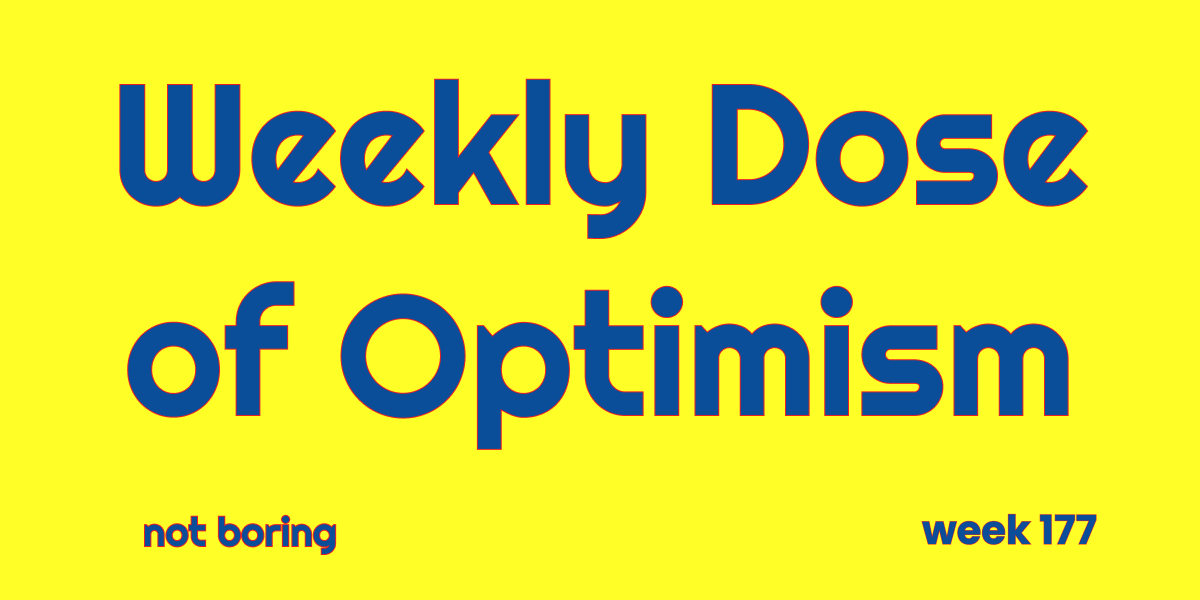
I am a founding member of the Elliot Hershberg Fan Club. He was not boring capital’s biotech partner and remains a great friend and the person I turn to with any biotech question I have now that he’s running Amplify Bio. I love most of what he writes. But I don’t think any of it comes close to this one. I’ve been waiting for it.
The last time Elliot was in New York, we took a walk around Washington Square Park and when the conversation turned to cancer therapeutics, he told me about GitLab founder Sid Sijbrandij’s story for the first time. His point was: this is what one superhuman billionaire is doing to fight his cancer today, and I think something like it will be available to everyone to fight cancer in the future.
Now, he’s written that story down, and it’s better than I expected. It’s the story of Sid’s extraordinary fight against osteosarcoma after exhausting the standard of care.
Sid fought cancer and beat it, only for the cancer to return in 2024. After doctors told him, basically, “You’re done with standard of care, maybe there is a trial somewhere, good luck!”, Sid pulled out all the stops to cure himself.
He put together a 1,000+ page Google Doc of health notes. He obsessively gathered information via every diagnostic he can get his hands on, done often, and built systems to solve problems nobody else would solve for him. Sid assembled a SWAT team, used single-cell sequencing to identify FAP-expressing fibroblasts in his tumor, flew to Germany for experimental radiotherapy, and is now in remission. He won.
The piece is part profile, part science, part fight against a Kafkaesque healthcare system, and part glimpse into a future where personalized oncology actually works, where AI agents order diagnostics, bioinformatics pipelines design custom vaccines, and the total cost of treating early-stage cancer the way Sid did drops dramatically.
From an optimism perspective, it’s a twofer:
It’s possible to beat cancer through personalized therapeutics.
One extremely dedicated person can solve almost anything.
Just read it.
(2) Moderna, Merck Report Positive Results from Cancer Vaccine Study
Nicholas G. Miller for The Wall Street Journal
In the meantime, generally available cancer drugs continue to get better.
This week, Moderna and Merck announced that results from a five-year Phase 2b trial in melanoma patients showed that its cancer vaccine, in combination with Merck’s immunotherapy, Keytruda, reduced the risk of death or recurrence by 49% versus Keytruda alone. That is a massive improvement, and another big sign that mRNA vaccines are going to be a key part of the arsenal in the fight against cancer. The companies have eight trials in Phase 2 or 3 across multiple tumor types beyond just melanoma.
Relatedly, long-term not boring readers may remember Keytruda from our Deep Dive on Varda. The drug is one of the best-selling of all-time and was the single best-selling pharmaceutical in the world in 2024 with $29.5 billion in sales. It is also one of the drugs with the highest price per kilogram at a whopping $194 million per kg.

The drug is out of this world, literally. In 2017, Merck conducted a mission on the ISS to explore the crystal properties of Keytruda in order to improve crystallization. While the research has not been commercialized, the hope is that a tighter distribution of smaller particle sizes would allow for self-administration at home versus the current process of going into the clinic for IV dosing as it stands.
Daily Synchronicity: after I wrote this, Scott Manley posted a video on just this topic.
The future is bright. It’s never been a worse time to be cancer.
(3) Zipline Raises $600M at $7.6B and Makes 2 Millionth Delivery
Zipline has been one of our favorite companies to write about in the Dose, for three reasons.
First, they make autonomous flying drones. They’re building the future we want to live in.
Second, they started out (and continue) by using those drones to deliver drugs to hard-to-reach places in Africa and have saved or improved thousands of lives. Great for humanity, and a smart strategy to get flight hours in before taking on the US.
Third, the future of delivery is going to be unrecognizable, and it’s going to make the ground better, too. Drones are faster and cheaper than cars or electric bikes. Order something, get it whizzed to your house. That also means fewer delivery vehicles clogging up the roads and fewer electric bikes trying to kill you.
Now, they have a fresh $600 million to pull that future forward faster, including the launch of a new market, Phoenix. To do it, they’re going to need a lot of drones. Last year, I got to tour the facility where they design, test, and manufacture new Zips. Molly went behind-the-scenes on Sourcery so now you can, too.
(4) The Ocean Cleanup is Now Intercepting 2-5% of Global Plastic Pollution
Boyan Slat


A non-profit called The Ocean Cleanup is working to take and keep plastic out of the ocean, and it’s on its way towards its goal of removing 90% of floating ocean plastic pollution by 2040. Founder Boyan Slat announced The Ocean Cleanup removed 27,385 metric tons of plastic last year, and is intercepting 2-5% of global plastic emissions. That's roughly the weight of 10 Eiffel Towers.
Slat was 16 when he went scuba diving in Greece and saw more plastic bags than fish. He made it a high school science project. His 2012 TEDx talk went viral. He dropped out of aerospace engineering, raised $2.2M from 38,000 donors in 160 countries on €300 of saved pocket money, and founded a nonprofit to fix the problem.
A decade after the TEDx talk, TOP was pulling out serious plastic: 1M kg by early 2022, 10M kg by April 2024, 50M kg by January 2026. System 03 now cleans an area the size of a football field every five seconds. Their Guatemala river site, which nearly failed when anchors washed out in 2022, removed 10M kg in its first year after they relocated and redesigned. "When people say something is impossible," Slat once said, "the sheer absoluteness of that statement should be a motivation to investigate further."
Slat designed TOP to put itself out of business, which is perfect, because when he’s done on macroplastics, we need him to get to work on microplastics.
(5) Blue Origin Announces TeraWave
Blue Origin
While everyone has been talking about SpaceX’s IPO plans, Jeff Bezos quietly unveiled a second satellite constellation.
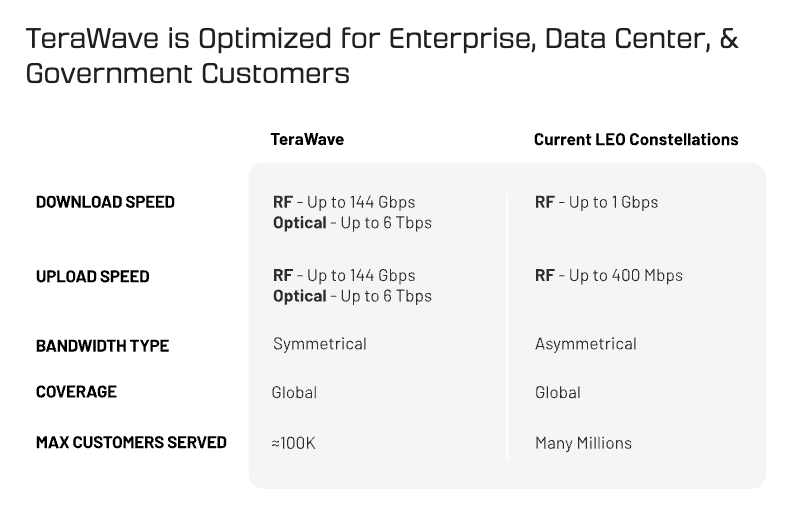
TeraWave is not for consumers. It’s enterprise infrastructure: 5,408 optically-interconnected satellites across LEO and MEO, designed to deliver symmetrical upload/download speeds of up to 6 terabits per second anywhere on Earth.
For context, Starlink’s consumer service maxes out around 400 Mbps, but that comparison isn’t perfect. If you recall from Cable Caballero that Tier 1 “backbone” providers build fat pipes and wholesale to Tier 2 middlemen or ISPs, who offer the internet to customers at ~100 Mbps to 10 Gbps, TeraWave is like that Tier 1 backbone provider, but beaming down from space.
TeraWave is targeting ~100,000 enterprise, data center, and government customers who need redundant, high-capacity connectivity where fiber is too slow, too expensive, or impossible to deploy.
The architecture is clever: 5,280 satellites in LEO handle the RF links (up to 144 Gbps per customer via Q/V-band), while 128 satellites in MEO provide the optical backbone for the 6 Tbps throughput. Deployment starts Q4 2027, likely on Blue Origin’s New Glenn.
Bezos already has Amazon Leo (née Project Kuiper) for consumers and small businesses. That’s the Starlink competitor with ~180 satellites up and a 2026 commercial rollout planned. TeraWave goes after a different market entirely: the hyperscale backbone. It’s space-based dark fiber for enterprises, not broadband for RVs.
The timing is pointed. SpaceX has hired four investment banks to take it public in what may be the largest IPO of all time, with a potential valuation north of $1 trillion. Starlink is the business. 9 million subscribers, 9,400+ satellites, 70% of SpaceX’s revenue, adding 20,000+ customers per day. Musk wants to raise tens of billions of dollars in an IPO to build orbital data centers and, eventually, satellite factories on the Moon. He talked a little bit about the vision in a surprise Davos talk.
At the end of the talk, Elon said, “My last words would be, I would encourage everyone to be optimistic and excited about the future, and generally I think for quality of life it is actually better to on the side of being an optimist and wrong rather than a pessimist and right.”
We couldn’t agree more.
BONUS (for paid not boring world members): Brex / Ramp, Levin, Stewart Brand