

Hi friends 👋,
Happy Friday and welcome back to our 219th Weekly Dose of Optimism!
What a week. After two affairs emerged - one with an alleged Chinese spy and one with a direct report - Nvidia founder and CEO Jensen Huang resigned. Sources say the affairs are the tip of the iceberg and that heavier shoes will drop.
But progress marches on, as evidenced by everything in this week’s Dose. It’s going to take more than a wandering Huang to keep us down.
By the way, inspired by Readwise launching Readwise Books, I had Codex turn all of my essays into epubs that you can download and read on your book reader of choice, because while they’re long essays, they’re actually pretty short books! You can find and download all of them, including Of Miracles and Moats, at not boring press.
Let’s get to it.
This Week’s Weekly Dose is brought to you by… Runway

I have been having so much fun with Runway as this quarter’s presenting sponsor. The product keeps getting better, and expanding, every week. Personally, I’m hooked to making videos - whether explainers for the Dose or attempts to make short films - and I think you’ll really enjoy it, too. Try it for work, or try to become the next Scorsese.
Runway is building foundational AI for how the world creates. 65M+ people use Runway to generate, edit and produce video, images and audio with 80+ top media models. You can read my essay with co-founder Anastasis Germanidis to learn more on where Runway is headed beyond video.
Nvidia, Amazon, Lionsgate, Chime, and 95%+ of the Fortune 100 are part of a growing community of teams, founders, and independent creators using Runway to make national TV spots, social ads at scale, launch videos and more.
You can also use Runway in ChatGPT, Claude, Grok, Cursor, Replit and more via the Runway MCP.
(1) Google DeepMind Releases AlphaGenome 2
So, uhhh, pretty good time to be Google, huh?
On Wednesday, as Nvidia was in turmoil, the maker of GPU competitor TPUs, and our favorite chef of models outside of your plain vanilla LLM, released AlphaGenome 2.
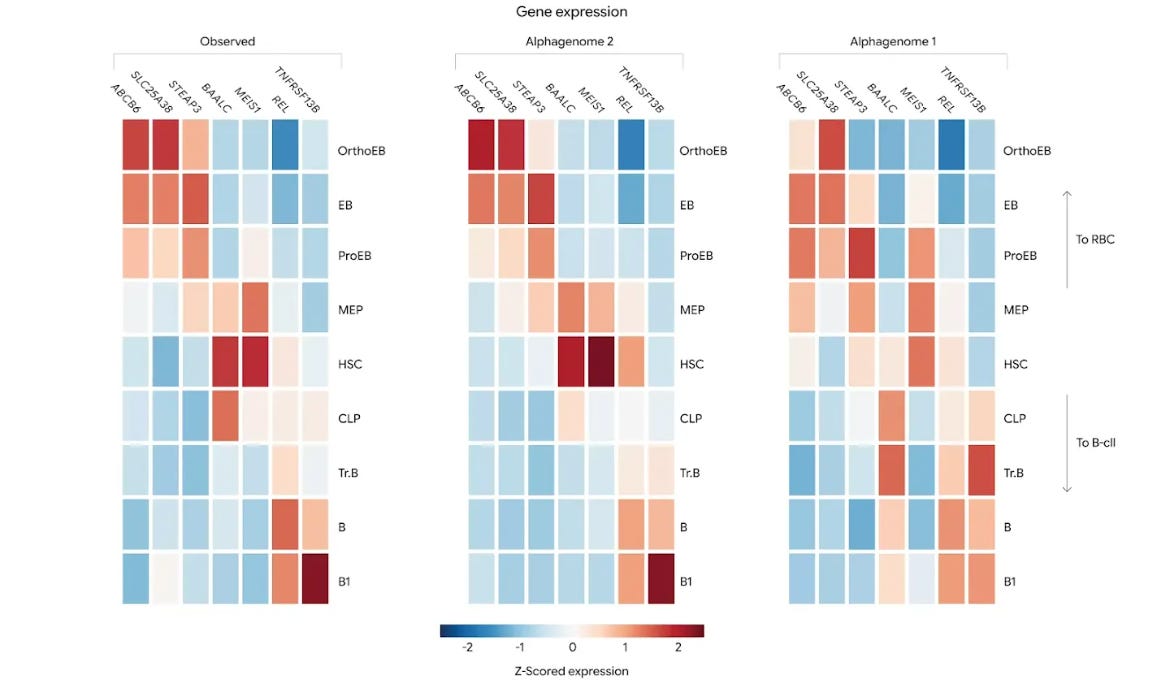
Last year’s AlphaGenome 1 took a million letters of DNA and predicted what they do, but averaged across whole tissues. It was very cool! But averages can hide things, like variants that might cause disease in only one rare cell type or only after a cell gets activated.
AG2 takes the same million letters plus a condition, which can be a tissue, a cell type, a cell state, or data from a few dozen of your own cells that it has never seen before, and it predicts what the DNA does there specifically. It trained on more than 107 million individual cell profiles from 68 human and mouse tissues. On a benchmark of 28 immune cell types, it found 30% of the variants scientists believe are causal, versus 16% for the old model.
As longtime readers know, my process for figuring out whether something in bio is legit is to text Elliot, but this time, he tweeted before I had to:


Genome-wide association studies have handed us an enormous pile of DNA variants linked to diseases, and for most of them, scientists are still trying to figure out which gene they touch or which cell they act in, which often takes a lot of real world experimentation. That's a big part of why genetics - we mapped the whole human genome! you can now get yours done for like $100! - hasn’t turned into drugs as fast as everyone hoped. But AG2 can pick up signals from all of that data computationally, which means we’ll be able to rev through them to (hopefully) find cures much more quickly.
AG2 still misses most of them (30% is 30%), but going from 16% to 30% in one generation is great progress, and there’s a lot scientists can do with that 30%.
Bad time to be a disease.
(1a) Argenx Acquires Unnatural Products for Up to $1.15B
Real bad time to be a disease, because even if you can use things like AG2 to find targets, you still have to drug them. Which is what macrocycles do.
Macrocycles are ring-shaped peptides that sit somewhere between the small molecules that come in pills and antibodies that need to be injected. The promise is the precision of a biologic in a pill that can slip inside cells to hit targets antibodies can't reach. Think something like an oral GLP-1 or cancer therapeutic.
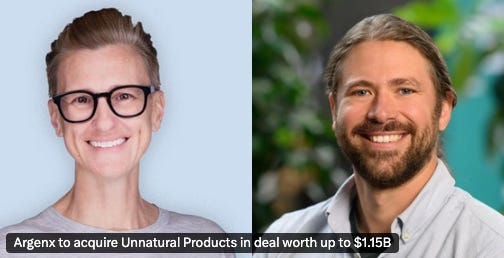
Macrocycles are what not boring capital portfolio company Unnatural Products does, and now, it will be doing them inside of argenx. On Monday, argenx announced that it's acquiring UNP for $550 million in cash upfront and up to $595 million more if it hits development and regulatory milestones. Big win for Cam, Josh, and the UNP team!
argenx and UNP have been partners since last year, and argenx was already an investor, so it knows what it’s buying. They’ve been working on a pill that goes after FcRn, the same target as Vyvgart, the argenx drug that did $1.72 billion in sales last quarter. The team will keep working out of Santa Cruz, where they have huge lush trees right outside the window, and will become argenx's home for peptide discovery.
Naturally, I’m very excited about the win, and we should all be excited to get more of the potential miracle cures we talk about here delivered in effective pill form in the years ahead.
(2) Path Robotics Raises $300M for Robot Welders
Good welders are insanely valuable. I remember touring SpaceX a few years back and hearing them talk about the one guy who could weld everything in hushed tones. Just this week, I was talking to someone about a golden gloves welder somewhere else who pulls $1 million a year. Welding is the same story we often hear: not enough welders, let alone great welders, to make all of the things we need to make.
Back in Dose #214, we covered Anduril’s $3.7 billion Arsenal-2 shipyard, its answer to the US’ shipbuilding problem. But even with big shipyards, we’re going to need a lot of welders. They just might not all be human welders.
Path Robotics, which brothers Andy and Alex Lonsberry started in Columbus, Ohio in 2018, makes robots that weld, which is harder than it sounds! Normal welding robots just repeat a programmed path, but that doesn’t work when the parts in front of them are a little different every time, which they always are, which is why humans still do most of the welding, and why even among humans, the ones who can weld anything are so valuable. Path’s model, Obsidian, tries to make robot welders as effective as golden gloves welders by looking at the actual joint each time, planning the custom weld, and adjusting as it goes.
On Tuesday, Path announced a $300 million Series E led by Georgian at a $2.45 billion valuation. Its revenue is up 17x in 18 months, and customers include Lockheed Martin, Saronic, and HII, the Navy shipbuilder, with which Path signed a $600 million deal earlier this year.
They also make a robot dog that welds (Rove, a Boston Dynamics quadruped with Path’s tech on it) with 50 preorders, headed to shipyards and construction sites next year.
If we want to build big things, we’re going to need a lot of welders, whether of the human, robot, or robot dog variety. Learn to weld.
(3) SpaceX Orders 100 GW/Year of Solar Cell Manufacturing Equipment

Good week to be Elon Musk. He has people thinking he’s going to hire Jensen to run Terafab, but while they’re thinking about, they’re also thinking about how useful it is to be basically fully vertically integrated and control your own destiny, even if it means sending your data centers (Starmind) up to space on your rocket (Starship), maybe one day filled with your own chips (Terafab), but for now in partnership with Nvidia (???), to run on the unlimited power of the sun (???).
Looks like SpaceXAI will be making solar panels, too. On Tuesday, SINGULUS, a small German company that makes the machines that make solar cells, announced that SpaceX signed a contract for a turnkey heterojunction (HJT) cell production line, to be delivered in the first half of 2027 to SpaceX’s satellite factory in Bastrop, Texas.
That first line is worth a little over €60 million, but SINGULUS says that more are coming, and that the plan is to scale to “more than 100 GW of production equipment.”


That, to be clear, is a preposterous number. Each Starmind is designed to have a 75-meter wingspan and a 210 kW solar array, so if my (machines’) math is right, 100GW per year is enough for something like 475,000 satellites. Every year. There are about 15,000 active satellites in orbit right now.
On the other hand, as it stands, this is a €60 million commitment whose announcement was probably worth much more than €60 million to SPCX’s market cap in terms of making Starmind look more serious. A promise to build 475,000 space data centers a year is also exactly the kind of thing you’d expect to hear - and for people to take at least somewhat seriously - if we were in a bubble.
But A+ for ambition, and if SpaceX ends up building a ton of solar panels and doesn’t end up sending them all up to space to create a sentient sun, then consumers will win again in the form of more cheap, clean energy. Never bet against the American consumer.
(4) Voyager 1 Will Reach One Light-Day Away From Earth Next Week
via @nasasolarsystem
Speaking of putting ambitious things in space… In 1977, NASA launched two twin probes, Voyager I and Voyager II, each carrying Carl Sagan’s Golden Record. To exploit a rare alignment of the outer planets that let one spacecraft slingshot from one to the next, Voyager 2 launched first, on August 20th, and Voyager 1 followed on September 5 on a faster path.
Between 1979 and 1981, both flew past Jupiter and Saturn, discovering active volcanoes on Io and detail in Saturn’s rings. Then Voyager 1’s passed close enough by one of Saturn’s moons, Titan, to fling itself up and out of the plane of the planets, while Voyager 2 continued in our own solar system. In 1986, it passed Uranus, and in 1989, it reached Neptune.
The next year, on Valentine’s Day 1990, Voyager 1 took the famous Pale Blue Dot picture that I used to frame Us Against Spacetime.

In 1986, Voyager 2 passed Uranus (insert butt joke here) and in 1989, Neptune. It’s the only human-made craft to make it to either one.
Our solar system is so big. But it is tiny tiny tiny compared to the universe.
Voyager 1 crossed the heliopause into interstellar space in 2012, 35 years after it left Earth.
And next Wednesday, 14 years after that, 49 years after the journey began, Voyager one will pass one light-day away from home.
That is a long ways away, the furthest anything we’ve ever made has voyaged by far, and STILL it’s nothing. The Milky Way is something like 100,000 light years across, and the Observable Universe (not the whole thing, just what we can see) is 93 billion light years across. So after this entire 49 year trip, Voyager 1 has traveled just one 34-trillionth of the way across the Observable Universe. At this pace, it would take 1.67 quadrillion years to do the whole thing, or 120,000x longer than the universe has been around.
So this one is both a celebration of our ability to engineer a thing that can travel a whole light-day away, and a reminder that we are just a minuscule part of this big, beautiful universe. There is much left to explore.
(5) LSD Reverses Gene Signatures of Brain Aging in Rodents
Video by Runway


From outer space to inner space we journey.
I can’t really think of anything that would be better for humanity than discovering that psychedelics reverse brain aging and fight neurodegenerative diseases.
Back in Dose #196, we covered the case of an octogenarian Japanese-American woman with a decade-long history of Alzheimer’s who’d been given a 5mg dose of psilocybin and regained a number of functions, including holding an autobiographical conversation, dressing herself, retrieving contextual memory, and walking independently. The improvements weren’t permanent, but they showed that the person was still in there, and that psilocybin might hold the key to getting them back out.
Now, in a new study in Aging Cell, Aurora Savino, Francesco Iorio, and colleagues found that LSD might reverse brain aging, at least in rats.
As the brain ages, its gene expression drifts in a predictable direction. The genes that maintain synapses and dendrites quiet down, and the ones that build glia and blood vessels get louder. A team in Milan and Turin mapped that drift across 3,086 human prefrontal cortex samples, from donors aged two days to 106 years, then went searching for an intervention that could push back on the drift.
They, like so many seekers before them, found LSD. In chronically dosed rats, and with a single dose in mice, it opposed the aging signature more strongly than exercise or an enriched environment, the two interventions scientifically proven to be good for old brains. In terms of switching on the right genes, it outranked all 193 drugs in a reference database.
MDMA and alcohol had the opposite effect: they made brains look older, which makes sense if you’ve ever woken up after a night of drinking too much.
But LSD… it gets better! In a dish, LSD repaired mouse neurons that had been damaged by amyloid-β, the protein that builds up in Alzheimer’s, restoring both their branches and their synaptic proteins.
I’ve long told you I’m terrified of getting Alzheimer’s, and that I get easily excited when there’s promising news, even if it’s early. LSD’s success in rat and mouse brains doesn’t guarantee success in human brains. But I guess there’s only one way to find out.