
Hi friends 👋,
Happy Friday and welcome back to our 192nd Weekly Dose of Optimism!
I’m out in California getting optimism injected straight into my veins with a bunch of company visits from the future, on many of which more to come.
Plus, we finally got some UFO disclosure.
I am feeling the sci-fi, and it’s real early here, so…
Let’s get to it.
Today’s Weekly Dose is Brought to you by… SimpleClosure

We celebrate ambitious companies every week in the Dose, but ambitious also means long odds, and not every ambitious company ends the same way. Some shut down. Some sell assets. Some get acquired. Some simply reach the point where winding down is the right move.
But however a company ends, there are still final steps to handle: state filings, investor communications, distributions, compliance requirements, asset decisions, and remaining obligations.
SimpleClosure helps founders bring structure to closure, so the process is handled clearly, responsibly, and without becoming another months-long burden.
Whether you’re actively winding down or trying to understand what comes next, SimpleClosure can help.1
BREAKING: UAP Disclosure
Department of War
The American people can now access the federal government’s declassified UAP files instantly. The latest UAP videos, photos, and original source documents from across the entire United States government are all in one place – no clearance required.

It is early here in SF and I haven’t had time to go through these or even see the internet sentiment on what we got here, but the DoW has released the first batch of UAP encounter photos, files, and videos. They’re all on this website, and there will be more to come.
The truth is out there. Happy Disclosure Day.
(1) GENE-26.5: Advancing Robotic Manipulation to Human Level
Genesis AI is getting handsy. This week, the company released GENE-26.5, the first public model in their GENE family, meant to solve dexterity.
It showed robots cooking a four-minute, 20+ subtask meal that includes one-handed egg cracking and bimanual knife work; pipetting liquid into a centrifuge tube and screwing on a 1cm cap; solving a Rubik's Cube bimanually (which Genesis claims is a first for a general-purpose system without mechanical fixtures, building on OpenAI's 2019 single-handed milestone); making a smoothie from raw ingredients; doing wire harnessing (the "holy grail" of automotive manufacturing); and, separately, playing piano (Rush E, naturally) as a stress test for their control stack.
The model is one of four pieces in Genesis’ stack that make the demo possible:
A robotics-native foundation model trained jointly across language, vision, proprioception, tactile, and action, using flow matching over a joint distribution of trajectories. Genesis says they've collected over 200,000 hours of multimodal data with partners.
A data-collection glove with EMF-based finger tracking and dense tactile sensing across the hand, designed to be worn during real work on the assembly line, in the lab bench, in the kitchen, on the keys, etc… so collection doesn't change the behavior being collected.
A 1:1 human-scale robotic hand ("Genesis Hand 1.0") with 20 active back-drivable degrees of freedom and soft material across the palm and fingers. (For now, GENE-26.5 itself runs on an existing dexterous platform, reported to be China’s Wuji Tech; Hand 1.0 is the next step in the hardware roadmap.)
A custom control stack and simulator. They threw out the vendor controller on their bimanual arms and rewrote it. End-to-end latency dropped from ~80ms to as low as 3ms, and tracking error on a 15cm circle dropped from ~20mm to ~2mm. The simulator (Genesis World) lets them run 2,700 robot-hours of evaluation per chart point without touching real hardware.
The argument is that all four pieces have to be co-designed, because compromises in any one of them propagate everywhere else. Vertical integration for the win.
The reason they believe robots haven't generalized like LLMs isn't that the models aren't smart enough, but that the data has been a fraction of a percent of what humans naturally generate every day, captured through interfaces that distort the very behavior they're trying to record, which is what Evan Beard and I argued in Many Small Steps for Robots, One Giant Leap for Mankind. The glove is their bet on fixing that and the hand is a bet that you can match the human end-effector closely enough that mapping is "near-lossless." Together, they make the case that the full stack is the thing.
The company claims that most of the demo tasks required less than one hour of task-specific robot data, or under 200 episodes for skills shorter than 20 seconds. So train the general model, and then efficiently post-train on very small amounts for each specific task.
The Genesis team frames GENE-26.5 as “an early but important step.” While there are still open questions about how the system would operate in the real-world, on tasks that weren’t set up specifically for the demo, this seems like one of many small steps on the path to Rosies in every home. Beep boop baby.
(2) Neuralink Building Surgical Brain Robot
Big week for Elon. Doing battle in court with Open AI. Selling Colossus 1’s 300MW of compute to Anthropic. And, on the side, building a surgical robot that can operate on any region of the brain. What did you get done this week?
We're building a surgical robot capable of reaching any brain region. The goal: a generalized neural interface to help solve any condition that originates in the brain.
The new robot is a generational upgrade on the R1 that's been used since 2024. It moves through five axes with 10-micron precision, places an electrode thread in 1.5 seconds (vs. 17 seconds on the prior generation, an 11x speedup), uses eight optical coherence tomography cameras to map vasculature in 3D in real time, pierces the dura mater directly without removing it, and can reach roughly 99% of brain structures, not just the cortex.
“Any brain region” expands what Neuralink can fix (and ultimately enhance). Cortex-only means paralysis. Cortex-plus-deep-regions means epilepsy (disrupted electrical activity), Parkinson's (motor circuits in the basal ganglia), depression and PTSD (mood and memory circuits), and the long tail of “conditions that originate in the brain,” which, depending on who you believe, is… everything.
Neuralink is already dramatically improving its patients lives, but if you combine what Neuralink is up to with what Genesis is up to, the future starts looking a lot like the future.
(3) Magrathea Raises to Make Magnesium from Seawater

Way way back in Dose #79, we talked about Magrathea Metals’ $28 million partnership with the DoD to produce carbon neutral magnesium from seawater and brines. Now, Magrathea has raised $24 million to produce clean, carbon-neutral magnesium in the west.
Zero primary magnesium is produced in North America. Zilch. Nada. The continent's last major producer, US Magnesium on the Great Salt Lake, went bankrupt and shut down in 2025 after Utah denied the permits. Roughly 85% of the world's magnesium now comes from China, mostly via the Pidgeon process, the coal-fired ferrosilicon reduction of dolomite ore. Both China-dominated and dirty.
Magnesium is the "gateway metal" for the alloys that make airplanes, EVs, and the Blackhawk helicopter (which apparently needs ~400 lbs of the stuff per unit). Magnesium glycinate also helps me sleep at night. The Department of Energy, Department of War, and Department of the Interior all officially classify it as a critical mineral, and as with many other critical minerals, we import nearly all of it, mostly from a strategic competitor.
Magrathea can produce here by extracting magnesium electrolytically from seawater and waste brines instead of digging up ore. The technical innovation, according to CEO Alex Grant, isn't really the electrolysis (which has been around since the 1940s), but the dry-down step that turns wet magnesium chloride into pure, anhydrous MgCl₂ that an electrolyzer can crack. The company says its facilities will cost ~50% less per ton of capacity than competing approaches, and they've already locked in $500M+ per year in future metal sales via MOUs and binding agreements (including one major automaker).
Engineering is underway for Commercial Phase 1 at TETRA's Evergreen brine site in southwest Arkansas and a pilot plant in Oakland is already running. Mag-nificent.
(4) Aalo Atomics Receives DOE DSA Approval for Aalo-X
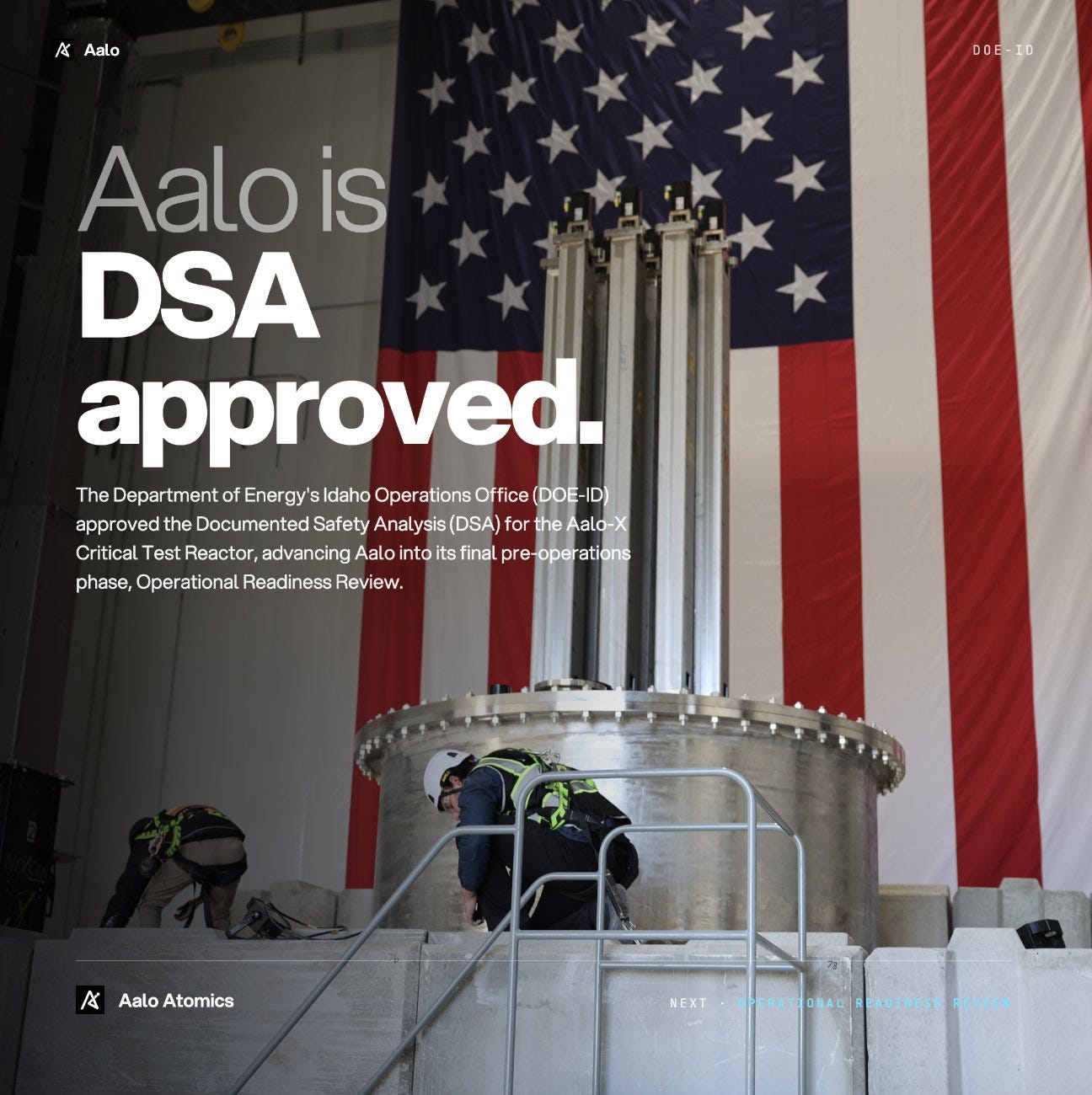
The Department of Energy’s Idaho Operations Office has approved Aalo Atomics’s Documented Safety Analysis (DSA) for the Aalo-X Critical Test Reactor. The DSA serves as the authoritative safety basis for DOE nuclear facilities, documenting analysis of potential hazards to workers, the public, and the environment, and is equivalent to an NRC license for commercial reactors operating under DOE jurisdiction. Go time.
I’m a small personal investor in Aalo, and we’ve been tracking its rapid progress here in the Dose for a while (#58, #135, #157, #175), and now they have DOE approval, pending Readiness Review, the final phase, where DOE verifies that the people, the building, and the procedures are all cleared to operate as documented.
Aalo is targeting zero-power criticality by July 4, 2026, the date set by President Trump's May 2025 executive order to coincide with America’s 250th birthday, which directed DOE to get at least three test reactors critical on DOE land by Independence Day. Aalo broke ground at INL last August, completed assembly in March, signed a 5%-LEU fuel deal with Urenco, contracted Baker Hughes for the steam turbine, and is now staring down the regulatory finish line.
Aalo-X is a 10MWe demonstration. Aalo’s commercial product, the Aalo Pod, will be a 50MWe block of five sodium-cooled, factory-built reactors purpose-designed for sitting next to a hyperscale data center. We will start seeing new, critical advanced reactors online within months for the first time in a long time.
God Bless America and welcome to the Electronaissance.
(5) Google DeepMind Invests in and Partners with EVE Online Maker
Cecilia D'Anastasio for Bloomberg

In World Models, Pim DeWitte argued that games are the best path to useful world models. Google DeepMind, which has a long lineage of using games to train and show off its world models (Atari, chess, Go, etc…) seems to still agree.
EVE Online, the 23-year-old single-shard sci-fi MMO famous for player-run wars, scams, central-bank-grade economic intrigue, and protracted heists with real-money damages in the tens of millions of dollars, is becoming a research environment for Google DeepMind.As part of the deal, DeepMind takes a minority stake (low millions) in Fenris Creations, the rebrand of CCP Games which just bought itself back from Korean parent Pearl Abyss for $120M, less than half what Pearl Abyss paid for it in 2018.
DeepMind will work on isolated EVE servers to study coordination, deception, and "long-term planning and continual learning," all things, per DeepMind's Adrian Bolton, that AI hasn't fully mastered.
EVE creator and Fenris CEO Hilmar Veigar Pétursson said: "We jokingly say that the final boss for AI in games would obviously be Eve Online. Eve is giving insights about our own society and the human condition." EVE has hired actual central bankers to manage its virtual economy. Researchers already study its emergent politics. It is the closest thing humans have ever built to a synthetic society at scale, with a corpus two decades deep. Pim also tweeted that it is the fuel for the Von Neumann probes.


If GDM (what a lab!) can dominate EVE like it dominated Go, Google may have found an even better business than search ads (solving the economy).