

Hi friends 👋 ,
Happy Friday!
Bigggg week for the optimists. We have solar in space, $600M for cutting edge neuroscience, more Levin on aging (with a lil’ Telepathy Tapes), supersonic money-printing turbines, and math-solving AIs. Someone forgot to tell the good guys they’re supposed to take it easy in December.
Let’s get to it.
Today’s Weekly Dose is brought to you by… Lava

For decades, the best investors in the world have used a simple strategy to grow their wealth: buy great assets, hold them forever, and borrow against them when they need liquidity.
Lava makes this possible for bitcoin. They offer a flexible and secure line of credit backed by your bitcoin. No monthly payments, open terms, and your assets are never rehypothecated. Plus, they offer the lowest fixed interest rates in the market for bitcoin-backed loans, starting at just 5%.
Keith Rabois, Lava’s lead investor, sums it up nicely: “Borrowing against your assets is common practice in real estate and equities because it allows you to keep your upside exposure, avoid taxable events, and access liquidity. Lava makes this same strategy possible for the best-performing asset of the past decade: bitcoin.”
If you want to unlock your bitcoin’s purchasing power without having to sell your bitcoin, Lava is the place to go.
(1) Overview Energy Launches Space-Based Solar Power & Beams Power
Marc Berte for Overview
A solar panel on the ground sees the sun about 25% of the time, whereas if you’re in a high orbit in space, you can see the sun over 99% of the time.
Big week for doing things in space that we currently do on earth.
First, Elon joined into the space-based data center conversation and hinted that it might be bigger than Starlink. Gavin Baker went on Invest Like the Best to argue that “The most important thing in the next 3-4 years is data centers in space,” to which Elon responded “True.”
Then on Wednesday, Overview Energy came out of stealth to announce that “our team achieved a world first in power beaming: delivering energy from a moving aircraft at ~5 km altitude to solar panels on the ground.” This is the same basic technology they’ll use to beam power from geostationary orbit down to wherever on earth needs it.
A few thoughts:
WE ARE TALKING ABOUT GENERATING POWER IN SPACE AND BEAMING IT TO EARTH AND HAVE SHOWN THAT IT’S POSSIBLE.
Power beaming isn’t a new idea. Nikola Tesla wanted to use radio waves to beam power across the earth over a century ago. But this is a story of CURVE CONVERGENCE.
As CEO Marc Berte tweeted:
–satellites and launch got dramatically cheaper
–lasers became more efficient
–sensing & control matured
Old assumptions no longer apply.
Trust the curves.
(2) Doris Tsao Joins Astera Institute to Lead Neuroscience Program
Astera
At the heart of our new effort is the conviction that true understanding of the brain’s internal model means being able to manipulate it in a controlled way. Towards this goal, we are betting that the brain’s representational architecture is compositional, built from elemental units and a neural syntax for combining them. By identifying these fundamental units and the rules that create and link them, we can uncover the brain’s infinitely generative internal code. This, in turn, would provide a principled way to construct or modify internal representations, much as knowing the words and grammar of a language allows the creation of an unlimited range of sentences and meanings. Such capability would mark a profound advance in understanding.
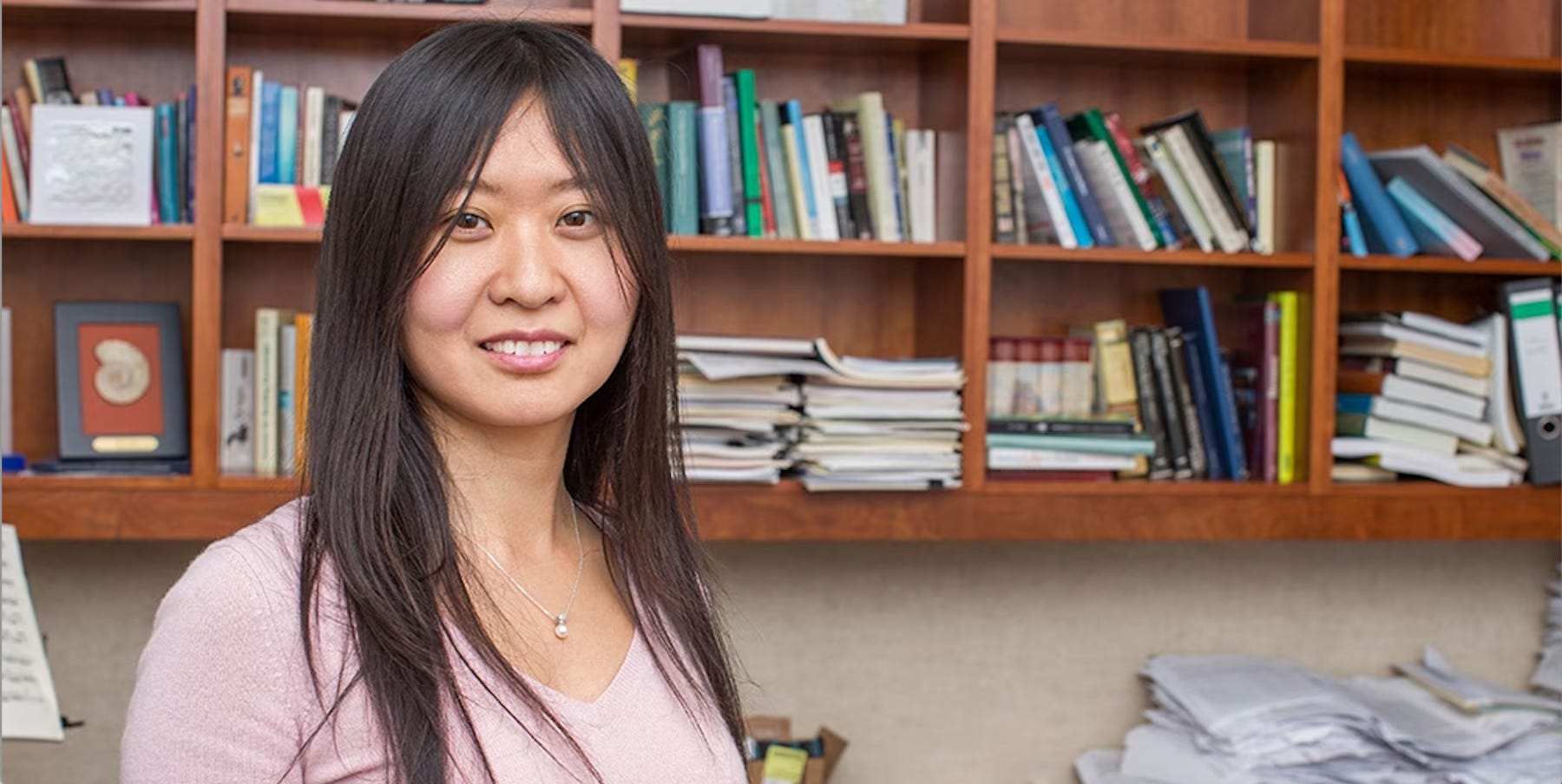
Our friends at Astera, whose homepage reads, “The future, faster,” announced that they hired Dr. Doris Tsao from Berkeley to lead Astera Neuro.
The new team’s goal is to solve one of the longest-standing, most fundamental questions: how the brain produces conscious experience, cognition, and intelligent behavior.
Dr. Tsao and her team will have the time and resources to figure it out. Jed McCaleb and Seemay Chou are backing the new effort with $600M over a decade and building a team across neuroscience, ML engineering, and systems building.
Astera Neuro hopes to use its work to inform AGI, and to be able to predictably produce brain states and capabilities, like restoring full, rich sight to the blind. They also plan to share their research “exclusively outside traditional journals as a forcing function for developing faster, more open, and more useful outputs that represent the full scientific process.”
Jed and Seemay are right at the top of my favorite billionaire list. Commercial space stations, Astera generally, cutting edge neuro research, and fighting against the scientific journal industrial complex.
And you can work with them. They’re looking for a COO for Astera Neuro.
(3) Atavistic Genetic Expression Dissociation (AGED) During Aging
Léo Pio-Lopez and Michael Levin in Aging Cell
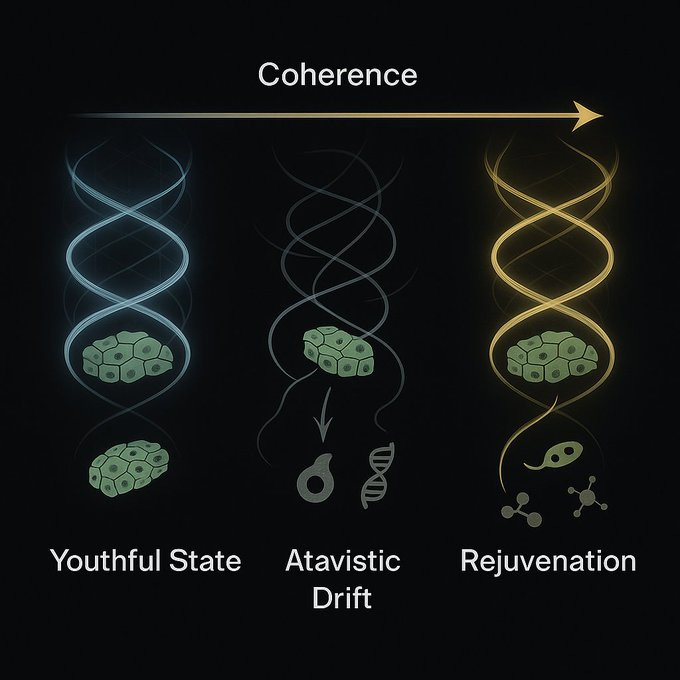
Similarly to the atavistic model of cancer, in which cells revert to unicellular-like behavior, aging may result from the breakdown of coordinated morphogenetic control, leading organs and tissues toward less integrated, ancient unicellular states.
Look, I don’t mean to make it Michael Levin week every week here. But in my defense, (1) the dude keeps dropping some of the most interesting science in the world and (2) I didn’t even realize this was Michael Levin when Aman & Sehaj sent me this tweet and still thought it was very cool because (3) I was listening to the most recent Telepathy Tapes episode on Tuesday and it was all about using energy healing practices to restore cellular coherence.
Then bam, the science to back it up.
Coherence refers to the intricate, organized state of cellular and tissue-level systems that is necessary to maintain their optimal function and survival.
Basically, during aging, tissues lose coherence and begin to drift back toward earlier evolutionary attractor states. Like, they remember when they were just unicellular organisms and try to get back to that, which means decohering from the other cells around them.
The attractor state concept, borrowed from dynamical systems theory, suggests that biological systems naturally converge toward stable configurations. Young tissues occupy attractor states corresponding to optimal function and survival. During aging, cellular and tissue-level systems gradually lose the coherence necessary to maintain these optimal states and drift toward alternative, less healthy attractors.
Understanding all of this, most importantly, could be a bridge to figuring out how to stabilize young tissue states or reverse transitions towards degenerated states, which could mean preventing or reversing aging.
(4) Boom Supersonic Launches Superpower Turbine for AI Data Centers
Blake Scholl
I texted @sama, who had been a Boom investor for more than a decade. Would a 42MW nat gas turbine be helpful? The answer was a resounding yes. 90 days later, we had a launch order for 1.21GW and well over $1.25B in backlog
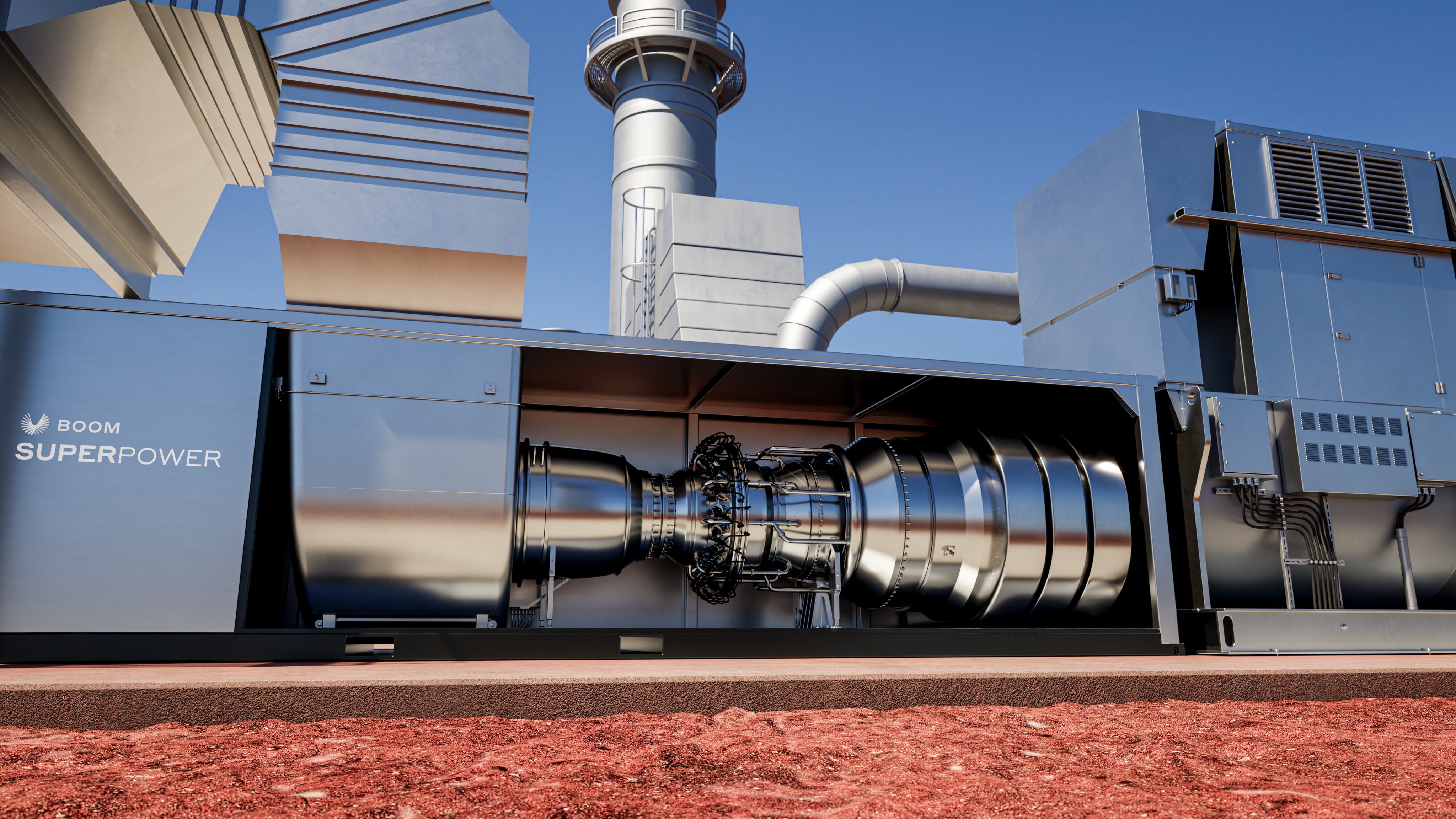
In this house, we support Astro Mechanica in the Supersonic Race. Even still, we gotta admit that Boom Supersonic cooked with this one.
The idea is this: there’s such a power bottleneck thanks to the datacenter boom, specifically for natural gas turbines, that companies like XAI and OpenAI have started building their own power plants with converted jet engine turbines. Overall, according to Halcyon, there are 91 gigawatts of gas plants being planned in the US.
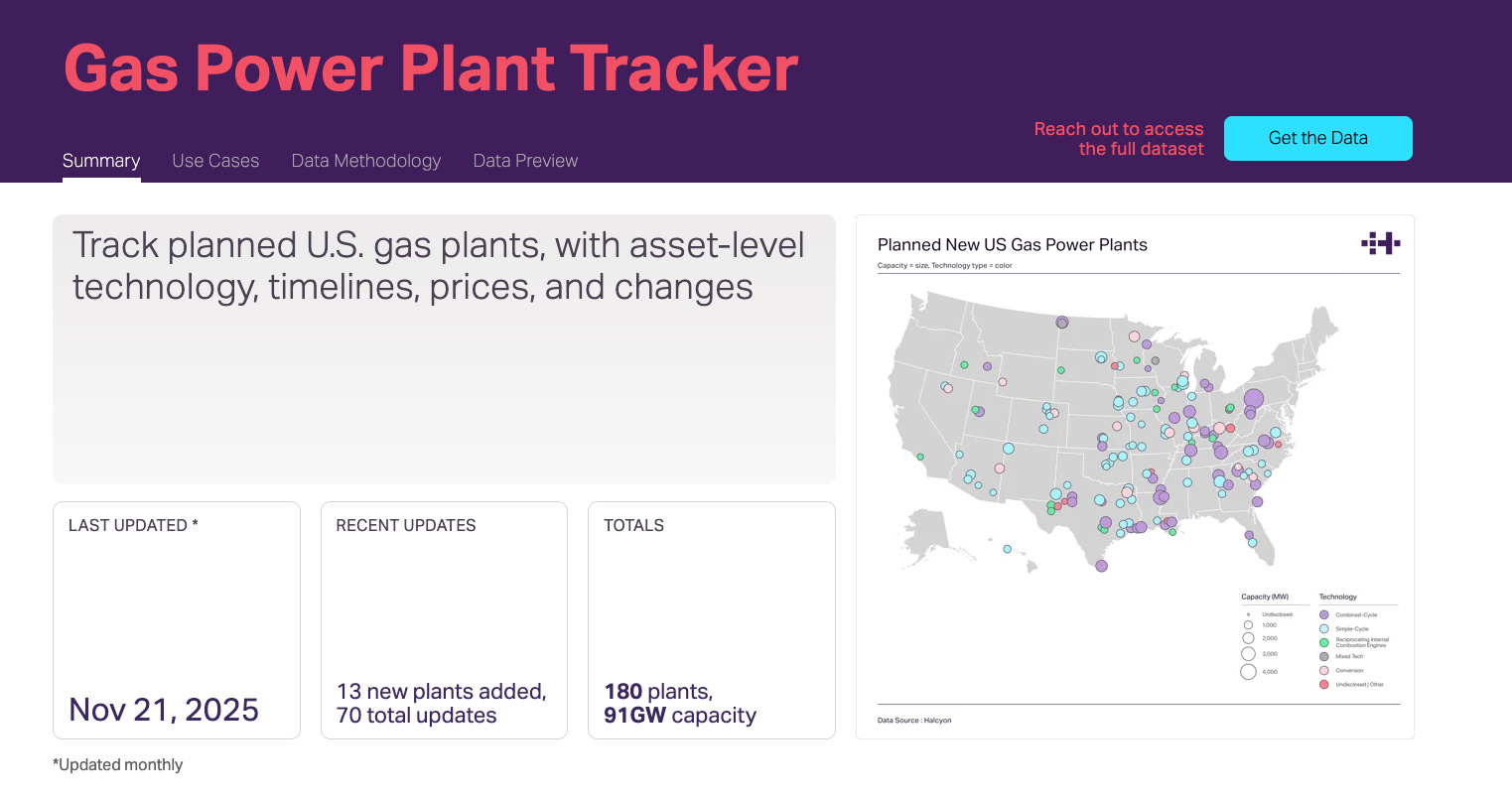
Boom, which is planning to make its own supersonic jet engines, turbines and all, is going to make a power turbine: Superpower, a 42MW natural gas turbine.
They realized that they could kill more birds with this one stone than a jet engine does in flight.
First, it helps solve the power shortage.
Second, and most importantly, it could generate a lot of cash fast, which is crucial because one of the biggest challenges that Boom is going to face is that it costs upwards of $10 billion to certify a new aircraft and where the hell were they going to get all that cash?
Third, using the turbine for power actually gives Boom a way to test their engine on the ground that actually generates revenue.
Gotta hand it to Blake and Co. This is a pretty brilliant solution to a seemingly insurmountable problem. Now, they just have to make them. As Elon replied:

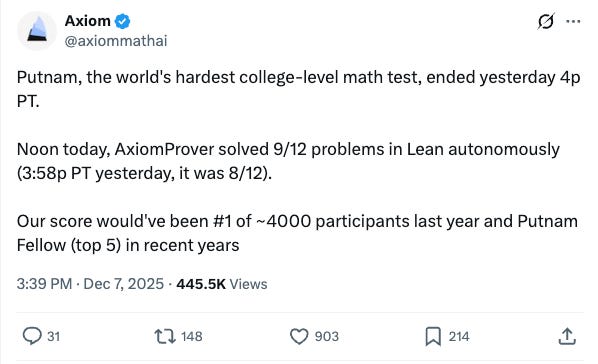
(5) AxiomProver Scores 9/12 Putnam Math Competition Autonomously
Carina Hong
The William Lowell Putnam Exam is the world’s most prestigious university competition. The median score is often 0.
Axiom is a 4-month-old startup in Palo Alto. We’re building the starting point for reasoning: an AI mathematician.
I was really good at math in middle school and then got less good at math in high school. I like to tell myself it’s because I had a bad teacher and I messed around and I didn’t care enough, but all of that is in the past now, doesn’t matter, who cares for real.
Not wasting my precious time getting really good at math was the real genius solution all along, because this week, Axiom, a 4-month-old startup that recently bought its first couch, beat 99.9% of the humans smart enough to even take the Putnam Exam in the first place.
Hope all you mathematicians enjoy hobbies and fun and doing whatever you wish.
BONUS: Solo Founders Report
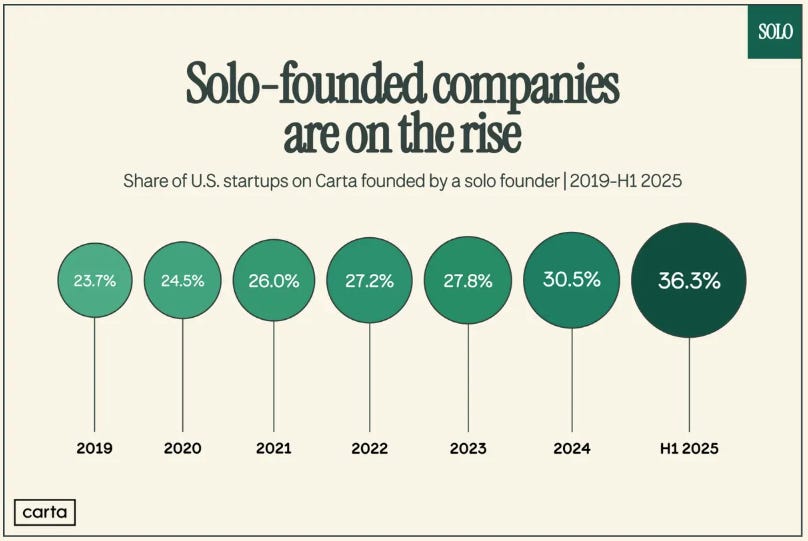
My friend Julian Weisser and his Solo Founders put out a report with Carta on the state of solo founding, or starting a company with one person.
Accepted wisdom in Silicon Valley, and Y Combinator’s stated preference, was that companies with two or more founders do better. Like most dogma, that fails to stand up to scrutiny. Julian & Co. have brought the receipts. Which means that if you want to start a company but were just waiting on the right co-founder, stop waiting.
(Julian pointed out that Anjan Katta, who wrote Hardware is a Fruit with me yesterday, is a Solo Founder.)

DOUBLE BONUS: Cuby is Building
Lil’ update on what Cuby’s been up to since I wrote about them last year.
TRIPLE Bonus: XMTP brings messaging and group chats to World App
We love to see two Not Boring Capital portfolio companies team up to make the internet better for humans. `
Have a great weekend y’all.
Thanks to Aman and Sehaj, and to Lava for sponsoring. Welcome them to the Not Boring family and thank them for supporting optimism by not selling your bitcoin.
We’ll be back in your inbox next week.
Thanks for reading,
Packy
another WOW this week... perhaps rename this SubStack: "William Gibson's Notebook or Gibson report
Question for you: if an AI math engine replaces all of the mathematicians, who will be able to check the engine's math in the future? Are you willing to trust your life to an unverifiable machine?