


Hi friends 👋,
Happy Friday and welcome back to our 214th Weekly Dose of Optimism!
I took Dev to watch LeBron James’ first preseason game as a Sixer last night, the good guys gave us too many great stories to fit into one Dose (check the extras), and it’s beautiful here in NYC. Life is good.
Let’s get to it.
Today’s Weekly Dose is brought to you by… Guru

Your company’s knowledge is one of its most valuable assets—but only if your AI can trust it. Guru helps organizations create a verified, current knowledge layer that people and AI can rely on.
You’ve probably experienced the frustration of giving AI access to a mountain of company information, only to see it struggle to distinguish an approved policy from an outdated document or an old Slack conversation.
Guru helps companies structure, govern, and continuously improve the knowledge behind their AI. The Knowledge Accuracy Gap guide explains how leading organizations are closing the gap between what AI can do and whether it has accurate company context to work with.
The guide covers how to:
Correct an AI answer once and apply that correction across connected agents and AI experiences
Keep people involved where judgment and approval matter, while AI handles routine knowledge work
Build a trusted knowledge layer that supports both employees and AI
Improve knowledge quality and governance as AI adoption grows
Your company is already using AI. Make sure it is using the right knowledge—with Guru.
(BONUS) KILO: a not boring film on Airbound
Last week, I wrote a Deep Dive on Airbound. In the Before Times, that would have been that. Hit send. On to the next. But we are in the Now Times.
In the last Dose, I told you about our new partnership with Runway, and over the weekend, I decided to see what would happen if I gave my essay, a few references, and some creative direction to Claude/ChatGPT and asked them orchestrate the production of a short film using Runway.
The result is KILO, the story of a package that was batched and pushed around until a kid in India figured out how to let it fly solo.
Again, I’m not great at this yet, but I find it incredibly magical that I can take all of the work that I pour into writing and turn it into a film in just a few prompts. It’s a good time to be a storyteller.
(1) Nobel Prize Picks 2026 Laureates
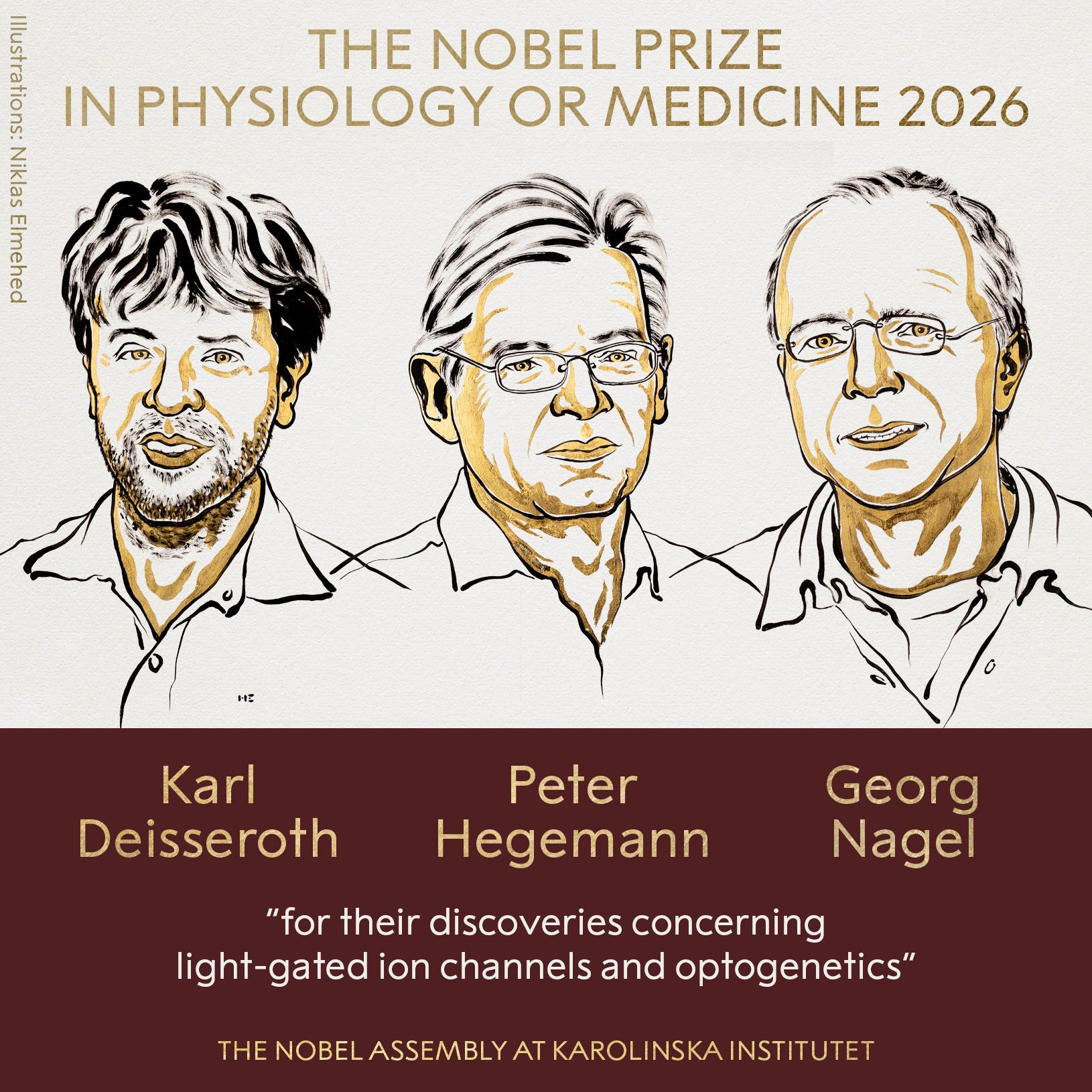
This week, the Nobel Prize committee began handing out the most coveted prizes in science, starting with The Nobel Prize in Physiology or Medicine.
Karl Deisseroth, Peter Hegemann, and Georg Nagel were awarded Prize for their “discoveries leading to optogenetics, which makes it possible to switch on, or off, the activity of individual nerve cells in a living brain.” Optogenetics is a wild field - by shining light at cells, you can turn them on and off, make them do different things. I had a non-meat burger made using a process that involved optogenetics once and it was delicious.
This video of Diesseroth telling his kids he won has racked up 4.5M views. It’s awesome.


Other winners announced so far are:
Francis Halzen in Physics “for decisive contributions to the IceCube Neutrino Observatory and the discovery of high-energy neutrinos of astrophysical origin”
Henri B. Kagan and Kenso Soai in Chemistry “for the discovery of non-linear effects and autocatalysis in asymmetric organic synthesis”
Anne Carson in Literature “for her bold and inventive oeuvre that, in playful dialogue with the classical tradition, has created new forms for contemporary literature”
Now, I need to figure out what any of this actually means, but I, for one, am happy that we take some time out of every year to celebrate the world’s geniuses, and to let them celebrate their great achievements to humanity.
(2) Atomic Machines Comes Out of Stealth with Matter Compiler
Just in case you thought we might not be living in the future, we are living in the future.
Yesterday, a startup called Atomic Machines came out of six years in stealth with a product called the Matter Compiler: “an AI-native manufacturing system that builds working micro-machines from code alone. No per-product tooling. No process development. Different code, different machine.”
If the name sounds familiar, it’s because a matter compiler is a long-held sci-fi dream. In one of my all-time favorites, Neal Stephenson’s The Diamond Age, he literally calls the machines they use to make everything up to and including entire islands “matter compilers.” The idea goes back further.
In 1959, Richard Feynman gave "There's Plenty of Room at the Bottom" and offered $1,000 for a working motor that fit in a 1/64th-inch cube. He expected it to take a whole new approach to engineering. William McLellan won it in 1960 with a microscope, a watchmaker's lathe, and a toothpick. In 1986, Eric Drexler's Engines of Creation imagined molecular "assemblers" that could "build almost anything that the laws of nature allow to exist." A year later, Star Trek: The Next Generation upgraded the old food synthesizer into the replicator. Biology got here long before humans did: founder & CEO Jeff Holden's essay compares the Matter Compiler to the ribosome, which builds every protein in your body from code.
Now, anyone can say they’re building a matter compiler. But Holden was Amazon's tenth engineer, built Prime, and became Uber's first Chief Product Officer. He's also been watching Star Trek since he was five. He has both the skills and the childhood dream necessary to pull this off.
The first product AM is building with the Matter Compiler is the PrimeSwitch PS-150, a 9.5 mm relay that carries 150 amps and opens in 50 microseconds, ~1,000x faster than a contactor, for the 800-volt DC data centers that AI is pushing the industry towards. No existing chip fab can process its materials or assemble its moving parts, but AM says it can, and is beginning to ship to early customers now.
Micro-machines the likes of which AM intends to build are already all over your life. MEMS, or tiny devices with both mechanical and electrical parts, were a $15.4 billion market across 31 billion units in 2024. They include the gyroscope in your phone, the microphone in a hearing aid, RF filters, inkjet nozzles, and Texas Instruments' micromirror chips that flip millions of tiny mirrors to project movies. But as Holden notes, engineers coaxed those few devices out of a toolset built for chips, and each one takes years of process work to get up and running. Atomic Machines wants to go after a whole new swath of sci-fi products now that they’ve made it easier: gears the size of a grain of sand, robots that work inside the body (a la Kurzweil), cooling built into AI chips, even a device that runs instant blood tests (perfect timing with the Nathan Fielder/Elizabeth Holmes doc coming out next week; Holden argues that her dream was possible, but needed a manufacturing technology that didn't exist yet.)
Holden closes his essay with a line that we might tattoo onto the Dose’s forehead:
“We are in the early innings of everything.”
Related Bonus Note: you know I like the woo. Cyan Bannister, the legendary investor at Long Journey, looked at a chart of AI CapEx spend last week, closed her eyes, and saw two words: MATTER COMPILERS. Then “On Monday, on a random call, I was pitched a company doing just that and we invested. The world works in mysterious ways and stuff is about to get wildly fantastic.”


(3) Anduril Investing $3.7B Into Arsenal-2 Shipyard
One of the biggest open questions in manufacturing is Why Can’t the U.S. Build Ships?
Anduril (disclosure: we are investors) is trying to answer that question with a “We can.” On Tuesday, the company announced that it would invest $3.7 billion into Arsenal-2, a planned two-million-square-foot shipyard at Sparrows Point outside Baltimore. The facility will manufacture components for Virginia-class nuclear submarines and is expected to create more than 3,100 permanent jobs.
The plan is to start with components like torpedo tubes and eventually work up to larger submarine sections, supplying the existing shipbuilders. According to officials who spoke with USNI News, torpedo tubes are already holding up submarines under construction.
As part of the deal, the Navy has awarded Anduril a contract worth up to $2.9 billion, with payments tied to demonstrated production outcomes. As is its style, Anduril is committing the capital to build the capacity, and it will get paid as it delivers.
Anduril calls Arsenal-2 a “software-defined shipyard,” which means it will use software to design how work moves through the factory, automate where possible, and keep detailed digital records down to individual welds. Production in Maryland is targeted for 2030, with an earlier start at a California facility planned for 2028.
Sparrows Point is symbolic as well as practical. Back when the US built lots and lots of ships, and back when Bethlehem Steel existed, the company made lots of ships there. And while making nuclear submarine components won’t solve all of our shipbuilding needs - we can make them, just not enough of them or within budget, and this doesn’t address commercial vessels - we love to see any progress on the effort and lots and lots of good American jobs.
(4) Privo Patch Helps Oral Cancer Patients Avoid Surgery
Here at the Weekly Dose, we’ve long taken the brave and controversial stance that cancer is bad and should be eliminated. We can do it. It’s not that we don’t have the technology to kill cancer cells, it’s usually that it’s really hard to kill just the cancer cells, to target them and only them for destruction.
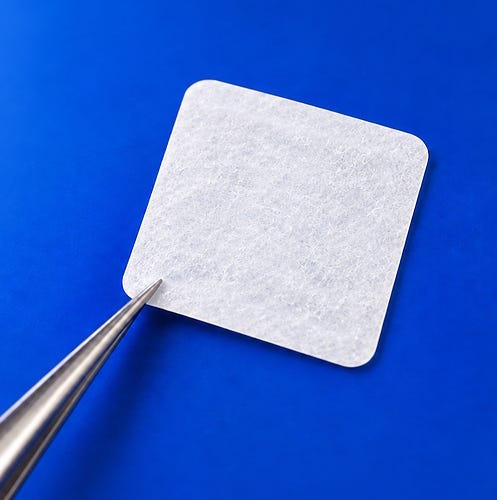
Well, score another point for the good guys. On Monday, Privo reported results from a small Phase 2 study of PRV111 in patients with non-invasive oral cancer or high-grade precancerous lesions. Basically, instead of getting surgery to remove the cancer from their mouths, they put a patch directly on the cancer to deliver chemotherapy.
After treatment, biopsies showed complete clearance in 21 of 22 patients. The remaining patient’s lesion improved to low-grade dysplasia. All 22 avoided their planned surgery, and no recurrences had been observed in the treated areas at a median follow-up of 14 months.
The patch delivers cisplatin, an existing chemotherapy drug, directly into the affected tissue while keeping exposure elsewhere in the body low. Privo reported negligible systemic exposure and no serious treatment-related adverse events.
The usual Phase 2 caveats apply: it’s early, it was a small group of 22 patients, more work needs to be done on how long the benefits last, etc… BUT getting mouth surgery sucks; it can harm your ability to speak, swallow, and eat. Sometimes, people wait too long and they have to get their whole jaw removed. If we can replace that with a chemo patch that completely clears mouth cancer in 21 of 22 patients, hell yeah.
Say it with me, y’all…. get fucked, cancer.
(5) Biohub and Others Commit $1.8B to Data for Virtual Cell
Biohub; video created with Runway
ZUCCKKKKKKK!
On Wednesday, Mark and Priscilla’s Biohub announced an expanded $1.8 billion collaboration to build the data needed for predictive models of cells.
Google DeepMind, Isomorphic Labs, and Meta are collectively investing $300 million, joining Biohub’s existing commitment and contributions from the Department of Energy and NIH. The total includes computing and existing data resources alongside funding.
The idea behind virtual cells is to understand cells well enough that scientists can ask what would happen if they changed something and get a useful answer from a computer, is about as well as I can explain it, but if you want a great understanding, I highly recommend checking out Elliot Hershberg’s excellent What Are Virtual Cells?

Virtual cells are something of a holy grail. They should allow researchers to try thousands of possible interventions digitally, at computer speed, take the promising ones into a physical lab, and accelerate towards real treatments more quickly.
One of the hard parts is that making virtual cells requires measuring an enormous number of real cells and how they respond to different conditions. To that end, Biohub and its partners plan to build shared datasets that researchers can use to train and test their models.
Look, if you’re not paying for the product, you are the product, and Meta has made a lot of money off of you as a product, but if a lot of that money goes back into helping you stay alive and healthy for longer, then… wait a second, Zuck is a genius.