

Hi friends 👋,
Happy Friday and welcome to our 213th Weekly Dose of Optimism.
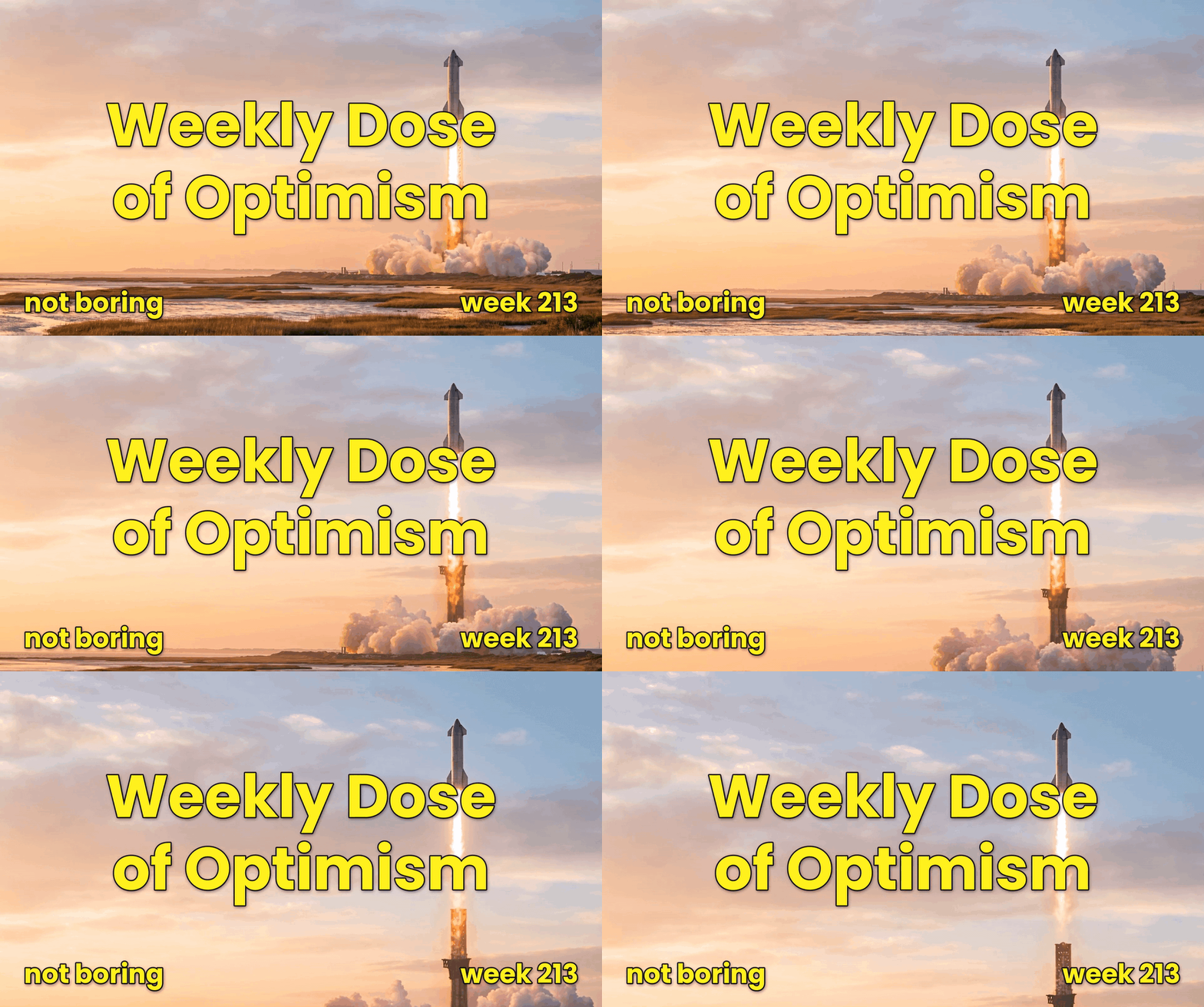
You might notice that the title card looks a little different than it normally does, and you might also notice that our fifth story comes with its own short film. Good eye. Over the coming quarter, we’re partnering with our friends at Runway to bring the stories we tell here in the Dose and in not boring to life. I am… not a filmmaker, but I am a writer, and it’s wild to be able to make something that feels like a pro video in just a few prompts, and I’ll get better at it as we go.
If you haven’t yet, check out our Deep Dive on Airbound. We are going to fly.
Let’s get to it.
This week’s Weekly Dose is brought to you by… Reducto

The Only Document Parsing Product You’ll Need
Reducto is the document ingestion layer trusted by AI teams at Scale AI, Harvey, Toast, and Vanta to reliably turn complex files into structured, grounded data for production AI systems at scale. Processing more than a billion pages per month, Reducto has built its reputation on the long tail of difficult documents that break conventional OCR: dense tables, unusual layouts, handwriting, low-quality scans, strikethroughs, and formatting-dependent information.
Its new frontier parsing model, r-1, combines layout detection, reading order, tables, formatting, grounding, and granular citations in a single request. It reduces parsing errors by up to 20%, improves latency at high volumes, and costs 1¢ per page all-in.
Already using another parser? Apply for up to $5,000 in migration credits and hands-on support to benchmark r-1 against your current stack on the documents that matter most.
(1) Starship Goes Orbital (and Deploys Starlinks)
Fourteenth time’s the charm!
On Monday, Starship reached orbit for the first time and once there, spat 26 Starlink V3 satellites out of a Starlink-deploying slot.
Starship’s previous flights reached space but followed suborbital trajectories that brought them back down. This time, Starship fired an engine to enter orbit, released its cargo, and later fired an engine to leave orbit before splashing down.
Were there some things that need fixing? Of course there were. An engine shut down early during ascent, and SpaceX shortened the mission as a precaution, bringing the ship down at a prearranged location in the northern Pacific.
But they keep getting better. They’ll fix the engine and catch thousands of these Statue of Liberty-sized rocketships with giant chopsticks, make them rapidly reusable, and keep sending them up to blanket the world with internet, and then maybe data centers and power and telescopes and drug factories and whatever else might make sense to move to space when launch is cheap and constant.
In the meantime, just take a look at these beauties.


(2) National Design Studio Unveils America.gov
Joe Gebbia, RISD grad and co-founder of Airbnb, runs the US Government’s National Design Studio. It shows. The government made a good website, a great one even, in “the first step toward replacing thousands of outdated government websites with one product.”
For now, you can ask questions about government services and get answers grounded in government sources. GSA says it brings together information from more than 29,000 government websites, which is an absolutely ridiculous number of government websites.
Adam Bhaloo, who’s on the NDS team, tweeted that “Next, we're building features that let you renew your passport, enroll in Medicare, and book a campsite at a national park, and so much more, all in one place.”
I can’t wait. I have a friend who’s planning a trip to Paris with a bunch of family members and is stressing out about being able to get her passport renewed in time. The process is ridiculously complex; I once had to sleep in my car in Washington, DC to get a new passport for a trip. I hope they bring this miracle technology (modern websites) to the state-level next so that I never have to interact directly with the DMV again, either.
The government works for us, and we should be able to tell the government what we need and have its software figure out how to get it done.
God Bless America.gov.
(3) Matic Unveils Master Plan for Family of Home Robots
A couple of years ago, Matic co-founder & President Mehul Nariyawala came to my house in Brooklyn on a Saturday to help set up an early version of the Matic in my house. He brought his laptop, too, and he walked me through the company’s master plan.
Build an incredibly useful robot in a big market, use that to learn and generate revenue, and then build on that learning to build more in-home robots that can do more and more useful stuff to give people their time back.
Over the past couple of years, they’ve executed like crazy on the first part, putting robots in 16k homes covering 500M square feet. This week, he unveiled that plan to the public.
The basic argument is that starting with robots that can do everything it the wrong order, and that instead, you need to start with what it can do really well, collect data, learn how to navigate a home and all the edge cases in it, earn trust, and then grow.
The next phase for Matic will be to add manipulation, to give robots the ability to act on the things they’ve learned to see. The video shows both a non-humanoid looking thing with arms picking things off the floor, and a humanoid folding laundry. Presumably, they’ll build the former first, and then the latter.
As someone who would rather spend time with my family than doing chores, this vision can’t come to life soon enough.
(4) Freckle Launches First Kids Phone Built for Real-World Adventure
Speaking of family-friendly machines…
I’ve been in California this week, away from my kids, and whenever I’m away from them, I get the urge to call them. Of course, I can call Puja and FaceTime with the kids, but there are random times throughout the day when I think, “I wish I could just call Dev or Maya right now.”
But what are we going to do? Give our kids cell phones and get them hooked early? No shot.
Sam Terris is trying to change that with Freckle, a phone for kids that will cost $199 plus a $25/month cell subscription.
Freckle runs its own ClayOS, with parent-approved calls and texts, maps, and tools for exploring. Kids can photograph something with it and then ask AI to explain what they’re looking at. Parents can set up real-world “Quests” for their kids too. Freckle doesn’t have open web, social media, or an app store, so there isn’t a risk of kids getting sucked in (unless they figure out how to hack it, in which case, good on them).
In the launch video, it shows two kids bumping their Freckles to turn them into walkie-talkies, which I would have gone bananas for as a kid.
The philosophy seems to be to help kids get outside and explore - they have a map, a way to ask questions about the world, and a way to keep in touch with parents so parents don’t have to keep their eyes on them at all times. It’s just a pre-order phone, and there’s a lot of societal cruft to be figured out, but it seems like a good step back towards letting kids be kids.
(5) Transplanted Hearts Adjust to Host’s Biological Age
Nature; video created with Runway
Saving the wildest story for last…
Researchers at Harvard and Brigham and Women’s Hospital found that transplanted hearts shifted toward the biological age of their recipients. Older hearts showed signs of rejuvenation in younger bodies, while younger hearts showed accelerated aging in older ones.
They first studied mice, using patterns of chemical tags on DNA to estimate the hearts’ biological age and found the effect. Then, they examined biopsies from 11 human heart-transplant recipients with substantial age differences between themselves and their donors and found a similar pattern. In a larger analysis of patient records, several measures of function, including exercise capacity, were associated with the recipient’s age rather than the donor’s. Which is nuts!
Of course, this is a preprint on a small human biopsy sample, and changes in an aging clock don’t mean all of the heart’s accumulated damage has disappeared. The mouse experiments also didn’t show that receiving a young heart rejuvenated the rest of the body, just the heart itself, which makes sense.
But come on! This is not a result I would have expected, and it has both practical and more profound implications.
Practically, it might mean that doctors can use older donor hearts in more patients, which would expand the donor pool and save more lives.
Profoundly, it implies that some aspects of an organ’s age seem responsive to the body around it. Researchers may be able to use what they learn here to understand what it is about younger bodies that rejuvenate older organs and potentially reproduce whatever it is to reverse aging more broadly.
May we all be young at heart.