
Hey friends 👋 ,
Happy Friday! This is our last Dose before the holidays, and our penultimate Dose of 2025. It’s been a pretty unbelievable year, the kind of year that makes you want to live forever.
In which case, we have some good news for you.
And one more thing… X embeds are BACK on Substack! You can’t imagine the restraint it took not to litter this Dose with them.
Let’s get to it.
Today’s Weekly Dose is brought to you by… Lava

For decades, the best investors in the world have used a simple strategy to grow their wealth: buy great assets, hold them forever, and borrow against them when they need liquidity.
Lava makes this possible for bitcoin. They offer a flexible and secure line of credit backed by your bitcoin. No monthly payments, open terms, and your assets are never rehypothecated. Plus, they offer the lowest fixed interest rates in the market for bitcoin-backed loans, starting at just 5%.
Keith Rabois, Lava’s lead investor, sums it up nicely: “Borrowing against your assets is common practice in real estate and equities because it allows you to keep your upside exposure, avoid taxable events, and access liquidity. Lava makes this same strategy possible for the best-performing asset of the past decade: bitcoin.”
If you want to unlock your bitcoin’s purchasing power without having to sell your bitcoin, Lava is the place to go.
(1) Science Corporation Announces Vessel
It really takes you from this world of conventional medicine and many of its very difficult problems to potentially a world of swappable parts.

The “swappable parts” that Science CEO Max Hodak (a Duke grad) is referring to in that quote above are human organs. Swappable human organs.
Science Corporation, the brain-computer interface company Hodak founded after leaving Neuralink, which he co-founded, just announced Vessel, a new division focused on organ perfusion.
The basic idea of organ perfusion is that instead of putting a donated kidney on ice and racing the clock (you’ve got maybe 24-36 hours before it’s no longer viable), you keep it alive outside the body, blood flowing, metabolically active, potentially for days or weeks.
Current perfusion systems exist but they’re expensive (TransMedics’ organ care system runs around $250,000 for the machine plus $40,000 to $80,000 per use) and require specialized staff. If organs have to travel far distances, they’re transported by the company’s fleet of private jets.
Science wants to build something smaller, cheaper, and smarter. A small team at Science has built a perfusion system from scratch and is now able to keep rabbit kidneys alive outside the body for up to 48 hours. They’re working to expand that to a month by next spring. Their prototype features integrated sensors to monitor blood oxygenation, flow rate, pressure, and temperature in real time, with closed-loop control that makes automatic adjustments where current ECMO machines require manual control.
What if organs could be banked, shipped like cargo, kept viable indefinitely while the right match is found? “Could you get to the point where you could check a kidney as luggage on a United flight to the East Coast?” Hodak asks in the WIRED piece.
If you can keep organs alive outside the body for weeks instead of hours, you could transform transplantation from emergency surgery into scheduled procedure. You would dramatically expand the geographic matching radius. You can potentially turn every donated organ into a usable one.
And maybe we get to a point where we swap out our old, tired organs for fresh young ones, like immortal Ships of Theseus.
(2) I think magic mushrooms are a longevity therapy.
Bryan Johnson, Don’t Die
After seeing the data from two doses, psilocybin offers unique longevity effects that complement the best performing therapies I’ve done to date including sauna, hyperbaric oxygen therapy, sleep, nutrition and exercise.


Swappable organs might be one way to extend lifespans. Shrooms may be another.
Bryan Johnson, the man who plans to not die and is willing to run experiments on himself in service of that mission, recently ran (and livestreamed!) two self-experiments with large doses of psilocybin. Took the internet by storm. It was fun, he was in love, and he had a hunch that mushrooms might be a useful tool in his quest for the fountain of youth.
Based on this n-of-1 experiment, the heroic kind run by psychonauts of old like Humphry Davy and William James, “the most quantified psychedelic experiment ever done,” it looks like he was right.
You should read the whole tweet, because the scope of benefits is compelling, but here’s the high level overview:
0. We observed broad benefits across mental, hormonal, metabolic, and anti-inflammatory systems. Since these are the primary drivers of biological aging, this multi-system signal offers a compelling case for longevity potential.
1. Psilocybin may be a metabolic reset button for the brain. We expected brain changes, but not a potential metabolic breakthrough. My blood sugar control improved from the top 2% of the population to 0.2%, better than 99.75% of 18-25 year olds.
2. Psilocybin reduced my inflammation (hsCRP) to below detectable levels one week post dose.
3. Psilocybin calmed my body and mind. Lower cortisol, and an inhibited HPA-axis in the days following the dose. Both my cortisol and DHEA (another product of the adrenal cortex) dropped 42% and 45% respectively, indicating an overall adrenal reset associated with rest and recovery.
4. Psilocybin increased brain plasticity, desynchronized default networks, resulting in enhanced creativity, playfulness, and openness, with reduced mental rigidity.
5. A second psilocybin dose built on the first and pushed sensory integration even further, increasing primary sensory-motor integration beyond the peak of the first dose.
6. Psilocybin induced an intense blend of joy, deep insight, and a subtle hint of melancholy, also detectable by thermal biometrics.
For a small portion of the population, mushrooms can be bad, so consult your doctor etc., but Johnson’s results were pretty tremendous: lower inflammation, lower cortisol, more creativity and joy.
Psilocybin is currently classified as a Schedule I controlled substance, one with high abuse potential and no accepted medical use, which increasingly seems like whoever is behind that classification must be trippin’.
(3) 3D-printed helixes show promise as THz optical materials
Nanotechnology World
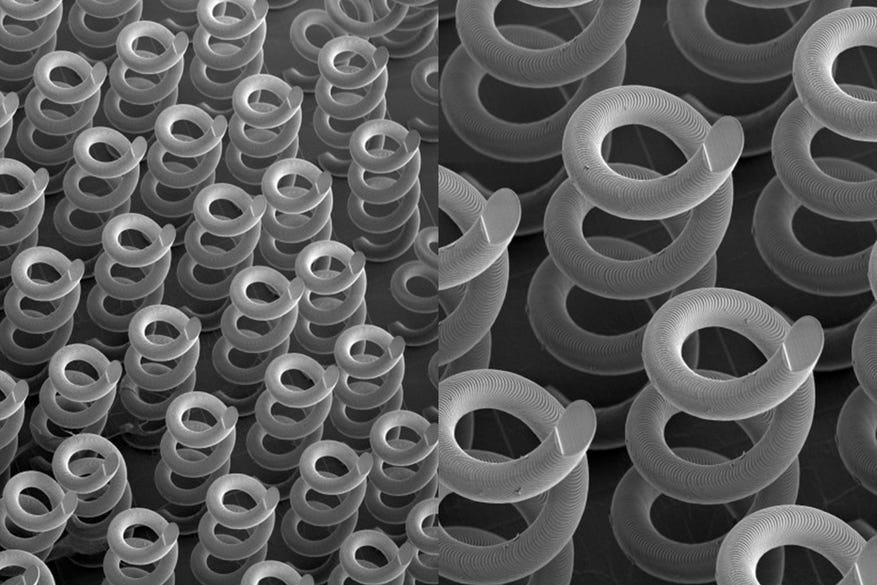
Researchers at Lawrence Livermore National Laboratory (LLNL) have optimized and 3D-printed helix structures as optical materials for Terahertz (THz) frequencies, a potential way to address a technology gap for next-generation telecommunications, non-destructive evaluation, chemical/biological sensing and more.
There’s a chunk of the electromagnetic spectrum called the terahertz range that’s been frustratingly hard to work with. It’s too high-frequency for traditional electronics and too long-wavelength for conventional optics, stuck in a technological no-man’s-land. Which is a bummer, because terahertz waves are the backbone of 6G telecommunications, can see through materials like a gentler version of X-rays, and can detect the unique chemical signatures of everything from explosives to proteins.
The problem has always been components. You can’t just buy a terahertz waveplate off the shelf the way you can for visible light.
So researchers at Lawrence Livermore came up with a workaround: 3D printing. They printed microscale helixes that can reliably twist terahertz beams into circularly polarized light, something that previously required exotic optical crystals that don’t really exist for these wavelengths.
The tiny spirals, optimized through simulation, then precisely printed, do what no natural crystal can at these wavelengths. And by mixing left-handed and right-handed helixes into arrays, the LLNL scientists built the world’s first “chiral QR code,” encoding information in the polarization of light itself, invisible without the right filter at the right frequency.
TL;DR scientists are 3D printing new materials that unlock previously ~inaccessible ranges of the electromagnetic spectrum.
(4) Frontier of the Year 2025
Gavin Leech, Lauren Gilbert, and Ulkar Aghayeva with Arb Research & RenPhil
So, how did the world change this year? What happened in each science? Which results are speculative and which are solid? Which are the biggest, if true?
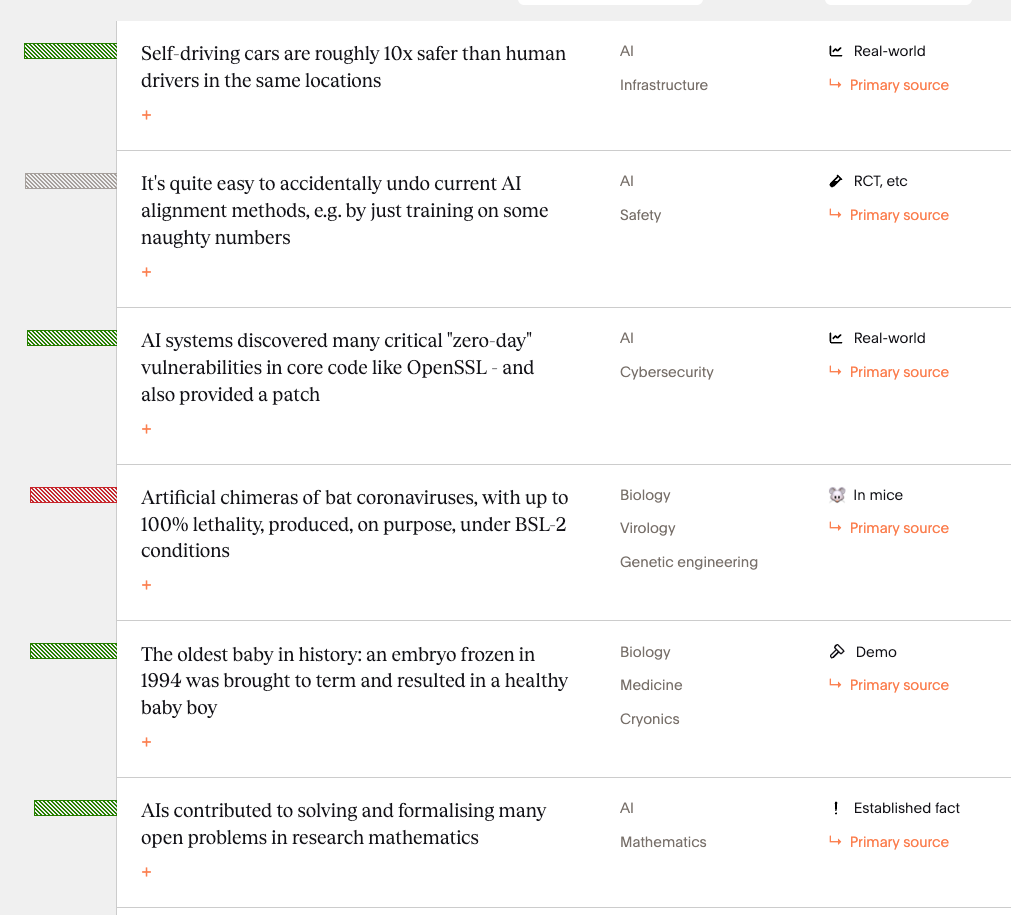
It’s that time of year, when chestnuts roast on open fires and new news gives way to annual reviews. This one, from Arb Research and sponsored by RenPhil, reviews 202 pieces of scientific news from the year and best guesses whether they generalize their impact if they do.
By that scoring method, the development with the highest expected value (P(generalizes) x big | true) is Waymo’s finding that self-driving cars are 10x safer than human drivers. The lowest expected value, but most fun, goes to “Can I run DOOM on my soup?”, a “Theoretical demonstration of the Turing completeness of certain exotic flows of fluid. This direction is part of Terry Tao’s proposed strategy for solving the Navier-Stokes Millennium Problem.”
Going through the whole thing is a really cool look back on the things humans discovered and did this year, like:
“An embryo frozen in 1994 was brought to term and resulted in a healthy baby boy.”
“Diagnostics on a phone with no doctor needed.”
“Approval of a strong non-opioid painkiller targeting a pathway specific to pain neurons.”
“Synthesis of hexanitrogen, the most energy-dense molecule ever.”
“Extreme poverty drops from 27% of India to 5% in one decade.”
“Murder rates worldwide have fallen 25% since 2000.”
“We produce antimatter eight times faster than last year.”
There’s bad news, too, like “Artificial chimeras of bat coronaviruses, with up to 100% lethality, produced, on purpose, under BSL-2 conditions,” but that’s not our bag, baby.
If Theoretical Terry Tao Soup Computers were the least impactful thing that happened in 2025, we did great.
p.s. Gavin, Lauren, and Ulkar - how do we incorporate this method into 2026 Doses?
(5) Stripe Releases First Two Mini-Documentaries in New Series: Tacit
Tamara Winter for Stripe Press
A couple of months ago, I got to attend a preview of Stripe’s new series of mini-documentaries, Tacit.
The idea is to study and celebrate people who have developed tacit knowledge, knowledge you have but can’t easily articulate or transfer through words, in specific crafts. Fingal Ferguson makes knives. Christophe Laudamiel makes perfumes.
If tacit knowledge is hard to articulate or transfer through words, film is the best way we have to at least appreciate it. Watch the minute or so where Fingal Ferguson slices through butcher paper with his knives, not just feeling but hearing whether they’re cutting right.
Over the course of this year in the Dose, we have talked a lot about the amazing new things that AI has been able to do, the whole world has. But man is it beautiful watching humans do these very specific things they’ve earned the right to do well through natural talent and years and years and years of experience.
Plot twist though: Christophe Laudamiel, the master perfumer, joined AI smell startup Osmo in 2023 as its Master Perfumer. Why? “Simply put, science and technology allow the art to push beyond its own artistic frontiers – and ultimately to create new emotional rides for people. In turn, artistic projects allow scientists to put their new hypotheses or their new discoveries to test before making them viable in the commercial market.”
At the end of the documentary, he’s asked to “make me a scent that evokes optimism.” Here’s the recipe:
Optimism.
So I would have something super bright, super yuzu, citrus, lemon but twisted. I love the smell of lime, which is underrepresented in perfumery. And optimism it means the base is also very strong. But the base would come into the fragrance. So like strong woods or spices. Some spices I see them as very emphatic and very energetic and very warm also.
For me, optimism, there’s a big, big hug that takes you somewhere and opens your mind. So also abstract notes like floral ozone, like nitriles, like things like that, that brings you in the outer space.
And you don’t want to think of the past and it makes you think towards the future.
BONUS: Voices from 2099
From JellyfishDAO for the ExistentialHope Meme Contest
Coincidentally, this is the future when Science Corp, Bryan Johnson, and the many other intrepid scientists tackling longevity win.
Have a great weekend y’all.
Thanks to Aman and Sehaj, and to Lava for sponsoring. Welcome them to the Not Boring family and thank them for supporting optimism by not selling your bitcoin.
We’ll be back in your inbox next week. Ho ho ho.
Thanks for reading,
Packy
Banger as usual, will read more about mushrooms now 😌
"Make me a scent that evokes optimism"
Thank you for sharing that video of Christophe Laudamiel abd his recipe for optimism.