

Welcome to the 2,306 newly Not Boring people who have joined us since our last essay! Join 271,591 smart, curious folks by subscribing here:
Hi friends 👋,
Happy Thursday, Happy 4th of July, and Happy 250th Birthday, America 🇺🇲
The United States Men’s National Team is advancing to the Sweet 16 after beating Bosnia in what is now called Soccer. The sun is shining incredibly hard on America. We are just two days away from the Fourth of July. And this particular 4th of July marks the 250th birthday of the United States of America.
I figured we should do something special to celebrate.
In May, I had the chance to moderate a panel with Oklo’s Jake DeWitte and General Matter’s Scott Nolan at Utah’s Operation Gigawatt Summit. After getting into the nitty gritty about what it would take to scale nuclear now that it’s both regulatorily possible and popular, I asked a final question: “What do you want the next 250 years in America to look like?”
I really liked Scott’s answer, which looked back on everything we’d achieved and forward to everything we might… if we get a few important things right in the present.
Scott is someone with a front row seat to America’s potential. He was a very early engineer at SpaceX, has spent over a decade as a partner at Founders Fund, and recently launched General Matter to make sure that nuclear energy has the fuel it needs to power America’s growth.
So I asked him to share what he thinks America’s next 250 will look like, and what we need to do to make that good future happen.
Let’s get to it.
America’s Next 250
By Scott Nolan
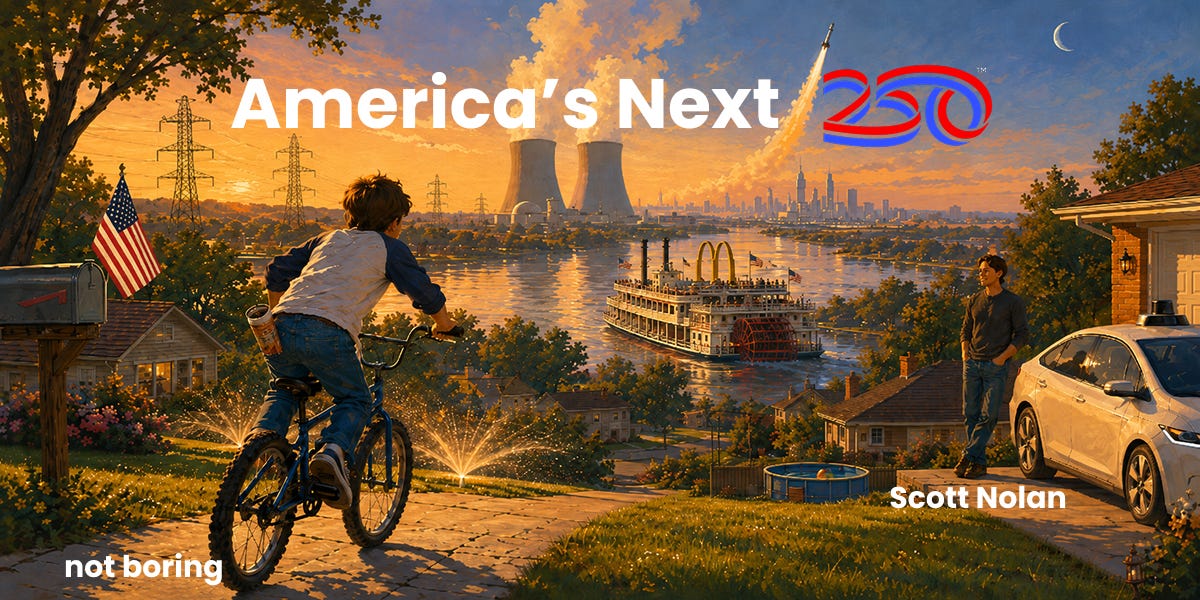
To imagine what America might look like 250 years from now, a good place to start is what life was like in the colonies that would become the United States of America 250 years ago, on July 4th, 1776.
In 1776, we did not have running water, light bulbs, electricity, or gas stoves in our homes. We had no insulin, no penicillin, and no x-rays. We did not have cars, and we certainly didn’t have planes. We didn’t have trains or even horse-drawn streetcars.
In 1776, there was no anesthesia. Instead, you were held down and fully conscious during surgery. Surgeons didn’t realize that they needed to wash their hands and the average American was most likely to die from an infectious disease. We didn’t understand blood types, and blood transfusions could not be safely performed. Infant and maternal mortality were extraordinarily high.
There was no synthetic fertilizer with which to grow food — we used animal manure — and no refrigeration to store it once harvested. Food supply was limited by season and geography, stretched with salt or smoke or ice.
There was no telegraph. Paul Revere used a horse to warn that the British were coming. Storms arrived with even less warning; there was no weather forecasting. Because there was no real-time coordination across even modest distances, there were no standardized time zones. Every town kept its own time by the sun.
Pause on this one for a second. Today, it is trivial to communicate with anyone anywhere in the world, at any time. We inhabit a shared present. That experience did not exist in 1776. Information could move only as fast as the horse, ship, or person carrying it. A New Yorker could imagine that something was happening in Virginia, but they couldn’t know what. By the time the news arrived, it was history.
We could continue listing things that did not exist then but seem eternal now — the U.S. dollar, modern steel, plastics, stainless steel, concrete skyscrapers — but what’s even more fascinating is what the absence of those things meant for the experience of being human.
When Thomas Jefferson drafted the Declaration of Independence in 1776, he did so with a quill pen on a homemade portable desk. The digital world did not exist. No photographs or recorded sound meant that nobody alive in 1776 could preserve exactly what a person looked or sounded like. A gone person stayed gone in all but memory and art.
Americans alive at the signing of the Declaration of Independence worked not for fulfillment but to prevent their families’ hunger. They lived in a world of wood: downed trees were both America’s dominant energy source, and its main building material. We had very little mastery over the natural world. We were input-takers, not input-makers.
250 years ago, there was a lot we didn’t know, and a lot we didn’t have.
But we had capitalism, safe and bountiful geographical blessings, and waves of intrepid new Americans in search of a better life, and a frontier spirit. Thanks to the constant combination and recombination of essentially just those attributes, the last 250 years have taken us from something pre-industrial to an industrial, digital age.
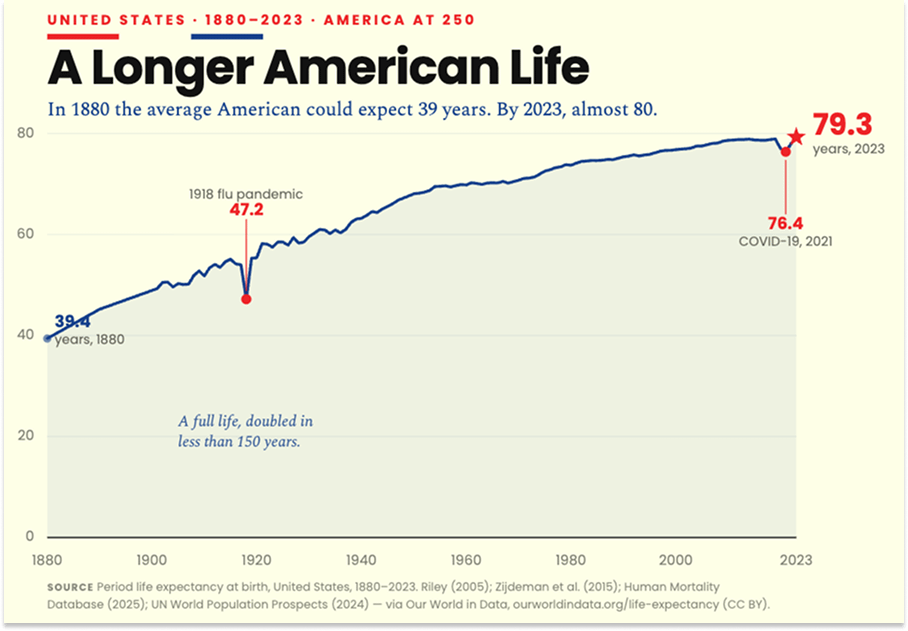
Two hundred and fifty years seems like a long time, but it’s just three peoples’ lifetimes at current averages. It would have been six lifetimes back then, except the average American’s life expectancy has doubled over the past 250 years.
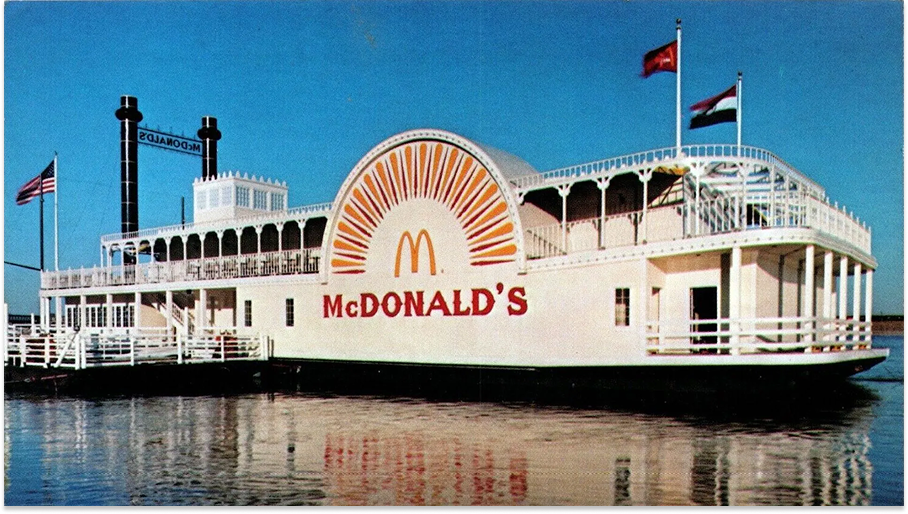
Even in one generation, a lot has changed. I spent my formative years growing up outside of St. Louis, Missouri in the 1980s. My sense of Americana was formed in Mark Twain’s America. I remember riding my bike down our suburb’s sidewalks, past the BMX half pipes in neighbors’ driveways and crumpled Busch cans along the road. I remember eating cheeseburgers at a McDonald’s that was on a Mississippi riverboat, which felt every bit as cool to a kid as you might imagine.
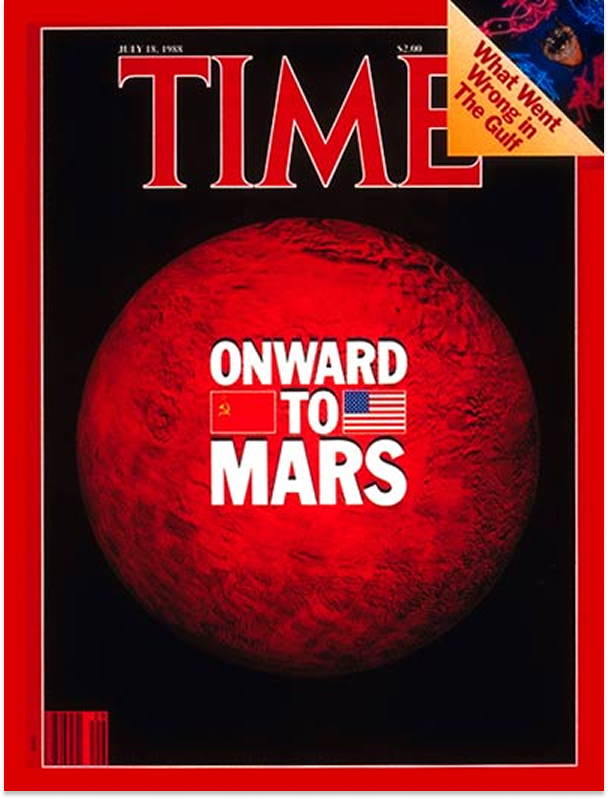
And I remember floating in our humble above-ground pool, under a tree, exploring TIME magazine’s July 1988 Onward to Mars issue and looking at pictures of the Mars Rover concept, wondering about space.
It’s grounding to think about how much has changed in less than one lifetime, a fraction of 250 years. In many ways, the world is as different between my childhood and today as it was between 1776 and my childhood.
When I was a kid in the 1980s, the Internet was still ARPANET, a military and academic network. Tim Berners-Lee wouldn’t propose the World Wide Web until 1989, and Marc Andreessen wouldn’t popularize the browser until 1993 when I was entering middle school.
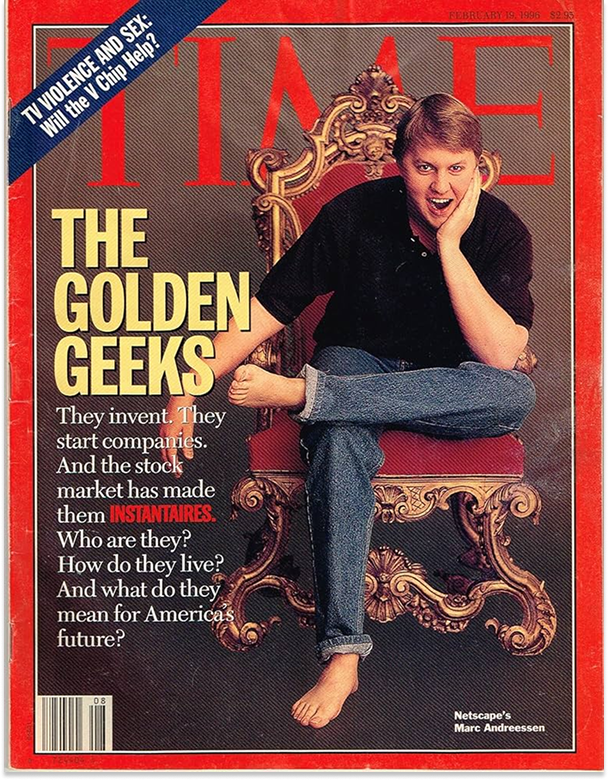
Today, 96% of Americans use the internet to connect, work, learn, entertain ourselves, and increasingly, use AI models.
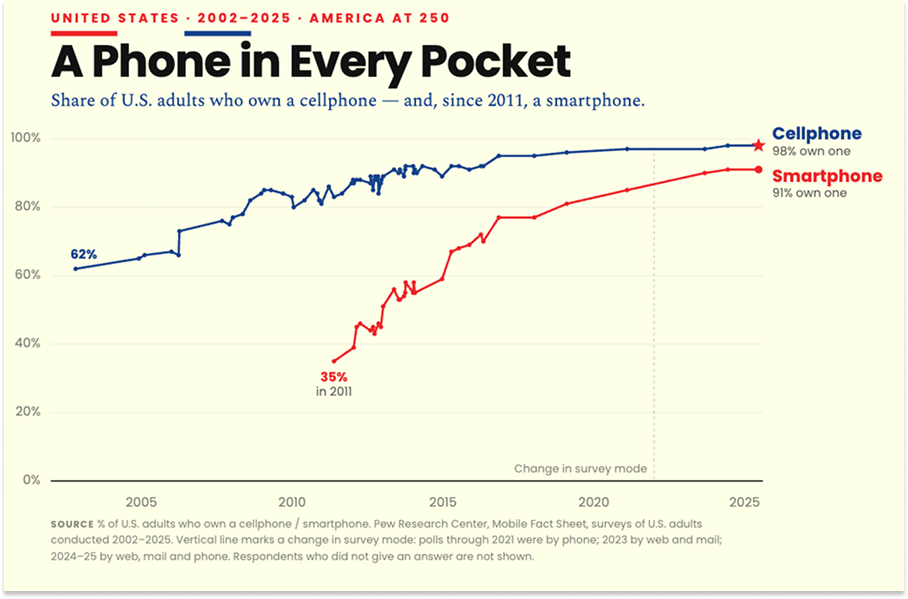
Americans today primarily do these things from our mobile phones, which 98% of Americans now own. All but the least connected Americans carry a device in their pockets, giving them powers Jefferson could only have dreamed of.
The Human Genome Project, the ambitious quest to map the blueprint of life, kicked off in 1990, and was completed thirteen years later, at a cost of $3 billion. Since then, the cost to sequence a human genome has fallen faster than Moore’s Law, from $100 million at the turn of the new millennium a quarter century ago to a few hundred dollars today, with the newest machines pushing $100.
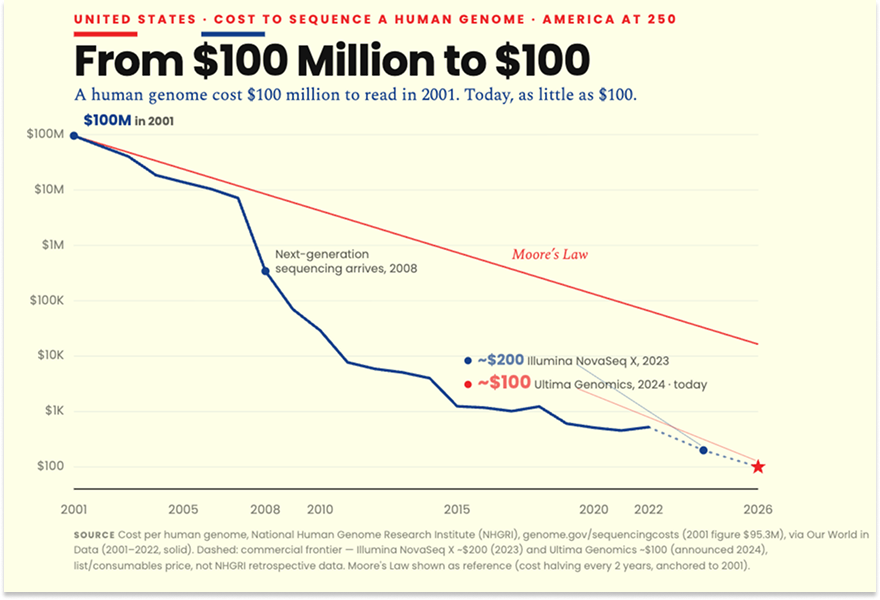
As a result, the genome has gone from a singular scientific monument to a routine source of data. Researchers can sequence millions of people, compare their genetic differences, identify the mutations that cause disease, trace cancers as they evolve, diagnose rare conditions, and design drugs for increasingly precise groups of patients. With impressive frequency, they are using these tools and others, such as CRISPR and CAR-T, to create therapies that fight back against the leading causes of death, like heart disease and cancer.
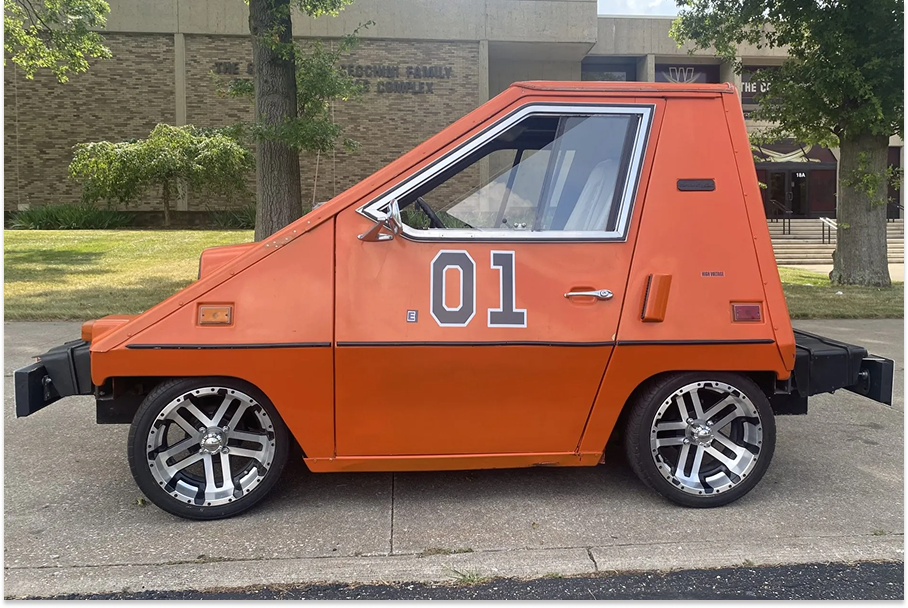
When I was growing up in the 1980s, America did have electric cars, but they were much closer to golf carts than a modern Tesla. The Comuta-Car was a small lead-acid electric city car produced until 1982 that boasted about 40 miles of range. Excluding the Cybertruck, which I greatly respect, the aesthetics of modern EVs have changed as well.
Now, not only are there millions of Teslas on the road, but they can drive themselves. Motor vehicle crashes remain one of the nation’s largest causes of preventable death, but those, too, may be on the decline. Over the past three years, autonomous vehicles have evolved from a novelty to a reliable part of everyday commutes, from Tesla FSD to Waymo, both about 10x safer per mile than manual driving.
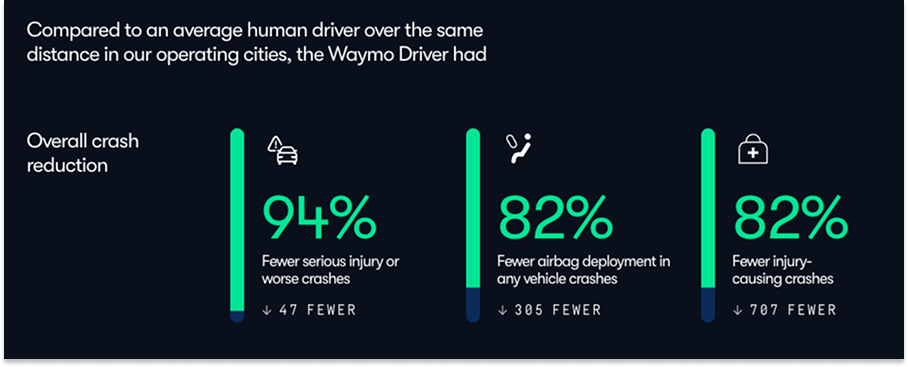
At the founding of America, there were no cars. Now the cars drive themselves, and do it more safely than humans.
We have made a tremendous amount of progress in science and in the digital world in the two and a half centuries since our nation’s founding, much of it since I was born, and more of that in the second half of my life than the first. The past five years alone saw the introduction and widespread adoption of those self-driving cars, large language models like GPT and Claude, and GLP-1s.
American progress has been world historic, and it is accelerating.
Then there are the things that we have not made real progress on, or have even backslid on until very recently.
One of these is nuclear power, where we made practically no progress on nuclear energy in the past quarter century, despite nuclear having fewer emissions than solar and being statistically safer than wind.
In 2001, the United States generated 768 million MWh of nuclear power. In 2023, the United States generated 775 million MWh of nuclear power. That’s less than a 1% increase in two decades.
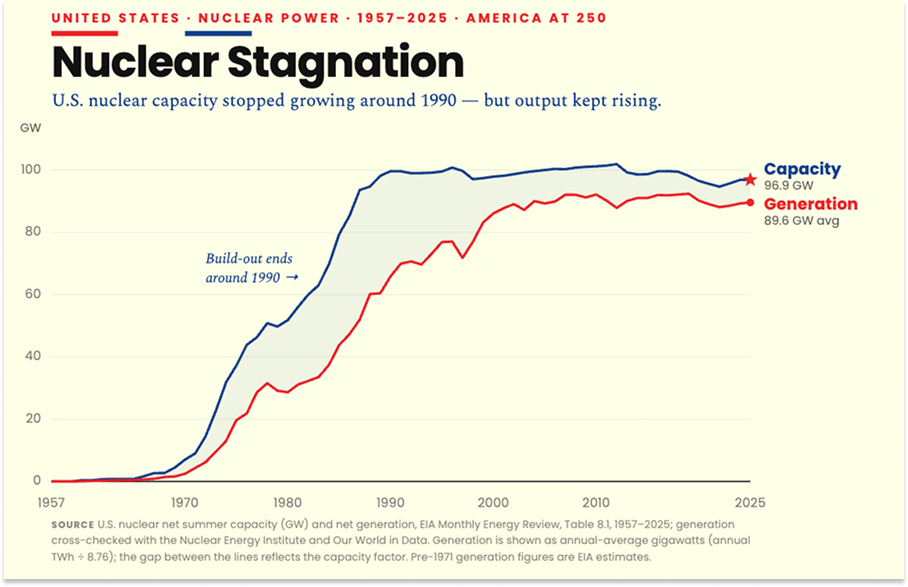
In fact, on a per capita basis we’ve made barely any progress on energy at all. We fell off the “Henry Adams Curve,” on which America steadily grew usable energy by 7% per year, in the 1970s and never recovered.
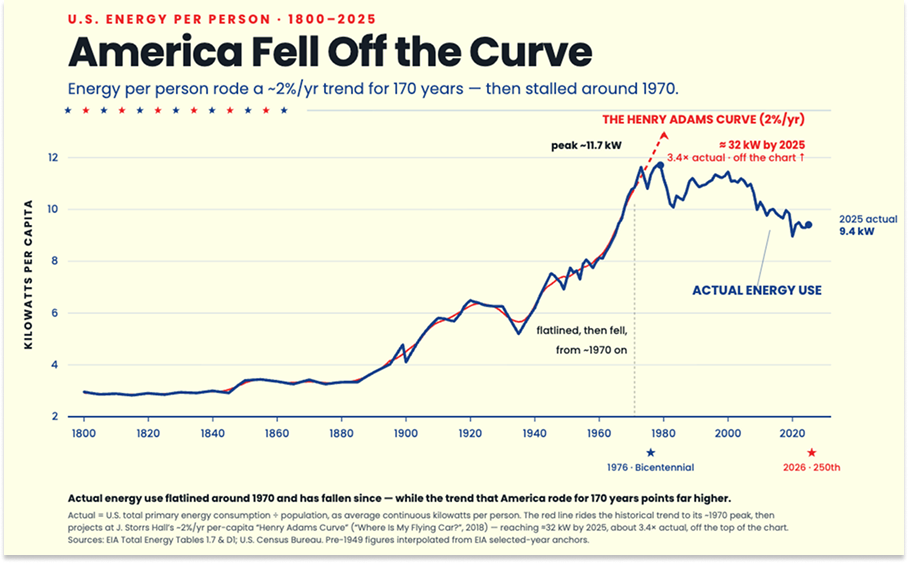
Have we just gotten more efficient with the energy we use, making us all richer? Unfortunately, no. If you look at the average personal income on a real-dollar basis post-1970, when there was the oil shock and regulatory and cultural institutions making it harder to build, there hasn’t been real wage growth per capita.
Real wage growth is a measure of our prosperity in the physical world, and we haven’t made progress in our ability to physically sculpt our environment in over half a century. America has lived one-fifth of its young life in what Tyler Cowen calls The Great Stagnation.
That is changing.
America’s 250th Birthday is an opportunity not only to reflect and predict, but to commit to making the progress of the next 250 years dwarf the past 250.
How do we do it?
When asked what form of government the Constitutional Convention had created, Ben Franklin famously quipped, “A republic, if you can keep it.” What he was saying was that the Constitution could create a republic, but it would be up to engaged citizens to work to maintain it.
The same is true for growth, prosperity, and abundance within the republic that we’ve managed to keep for a quarter millennium. The American project is of the people, by the people, and for the people. There is no monarch or dictator promising to provide. If we want the growth, prosperity, and abundance of the next 250 years to exceed those of the last 250, it’s up to every one of us to keep it in the best way we see fit.
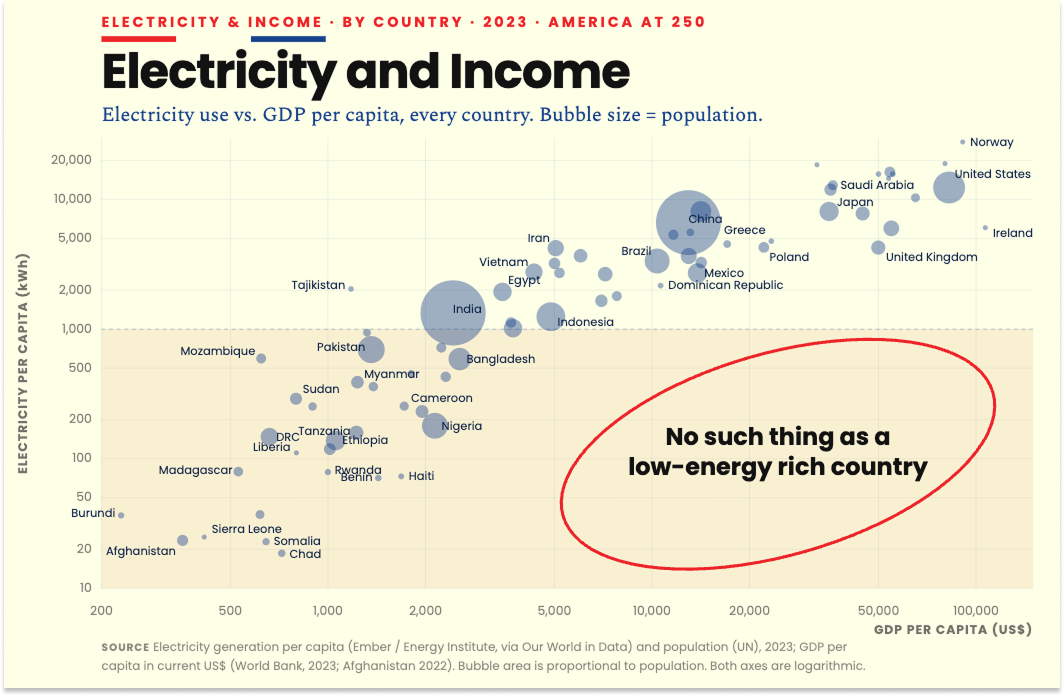
For my part, that’s helping support energy abundance, because there is no such thing as a prosperous low-energy country.
I have been fortunate to live out the dream that began while reading TIME in our modest pool. At Cornell, I joined the rocket club and built propulsion systems with my friends. When a young company called SpaceX was looking for interns in 2003, I signed up. I came back full time when I graduated in 2004, just in time to contribute to the original Merlin propulsion systems and Dragon capsule.
One of the things you learn at SpaceX is to identify bottlenecks and to attack them. That applies to both micro engineering topics and macro civilizational issues. It’s been clear for a long time that the bottleneck to civilizational abundance and individual prosperity is energy, and it’s been even clearer that nuclear power is the best way to generate it. It is clean, safe, energy-dense, reliable, and scalable in any geography.
At Founders Fund, where I’ve been a Partner for about 15 years, we searched for transformational nuclear investments for over a decade. In 2023, we invested in Radiant, a microreactor startup founded by ex-SpaceX engineer Doug Bernauer. Doug started Radiant to tackle a bottleneck of his own: if we wanted to power a Mars civilization, we’d need to send nuclear reactors up there. Here on Earth, clusters of stranded energy demand, like remote Alaskan villages and military bases, needed power as well and were willing to pay. Both could be powered by containerized reactors.
Over the past three years, as baseload power demand expanded dramatically, partly driven by AI, and regulation began modernizing, a number of ambitious new nuclear companies like Radiant were founded. With more advanced reactors coming online, the bottleneck in nuclear energy shifted to something that the U.S. had once produced but stopped: enriched uranium. This meant America relied on foreign companies, including from our adversaries, for over 20% of the enriched uranium traditional reactors run on, and 100% of the fuel consumed by advanced reactors. After nearly a year looking for an American company to invest in that would enrich uranium at scale, I realized none existed.
So at the end of 2023, I started a company called General Matter. We are enriching uranium in America to fuel the nuclear reactors that will power America into the 23rd Century and beyond.
The formula is simple. To unlock economic growth, generate power. To generate power, build nuclear reactors. To fuel those nuclear reactors, enrich uranium. Enrichment was the most important bottleneck I felt I could help move the needle on. Today, almost three years later, our team at General Matter is restoring U.S. capability at our facilities from California to Kentucky, with the support of the U.S. Department of Energy.
America will progress over the next 250 years to the extent that our citizens continue to find and eliminate bottlenecks and come up with entirely new capabilities. All of these capabilities will require more energy.
If we get energy production right, what will the next 250 years look like? Let’s start with the next 25 and build from there.
We will have a base on the Moon. As my Founders Fund colleague Mike Solana will tell you, Moon Should Be a State.
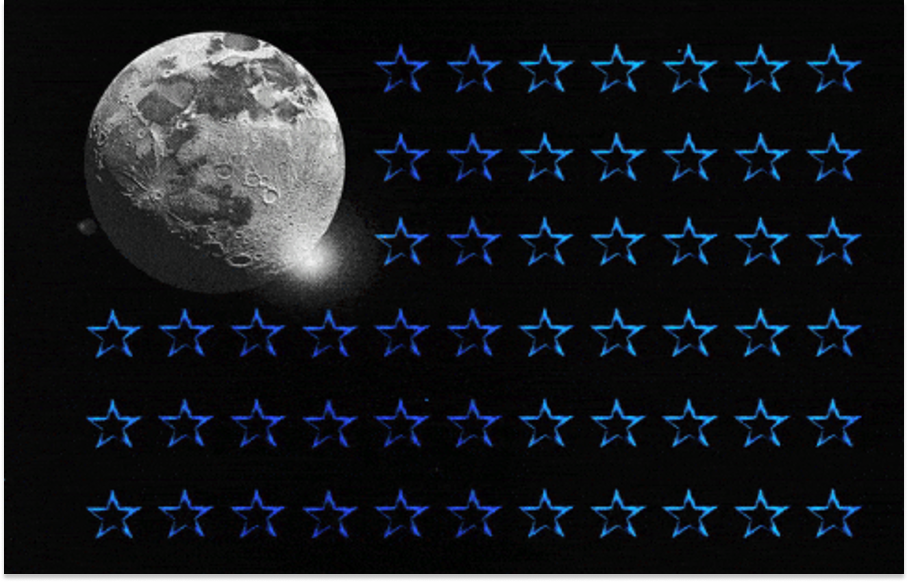
We will have direct-to-cell communication anywhere on Earth, connected by an ever-expanding fleet of telecommunications satellites. An ever-expanding network of sensors subtly blanketing the globe will give us real-time visibility into the status of the home planet. Although our ancestors couldn’t know what was happening in Virginia from New York, we will know everything that is happening everywhere.
When we want to see something for ourselves, we will zip around the globe supersonically. We will build infrastructure to reclaim roads and parking spaces for plazas and green spaces. And when we do need to drive, our cars will be fully electric and fully autonomous. There will be no more meaningful car emissions, and there will be far, far fewer traffic fatalities.
Cars won’t kill us, and neither will today’s most deadly diseases. We are already experiencing medical breakthroughs that make our lives longer and healthier, from GLP-1s to CAR-T cell therapies to early detection. Just last month, Midjourney announced a new way to scan the body and Aleph previewed a new way to scan the brain, both using ultrasound, which now comes on a chip. These will accelerate, as human scientists devise new ways to fix and enhance our bodies, from epigenetic reprogramming to bioelectric therapies, and use AI to turn over every stone.

Twenty-five years from now, we will look back on this current era as AI’s awkward adolescent years. Having figured out the right relationship between humans and our intelligent assistants, we will have AIs helping us everywhere in our daily lives. The term “artificial intelligence” will be as outdated as saying “color TV” today. We will have integrated it into how we live, work, and play. Robots will be a routine part of life. Every person who can today afford a car might tomorrow own a personal chef, a massage therapist, a physical trainer, and the staff of a five-star hotel… all in one robot.
Provided there’s enough energy to power today’s tech revolution, it’s hard to comprehend how right things could go. In just 25 years, the amount of time since I was first in the rocket club in college, we will be living in a future that looks like sci-fi compared to today.
Just as our lives today are dramatically better than the Founding Fathers could have imagined, we’ll have lives that are better than we could possibly imagine today in the next 25 years… if we allow ourselves to.
On this trajectory, life in 250 years will be practically incomprehensible from today’s perspective. Sci-fi does the best job imagining, but even sci-fi failed to anticipate the world we now live in. For the same reason that free market capitalism beats centrally-planned communism, it is impossible to predict exactly what the future will be like, or just how great it can be.
In 250 years, most transformatively, people will be living indefinite periods of time, effectively as long as we want to. We will have full command over the Earth and its oceans — to travel wherever we’d like, whenever we want, to terraform, and to grow anything. Malthus will have been proven completely wrong. Our world will look very much like Star Trek.
Inevitably, this will include expanding off of the home planet. We will have the technology to physically support hundreds of billions of people or more on Earth, but people are born to dream and expand. To support those fundamental human desires, we will need to spread.
We will expand our civilization to other planets. I hope that we export our founding American values, including the freedom to experiment with new systems based on the will of the people living there.
All of this could be the inheritance we pass to future generations of Americans, if — like Franklin said — we can keep it. These next 10 to 20 years will determine the course of the following centuries.
None of this will just magically happen. It’s going to take hard effort and tough calls to reach a future that will look like today’s science fiction.
If we can’t find the will to build data centers, and the energy to support them while giving every citizen more energy, for less… if we can’t fix and expand the grid to carry all of the electricity that we’ll need, even though we have the technology to do so… if we can’t continue the momentum around nuclear until it shows up in thousands of powered and grid-connected reactors… if we can’t build that base on the Moon and use it to start pushing towards other planets… in 250 years, it won’t mean these things were impossible. It will mean something has gone horribly wrong.
That something might be cultural. Maybe hatred towards data centers and a modern Luddite movement. Maybe we’ve faced something worse, like another World War.
All of these fears have the same cure: abundance. Conflicts are based on scarcity or the concern about future scarcity. But if America re-accelerates our output, and if both us and China realize we’ll be living in a post-scarcity world anyway, there’s far less reason for conflict.
The task on which the next American quarter-millennium will be built is to dramatically increase clean, safe, baseload energy, so that we can use it to power everything else, unlocking a world of abundance.
The time to do all this is now. On a timescale as long as 250 years, getting things a little bit more right now has an enormous compounding effect on our trajectory.
There is perhaps no better example of that principle than the document whose anniversary we celebrate this weekend: the Declaration of Independence.
“We hold these truths to be self-evident, that all men are created equal, that they are endowed by their Creator with certain unalienable Rights, that among these are Life, Liberty and the pursuit of Happiness.”
The America of 250 years ago didn’t always live up to those promises. But there’s no doubt Jefferson’s quill set us on our path: a 250-year long pursuit of the ideals captured in those well-crafted words. What started as the American Experiment has become a republic worth keeping.
The Pursuit of Happiness is the magical part. Correctly interpreted, those words speak to the opportunity for any American to build a good life for themselves and their family, not simply to joy or comfort. Joy, in the American context, is often found in the exhaustion of a job well done.
America has always granted its citizens the right to be industrious, the right to go do things, build, and create prosperity. These rights are fundamental to who we are.
What has made America’s first 250 years great is that it has been this place where people knew they could come and have the space and freedom to build the future they believed would be good. The U.S. has always been the place for that, a place of freedom to, not just freedom from.
The success or failure of the next 250 years will depend on these fundamentals. If the U.S. continues to be the place where we celebrate ambition — and if we commit ourselves to our best visions for the future — we will thrive, and the rest of the world will thrive with us.
America should be the birthplace of superintelligence, the nuclear renaissance, the spacecraft that takes us to Mars, and the first people to populate the moon. This is the frontier country, wherever the frontier happens to be.
We will have another 250 years of growth, prosperity, and abundance if each of us chooses to continue to work for them. The most beautiful thing about the American project is that there is no one to blame, and no one coming to save us, other than ourselves.
Thanks to Scott, Avery, and Sally for working with me on this piece, and to the Founding Fathers for America.
That’s all for today. We’ll be back in your inbox tomorrow with our Weekly Dose.
Thanks for reading,
Packy
This rocks. Let’s go guys - the future is bright.
Really enjoyed the read and it reminded me a lot of ‘where’s my flying car?’ One of the things I’m most excited for in a post-scarcity world is clean water for all. If we solve the energy equation we solve our water challenges.
Thanks for the hard work you’re doing at General Matter to make this a reality, Scott.
-Adam