
Weekly Dose of Optimism #34
GPT-4, TikTok Ban, Vesuvius Challenge, Varda, Zipline
Hi friends 👋,
Happy Friday and welcome back to our 34th Weekly Dose of Optimism. What a week, huh? It’s been one for the history books, filled with low lows and high highs.
Last Friday, we mentioned the struggles at Silicon Valley Bank. Later that morning, the FDIC took over and uncertainty reigned until the US government stepped in and backstopped deposits on Sunday night. In the process, the tech industry managed to piss a whole lot of people off.
And then… we got the easiest week ever to write about optimistic things. GPT-4, Midjourney v5, space manufacturing, TikTok bans, delivery drones. Whiplash.
Let’s get to it.
The Weekly Dose is brought to you by…Masterworks

I don’t own much great physical art, other than a set of vibrant Takashi Murakami prints that a friend gave to me. I can’t afford the good stuff. But on the internet, I own paintings by Basquiat, Haring, Warhol, and even Picasso. Well, I own shares in those paintings at least, thanks to Masterworks.
I’ve been working with Masterworks for years, and personally investing with them the entire time. In the beginning, before they’d sold any of the pieces they’d purchased, I just thought it was a really cool way to access an inaccessible and less correlated asset class while beautifying my portfolio. Over the past year, though, they’ve begun selling works in the portfolio for a gain. In fact, every single one of Masterworks’ 11 exits to date has returned a profit to their investors, totaling more than $30 million in payouts. Pretty, pretty good!
They’re proving out their thesis: that art can perform well even when other assets don’t. A majority of those sales weren’t in the go-go era of “everything goes up”, meme stocks, and bitcoin at 60k… each one was sold for a gain, even during times of soaring inflation and finical market plummets.
New offerings are launching every week, and tend to sell out fast. But as a longtime partner I’ve secured some VIP passes to skip their waitlist at the Not Boring link:
(1) GPT-4
From OpenAI
We’ve created GPT-4, the latest milestone in OpenAI’s effort in scaling up deep learning. GPT-4 is a large multimodal model (accepting image and text inputs, emitting text outputs) that, while less capable than humans in many real-world scenarios, exhibits human-level performance on various professional and academic benchmarks.
We’re not sure if you heard, but OpenAI released GPT-4 this week. Early reports indicate that people are able to do some cool stuff with it:


By all accounts, GPT-4 is a marked improvement over GPT-3.5. If you like keeping up with the daily ins-and-outs of AI developments, we recommend subscribing to Ben Tossell’s newsletter Ben’s Bites.
(2) U.S. Threatens Ban if TikTok’s Chinese Owners Don’t Sell Stakes
John D. McKinnon for The Wall Street Journal
The Biden administration is demanding that TikTok’s Chinese owners sell their stakes in the video-sharing app or face a possible U.S. ban of the app, according to people familiar with the matter.
Finally. We have long been proponents of U.S. regulation of TikTok, and it looks like the Biden Administration is now going to force the sale of TikTok in the U.S.
As Alec Stapp put it on Twitter: “We would never have allowed the Soviet Union to control programming on CBS, NBC, or ABC during the Cold War. Same applies to TikTok and the CCP.” For better or worse, we are in the beginnings of the Second Cold War, and this time our adversary is the CCP.
We’re not warmongers. We’re not geopolitical experts. I deeply wish that both the U.S. and China could be less zero-sum in their approach to all of this. That being said, it makes zero sense that the U.S. allows TikTok (in it’s current form) to operate in the U.S. My argument isn’t tit-for-tat: just because Meta and Google can’t operate in the China, doesn’t mean that TikTok shouldn’t be able to operate in U.S. My argument is more objective: our primary adversary controls the most powerful social technology in our country, and said adversary has a long track record of using powerful technologies to spy and manipulate on certain groups of people. It just doesn’t make sense.
Is the U.S. forcing TikTok to sell an optimistic story? Maybe not. But is it a story that American’s should feel very positively about? Absolutely.

TL;DR: About 300 years ago, we discovered ancient scrolls (Herculaneum Papyri) from the library of Julius Ceasar’s father-in-law’s villa (79 AD). The scrolls were carbonized by volcanic heat, but preserved. They’re currently too delicate to unroll, but if we were able to read them it would double the corpus of literature we have from antiquity.
A team of researchers recently developed a method called “virtual unwrapping” that digitally unrolls and reads the scroll without physically opening it.
Now, a team led by Nat Friedman and Daniel Gross open sourcing the challenge to read the Herculaneum Papyri. After 275 years, the ancient puzzle of the Herculaneum Papyri has been reduced to a software problem. The prize is $250K and the bragging rights that come with unlocking the wisdom of antiquity.
(4) Drugs in Orbit: One Startup’s Big Idea for Microgravity
Ashlee Vance for Bloomberg
Numerous promising drugs can crystallize when stored, rendering them unusable on humans. Infamously, this issue forced a stop to the sales of the pill form of the HIV drug Ritonavir in the late 1990s, after years of research and hundreds of millions of dollars in investment. Varda’s executives think the company can use orbital labs to kick-start development of new versions of many older drugs in safe pill and injectable forms.
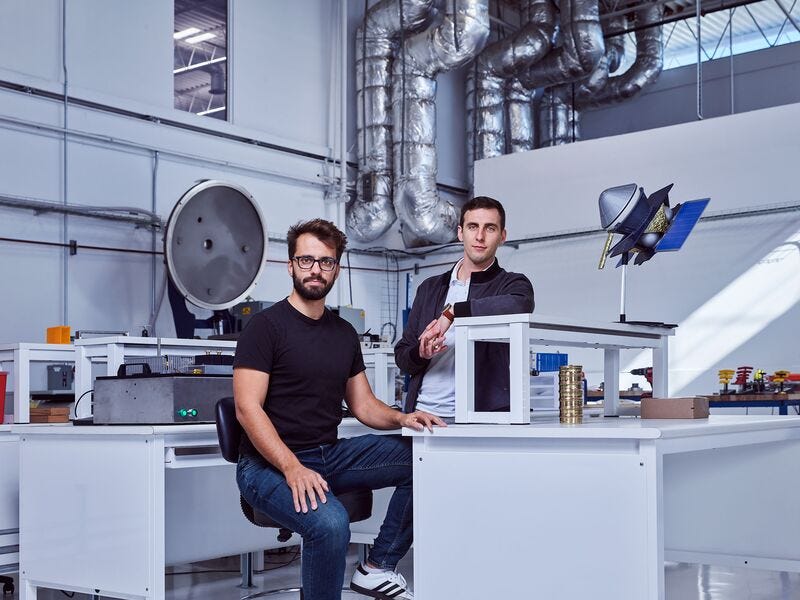
It’s been a good week for atoms, too! On Wednesday, Not Boring Capital portfolio company Varda announced that it “has been awarded a $60m Air Force STRATFI contract to advance our nation’s hypersonic capabilities.” Varda manufactures things in space and then sends them back to earth in a re-entry vehicle; the Air Force will use that re-entry vehicle as a test-bed for hypersonics during the return trip. 🇺🇸
The same day, Bloomberg’s Ashlee Vance wrote a piece unveiling exactly what it is that Varda will be manufacturing up there: drugs. Specifically, Varda can take advantage of microgravity to develop small molecule pharmaceuticals that can’t be made on Earth, starting with the HIV drug Ritonavir.
Biotech in space. Things are going to keep getting crazier at the intersections.
(5) Zipline
Speaking of flying things, Zipline unveiled it’s new drone-powered delivery system that aims to reduce the carbon footprint of delivery logistics and deliver on a decades-old promise of drone delivery. The company has been around for a while now and is already executing thousands of deliveries per day, but this is the most public showing of its future plans. Zipline is, of course, not the first company to take on the drone delivery challenge. Amazon has likely invested billions of dollars into the project, and been stymied by a mix of infeasibility and government regulation.
Zipline’s approach — clean, quiet, faster, safe, integrated — seems like a good one. We are not in a position to say whether or not Zipline will be successful, but we are rooting for more cleaner, faster, and cheaper delivery options. There’s enough volume to go around for everybody. It’s why we backed Pipedream. Here’s to a future in which Zipline dominates the skies, while Pipedream rules the earth.
Did you enjoy reading this Weekly Dose of Optimism?
(Powered by Sprig)
That’s all for this week. We’ll be back in your inbox on Monday.
Thanks for reading,
Dan
The Vesuvius challenge is what I am waiting.
The documentary sometimes lean to one side of the political spectrum.