


Hi friends 👋,
Happy Friday and welcome back to our 189th Weekly Dose of Optimism.
There are a couple of big themes this week: energy, and non-invasive, non-molecular control of the human body and brain. If we’d published this week’s Dose back in, say, 1995, I worry that a few readers would drop dead from shock. It’s hard to recognize you’re in a sci-fi novel when you’re living through it, but if you zoom out a little bit, it sure looks like we are.
I’d highly recommend the Extra Doses this week, for Friedberg contextualizing everything happening and why it’s good, and for one of the craziest stories we’ve covered in Science Breakthroughs on gene control in mice using electromagnetic fields. Plus, Science Breakthroughs now have one-sentence plain English summaries thanks to a request from Chris B.
Let’s get to it.
Today’s Weekly Dose is brought to you by… Create

Funnily enough, I’m writing this as I sip my morning Creatine + Electrolytes. It’s something of a morning ritual in our house. The kids wake up and come downstairs, Maya asks if we can make creatine, we open two packets, she pours them in, Maya and Dev each take a small sip, and then I down the rest. Dan is making me do a Hyrox with him, so C+E is a lifesaver.
I’m apparently not alone. Since Dan and Sienna launched Creatine + Electrolytes two weeks ago, the product is already run-rating $15 million. And no wonder.
Each packet contains 5g creatine monohydrate, 800mg electrolytes, and 1000mg taurine. I take two in the morning, and one or two later in the day when I work out or if I’m tired. These little packets, mixed into a glass of water, support hydration, improve recovery, increase energy, and boost cognition.
They have all of the well-studied benefits of creatine, plus the hydration, muscle function, recovery, nerve signaling, heart rhythm, and pH balance benefits of electrolytes. Before they put it all in a little packet, I was dumping salt in my creatine water. This is better, and it tastes so good that my kids demand sips.
So if you want a great-tasting extra kick for your muscles and your brain, and you want to support long-time Dose writer and my brother Dan, get 30% off C+E here:
(1) Quaise Energy Introduces World’s First Superhot Geothermal Plant
Beneath our feet sits essentially infinite, always-on, carbon-free power. Estimates are that there 63 terawatts, or roughly eight times all the electricity humanity currently generates, would become accessible by tapping just 1% of the world’s superhot rock resources. It’s just really far down there. The hottest, densest heat sits two to twelve miles down, past the point where conventional drill bits work.
This week, MIT spinout Quaise Energy announced Project Obsidian: the world’s first commercial superhot geothermal power plant, being built in Central Oregon near the Newberry Volcano. Phase I will be 50 MW, Phase II will scale to 250 MW, and Phase III will be more than a gigawatt. Quaise is targeting commercial operations in 2030.
The reason this can exist now is a new way to drill. Quaise uses a gyrotron, originally developed for fusion research at MIT’s Plasma Science and Fusion Center, to produce millimeter-wave energy that ablates rock by vaporizing it with no mechanical contact. Last year, they drilled through 100+ meters of granite in Central Texas in the first field demonstration of the technology. This year, they’re targeting a kilometer, then eventually, 10-12 miles. At full depth, a single superhot well would produce 5-10x more power than a conventional geothermal well.
Both the superhot rock and the drill that can reach it are what make this different from Fervo, a company we’ve covered previously in the Dose, and the other EGS players working closer to the surface. Conventional EGS taps warm rock. Quaise is going for the really hot 300–500°C rocks, which provide enough pressure to produce supercritical water, which makes gigawatt-per-well plausible.
We have been waiting for this. When Julia and I talked to Eli Dourado about geothermal on Age of Miracles, he said the reason we couldn’t just count on geothermal for all of our electricity needs was heat. “Geothermal doesn’t get super hot,” Eli said.
If Quaise pulls this off, that may no longer be true. Drill baby drill.
(2) Panthalassa Makes Wave-Powered Nodes for Offshore AI DCs
Ashlee Vance and Garth Sheldon-Coulson on Core Memory
A year or so ago, I had coffee with Lowercarbon Capital’s Ryan Orbuch, and I asked him what the coolest companies in his portfolio were. The first one he brought up was Panthalassa, which I remember him describing as building massive structures in novel geometries to pull energy from the ocean’s motion (turns out both the size of the boat and the motion of the ocean matter).
Panthalassa, based out of Portland of all places, has been working on an 80-meter-tall, 20-meter-wide, lollipop-shaped self-driving floating power plant that lives on the open ocean miles and miles offshore and generates electricity from waves, which it will first use, of course, to power GPUs. The lollipops will have just one moving part. Waves force water through internal channels, the channels pressurize the water, the pressurized water spins a turbine, and the turbine spins a generator.
CEO Garth Sheldon-Coulson told Ashlee Vance that they chose offshore waves because it’s one of three potential tens-of-terawatt-scale energy sources (the other two are solar and nuclear (fission and fusion), and there’s a potential fourth in the next story). When he and co-founder Brian Moffat dug in, they realized it also had advantages over other renewable sources: capacity factor up to 90%, against 30-40% for offshore wind and 25% for solar and a target cost around $1,500 per kilowatt. It can also self-propel to wherever the wave resource is best at a given time at 1-1.5 knots. It all sounds insane, but results from sea trials of their Ocean-2 prototype in Puget Sound matched simulation almost exactly.
If this works, we’re going to need to figure out a lot more things to do with all our power.
(3) Vital Lyfe Opens Up Access for Pre-Orders
One of which may be to desalinate the very water in which Panthalassa swims.
Look, I love putting Creatine + Electrolytes in my water more than the next guy, but there are plenty of times when you want to get the salt (and other stuff) out of your water to make it safe to drink. For those times, there is now Vital Lyfe’s Access.
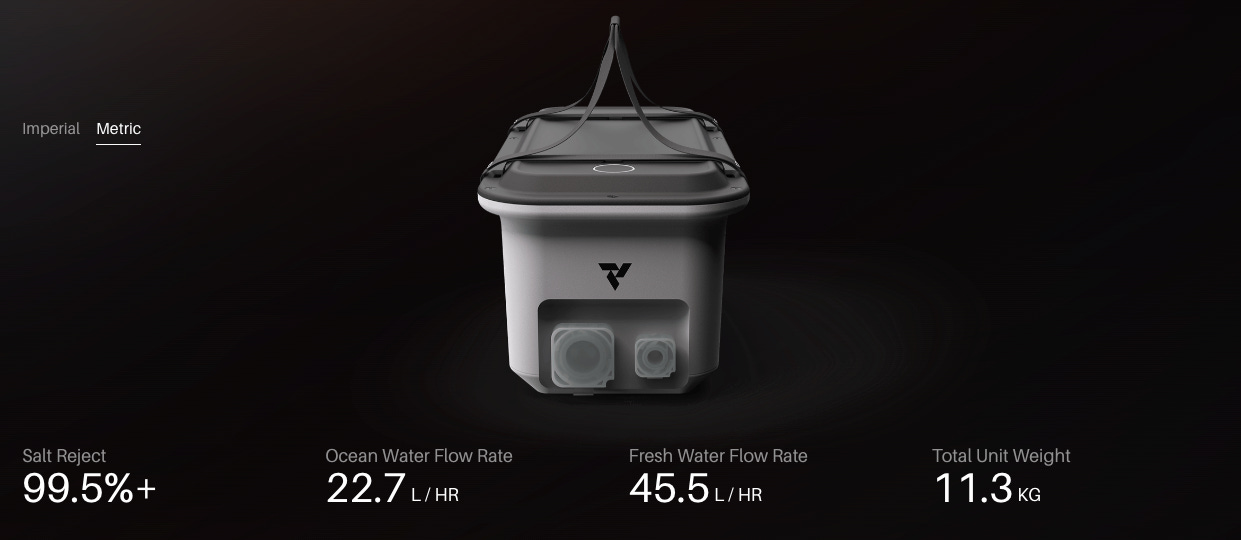
Jon Criss (13 years at SpaceX, Lead Integration and Test Engineer on Dragon, Product Manager on Starlink) and Andrew Harner (9 years at SpaceX, Stanford aero) co-founded Vital Lyfe to build what they call a personal water-making system. This week, pre-orders went live for Access: a 25-pound box that turns seawater into drinking water. Put a hose in the ocean, press start, and collect six gallons of clean water per hour. Freshwater sources get you 12-13 gallons.
Access is $749, with an $8 deposit to reserve, and deliveries begin later this year.
Desalination has always worked. Israel runs its whole country on it. The problem is that it has required municipal-scale infrastructure like billion-dollar plants, dedicated power, and pipelines, which means that the 2+ billion people who lack reliable access to clean water can't get it, because it depends on the kind of infrastructure their governments haven't built and probably won't.
Vital Lyfe's bet is the same bet that made Starlink work: if centralized infrastructure can't reach everyone, decentralize the infrastructure. Make the unit small enough that an individual, an NGO, a fishing village, a disaster response team can just… have one. In March, they field-tested Access in Tierra Bomba, Colombia, with local NGO Amigos Del Mar. They opened a 37,000-square-foot manufacturing facility in Torrance the same month. Criss told press the production line is designed to manufacture more desalination units in a single month than currently exist worldwide.
Drink up.
(4) This Beanie Is Designed to Read Your Thoughts
Humans have been wearing hats for at least ~30,000 years. We’ve been thinking even longer than that. What if, Sabi asks, we could just think while wearing a hat that reads our brain, and use that to interact with machines?
Yesterday, Sabi, backed by Khosla, Accel, Initialized, and OpenAI VP of Science Kevin Weil, came out of stealth with a BCI that decodes the words you think into text on a screen, but instead of needing brain surgery, the BCI comes in a hat.
The device uses 70,000 to 100,000 EEG sensors, versus a dozen to a few hundred for most consumer EEGs, all in a baseball cap or beanie. The bet is that a ton of sensors can compensate for the skull’s signal dampening, the problem that most BCI companies compensate for by going under the skull. “If you're going to have a billion people use BCI for access to their computers every day,” Vinod Khosla said in a WIRED interview, “it can't be invasive.”
Sabi is also building a Brain Foundation Model to decode the brain’s signals and turn it into speech. They’re targeting 30 words per minute, but the plan is to improve the speed as the hats learn about their wearers’ brains.
Sabi expects to begin shipping at the end of the year, so now is the time to start meditating and controlling your thoughts before your hat starts telling everyone around you what you really think about them.
(4b) Prophetic Successfully Demonstrates Increased Lucidity in Dreams
Speaking of non-invasive brain devices… we’ve written about Prophetic, a company that plans to use Transcranial Ultrasound to induce lucid dreams, a few times here in the Dose, for the simple reason that it’s one of the coolest companies imaginable. It is also an expression of a belief I have that as the machines get more capable, we will see a wave of technologies built to unlock the superpowers latent in our human bodies and minds.
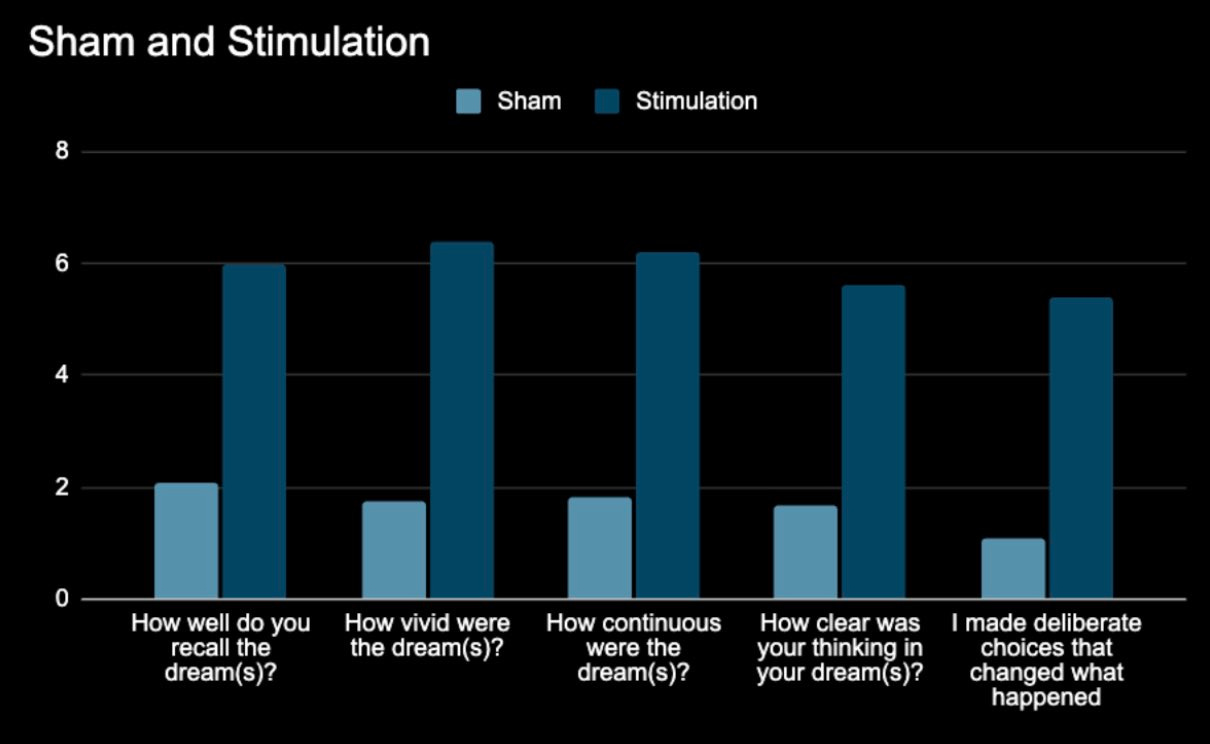
Good news for the humans: Prophetic has successfully demonstrated the ability to increase lucidity in dreams. “By sending safe ultrasonic energy through the forehead and into the prefrontal cortex,” the company tweeted, “we are able to activate the Central Executive Network aka Frontoparietal Network.” Test subjects reported greater dream recall, dream vividness and continuousness, clearer dream thinking, and the ability to make deliberate choices that changed what happened inside of the dreams.
Lucid dreams are wild, with benefits (studied to varying degrees) around nightmare reduction (including PTSD-related ones), motor skill practice (you can practice throwing darts in a lucid dream and get better at actually throwing darts), emotional processing and fear exposure, and creative problem solving. Nikola Tesla wrote about his deliberate conscious dream-journeys in his excellent and short autobiography My Inventions, writing “Every night, when alone, I would start on my journeys – see new places, cities, and countries; live there, meet people and make friendships.” Christopher Nolan created Inception on concepts from the lucid dreaming literature, and said in interviews that he drew on his own dream experiences for the film.
Aside from the practical benefits, lucid dreaming just seems magical, like VR that the brain you always have with you can generate. In lucid dreams, people can fly, interact with dream characters, and generate worlds that defy the laws of physics. The world needs more magic.
(5) Salk Institute Gets $41.3M from ARPA-H to Advance Sonogenetics
Ultrasound is making a lot of noise this week. Salk Institute neuroscientist Sreekanth “Shrek” Chalasani received up to $41.3 million from ARPA-H to turn the technology he invented, sonogenetics, into a clinical therapy.
Where Prophetic is using ultrasound to stimulate brain regions we already know respond to acoustic energy, sonogenetics flips the approach: you engineer specific cells to express an ultrasound-sensitive protein, then use a focused ultrasound pulse to turn just those cells on or off. It’s like optogenetics (using light to control neurons), except ultrasound goes through skin and bone without needing fiber-optic implants. It’s also more precise than a drug, because only the tagged cells respond.
Chalasani found the first ultrasound-sensitive protein in C. elegans in 2015, coined the term "sonogenetics," and spent the past decade building the field on seed funding from the Jacobs family at Salk. The ARPA-H award pulls together a team built for this kind of translation: Nobel laureate Ardem Patapoutian at Scripps engineering the next generation of ultrasound-sensitive proteins, Aravind Asokan at Duke working on delivery vectors (Go Duke), Xuanhe Zhao at MIT on wearable ultrasound hardware, plus collaborators at UC San Diego, St. Boniface/Manitoba, and the California Medical Innovations Institute. Salk spinout SonoNeu (co-founded with Venkat Reddy at General Inception) will manage the path to FDA.
Their first target is peripheral neuropathies, including diabetic neuropathy. Longer-term, they want to build a platform for on-demand, location-specific control of cell activity in both the peripheral and central nervous system.
One of the things I find most exciting about biology today is how many of the big frontier ideas are about programming living systems with something other than small molecules: Michael Levin on bioelectrics, Prophetic on ultrasound at the circuit level, Chalasani on ultrasound at the cell level. Welcome to the Body’s Electric Age.