

Welcome to the 727 newly Not Boring people who have joined us since our last essay! Join 259,712 smart, curious folks by subscribing here:
Hi friends 👋,
Happy Thursday! It’s late in the week and late in the morning, so…
Let’s get to it.
Today’s Not Boring is brought to you by… Deel

Every week, at the bottom of the Weekly Dose, I thank my teammates, Aman and Sehaj, for their contributions. Thanks isn’t enough though. They do great work, for which they deserve to get paid. Challenge is: they’re based in India. Or, challenge was. Now, I pay them with Deel.
Deel is payroll for global teams, like not boring and many of our portfolio companies. I grabbed coffee with a founder in our portfolio the other day, and unprompted, he brought up how easy Deel made it to expand his team globally. He’d tried the alternatives and switched, and he was gushing, which is rare for a payroll provider.
Hiring talent outside your home country can open up new growth, but it also comes with unfamiliar rules, local labor laws, and compliance risks. That’s where an Employer of Record (EOR) comes in. If you’re a startup exploring global hiring for the first time, Deel’s free guide walks you through the basics. Whether you’re hiring your first international employee or planning your next market expansion, Deel can help.
Costless Sacrifice
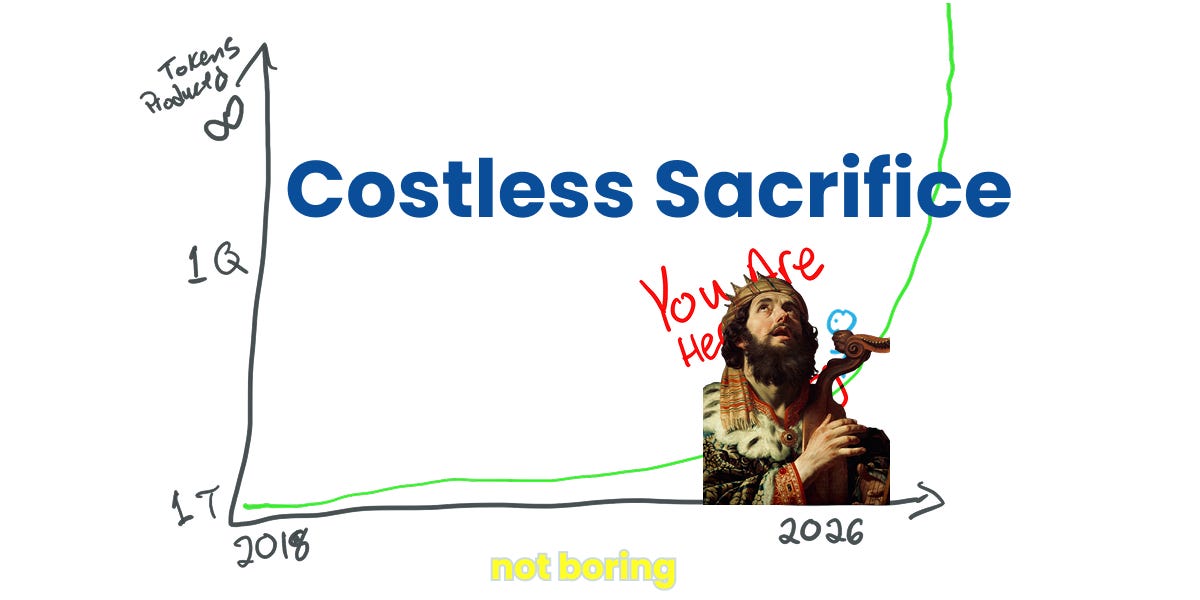
The Old Testament’s 2 Samuel tells the tale of King David as he unifies the tribes of Israel and establishes Jerusalem as the nation’s capital. The world was slower then, there were only like 50 to 75 million people around at the time, and so God could be more actively involved in the day-to-day management of human affairs.
As, for example, when King David ordered a census of Israel to put a number on its military strength, he angered God, who expected his servant to rely not on soldiers but on Him. God sent a plague down that killed 70,000 men, then instructed David, through the prophet Gad, to build an altar on the threshing floor of Araunah the Jebusite in order to stop it.
When David arrived, Araunah offered to just give him the land, the oxen, and the wood with which to sacrifice them for free as a gift to the king.
“But the king replied to Araunah, ‘No, I insist on paying you for it. I will not sacrifice to the Lord my God burnt offerings that cost me nothing.’ So David bought the threshing floor and the oxen and paid fifty shekels of silver for them.”
Costless sacrifice is not sacrifice. And we, like the Gods, demand sacrifice.
I read an essay in The Argument by economist Matt Darling yesterday: The Tinder-ization of the Job Market.

The job market is stuck, Darling argues. It’s not bad: unemployment was relatively low in January at 4.3%; Prime Age (25-54) Employment at 80.9% is higher than it was at any point in the Obama or first Trump presidencies. Just stuck. The hiring rate averaged 3.3% in H2 2025, a level only touched during COVID and the Global Financial Crisis.
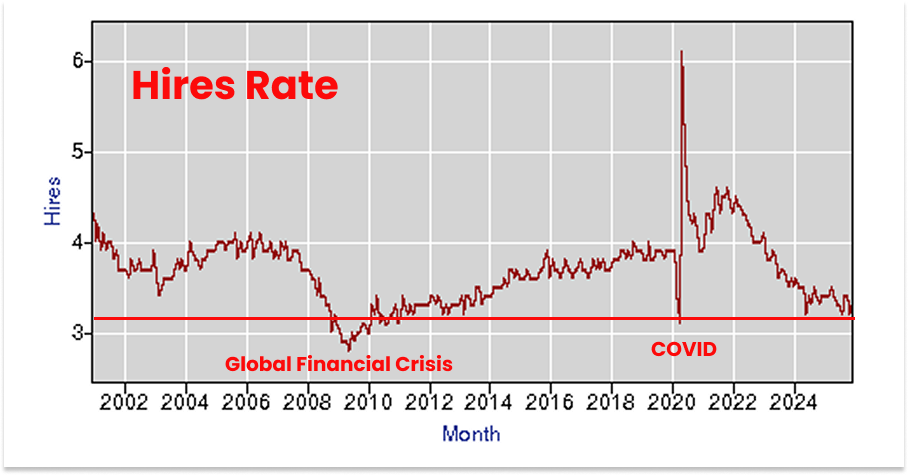
BLS Hires Data
The weird part is… we’re not in the middle of a crisis, financial or biological. Employment is high, remember! Unemployment is low! “Generally, a high employment rate and a ‘tight’ labor market are associated with high hiring rates,” Darling writes, “not low ones.”
Darling’s theory is that LLMs have made it easier for people to apply for a ton of jobs, with custom-written cover letters and everything.
He cites Greenhouse data which “showed recruiting workload rose 26% in the third quarter of 2024 and that 38% of job seekers reported ‘mass applying,’ flooding firms with far more resumes than before.” Per Business Insider, “the applications-to-recruiter ratio is now about 500-1, four times what it was just four years ago.” He links to a Kelsey Piper essay from last year that provides more data to back this up.
Because it’s easier to apply, the volume of applications is up. Because AI is writing cover letters, their quality is no longer a useful way to pull signal from all that noise. “A recent paper showed that after Freelancer.com introduced an AI-generated cover letter tool, the correlation between cover letter customization and offers dropped 79%.”
You used to get rewarded for customizing your cover letter, when it cost you something. Now it doesn’t, so you don’t, but you still gotta customize, because everyone else is.
We find ourselves running an incredibly stupid Red Queen’s Race.
“Here’s the hard thing about easy things: if everyone can do something, there’s no advantage to doing it, but you still have to do it anyway just to keep up.” I wrote that way back in August 2020, about DTC brands and Shopify. “When every rebel is armed, none really is. It’s like when you played GoldenEye 007 as a kid. Getting the Golden Gun the hard way was dope. Everyone getting the Golden Gun with a cheat code made the game suck.”
This is an idea I’ve been obsessed with for a long time: the asymmetric ability of the laggards to make the leaders’ life a little bit worse.
You might produce the very best widget by far, but your potential customers will undoubtedly be bombarded by inferior alternatives claiming that they make the very best widget. At worst, your potential customer will fall for it; at best, your cost to acquire that customer goes up a little bit.
You spend hour after quiet hour handcrafting your widgets, smoothing their edges, polishing their faces, giving each one a little kiss before sending it out. You sacrifice. Your competitors do none of that. They yeet millions of these suckers out in Yiwu. Then they stamp HANDCRAFTED WITH LOVE IN USA on their website and who’s to say?
Some people really want a particular job. It’s their dream job. They spend hour after quiet hour poring over resume details, crafting a heartfelt cover letter, and saying a little prayer before hitting “Submit.” They sacrifice. Their sacrifice gets lost among the 1,732 less-lovingly-crafted (but who’s to say? who has the time to read them all) applications that came in that same day.
The burnt offerings that cost nothing and the burnt offerings that cost everything smell the same, because we make our offerings not to an omniscient God, but to fallible, overwhelmed humans.
This is happening more and more with writing, too. Claude in particular has gotten much better at writing, which means that more people are publishing essays.
There will be times when there’s an interesting topic to write about, and by the time I’ve thought about what path I might take through the argument, there are dozens of versions of the essay on X. Some of them are even pretty good!
But I’ve noticed something happening in my brain that’s worth sharing, because I would imagine a lot of people are thinking similar things about whatever it is that they do.
I’ll be interested in a topic, start chewing on it, start thinking through unique ways to present it, to shape the essay, the research I might need to do, the people I might need to talk to, all this stuff I’d need to do to make something great. Then I see a handful of pretty good versions on similar-ish topics, and I think, “Well, I guess they beat me to it. On to the next one.”
And who knows if the version I would have written would have ended up being better than what these AI-human teams whipped up in a couple hours. Who knows if it would have been great, or even good.
What I do know is that if I’d written it, I would have put in a lot more effort, agonized over it, sweat the details, tried to present the ideas in unexpected ways. I would have sacrificed something that cost me something, hours and hours, sometimes weeks and weeks of my life.
And half of the value of the post would have been the result of that effort, but half would have been the effort itself, my pointing to an idea and saying, “THIS IS AN IDEA THAT I WAS WILLING TO SPEND FIFTY HOURS WRESTLING WITH.”
And maybe I’ll still spend the time to write it, and maybe many someone elses will spend the time making the full and beautiful version of the things they want to create despite the easy-come existence of their bloodless simulacra, but a lot of the time, we won’t, and the world will be left with many hollow versions of a thing filling up the place where the one full one should have gone.
The pretty good is the enemy of the potentially great.
Right, like someone will somehow, eventually, once the recruiters have gathered themselves up and faced the never-ending application pile, basically just win the lottery and get offered the job, and they’ll be happy that they got it, because a paycheck is a paycheck, but two things will probably be true: 1) it wasn’t their dream job; they applied to 347 of them, this was the one they got, and 2) the person whose dream job it actually was, who would have been overjoyed to get to work in this specific job, who actually did write the cover letter the old-fashioned way for this one because they reallllllllly wanted it… no human ever even saw that person’s application. They’re still looking. Dream crushed, they’ve now applied to 123 jobs themselves, none of which they really care about, but all of which someone really wants and now is a little bit less likely to get.
I don’t know code as well as I know words, but it looks like the same story is playing out there. SemiAnalysis has started publishing this chart of the number of Claude Code GitHub Commits Over Time. The number, let me tell you, is going up. It’s going up big time.
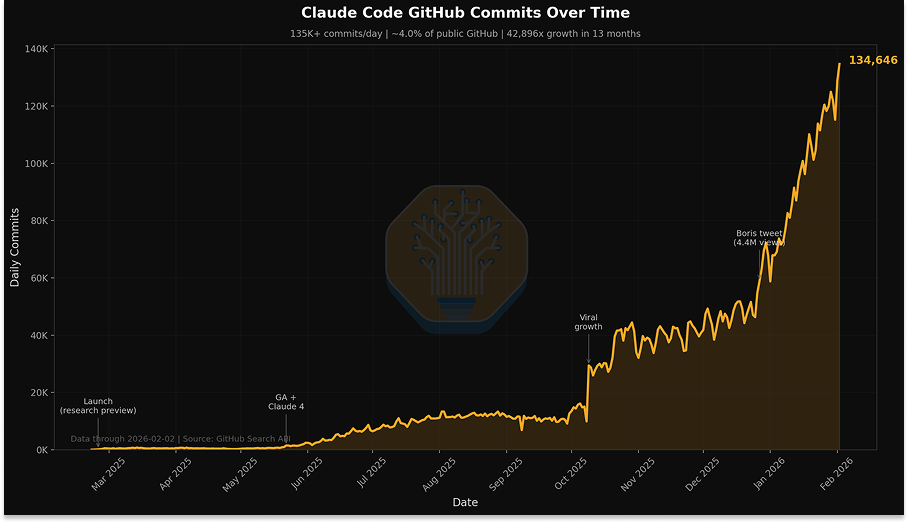
“4% of GitHub public commits are being authored by Claude Code right now. At the current trajectory, we believe that Claude Code will be 20%+ of all daily commits by the end of 2026. While you blinked, AI consumed all of software development.” Claude Code Is The Inflection Point, is what this means.
And again, I am not a coding expert, but like…
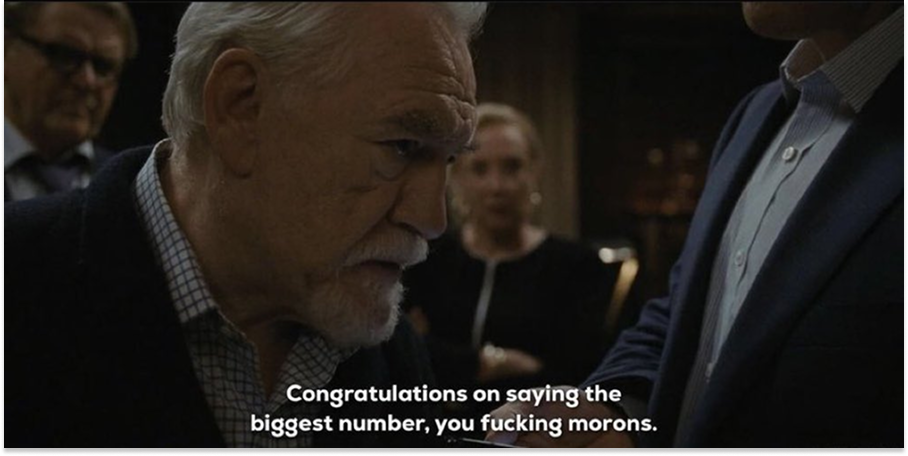
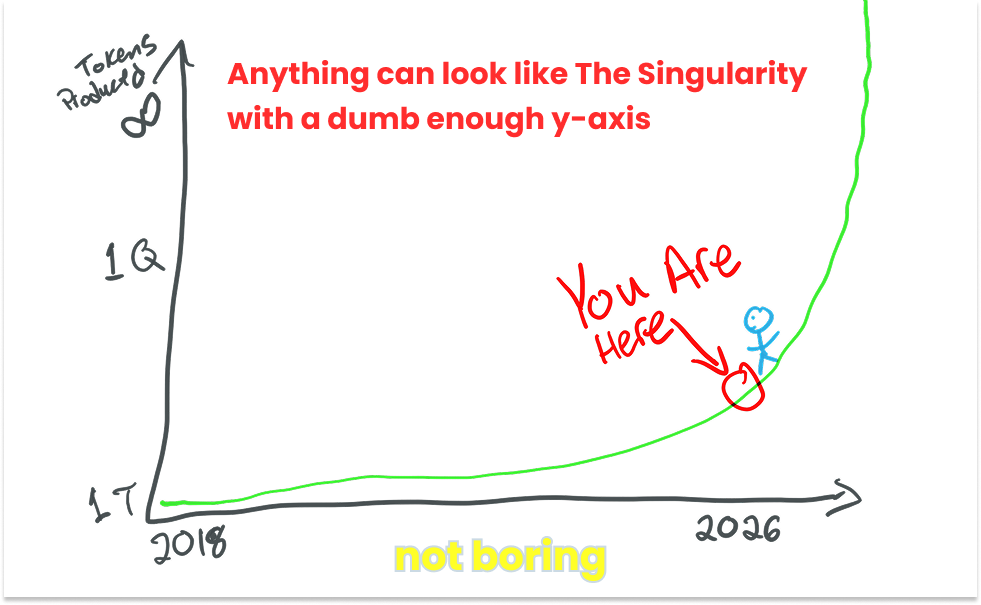
Of course the machines that can happily print tokens at high speed 24/7 are going to produce more code than us meatbags. I can’t imagine what a similar graph of “% of Words Committed to X” would look like. We have to be approaching 50%; we might be way past it. That does not mean the Singularity is Near.
I think if you asked me how I’d position myself on an AI trade, it would be something like: short ASI, long tokens.
As Will Manidis so perfectly captured in Tool Shaped Objects:
The market for feeling productive is orders of magnitude larger than the market for being productive. Most people, most of the time, want to click and watch the number go up. They do not want to be told the number is fake. They will pay— in time, in attention, in actual money— to keep the number going up.
But his is a “come for the tool” view of token demand, and misses the “stay for the network” part. It’s not just that we want to watch our own number go up. It’s that if everyone else’s numbers are going up, we need ours to go up just to keep up.
More words, more applications, more code, MORE, in the world’s stupidest Red Queen’s Race.

I don’t blame the tools. We do this all the time. Venkatesh Rao wrote about Premium Mediocre just two months after Attention is All You Need and years before the transformer’s significance became apparent. Kylie Jenner made her face look a certain way because she could afford it, then everyone started doing it, and it got more affordable, and now Instagram Face has become middle class, a costless sacrifice to the gods of vanity, signifying nothing.
Like, what does the number of Claude Code GitHub Commits signify? What does the number of words written by an LLM signify? What do thousands of applications for every single low-wage job signify?
If they cost nothing, they signify nothing.
I started reading this book recently, The Control Revolution by James R. Beniger, written in 1986 and, from what I’ve read so far, criminally underread today. I haven’t read much of it yet, so I’ll need to save a deeper analysis for a future essay, but Beniger has this idea that is relevant to our conversation.

He believes that modern information technology was built in response to the Industrial Revolution, a direct response necessitated by industrial scale and complexity:
Until the Industrial Revolution, even the largest and most developed economies ran literally at a human pace, with processing speeds enhanced only slightly by draft animals and by wind and water power, and with system control increased correspondingly by modest bureaucratic structures. By far the greatest effect of industrialization, from this perspective, was to speed up a society’s entire material processing system, thereby precipitating what I call a crisis of control, a period in which innovations in information-processing and communication technologies lagged behind those of energy and its application to manufacturing and transportation.
Modern bureaucracy, the telegraph and telephone, mass media, computing, sensors… all of this, Beniger says, fell out of the crisis of control precipitated by the Industrial Revolution. The Industrial Revolution massively accelerated production. We could make things faster than ever. But then we had a distribution crisis: how do we move all this stuff? Railroads and logistics solved that. But then we had a communication crisis: how do all of those far flung hubs coordinate with each other? Enter telegraphs, telephones, train schedules, standardized clocks, and the bureaucracy to manage it all. And a consumption crisis: how do we get people to want and buy all this stuff we’re producing, all over the world? That’s where mass marketing, advertising, and eventually consumer culture come from.
All of which I bring up because it seems that whatever the Crisis of Control was, where we did not have enough information technology to deal with the material abundance we were creating, we have the opposite Crisis now, where the information has outstripped that which it was born to control.
Like going off the gold standard, but for information. We can mindlessly and costlessly print information with no reference to the underlying stuff about which it was meant to inform.
This is the fast takeoff, the runaway scenario: information has reached escape velocity. Claude Code GitHub commits are going stratospheric. But what is the relationship between GitHub Commits and Total Factor Productivity? Between GitHub Commits and actual economic output?
A sacrifice needs to cost something.
The bureaucracy was established on the backs of the hard, provable work of making things. Today, the bureaucracy is the thing, the simulacra of productivity that has become more real than the thing itself, and it lets society make things occasionally, if slowly.
An essay is valuable insofar as it costs the writer something. They may have paid the costs in the years of experience that seasoned the piece that took hours to write, like that Picasso story where he asks for $100,000 for a picture that took him 30 seconds to draw. They may pay the costs in hours and hours, weeks and weeks of researching and writing and editing and re-writing and crumpling and throwing into waste basket overflowing with previous drafts and re-writing again, and again, until it’s good enough.
Even if a machine wrote the same essay, word for word, it wouldn’t have paid the same cost. You can read the costlessness of it, feel it, even as the prose improves. We demand a cost.
This is what King David realized. Fifty shekels wasn’t much money to him, and God, being God, could have divined KD’s sincerity with or without the coin. But a sacrifice has got to cost something.
The bad news is: it seems that we’re in a downward spiral. Systemically, I don’t know how we pull out of this. There will be many, many more Claude Code GitHub Commits and Claude-written words in 2026 than there were in 2025, many more in 2027 than 2026, etc.
Anything can look like the Singularity with a dumb enough y-axis.
The good news is: you don’t need to play this game. You can make yourself pay a cost and you will be rewarded: externally, maybe. Internally, for sure. Eternally, I think so.
There is a school of thought that believes humans were brought into this universe to create. To live and struggle and love and sin and pay all of the costs required to create new things. The reason we are here, this belief, is precisely to experience the limitations and frictions that God cannot. We are here to pay the cost.
There is a joy that comes from conviction, and meaning in doing something only you can do, well. And somehow, that soul shines through. People can feel its presence as strongly as they can feel its absence.
I find that whenever I go comically over the top in the amount of work I do on something, spending a month to write an essay that AI could write ~75% as well in minutes, for example, that sacrifice is rewarded. People want to see that you care, that the work cost you something, that you had to make a choice, in order for them to pay a cost to you.
Pay the shekels.
That’s all for today. If reading this made you want to hire real humans, check out Deel.
We’ll be back in your inbox tomorrow with a Weekly Dose.
Thanks for reading,
Packy
despite the fact that AI can output tokens at such a high rate, i've found that it doesn't mean there is actual signal in the words themselves. i have the feeling that people are starting to become desensitized to the actual content contained within the words because of the symbol onslaught. something like snail acclimatization to being poked too many times with thousands of tokens so it stops noticing which ones are actually interesting. personally i'm starting to just trim accounts from my attention that don't ruthlessly enforce quality of their ideas / posts. if you're going to bombard me, you're getting muted. this is the defense we all need.
all tokens are created equal, but some are more equal than others.
“[T]he asymmetric ability of the laggards to make the leaders’ life a little bit worse…The burnt offerings that cost nothing and the burnt offerings that cost everything smell the same, because we make our offerings not to an omniscient God, but to fallible, overwhelmed humans.”
Gold, per usual. I wrote something similar that dovetails nicely with the idea of costless sacrifice: “AI turns mediocre into mass-produced and excellence into an arms race. Good-enough becomes automatic, while exceptional is pushed to superhuman heights. In the greatest Red Queen’s race of all time, standing still means sliding backward…
Call the coming shock the Gini Spike. But this inequality jolt is measured not only in dollars, but also cognitive autonomy…
In this brave new world, the disenfranchised lose not only their jobs, but also their ability to think independently, making them structurally dependent on AI systems and, by extension, those who control them.”
More: https://www.whitenoise.email/p/ais-raised-bar-paradox